

Moonshot AI’s Kimi K3 has arrived as a direct challenge to the closed AI models powering many Windows developer workflows, topping Arena’s Frontend Code Arena shortly after its July 16 release and, according to Reuters, approaching the performance of Anthropic’s frontier Fable models. The immediate consequence is not that Windows PCs will suddenly run a 2.8-trillion-parameter model locally. It is that enterprises and developers now have another high-end coding and reasoning option whose weights are scheduled to become available on July 27.
The Associated Press first reported the model’s rapid ascent in Arena’s front-end coding ranking, while Reuters described K3 as a 2.8-trillion-parameter, open-weight system with native multimodal support and a 1 million-token context window. Moonshot is positioning it for long-horizon coding, complex knowledge work and deep reasoning—three areas now central to IDE assistants, software modernization projects and AI-driven help desks.
For Windows users, the headline is less about a consumer chatbot and more about model choice becoming infrastructure choice. The contest is shifting from “which hosted assistant has the best answer?” to whether organizations can choose where a capable model runs, which data it sees, and which tooling sits around it.
Arena’s front-end leaderboard is a useful signal, particularly for developers who ask models to build interfaces, repair React components, generate CSS, or iterate on browser-based prototypes. It is not a substitute for evaluating a model against an organization’s own codebase, security controls, framework versions and acceptance tests.
Reuters reported that Arena ranked Kimi K3 first for web interface-building capability, while other third-party tests placed it closer to the top tier rather than decisively ahead of every U.S. model. That is the more practical reading: K3 is now credible enough that teams accustomed to treating OpenAI or Anthropic as the automatic premium default should include it in comparative testing.
That testing should be grounded in the work Windows developers actually need done. A model that produces an impressive interactive landing page can still struggle with a large .NET solution, a WinUI 3 application, PowerShell automation, Windows Installer packaging, legacy COM interop, or an Azure DevOps pipeline. The code quality question is also larger than whether a demo builds: can the model respect existing project structure, preserve accessibility, handle dependency constraints, and avoid introducing insecure libraries?
The Arena result therefore creates a procurement and engineering question, not an automatic migration order.
That distinction matters to Windows administrators and security teams. If the weights arrive under terms compatible with a company’s intended use, a business may be able to self-host K3 rather than send source code, documents and support tickets to a third-party AI service. But self-hosting a massive frontier model also shifts responsibility for identity controls, logging, retention, patching, network isolation, model gateways and abuse monitoring back to the organization.
The size alone rules out ordinary local deployment. Moonshot says K3 has 2.8 trillion parameters. Even with sparse mixture-of-experts architecture and aggressive quantization, this is not a model for a typical Copilot+ PC, gaming desktop or workstation with a single consumer GPU. The realistic near-term paths are hosted API access, a managed inference provider, or deployment on substantial multi-GPU server infrastructure.
That makes K3 potentially relevant to Windows shops running NVIDIA GPU clusters, Kubernetes, Azure-connected private clouds, or internal developer platforms—not as a download-and-double-click application.
For an individual developer paying for a chatbot subscription, the difference may be modest. For an IT organization processing millions of support interactions, documentation searches, test-generation runs or agentic coding tasks, inference cost can determine whether an AI project survives beyond its pilot phase.
This is especially relevant to Windows-heavy environments that are already assembling model-routing layers. Rather than wiring Visual Studio extensions, internal portals and Power Platform automations to one vendor, teams can direct routine tasks to lower-cost models while reserving the most expensive systems for work that truly requires them. K3’s emergence adds pressure to make that routing portable.
The benefit of portability is not merely negotiating leverage. It is resilience. If a provider changes pricing, rate limits, geographic availability, model behavior or acceptable-use terms, a model gateway with standardized prompts, evaluation sets and audit logging gives the organization a credible alternative.
That backdrop matters because U.S. export restrictions have sought to limit China’s access to the most advanced AI accelerators. A competitive Chinese model released openly is evidence that model capability cannot be assessed solely through access to a particular American chip generation. Algorithmic efficiency, training approaches, domestic hardware, system engineering and faster release cycles all matter.
It does not mean hardware restrictions have no effect, nor does it establish that K3 matches every capability of the strongest closed American models. It does mean the assumed gap can close faster than enterprise AI roadmaps are typically refreshed. The DeepSeek shock of early 2025 made that point once; K3 is forcing the industry to revisit it.
For Microsoft-centric organizations, there is a second-order implication. Windows, Azure, GitHub and Visual Studio will remain crucial layers in developer workflows even as the model behind a coding assistant becomes more interchangeable. The differentiator will be integration quality: authentication, source control context, testing loops, governance and compatibility with the Windows application stack.
A security review should also look beyond the base model. The practical attack surface includes the hosting provider, API client, IDE extension, retrieval pipeline, tool permissions, prompt logs, plugins, model downloads and update mechanisms. An AI coding agent with access to a local repository, PowerShell, browser session or cloud credentials is more than an autocomplete tool.
Before connecting K3—or any competing model—to production code or corporate data, administrators should establish whether:
The Associated Press first reported the model’s rapid ascent in Arena’s front-end coding ranking, while Reuters described K3 as a 2.8-trillion-parameter, open-weight system with native multimodal support and a 1 million-token context window. Moonshot is positioning it for long-horizon coding, complex knowledge work and deep reasoning—three areas now central to IDE assistants, software modernization projects and AI-driven help desks.
For Windows users, the headline is less about a consumer chatbot and more about model choice becoming infrastructure choice. The contest is shifting from “which hosted assistant has the best answer?” to whether organizations can choose where a capable model runs, which data it sees, and which tooling sits around it.
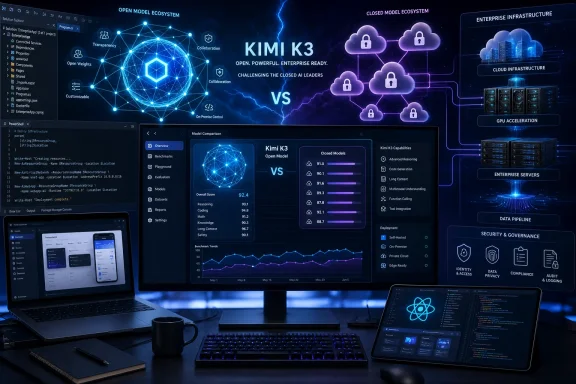 The benchmark win matters, but it is not a deployment guide
Arena’s front-end leaderboard is a useful signal, particularly for developers who ask models to build interfaces, repair React components, generate CSS, or iterate on browser-based prototypes. It is not a substitute for evaluating a model against an organization’s own codebase, security controls, framework versions and acceptance tests.Reuters reported that Arena ranked Kimi K3 first for web interface-building capability, while other third-party tests placed it closer to the top tier rather than decisively ahead of every U.S. model. That is the more practical reading: K3 is now credible enough that teams accustomed to treating OpenAI or Anthropic as the automatic premium default should include it in comparative testing.
That testing should be grounded in the work Windows developers actually need done. A model that produces an impressive interactive landing page can still struggle with a large .NET solution, a WinUI 3 application, PowerShell automation, Windows Installer packaging, legacy COM interop, or an Azure DevOps pipeline. The code quality question is also larger than whether a demo builds: can the model respect existing project structure, preserve accessibility, handle dependency constraints, and avoid introducing insecure libraries?
The Arena result therefore creates a procurement and engineering question, not an automatic migration order.
“Open-weight” is the operative term, not “open-source”
Moonshot’s terminology requires some care. Open-weight generally means organizations can obtain model weights and run or customize the model themselves; it does not automatically mean every aspect of the training data, code, methods, licensing terms and safety process is openly available. Reuters reported that Kimi K3 is an open-weight model, and Axios reported that Moonshot intends to release the weights on July 27.That distinction matters to Windows administrators and security teams. If the weights arrive under terms compatible with a company’s intended use, a business may be able to self-host K3 rather than send source code, documents and support tickets to a third-party AI service. But self-hosting a massive frontier model also shifts responsibility for identity controls, logging, retention, patching, network isolation, model gateways and abuse monitoring back to the organization.
The size alone rules out ordinary local deployment. Moonshot says K3 has 2.8 trillion parameters. Even with sparse mixture-of-experts architecture and aggressive quantization, this is not a model for a typical Copilot+ PC, gaming desktop or workstation with a single consumer GPU. The realistic near-term paths are hosted API access, a managed inference provider, or deployment on substantial multi-GPU server infrastructure.
That makes K3 potentially relevant to Windows shops running NVIDIA GPU clusters, Kubernetes, Azure-connected private clouds, or internal developer platforms—not as a download-and-double-click application.
Price pressure is the more immediate disruption
The Associated Press, citing Bank of America analysts, reported that K3’s usage pricing is still roughly half that of OpenAI’s GPT-5.6 Sol, despite being the most expensive Chinese model so far. Axios separately characterized K3 as roughly 40% cheaper in comparisons involving Arena results. The exact cost advantage will depend on token types, caching, context length, tool calls and any provider markup, but the direction is clear: advanced coding models are entering a sharper price war.For an individual developer paying for a chatbot subscription, the difference may be modest. For an IT organization processing millions of support interactions, documentation searches, test-generation runs or agentic coding tasks, inference cost can determine whether an AI project survives beyond its pilot phase.
This is especially relevant to Windows-heavy environments that are already assembling model-routing layers. Rather than wiring Visual Studio extensions, internal portals and Power Platform automations to one vendor, teams can direct routine tasks to lower-cost models while reserving the most expensive systems for work that truly requires them. K3’s emergence adds pressure to make that routing portable.
The benefit of portability is not merely negotiating leverage. It is resilience. If a provider changes pricing, rate limits, geographic availability, model behavior or acceptable-use terms, a model gateway with standardized prompts, evaluation sets and audit logging gives the organization a credible alternative.
China’s hardware story is becoming inseparable from the model story
K3’s release landed alongside China’s World Artificial Intelligence Conference in Shanghai, where Huawei demonstrated the Atlas 950 SuperPoD computing system. The Associated Press noted that Moonshot has not disclosed the hardware used to build K3, though it is a Huawei partner.That backdrop matters because U.S. export restrictions have sought to limit China’s access to the most advanced AI accelerators. A competitive Chinese model released openly is evidence that model capability cannot be assessed solely through access to a particular American chip generation. Algorithmic efficiency, training approaches, domestic hardware, system engineering and faster release cycles all matter.
It does not mean hardware restrictions have no effect, nor does it establish that K3 matches every capability of the strongest closed American models. It does mean the assumed gap can close faster than enterprise AI roadmaps are typically refreshed. The DeepSeek shock of early 2025 made that point once; K3 is forcing the industry to revisit it.
For Microsoft-centric organizations, there is a second-order implication. Windows, Azure, GitHub and Visual Studio will remain crucial layers in developer workflows even as the model behind a coding assistant becomes more interchangeable. The differentiator will be integration quality: authentication, source control context, testing loops, governance and compatibility with the Windows application stack.
Security teams should treat it as a new supplier class
The enthusiasm around an open-weight competitor should not override ordinary vendor-risk discipline. The Associated Press reported that Anthropic has accused Moonshot, DeepSeek and MiniMax of illicit model distillation, allegations Beijing has called groundless. Those competing claims have not been independently resolved in the reporting, but they underline that K3 is arriving amid commercial, geopolitical and intellectual-property disputes.A security review should also look beyond the base model. The practical attack surface includes the hosting provider, API client, IDE extension, retrieval pipeline, tool permissions, prompt logs, plugins, model downloads and update mechanisms. An AI coding agent with access to a local repository, PowerShell, browser session or cloud credentials is more than an autocomplete tool.
Before connecting K3—or any competing model—to production code or corporate data, administrators should establish whether:
- Source code and prompts remain within an approved data boundary.
- The model has access only to the repositories, tools and credentials required for a task.
- Generated code passes the same code review, dependency scanning, secret detection and test gates as human-written changes.
- The organization can reproduce which model version produced a recommendation or executed an action.
- Legal and procurement teams have reviewed the eventual K3 weight license and any hosted-service terms.
References
- Primary source: 1News
Published: 2026-07-18T04:31:11.415000+00:00
Loading…
www.1news.co.nz - Independent coverage: TRT World
Published: 2026-07-17T18:54:51.129000+00:00
Loading…
www.trtworld.com - Related coverage: fortune.com
Loading…
fortune.com - Related coverage: tomshardware.com
Loading…
www.tomshardware.com - Related coverage: elpais.com
Loading…
elpais.com