

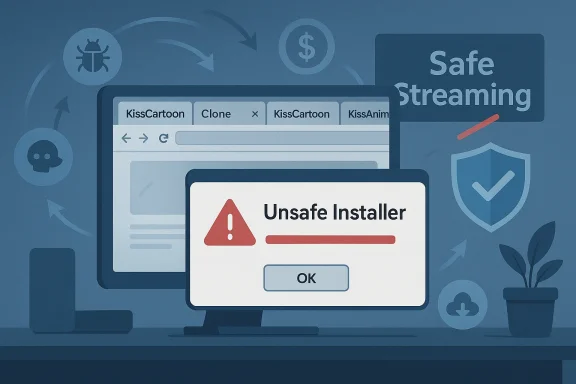
KissCartoon and its dozens of look‑alike domains still show up in search results, but the idea of a safe, official "KissCartoon Unlimited for Windows 10" app is a myth you should not trust—what you’re likely seeing online are clone sites, APK bundles, or thin wrappers that repurpose a web page into a desktop app, and those routes carry real legal and security risks for Windows users.
KissCartoon began as one of many free streaming portals focused on animated content. Over the years it has mutated into a sprawling ecosystem of mirrors, replacement brands (KimCartoon, KissAnime) and look‑alike domains that hop between top‑level domains and mirrors as enforcement actions and takedowns occur. That domain churn is the defining trait of the network: when one site is challenged or blocked it often reappears under another name. The pattern is well documented in reporting on takedowns and the broader piracy ecosystem.
Two simultaneous forces explain why KissCartoon clones keep appearing: (1) demand from users who want free access to cartoons and anime, and (2) an ad‑driven business model that monetizes that demand using aggressive ad networks and affiliate schemes. That model makes clones profitable enough to sustain rapid domain churn—and risky for visitors. The result is a crowded, inconsistent landscape where authenticity is impossible to verify by domain name alone.
Conclusion
KissCartoon and its clones will continue to appear in search results and social feeds—some promise a slick "Unlimited" Windows 10 client or an instant Toy Story 3 stream. But beneath the surface these offers are largely marketing, mirrors, or untrusted packages that expose Windows users to malvertising, multi‑stage malware chains, and privacy invasion. The best practice is simple: prefer verified apps from official stores, use security‑minded browsing habits (ad and script blockers, sandboxing), and stream films like Toy Story 3 through licensed services such as Disney+. If you value your data and your device, the few minutes you save by visiting a free pirate clone are not worth the months or years of cleanup and potential fraud that can follow.
Source: Born2Invest https://born2invest.com/?b=style-701698612/
 Background / Overview
KissCartoon began as one of many free streaming portals focused on animated content. Over the years it has mutated into a sprawling ecosystem of mirrors, replacement brands (KimCartoon, KissAnime) and look‑alike domains that hop between top‑level domains and mirrors as enforcement actions and takedowns occur. That domain churn is the defining trait of the network: when one site is challenged or blocked it often reappears under another name. The pattern is well documented in reporting on takedowns and the broader piracy ecosystem. Two simultaneous forces explain why KissCartoon clones keep appearing: (1) demand from users who want free access to cartoons and anime, and (2) an ad‑driven business model that monetizes that demand using aggressive ad networks and affiliate schemes. That model makes clones profitable enough to sustain rapid domain churn—and risky for visitors. The result is a crowded, inconsistent landscape where authenticity is impossible to verify by domain name alone.
What "KissCartoon Unlimited for Windows 10" really means (and what it doesn’t)
Myth vs. reality: there is no trustworthy, official Microsoft Store app called "KissCartoon Unlimited"
Search results, APK pages, and third‑party sites promote apps and wrapper packages that claim to let you run KissCartoon as an app on Android or Windows. Many of these are Android APKs or simple web‑wrapper packages created with third‑party tools. There is no credible evidence of an official, licensed Windows 10 application published by an authenticated rights‑holder on Microsoft’s store under the KissCartoon name. What you will find instead are:- Web pages masquerading as an “app” (PWA/web wrappers).
- Android APKs and third‑party "mod" installs that require enabling unknown sources.
- Desktop wrappers offered by aggregator tools (which create an app‑like window for a website) rather than a native, verified Windows Store product.
Common bait: "Unlimited", "Premium", or "Windows 10" labels
Terms like Unlimited, Premium, or platform names appended to a brand (for example, “KissCartoon Unlimited for Windows 10”) are classic SEO bait. They help a page rank for searches such as “Toy Story 3 KissCartoon 2026” but tell you nothing about legality or safety. In practice, they’re a red flag that the product is being marketed like a downloadable app when it’s probably a web stream or a bundled installer.The real technical risk: malvertising and multi‑stage malware campaigns
Microsoft’s clear warning
In March 2025 Microsoft Threat Intelligence published a detailed analysis of a malvertising campaign that originated on illegal streaming portals. Attackers embedded redirectors into video frames; visitors were routed through multiple intermediary domains and sometimes ended up downloading malware hosted on public platforms like GitHub, Discord, or Dropbox. Microsoft linked the chain to a wide campaign that impacted nearly one million devices, and they documented how the initial redirectors and GitHub payloads formed a multi‑stage infection chain. This is not abstract—this is a documented, large‑scale threat directly tied to the same class of pirate streaming sites that KissCartoon variants occupy.How the attack chain works (technical summary)
- A visitor loads a pirate streaming page; the page contains an iframe or embedded ad controlled by a malvertising redirector.
- The redirector funnels the browser through one or more intermediate pages (pay‑per‑click/pay‑per‑view funnels).
- The visitor lands on a seemingly legitimate page—often a tech‑support or “update” site—or is redirected to a repository hosting a payload (GitHub, Discord, Dropbox).
- The user is prompted to download what looks like a harmless helper app or update; if executed, the program becomes a dropper that pulls additional malware (info‑stealers, remote access trojans, etc.).
User reports and anecdotal signals
Forums and community threads are full of anecdotal reports about Trojan warnings, forced popups, browser redirects and, in extreme cases, suspicious webcam activity after visiting certain pirate streaming domains. While anecdote is not proof, the volume and consistency of these reports—paired with Microsoft's large‑scale telemetry—create a dangerous pattern. Security vendors and consumer advocacy groups have for years warned that pirate streaming portals are hotspots for malvertising and credential theft.The privacy snippet you posted: what that cookie copy‑paste means
The line you quoted—"The technical storage or access that is used exclusively for statistical purposes. The technical storage or access that is used exclusively for anonymous statistical purposes. Without a subpoena, voluntary compliance on the part of your Internet Service Provider, or additional records from a third party, information stored or retrieved for this purpose alone cannot usually be used to identify you."—is standard boilerplate used in GDPR‑style cookie consent dialogs.- What it says: Cookies and similar technologies are being categorized; Statistics cookies are described as cookies used solely for anonymous measurement and performance analysis.
- What it doesn’t guarantee: That every site using that snippet is actually anonymizing data. The wording is a legal/UX convenience; the actual behavior depends on the implementation and the vendor (Google Analytics, Matomo, etc.)—and rogue sites can include the wording while still shipping third‑party trackers or exploitable ad frames.
Strengths and attractions of KissCartoon‑style sites (why people still use them)
- Huge breadth: These sites aggregate rare, older or fan‑subbed titles that aren’t always available on mainstream services.
- No paywall: The core promise is free, immediate streaming—fast gratification for nostalgia or niche titles.
- Low friction: No account, no signups, immediate access—convenient for casual browsing.
Legal and ethical context
- Accessing copyrighted content via unauthorized streams is illegal in many jurisdictions. Enforcement focuses mainly on site operators, but rights holders and intermediaries have pursued domain takedowns, ISP blocking, and legal actions against major networks and hosting providers. TorrentFreak and other outlets have tracked domain seizures and DMCA actions against KimCartoon/KissCartoon derivatives.
- Consumer fraud and chargeback risk: Pirate sites sometimes push “premium” offers that collect credit card details—users who pay for a “premium KissCartoon” risk losing money and exposing their payment info. Industry groups have publicized fraud statistics showing that users of pirate‑site subscription scams report higher incidents of fraud and identity theft.
Practical, platform‑specific guidance for Windows 10 users
If you or someone in your household is tempted to download a "KissCartoon Unlimited" package or to visit clone sites for movie night—stop and follow these steps.Quick safety checklist (high level)
- Do not download or run unknown installers labeled as "KissCartoon", "Unlimited", or "Pro".
- Prefer official app stores: get apps only from the Microsoft Store, and verify the publisher and ratings.
- Keep Windows updated and run Windows Security (Microsoft Defender) or a reputable endpoint product.
- Use a content blocker (uBlock Origin) and a script blocker (NoScript / equivalent) to limit malvertising surface.
Step‑by‑step: how to verify an app (before you install anything)
- Open the Microsoft Store app on Windows 10 (or 11).
- Search for the app name and check the publisher field. Verified publishers are usually major brands or registered developer names.
- Inspect reviews and screenshots carefully; low review counts with bland language are red flags.
- If the app instructs you to install additional executables or to disable security features, decline—that’s not how legitimate streaming apps behave.
- If you downloaded an .exe or .appx from elsewhere, quarantine it first and scan with Microsoft Defender before running it.
Advanced protection techniques (for power users)
- Use Windows Sandbox for testing untrusted applications in an isolated environment.
- Run risky sites inside a dedicated non‑admin user account, or in a virtual machine (Hyper‑V, VirtualBox).
- Configure Edge or Chrome with strict pop‑up and site isolation settings; install uBlock Origin and enable multiple filter lists.
- Consider enabling Exploit Protection and Application Guard for Microsoft Edge on Windows 10/11 to reduce the blast radius of drive‑by downloads.
If you already clicked or installed something suspicious
- Disconnect the device from the network.
- Run a full scan with Windows Security and a second opinion scanner (Malwarebytes or similar).
- Check browser extensions and remove unknown ones.
- Change passwords for any accounts used on the machine from a trusted device.
- If you entered payment info, contact your bank/issuer and monitor for fraud.
How to check whether a streaming experience is legal and safe
- Does the site list licensing information or the name of a legitimate distributor? If not, that’s a red flag.
- Are mainstream services (Disney+, Crunchyroll, Netflix, HBO Max) also offering the title? If so, prefer those—often the safest path. For example, Toy Story 3 is widely available on Disney+ in many regions as of the latest checks. Renting or streaming through authorized storefronts protects you from malvertising and legal ambiguity.
- If a site demands that you disable your ad blocker to play content—leave. Genuine, licensed platforms don’t require you to turn off security features.
If you want to watch Toy Story 3 (the example mentioned in your message)
- The legitimate, widely used home for Pixar films is Disney+; catalog checks show Toy Story 3 is available there in many regions. If you are in a region where Disney+ tracks the title, use it rather than a pirate stream. Renting or buying from reputable digital stores is another safe option.
- Don’t be tempted by "one‑click" streaming pages that promise instant access to new releases. Those are the exact pages Microsoft and security researchers flagged as vectors for malvertising and repository‑hosted malware.
Critical analysis: what’s working, what’s broken, and where the risk concentration really is
Notable strengths (for users who flock to these sites)
- Content availability: Pirate aggregators often have obscure or older titles hard to find elsewhere.
- No friction: Instant plays without accounts attract users who dislike subscription fragmentation.
Serious shortcomings and risks
- Security: The ad ecosystem on pirate sites is unregulated. Malvertising campaigns have proven they can scale to huge numbers of victims, using real ad networks and creative redirectors to distribute malware at scale. Microsoft’s advisory on the GitHub‑hosted payloads underscored the real operational capability of these attackers.
- Authenticity: There is no central operator for “KissCartoon”—just a distributed cluster of copycats—so claims of "Unlimited" apps published for Windows 10 are almost always marketing copy or outright scams.
- Privacy: Cookie banners and GDPR boilerplate can be included as cosmetic copy while trackers and ad tech still siphon data. The phrase you pasted is common but not a guarantee.
- Monetization traps: Some clones push fake premium subscription offers that collect payment details; consumer advocacy groups show a higher incidence of fraud among people who pay for pirate services.
What rights holders and platforms are doing—and why clones persist
Rights holders and coalitions (MPA, ACE and others) continue to pursue domain seizures, takedowns and legal pressure against major pirate networks. These efforts do reduce individual large‑scale operations, but they do not eliminate demand. Clone domains and mirror farms are cheap to spin up and hard to permanently kill, which is why the ecosystem endures even while individual domains fall. This cat‑and‑mouse dynamic is why you see a constant parade of KissCartoon variants.Final recommendations for WindowsForum readers
- Assume every KissCartoon variant is risky: treat any "KissCartoon Unlimited" executable or APK as malicious until proven otherwise.
- Use official services when possible—Disney+, Crunchyroll, or ad‑supported legal platforms give safer, reliable access.
- Harden browsers with a script and ad blocker if you must research a clone domain (and never enter payment or personal data).
- Run untrusted installers in a sandbox or VM and scan thoroughly with Defender + an independent scanner.
- Report suspicious apps to Microsoft if a purported "KissCartoon" app appears in the Store under a dubious publisher.
Conclusion
KissCartoon and its clones will continue to appear in search results and social feeds—some promise a slick "Unlimited" Windows 10 client or an instant Toy Story 3 stream. But beneath the surface these offers are largely marketing, mirrors, or untrusted packages that expose Windows users to malvertising, multi‑stage malware chains, and privacy invasion. The best practice is simple: prefer verified apps from official stores, use security‑minded browsing habits (ad and script blockers, sandboxing), and stream films like Toy Story 3 through licensed services such as Disney+. If you value your data and your device, the few minutes you save by visiting a free pirate clone are not worth the months or years of cleanup and potential fraud that can follow.
Source: Born2Invest https://born2invest.com/?b=style-701698612/
