

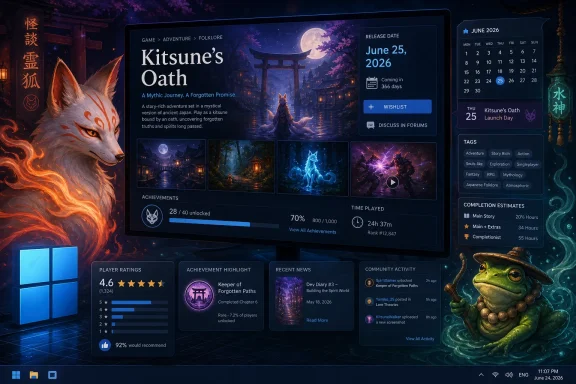
Kitsune Kaeru is currently listed by TrueAchievements as a Windows game due on June 25, 2026, attached to Bad Minions and Little Giant, with a live game hub, screenshots, wishlist tracking, forum hooks, and achievement-community infrastructure already in place. That is not much of a marketing campaign, but it is enough to tell us something about how small Windows releases now arrive. Before a trailer, review cycle, or platform-holder spotlight does the work of persuasion, the achievement database has already turned the game into an object of anticipation. For Windows players, that quiet listing is the story.
There was a time when a small PC game’s public life began with a Steam page, a press release, or a platform-holder roundup. Now, for a certain kind of Windows release, the first meaningful public footprint can be an achievement-tracking page: a title, a platform, a release date, a publisher line, a screenshot carousel, and a community tab waiting for players to arrive.
Kitsune Kaeru appears in exactly that liminal state. The page exists. The date exists. The machinery around the game exists. What does not yet exist, at least in public-facing abundance, is the usual blob of genre language, mechanic descriptions, comparison points, and carefully massaged capsule copy.
That makes the listing feel oddly modern. It is less an announcement than a placeholder with consequences. TrueAchievements is not merely cataloging the game after the fact; it is helping define the game’s pre-release surface area for the players most likely to care about it.
For WindowsForum readers, that matters because the Windows version is not a footnote here. It is the named platform. In an era when “PC” often means a vague cloud of storefronts, launchers, compatibility assumptions, and backend services, a clean Windows listing is still a signal: this is a release entering the Microsoft-adjacent ecosystem of tracking, identity, unlocks, and community scrutiny.
That is not a failure of communication so much as a consequence of how games are now discovered. Databases, storefronts, achievement trackers, subscription catalogs, release calendars, and community sites all want structured metadata early. Once that metadata appears, the game becomes real enough for the internet to sort, bookmark, and speculate about.
This is especially true for achievement hunters. A game does not need a giant reveal to become relevant if it might carry a short completion, a strange list, a high ratio, a stackable platform version, or an easy 1,000 gamerscore. The achievement community looks at release pages the way sysadmins look at changelogs: not for romance, but for operational clues.
Kitsune Kaeru’s page therefore functions as a kind of pre-launch packet capture. It shows the handshake before the conversation. The game has not yet made a loud argument for itself, but the infrastructure around it is already negotiating who will notice it and why.
That dual identity is one of Windows gaming’s strangest strengths. It is not just “PC” in the old sense of mods, graphics settings, and keyboard shortcuts. It is also a platform where Xbox identity, achievements, cloud saves, Game Bar overlays, and Microsoft Store distribution can blur the boundary between console-style tracking and open-ended desktop play.
A TrueAchievements listing for a Windows game sits directly in that blur. The site’s audience does not treat Windows releases as invisible cousins of Xbox games. It tracks them, scores them, compares them, and often folds them into the same completionist habits that used to be primarily console behavior.
For developers and publishers, this means a Windows launch can reach a community that is unusually sensitive to structure. Players are not only asking whether the game is good. They are asking whether the achievement list is fair, whether completion is bugged, whether progress tracks properly, whether the Windows version behaves consistently, and whether the game respects their time.
That pattern says less about any single game than it does about a publishing lane. There is a recognizable space for compact, approachable Windows titles that can live comfortably inside release calendars, achievement sites, and low-friction discovery feeds. These games do not need to dominate a showcase. They need to be findable, understandable, and technically functional when the day comes.
The danger, of course, is that discoverability infrastructure can make a game look more ready than it is. A listing can appear polished because the surrounding site is polished. The page chrome, tabs, screenshots, and platform labels create a sense of completeness even when the public pitch remains thin.
That puts pressure on the release itself. When a modest game arrives with limited pre-launch context, the first players become the documentation layer. Their forum posts, achievement notes, bug reports, and completion estimates quickly become the real guidebook.
But the current listing does not give us enough to responsibly declare what the game is. The screenshots may provide visual hints, and the publisher line provides a market context, but the absence of detailed public copy should restrain anyone from pretending certainty. This is where games coverage often goes wrong: a name becomes a genre, a screenshot becomes a mechanic, and a release page becomes a review.
The more interesting point is that players do not need full certainty to begin sorting the game. Achievement hunters will watch for the list. Cozy-game fans may infer a tone from the title. Windows completionists may track the date. Forum users may create the early conversation simply because the hub is already live.
That is the quiet power of these pages. They invite categorization before confirmation. For a small game, that can be useful momentum; it can also be a trap if expectations harden around assumptions the game never intended to invite.
For a Windows title like Kitsune Kaeru, this can be disproportionately important. A small release may not receive dozens of traditional reviews. It may not trend on social platforms. It may not get a platform-holder blog slot with screenshots and a trailer embedded above the fold. But if it has achievements, it has a route into a community that knows how to create durable attention.
That attention is not always gentle. Achievement communities are forensic. If an unlock fails, if a list is padded, if a completion is impossible, or if a title appears to exist mainly as low-effort score fodder, the verdict can form quickly. Conversely, a clever, polished list can give a modest game a second life among players who might never have noticed it otherwise.
This is why the achievement layer should not be dismissed as ornamental. On Windows, where the store and launcher landscape can feel fragmented, achievements provide a common ritual. They make a small title legible across player diaries, leaderboards, and forum threads.
That uncertainty is not unusual. The indie and budget-release calendar often behaves less like a railway timetable and more like air traffic control: slots are assigned, adjusted, and occasionally delayed for reasons that are invisible from the outside. Certification, store-page readiness, localization, achievement validation, and last-minute fixes can all affect how real a date feels.
Still, a dated listing creates expectations. Players who add Kitsune Kaeru to a wishlist are not merely expressing interest; they are entering it into their own June calendar. Sites that track new Windows games will likely fold it into release roundups. Achievement hunters will watch for the list to populate.
The practical takeaway is simple: the date is news, but it is not a guarantee until the game is actually available. Windows players have learned to hold both ideas at once.
Right now, Kitsune Kaeru’s public footprint leaves much of that open. That can create intrigue, particularly when a title has enough charm to make players click through screenshots. But intrigue has a short half-life. If the page remains thin too close to launch, the game risks being defined by metadata rather than by design.
This matters because Windows players are spoiled for choice and ruthless with time. They do not merely compare a new release against other games launching the same week. They compare it against Game Pass backlogs, Steam libraries, Epic giveaways, emulation projects, early-access obsessions, and whatever service game has become their default evening habit.
A small title can still win in that environment. But it wins by being clear. The best modest releases tell the player, almost immediately, why they exist and what kind of satisfaction they offer.
For bigger releases, brand reputation absorbs some of that uncertainty. For smaller titles, community infrastructure absorbs it instead. A TrueAchievements page, a forum thread, and early user reports become the trust network around the game.
This is where Kitsune Kaeru’s listing may prove more useful than any one trailer. It gives players a place to compare notes. If the game launches smoothly, that hub can amplify confidence. If it stumbles, the same hub will document the stumble with painful efficiency.
That dynamic is familiar to IT pros. The official changelog says one thing; the deployment thread says another. The vendor claims compatibility; the admin community finds the edge cases. Games are not enterprise software, but Windows players have inherited the same skepticism.
Screenshots are not neutral, of course. They are selected. They flatter. They omit rough transitions, loading behavior, controller friction, and the hundred small interactions that determine whether a game feels good. But they are still harder to fake than adjective-heavy marketing text.
For small Windows games, screenshots often do the first work of audience filtering. A player can decide whether the tone is for them before learning anything else. A completionist can decide whether the game looks like a relaxed evening or a fiddly exercise. A parent can decide whether it appears approachable for a younger player.
Kitsune Kaeru’s pre-release presence therefore rests heavily on its visual surface. Until more detailed descriptions, trailers, or achievement data emerge, the images are the closest thing players have to a design statement.
This is one of the odder realities of modern Windows gaming: the achievement list can become a pre-review. A game with elegant unlocks can signal thoughtful design. A game with broken, missable, or opaque achievements can signal trouble before players even reach the store page.
Developers sometimes underestimate this audience. They treat achievements as a compliance chore or a late-production checklist. But for the communities orbiting TrueAchievements, the list is part of the product. It is a map of what the game values.
If Kitsune Kaeru wants to travel beyond the narrow lane of players already predisposed to click on a fox-and-frog Windows listing, its achievement design may matter more than its press copy. That is not how every player thinks, but it is how a measurable and vocal subset of Windows players decides what to install.
A title like Kitsune Kaeru shows how Windows gaming is increasingly mediated by systems outside the game itself. Discovery comes from databases. Trust comes from communities. Value comes from achievements, wishlists, screenshots, and the promise of a clean launch. The store page is only one piece of a larger apparatus.
That apparatus can be a gift to small developers. It gives them surfaces they could never build alone: searchable pages, release calendars, discussion hubs, automated tracking, and communities that reward completion data. But it can also expose them. A thin listing is visible. A bugged achievement is visible. A delayed release date is visible.
Windows remains generous in what it allows to ship, but the surrounding community is not passive. It watches, indexes, scores, and remembers.
For Windows users, the first questions will be practical. Does it install cleanly? Does it support the expected input methods? Does it scale properly across common displays? Does it avoid obvious achievement failures? Does it communicate what kind of game it is within minutes rather than asking the metadata to do the work?
Those may sound like low bars, but small releases often trip over low bars. The Windows audience is broad enough that every assumption gets tested: old laptops, ultrawide monitors, handheld PCs, controllers, keyboard-only setups, accessibility needs, and players who will alt-tab through anything that does not respect them.
That is why the most valuable launch asset for Kitsune Kaeru may not be a clever tagline. It may be boring competence. In a crowded Windows calendar, boring competence is underrated.
 The Achievement Page Has Become the First Storefront
There was a time when a small PC game’s public life began with a Steam page, a press release, or a platform-holder roundup. Now, for a certain kind of Windows release, the first meaningful public footprint can be an achievement-tracking page: a title, a platform, a release date, a publisher line, a screenshot carousel, and a community tab waiting for players to arrive.Kitsune Kaeru appears in exactly that liminal state. The page exists. The date exists. The machinery around the game exists. What does not yet exist, at least in public-facing abundance, is the usual blob of genre language, mechanic descriptions, comparison points, and carefully massaged capsule copy.
That makes the listing feel oddly modern. It is less an announcement than a placeholder with consequences. TrueAchievements is not merely cataloging the game after the fact; it is helping define the game’s pre-release surface area for the players most likely to care about it.
For WindowsForum readers, that matters because the Windows version is not a footnote here. It is the named platform. In an era when “PC” often means a vague cloud of storefronts, launchers, compatibility assumptions, and backend services, a clean Windows listing is still a signal: this is a release entering the Microsoft-adjacent ecosystem of tracking, identity, unlocks, and community scrutiny.
Small Games Now Launch Into Systems Before They Launch Into Minds
The most striking thing about Kitsune Kaeru’s current public profile is how much scaffolding surrounds how little information. A player can follow news, add the game to a wishlist, check screenshots, watch for achievements, and use the forum infrastructure before the broader pitch has fully landed.That is not a failure of communication so much as a consequence of how games are now discovered. Databases, storefronts, achievement trackers, subscription catalogs, release calendars, and community sites all want structured metadata early. Once that metadata appears, the game becomes real enough for the internet to sort, bookmark, and speculate about.
This is especially true for achievement hunters. A game does not need a giant reveal to become relevant if it might carry a short completion, a strange list, a high ratio, a stackable platform version, or an easy 1,000 gamerscore. The achievement community looks at release pages the way sysadmins look at changelogs: not for romance, but for operational clues.
Kitsune Kaeru’s page therefore functions as a kind of pre-launch packet capture. It shows the handshake before the conversation. The game has not yet made a loud argument for itself, but the infrastructure around it is already negotiating who will notice it and why.
Windows Is Still a First-Class Indie Target, Even When the Announcement Is Bare
The Windows label is doing more work here than it may appear. For many smaller publishers, Windows remains the most flexible launch target: broad hardware reach, lower friction for ports, mature input support, and access to both traditional PC storefront culture and Xbox-adjacent achievement audiences.That dual identity is one of Windows gaming’s strangest strengths. It is not just “PC” in the old sense of mods, graphics settings, and keyboard shortcuts. It is also a platform where Xbox identity, achievements, cloud saves, Game Bar overlays, and Microsoft Store distribution can blur the boundary between console-style tracking and open-ended desktop play.
A TrueAchievements listing for a Windows game sits directly in that blur. The site’s audience does not treat Windows releases as invisible cousins of Xbox games. It tracks them, scores them, compares them, and often folds them into the same completionist habits that used to be primarily console behavior.
For developers and publishers, this means a Windows launch can reach a community that is unusually sensitive to structure. Players are not only asking whether the game is good. They are asking whether the achievement list is fair, whether completion is bugged, whether progress tracks properly, whether the Windows version behaves consistently, and whether the game respects their time.
Bad Minions and Little Giant Are Building a Pattern of Modest Windows Visibility
The names attached to Kitsune Kaeru are worth watching precisely because they are not attached to blockbuster noise. Bad Minions and Little Giant have recently surfaced in relation to small Windows releases that appear through achievement and release-calendar infrastructure rather than through maximalist marketing.That pattern says less about any single game than it does about a publishing lane. There is a recognizable space for compact, approachable Windows titles that can live comfortably inside release calendars, achievement sites, and low-friction discovery feeds. These games do not need to dominate a showcase. They need to be findable, understandable, and technically functional when the day comes.
The danger, of course, is that discoverability infrastructure can make a game look more ready than it is. A listing can appear polished because the surrounding site is polished. The page chrome, tabs, screenshots, and platform labels create a sense of completeness even when the public pitch remains thin.
That puts pressure on the release itself. When a modest game arrives with limited pre-launch context, the first players become the documentation layer. Their forum posts, achievement notes, bug reports, and completion estimates quickly become the real guidebook.
The Name Promises Folklore, but the Page Promises Verification
“Kitsune” and “kaeru” both carry obvious Japanese-language associations: fox and frog. That combination gives the game’s title a tonal hook before a description even appears. It suggests folklore, animals, transformation, whimsy, or some blend of cozy and mythic imagery.But the current listing does not give us enough to responsibly declare what the game is. The screenshots may provide visual hints, and the publisher line provides a market context, but the absence of detailed public copy should restrain anyone from pretending certainty. This is where games coverage often goes wrong: a name becomes a genre, a screenshot becomes a mechanic, and a release page becomes a review.
The more interesting point is that players do not need full certainty to begin sorting the game. Achievement hunters will watch for the list. Cozy-game fans may infer a tone from the title. Windows completionists may track the date. Forum users may create the early conversation simply because the hub is already live.
That is the quiet power of these pages. They invite categorization before confirmation. For a small game, that can be useful momentum; it can also be a trap if expectations harden around assumptions the game never intended to invite.
Achievement Culture Turns Obscure Releases Into Measurable Events
TrueAchievements has always been more than a scoreboard. It is a behavioral engine. By assigning ratios, tracking completions, surfacing walkthroughs, and creating a shared vocabulary around difficulty and time investment, it changes how some players encounter games.For a Windows title like Kitsune Kaeru, this can be disproportionately important. A small release may not receive dozens of traditional reviews. It may not trend on social platforms. It may not get a platform-holder blog slot with screenshots and a trailer embedded above the fold. But if it has achievements, it has a route into a community that knows how to create durable attention.
That attention is not always gentle. Achievement communities are forensic. If an unlock fails, if a list is padded, if a completion is impossible, or if a title appears to exist mainly as low-effort score fodder, the verdict can form quickly. Conversely, a clever, polished list can give a modest game a second life among players who might never have noticed it otherwise.
This is why the achievement layer should not be dismissed as ornamental. On Windows, where the store and launcher landscape can feel fragmented, achievements provide a common ritual. They make a small title legible across player diaries, leaderboards, and forum threads.
The Release Date Is Close Enough to Matter and Far Enough to Shift
June 25, 2026, is close enough that Kitsune Kaeru belongs in the near-term release conversation, not the vaporous “coming soon” pile. It is also far enough away that practical details can still change. Small-game release dates move, storefront metadata evolves, and achievement lists sometimes appear late or change around launch.That uncertainty is not unusual. The indie and budget-release calendar often behaves less like a railway timetable and more like air traffic control: slots are assigned, adjusted, and occasionally delayed for reasons that are invisible from the outside. Certification, store-page readiness, localization, achievement validation, and last-minute fixes can all affect how real a date feels.
Still, a dated listing creates expectations. Players who add Kitsune Kaeru to a wishlist are not merely expressing interest; they are entering it into their own June calendar. Sites that track new Windows games will likely fold it into release roundups. Achievement hunters will watch for the list to populate.
The practical takeaway is simple: the date is news, but it is not a guarantee until the game is actually available. Windows players have learned to hold both ideas at once.
The Risk for Tiny Windows Releases Is Not Being Bad, but Being Undefined
The crowded Windows release calendar punishes vagueness. A tiny game does not need photorealistic production values or a cinematic marketing campaign, but it does need a crisp promise. Is it a puzzle game? A platformer? A cozy collection game? A narrative miniature? A family-friendly completion? A score-chasing curiosity?Right now, Kitsune Kaeru’s public footprint leaves much of that open. That can create intrigue, particularly when a title has enough charm to make players click through screenshots. But intrigue has a short half-life. If the page remains thin too close to launch, the game risks being defined by metadata rather than by design.
This matters because Windows players are spoiled for choice and ruthless with time. They do not merely compare a new release against other games launching the same week. They compare it against Game Pass backlogs, Steam libraries, Epic giveaways, emulation projects, early-access obsessions, and whatever service game has become their default evening habit.
A small title can still win in that environment. But it wins by being clear. The best modest releases tell the player, almost immediately, why they exist and what kind of satisfaction they offer.
The Windows Storefront Problem Is Really a Trust Problem
Windows gaming has never lacked quantity. Its problem is trust. Players want to know whether a game runs cleanly, whether input works properly, whether achievements unlock, whether display settings behave, whether cloud saves are reliable, and whether the executable feels like something maintained rather than merely shipped.For bigger releases, brand reputation absorbs some of that uncertainty. For smaller titles, community infrastructure absorbs it instead. A TrueAchievements page, a forum thread, and early user reports become the trust network around the game.
This is where Kitsune Kaeru’s listing may prove more useful than any one trailer. It gives players a place to compare notes. If the game launches smoothly, that hub can amplify confidence. If it stumbles, the same hub will document the stumble with painful efficiency.
That dynamic is familiar to IT pros. The official changelog says one thing; the deployment thread says another. The vendor claims compatibility; the admin community finds the edge cases. Games are not enterprise software, but Windows players have inherited the same skepticism.
Screenshots Still Matter Because They Are the Only Promise That Cannot Hide Behind Copy
The listing includes screenshots, and that matters more than it sounds. In a sparse pre-release environment, images become evidence. They show art direction, interface density, likely camera perspective, and sometimes the genre vocabulary the page itself has not yet articulated.Screenshots are not neutral, of course. They are selected. They flatter. They omit rough transitions, loading behavior, controller friction, and the hundred small interactions that determine whether a game feels good. But they are still harder to fake than adjective-heavy marketing text.
For small Windows games, screenshots often do the first work of audience filtering. A player can decide whether the tone is for them before learning anything else. A completionist can decide whether the game looks like a relaxed evening or a fiddly exercise. A parent can decide whether it appears approachable for a younger player.
Kitsune Kaeru’s pre-release presence therefore rests heavily on its visual surface. Until more detailed descriptions, trailers, or achievement data emerge, the images are the closest thing players have to a design statement.
The Achievement List Will Decide the Second Wave of Attention
The first wave of attention comes from the listing. The second will come from the achievement list, assuming one appears in the usual way. That list will tell achievement-focused players whether Kitsune Kaeru is a curiosity, a quick completion, a grind, a skill test, or a potential headache.This is one of the odder realities of modern Windows gaming: the achievement list can become a pre-review. A game with elegant unlocks can signal thoughtful design. A game with broken, missable, or opaque achievements can signal trouble before players even reach the store page.
Developers sometimes underestimate this audience. They treat achievements as a compliance chore or a late-production checklist. But for the communities orbiting TrueAchievements, the list is part of the product. It is a map of what the game values.
If Kitsune Kaeru wants to travel beyond the narrow lane of players already predisposed to click on a fox-and-frog Windows listing, its achievement design may matter more than its press copy. That is not how every player thinks, but it is how a measurable and vocal subset of Windows players decides what to install.
The Smallest Releases Reveal the Platform More Clearly Than the Biggest Ones
Blockbusters make platforms look simple. They arrive with coordinated trailers, review embargoes, store takeovers, controller presets, and known performance targets. Smaller games reveal the actual plumbing.A title like Kitsune Kaeru shows how Windows gaming is increasingly mediated by systems outside the game itself. Discovery comes from databases. Trust comes from communities. Value comes from achievements, wishlists, screenshots, and the promise of a clean launch. The store page is only one piece of a larger apparatus.
That apparatus can be a gift to small developers. It gives them surfaces they could never build alone: searchable pages, release calendars, discussion hubs, automated tracking, and communities that reward completion data. But it can also expose them. A thin listing is visible. A bugged achievement is visible. A delayed release date is visible.
Windows remains generous in what it allows to ship, but the surrounding community is not passive. It watches, indexes, scores, and remembers.
The Calendar Slot Is a Test of Execution, Not Hype
Kitsune Kaeru’s June 25 date lands in a release environment where attention is fractured and players are already trained to wait. That makes launch-day execution more important than pre-launch noise. The game does not need to be enormous; it needs to be coherent, stable, and accurately represented.For Windows users, the first questions will be practical. Does it install cleanly? Does it support the expected input methods? Does it scale properly across common displays? Does it avoid obvious achievement failures? Does it communicate what kind of game it is within minutes rather than asking the metadata to do the work?
Those may sound like low bars, but small releases often trip over low bars. The Windows audience is broad enough that every assumption gets tested: old laptops, ultrawide monitors, handheld PCs, controllers, keyboard-only setups, accessibility needs, and players who will alt-tab through anything that does not respect them.
That is why the most valuable launch asset for Kitsune Kaeru may not be a clever tagline. It may be boring competence. In a crowded Windows calendar, boring competence is underrated.
A Fox, a Frog, and the Windows Release Machine
Kitsune Kaeru’s current public footprint gives us a handful of firm points and a larger lesson about how Windows games now surface before launch.- Kitsune Kaeru is listed as a Windows release dated June 25, 2026.
- The TrueAchievements hub already includes the usual community and tracking infrastructure, including news, forum, wishlist, and screenshot areas.
- Bad Minions and Little Giant are attached to the listing, placing the game in the orbit of smaller Windows releases rather than major-publisher spectacle.
- The public information currently available is sparse enough that genre and gameplay claims should be treated cautiously until fuller store copy, trailers, or achievement details appear.
- The achievement list, once visible, will likely shape how completion-focused Windows players judge the game’s value and reliability.
- The launch will be judged less on how loudly the game is promoted than on whether the Windows version is clear, stable, and respectful of players’ time.
References
- Primary source: TrueAchievements
Published: 2026-06-19T06:20:12.175303
Kitsune Kaeru (Windows) News and Videos | TrueAchievements
All the latest Kitsune Kaeru (Windows) news, sales, achievements, videos and screenshots.www.trueachievements.com
- Related coverage: steambase.io
Kitsune Battlemage Steam Charts | Steambase
Kitsune Battlemage has 1 concurrent Steam players in-game. Explore more Steam Charts, stats, and trends for Kitsune Battlemage.steambase.io - Related coverage: store.steampowered.com
Steam:Kitsune Tails
日本神話風の世界で走って、ジャンプして、ダッシュ!自分探しの旅をする3人の女の子が繰り広げる恋の三角関係を見守ろう。キツネと人間の登場人物が複雑に関わり合う、昔ながらのプラットフォームゲーム。store.steampowered.com
- Related coverage: steam-games.org
Kaeru nyo Panyo~n (1997) - Steam Games
Kaeru nyo Panyo~n on Steam Games. A magician changes the prince of Parancho into a weird creature while he is on an errand in a distant land. Since his new form isn't very strong he has to entrust his life to a group of adventurers to get back home safely.steam-games.org
