

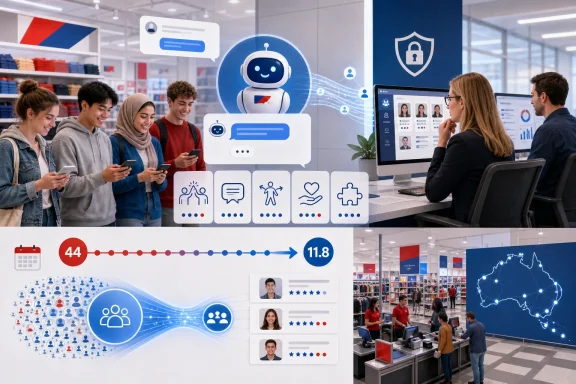
Kmart Australia says an AI-powered hiring chatbot has cut its average recruitment cycle from 44 days to 11.8 days, reduced costs by an estimated $5 million to $6 million over three years, and enabled the retailer to assess roughly 600,000 applications annually. The result is a striking case study in what happens when artificial intelligence moves beyond office productivity and becomes operational infrastructure: candidates no longer submit conventional CVs for many store roles, every applicant receives an assessment, and human recruiters focus on those recommended by the system rather than manually sorting an overwhelming queue.
High-volume retail recruitment has long been an exercise in compromise. Large chains receive far more applications than their recruitment teams can realistically review, particularly before Christmas, back-to-school promotions and other peak trading periods, so employers often rely on CV keywords, availability questions and hurried managerial judgement.
That model is especially weak for entry-level roles. Many applicants are teenagers or young adults with little formal employment history, meaning a CV may reveal more about access to previous opportunities than about whether someone can communicate, solve problems or work effectively in a busy store.
The company’s alternative is a five-question chat interview developed by Melbourne-based Sapia.ai. Kmart and Target began implementing the technology in July 2023, integrating it with SAP SuccessFactors and deploying it across their store network within approximately six weeks.
The retailer says it now handles about 600,000 applications a year. Even if a human reviewer spent only five minutes on each application, reading all of them would require 50,000 working hours before interviews, scheduling, references, compliance checks or offers were considered.
Speed also affects whether an employer gets its preferred candidate. Entry-level applicants commonly apply for several positions at once, and a business that takes 44 days to respond may lose capable people to competitors that make decisions within a week or two.
The basic workflow replaces an initial CV review with a short written interview. Candidates answer the same core questions through a chat interface, allowing the system to compare responses under more consistent conditions than a collection of differently formatted résumés.
Blind assessment cannot make a hiring process automatically fair, but it can remove some familiar opportunities for bias. A recruiter cannot favour a prestigious school, penalise an unfamiliar surname or infer social class from a home address if those details are not part of the first-stage decision.
That remaining 15 percent is significant. It demonstrates that later information, direct interaction, availability, role requirements or human judgement can override the system’s recommendation, although Kmart must ensure that managers understand when and how such overrides are appropriate.
For a 16-year-old applicant, a conventional CV can become an exercise in formatting a small amount of information to fill a page. Hiring decisions may then depend on extracurricular opportunities, parental assistance or familiarity with workplace conventions rather than genuine potential.
It also creates an uneven contest. Applicants who can afford professional résumé assistance, know how automated filters work or use generative AI to rewrite their documents may rank above equally capable candidates who submit simpler applications.
At extreme volume, manual recruitment often means that only a fraction of applications receives careful consideration. Recruiters may rely on shortcuts, stop after finding enough plausible candidates or spend just seconds deciding whether each résumé advances.
The approach does not eliminate differences in writing ability, language background or digital confidence. It does, however, shift the initial signal away from prior access to employment and towards behavioural evidence that may better predict performance in an entry-level role.
A recruitment model needs consistency more than creativity. Its value depends on asking comparable questions, identifying patterns associated with relevant behaviours and generating scores that can be validated against actual workplace outcomes.
A carefully designed model may analyse semantic content and linguistic patterns without requiring every candidate to use the same vocabulary. Yet employers must be cautious about assuming that language style reveals stable personality traits with scientific precision, particularly across cultures and levels of English fluency.
This configuration offers flexibility, but it also introduces governance questions. If managers choose the wrong success criteria, the software can apply that mistake consistently to hundreds of thousands of people.
For Windows-focused enterprise teams, this highlights a wider infrastructure challenge. Identity management, access controls, audit logs, data-retention settings, browser compatibility and endpoint security become part of an AI recruitment project even when the user-facing experience looks like a simple web chat.
The most consequential claim may be that candidates rated as stronger fits stay approximately two and a half times longer than those flagged as weaker. If sustained under independent analysis, that relationship would turn the chatbot from an administrative convenience into a workforce-planning instrument.
A faster process reduces the interval between identifying a staffing need and placing a trained employee on the floor. During peak periods, shortening that interval by more than a month can materially affect store operations.
Improving retention therefore has a multiplier effect. Kmart can save money not only by screening each application more cheaply but also by reducing how frequently it needs to repeat the entire process.
That is the strongest economic argument for the system. AI performs the high-volume, repeatable stage, while humans focus on decisions requiring context, accountability and interpersonal judgement.
The chatbot reportedly gives every participant a written personality or feedback report explaining strengths and potentially suitable roles. Candidate satisfaction has been reported at about 9.1 out of 10, with approximately 80 percent saying they would recommend the experience.
Kmart’s implementation therefore challenges the assumption that automation must worsen candidate relationships. The relevant comparison is not AI versus an attentive recruiter with unlimited time; it is AI versus the inconsistent, delayed process that volume recruitment previously produced.
A generated report can give applicants something useful in exchange for their time. However, the language must remain accurate and carefully bounded so that a probabilistic assessment is not presented as a definitive psychological diagnosis.
Text is not universally accessible. Candidates with dyslexia, limited literacy, visual impairment, intellectual disability or limited English proficiency may need assistive technology, additional time or a non-chat alternative to compete fairly.
These results support the company’s contention that removing CVs and identity cues can widen access. They do not, on their own, prove that the model is free from bias or equally fair to every group.
A system could improve representation overall while disadvantaging a smaller subgroup hidden within broader categories. Disability, for example, covers a wide range of physical, cognitive, sensory and psychological conditions, each of which may interact differently with a written assessment.
Models can also learn correlations that function as proxies without being deliberately programmed to discriminate. This is why “we do not give the AI protected characteristics” is not sufficient evidence of fairness.
Human oversight must therefore mean more than inserting a person at the end of the process. Recruiters need training, documented decision rules and mechanisms to identify patterns in which particular managers repeatedly override recommendations in ways that disadvantage certain groups.
The Australian Human Rights Commission has published a compliance checklist for employers using AI in recruitment. Australian Public Service agencies were also expected to implement principles for AI use in recruitment by June 1, 2026, illustrating the broader shift towards formal governance.
Contracts should require documentation, security protections, audit assistance, incident reporting and access to information needed to investigate discrimination claims. A promise that a model is “fair” should never replace evidence showing how fairness was tested.
The case had not produced a final finding on the underlying allegations by July 2026, but key claims were allowed to proceed. Its broader significance is that courts may examine the practical role played by a software supplier rather than accepting a simple distinction between a “tool” and a formal decision-maker.
Employers also need sufficient records to reconstruct a decision. That includes the model version, job profile, questions, candidate responses, score, recommendation, human actions and any override, all retained under defensible privacy and data-governance rules.
Candidate responses may reveal health conditions, ethnicity, family circumstances, financial stress or other personal details even when the questions do not request them. The platform must protect both the structured profile and the unstructured text from which it was created.
Retention periods should also be explicit. Keeping every answer indefinitely might assist future analytics, but it increases breach exposure and risks repurposing candidate data beyond the context in which it was supplied.
Enterprise controls should include:
Version control is therefore essential. If recommendation rates change unexpectedly, Kmart must be able to determine whether the cause was applicant behaviour, labour-market conditions, a new role profile, altered question wording or a revised model.
Store managers also receive a more curated shortlist. That can improve productivity, although it may weaken local judgement if managers become reluctant to question a system presented as objective.
They also need authority to intervene. A human reviewer who cannot access reasoning, request accommodation or challenge a recommendation provides little meaningful oversight.
Interfaces should communicate that scores rank evidence against selected criteria rather than quantify a candidate’s overall human worth. Training should explicitly warn reviewers not to treat small score differences as proof that one applicant is inherently superior.
Kmart will need to decide what assistance is acceptable. Attempts to detect AI-written text are unreliable, so later human conversations and practical assessment may be more effective than automated policing.
A five-question chat assessment may be unsuitable for licensed, highly technical or safety-critical positions. The correct lesson is not that every employer should abandon résumés, but that each stage of recruitment should be tested against the information it genuinely contributes.
The benchmark must nevertheless include more than speed and cost. A system that fills vacancies quickly but produces unfair exclusions, poor security or low-quality hires is not successful.
The system’s performance will also be tested as candidates adapt to it. Generative AI assistance, widespread interview coaching and repeated exposure to similar questions could alter the relationship between chatbot scores and actual workplace behaviour.
Audit scope matters as much as audit existence. A narrow check of whether protected attributes are supplied to the model would miss proxy discrimination, downstream managerial bias and unequal completion rates.
Kmart should also explain how candidates can request adjustments, obtain human reconsideration and raise concerns. Transparency is most useful when it is paired with an actionable remedy.
Professional hiring involves qualifications, specialist experience, leadership evidence and sometimes regulatory requirements. AI may still assist, but the balance between automated assessment and expert human evaluation would need to change.
Kmart’s recruitment chatbot is a compelling demonstration of AI applied to a specific operational bottleneck rather than deployed as a vague innovation exercise. Cutting time to hire from 44 days to 11.8 days, assessing hundreds of thousands of people and reportedly improving retention and representation show why structured automation will spread, but the same scale that creates savings also magnifies errors. The long-term test will be whether Kmart can preserve accessibility, transparency, security and genuine human accountability as the model, workforce and applicant population evolve; if it can, the retailer may have established a practical blueprint for high-volume hiring that is not only faster than the CV era, but more attentive to the people the old process routinely left waiting.
 Background
High-volume retail recruitment has long been an exercise in compromise. Large chains receive far more applications than their recruitment teams can realistically review, particularly before Christmas, back-to-school promotions and other peak trading periods, so employers often rely on CV keywords, availability questions and hurried managerial judgement.That model is especially weak for entry-level roles. Many applicants are teenagers or young adults with little formal employment history, meaning a CV may reveal more about access to previous opportunities than about whether someone can communicate, solve problems or work effectively in a busy store.
From stacks of CVs to structured conversations
Before introducing its current assessment process, Kmart reportedly had applications and CVs sitting at stores for weeks. Candidates could wait around six weeks without receiving a meaningful response, while local managers faced the repetitive task of reviewing documents that frequently contained little relevant information.The company’s alternative is a five-question chat interview developed by Melbourne-based Sapia.ai. Kmart and Target began implementing the technology in July 2023, integrating it with SAP SuccessFactors and deploying it across their store network within approximately six weeks.
The scale behind the decision
Kmart Group operates more than 450 Kmart and Target stores and employs a substantial population of younger workers. About 20,000 employees are reportedly under the age of 21, making the quality and accessibility of entry-level recruitment strategically important rather than merely administrative.The retailer says it now handles about 600,000 applications a year. Even if a human reviewer spent only five minutes on each application, reading all of them would require 50,000 working hours before interviews, scheduling, references, compliance checks or offers were considered.
Why the 75 percent reduction matters
Reducing time to hire by approximately 73.8 percent is not simply an HR efficiency statistic. In retail, an unfilled role can mean longer checkout queues, untidy shelves, slower online order fulfilment, additional overtime and greater pressure on existing employees.Speed also affects whether an employer gets its preferred candidate. Entry-level applicants commonly apply for several positions at once, and a business that takes 44 days to respond may lose capable people to competitors that make decisions within a week or two.
How Kmart’s AI Hiring Process Works
Kmart describes the Sapia.ai product as a hiring assessment tool rather than an applicant-tracking or autonomous recruitment system. That distinction is important because the chatbot does not appear to make the final employment decision; it gathers structured responses, evaluates job-related characteristics and supplies information to human recruiters.The basic workflow replaces an initial CV review with a short written interview. Candidates answer the same core questions through a chat interface, allowing the system to compare responses under more consistent conditions than a collection of differently formatted résumés.
Five areas of assessment
The chatbot evaluates candidates across five broad themes:- Teamwork measures how an applicant describes cooperating with other people and contributing to a shared objective.
- Helping others examines service orientation, empathy and willingness to support customers or colleagues.
- Adaptability considers how candidates respond when circumstances, priorities or instructions change.
- Problem solving looks for evidence of practical reasoning rather than formal qualifications alone.
- Communication assesses how clearly candidates explain situations, actions and outcomes in writing.
A blind first-stage assessment
Kmart says the system does not present recruiters with age, gender or background information during the initial assessment. Applicants are therefore judged on their answers to the structured questions rather than on names, photographs, schools, addresses or the visual polish of a CV.Blind assessment cannot make a hiring process automatically fair, but it can remove some familiar opportunities for bias. A recruiter cannot favour a prestigious school, penalise an unfamiliar surname or infer social class from a home address if those details are not part of the first-stage decision.
Human review remains in the loop
The AI recommends candidates, but people retain responsibility for progressing and ultimately hiring them. Kmart says human recruiters select approximately 85 percent of the applicants recommended by the tool, indicating strong alignment without suggesting that the algorithm’s result is treated as an irreversible command.That remaining 15 percent is significant. It demonstrates that later information, direct interaction, availability, role requirements or human judgement can override the system’s recommendation, although Kmart must ensure that managers understand when and how such overrides are appropriate.
Why Conventional CV Screening Failed at This Scale
The résumé remains useful for occupations in which qualifications, certifications and a detailed employment history determine eligibility. It is considerably less effective when an employer is recruiting people who may be seeking their first job.For a 16-year-old applicant, a conventional CV can become an exercise in formatting a small amount of information to fill a page. Hiring decisions may then depend on extracurricular opportunities, parental assistance or familiarity with workplace conventions rather than genuine potential.
Keywords are a poor proxy for ability
Traditional applicant-tracking systems frequently rank résumés by matching words and phrases against a job description. That approach can reward candidates who understand keyword optimisation while overlooking people who express the same skills differently.It also creates an uneven contest. Applicants who can afford professional résumé assistance, know how automated filters work or use generative AI to rewrite their documents may rank above equally capable candidates who submit simpler applications.
Manual screening is not necessarily personal
It is tempting to frame human review as compassionate and AI screening as impersonal. Kmart’s previous process illustrates why that comparison can be misleading: an unread CV sitting in a store for six weeks does not provide meaningful human attention.At extreme volume, manual recruitment often means that only a fraction of applications receives careful consideration. Recruiters may rely on shortcuts, stop after finding enough plausible candidates or spend just seconds deciding whether each résumé advances.
Structured assessment changes the signal
A common set of questions gives every applicant an opportunity to provide job-relevant evidence. Instead of asking whether a teenager has already worked in retail, the system can ask how that person responded to a difficult team situation, helped someone or adapted when a plan changed.The approach does not eliminate differences in writing ability, language background or digital confidence. It does, however, shift the initial signal away from prior access to employment and towards behavioural evidence that may better predict performance in an entry-level role.
The Technology Behind a Chat-Based Interview
The public description of the system suggests that it uses natural-language processing to evaluate written answers and map them against competencies selected for a role. This is different from a general-purpose chatbot that improvises an open-ended conversation or answers arbitrary questions.A recruitment model needs consistency more than creativity. Its value depends on asking comparable questions, identifying patterns associated with relevant behaviours and generating scores that can be validated against actual workplace outcomes.
Natural-language analysis
Written responses contain more than keywords. Their structure can indicate whether a candidate understands the question, describes personal actions, recognises other people’s needs and connects a decision with an outcome.A carefully designed model may analyse semantic content and linguistic patterns without requiring every candidate to use the same vocabulary. Yet employers must be cautious about assuming that language style reveals stable personality traits with scientific precision, particularly across cultures and levels of English fluency.
Role-specific success profiles
Sapia.ai’s system allows hiring teams to define competencies and their relative importance for particular roles. A customer-facing position might place greater weight on helping others and communication, while an operational role could emphasise adaptability and problem solving.This configuration offers flexibility, but it also introduces governance questions. If managers choose the wrong success criteria, the software can apply that mistake consistently to hundreds of thousands of people.
Integration with enterprise HR systems
The Kmart and Target deployment is integrated with SAP SuccessFactors, allowing recommendations and candidate reports to appear within an established human-resources workflow. Integration is essential because an isolated AI tool can create more administrative work if recruiters must transfer information manually.For Windows-focused enterprise teams, this highlights a wider infrastructure challenge. Identity management, access controls, audit logs, data-retention settings, browser compatibility and endpoint security become part of an AI recruitment project even when the user-facing experience looks like a simple web chat.
The Business Case for Automation
Kmart estimates that the system has saved between $5 million and $6 million over three years. Those savings likely extend beyond reduced screening labour and include faster staffing, lower candidate attrition and less repeated recruitment caused by employee turnover.The most consequential claim may be that candidates rated as stronger fits stay approximately two and a half times longer than those flagged as weaker. If sustained under independent analysis, that relationship would turn the chatbot from an administrative convenience into a workforce-planning instrument.
Calculating the hidden cost of vacancies
The cost of an empty store position does not appear neatly in a recruitment budget. It is distributed across overtime, manager workload, reduced service quality, missed sales, fulfilment delays and fatigue among existing employees.A faster process reduces the interval between identifying a staffing need and placing a trained employee on the floor. During peak periods, shortening that interval by more than a month can materially affect store operations.
Turnover compounds recruitment costs
Retailers often operate with high workforce churn, particularly among casual and younger employees. Every premature departure creates another vacancy, another advertisement, another onboarding cycle and another period in which experienced colleagues must train someone new.Improving retention therefore has a multiplier effect. Kmart can save money not only by screening each application more cheaply but also by reducing how frequently it needs to repeat the entire process.
Better allocation of human recruiters
Automation does not have to mean eliminating recruitment staff. It can redirect them from sorting documents towards interviewing candidates, supporting hiring managers, improving workforce plans and handling complex cases.That is the strongest economic argument for the system. AI performs the high-volume, repeatable stage, while humans focus on decisions requiring context, accountability and interpersonal judgement.
Candidate Experience Becomes Customer Experience
Kmart’s observation that applicants are also customers deserves attention. A recruitment process involving weeks of silence can damage a retail brand even when the candidate never becomes an employee.The chatbot reportedly gives every participant a written personality or feedback report explaining strengths and potentially suitable roles. Candidate satisfaction has been reported at about 9.1 out of 10, with approximately 80 percent saying they would recommend the experience.
Ending recruitment ghosting
Automated communication is often criticised as cold, but timely automation can be more respectful than no communication at all. A candidate who completes an assessment and quickly receives a result has more certainty than someone whose application disappears into a manager’s inbox.Kmart’s implementation therefore challenges the assumption that automation must worsen candidate relationships. The relevant comparison is not AI versus an attentive recruiter with unlimited time; it is AI versus the inconsistent, delayed process that volume recruitment previously produced.
Feedback creates value for unsuccessful applicants
Most employers provide rejected candidates with little more than a standard email. Individual feedback is difficult to produce manually when hundreds of thousands of people apply, and legal teams may discourage detailed explanations that could invite disputes.A generated report can give applicants something useful in exchange for their time. However, the language must remain accurate and carefully bounded so that a probabilistic assessment is not presented as a definitive psychological diagnosis.
Accessibility still requires alternatives
A text-based interview may benefit people who find telephone or video interviews stressful, need time to formulate answers or cannot travel easily. It also avoids some problems associated with automated video analysis, such as judging facial expression, eye movement, accent or vocal characteristics.Text is not universally accessible. Candidates with dyslexia, limited literacy, visual impairment, intellectual disability or limited English proficiency may need assistive technology, additional time or a non-chat alternative to compete fairly.
Diversity Gains and the Bias Question
Kmart says First Nations people account for 8.25 percent of hires made through the process, compared with a workforce parity benchmark of 3 percent. More than 3.5 percent of successful candidates reportedly disclosed a disability.These results support the company’s contention that removing CVs and identity cues can widen access. They do not, on their own, prove that the model is free from bias or equally fair to every group.
Representation is an outcome, not a complete audit
Hiring rates provide an important measure, but responsible evaluation requires examining the full recruitment funnel. Auditors should compare application, completion, recommendation, interview, offer and acceptance rates across demographic groups.A system could improve representation overall while disadvantaging a smaller subgroup hidden within broader categories. Disability, for example, covers a wide range of physical, cognitive, sensory and psychological conditions, each of which may interact differently with a written assessment.
Blind inputs can still contain proxies
Removing explicit demographic fields does not prevent candidates from revealing identity-related information in their answers. Language patterns, cultural references, schooling examples, caring responsibilities and experiences of discrimination can indirectly signal background.Models can also learn correlations that function as proxies without being deliberately programmed to discriminate. This is why “we do not give the AI protected characteristics” is not sufficient evidence of fairness.
Human bias can move downstream
If the initial recommendation becomes more equitable but managers later interview, roster or promote candidates inconsistently, automation has only relocated the problem. Kmart needs to assess whether improvements survive through final hiring and into employment outcomes.Human oversight must therefore mean more than inserting a person at the end of the process. Recruiters need training, documented decision rules and mechanisms to identify patterns in which particular managers repeatedly override recommendations in ways that disadvantage certain groups.
Legal and Regulatory Implications
AI-assisted hiring is receiving growing scrutiny because employment decisions can affect income, housing stability, health and long-term opportunity. Australian anti-discrimination, privacy and employment obligations can apply regardless of whether a decision is made by a manager, a vendor’s model or a combination of both.The Australian Human Rights Commission has published a compliance checklist for employers using AI in recruitment. Australian Public Service agencies were also expected to implement principles for AI use in recruitment by June 1, 2026, illustrating the broader shift towards formal governance.
Employers cannot outsource responsibility
Buying software does not transfer accountability to the vendor. An employer chooses the tool, defines the role criteria, decides how recommendations affect candidates and controls whether meaningful human review is available.Contracts should require documentation, security protections, audit assistance, incident reporting and access to information needed to investigate discrimination claims. A promise that a model is “fair” should never replace evidence showing how fairness was tested.
The Workday case raises the stakes
In the United States, the continuing litigation involving Workday has become a warning for the employment technology industry. Plaintiffs allege that AI-supported screening disadvantaged applicants based on protected characteristics including age, race and disability, while Workday disputes the claims and says its products do not make hiring decisions.The case had not produced a final finding on the underlying allegations by July 2026, but key claims were allowed to proceed. Its broader significance is that courts may examine the practical role played by a software supplier rather than accepting a simple distinction between a “tool” and a formal decision-maker.
Records must support an appeal
Candidates should have a clear route to request accommodation, correct inaccurate information or ask for human reconsideration. Without such a process, “human in the loop” can become a slogan rather than an effective safeguard.Employers also need sufficient records to reconstruct a decision. That includes the model version, job profile, questions, candidate responses, score, recommendation, human actions and any override, all retained under defensible privacy and data-governance rules.
Enterprise IT and Security Considerations
A recruitment chatbot handles sensitive information from people who do not yet have an employment relationship with the organisation. That makes privacy and cybersecurity central to the deployment, not secondary compliance tasks.Candidate responses may reveal health conditions, ethnicity, family circumstances, financial stress or other personal details even when the questions do not request them. The platform must protect both the structured profile and the unstructured text from which it was created.
Data minimisation and retention
The safest information is information an organisation never collects. Recruitment teams should design questions that elicit job-relevant examples without encouraging candidates to disclose protected or highly personal information.Retention periods should also be explicit. Keeping every answer indefinitely might assist future analytics, but it increases breach exposure and risks repurposing candidate data beyond the context in which it was supplied.
Access and identity controls
Recruiters and store managers should receive only the access required for their role. Central HR teams may need broader analytics, while a local manager may need to see only candidates assigned to a particular vacancy.Enterprise controls should include:
- Single sign-on should reduce unmanaged credentials and simplify access removal when an employee changes roles.
- Multifactor authentication should protect administrative and recruiter accounts from takeover.
- Role-based permissions should prevent unnecessary access to candidate responses and demographic analytics.
- Audit logs should record viewing, exporting, scoring changes and human overrides.
- Data-loss prevention policies should limit downloads and uncontrolled sharing of reports.
- Vendor incident procedures should define notification deadlines and evidence-preservation requirements.
Model and configuration changes
AI systems can change through retraining, vendor updates or employer configuration. A model validated in 2024 should not be assumed to perform identically after a major update in 2026.Version control is therefore essential. If recommendation rates change unexpectedly, Kmart must be able to determine whether the cause was applicant behaviour, labour-market conditions, a new role profile, altered question wording or a revised model.
Impact on Workers and Recruitment Teams
The Kmart deployment illustrates how AI may change white-collar and administrative work without simply removing an entire occupation. Recruiters spend less time reading basic applications, but they become more responsible for model governance, candidate escalation and interpretation of assessment data.Store managers also receive a more curated shortlist. That can improve productivity, although it may weaken local judgement if managers become reluctant to question a system presented as objective.
Recruiters become supervisors of automation
A modern recruitment professional increasingly needs data literacy alongside interviewing and employment-law knowledge. Staff must understand what a score represents, what it does not represent and how to detect unusual patterns.They also need authority to intervene. A human reviewer who cannot access reasoning, request accommodation or challenge a recommendation provides little meaningful oversight.
The danger of automation bias
People tend to place undue trust in computer-generated outputs, especially when those outputs include precise numbers. A score of 82 can look more authoritative than a manager’s qualitative judgement even if the underlying measurement contains uncertainty.Interfaces should communicate that scores rank evidence against selected criteria rather than quantify a candidate’s overall human worth. Training should explicitly warn reviewers not to treat small score differences as proof that one applicant is inherently superior.
Candidate optimisation will follow
As applicants learn how the assessment works, coaching services and generative AI tools will emerge to help them produce stronger answers. Some candidates may paste questions into an assistant and submit polished responses that do not reflect their unaided communication.Kmart will need to decide what assistance is acceptable. Attempts to detect AI-written text are unreliable, so later human conversations and practical assessment may be more effective than automated policing.
Lessons for Other Employers
Kmart’s results will attract organisations facing large applicant volumes, but copying the interface without copying the governance would be a mistake. The success of the deployment appears tied to a specific problem: entry-level retail recruitment in which CVs offered weak predictive value.A five-question chat assessment may be unsuitable for licensed, highly technical or safety-critical positions. The correct lesson is not that every employer should abandon résumés, but that each stage of recruitment should be tested against the information it genuinely contributes.
A responsible implementation sequence
Organisations considering a similar system should follow a staged process:- Define the recruitment problem before selecting a technology. Establish whether the principal issue is volume, delay, inconsistency, poor retention or inadequate candidate communication.
- Identify job-relevant competencies using evidence. Avoid simply encoding the preferences of existing managers or assuming that current high performers represent the only valid employee profile.
- Validate the assessment against real outcomes. Compare recommendations with performance, retention and conduct while accounting for training, store conditions and management quality.
- Test for adverse effects across demographic groups. Examine the complete funnel and investigate meaningful disparities rather than relying on a single diversity percentage.
- Provide accessible alternatives and human review. Candidates should not be excluded because they cannot use a particular interface effectively.
- Pilot the system before broad deployment. A controlled trial can expose integration, accessibility and scoring problems before they affect an entire workforce.
- Monitor continuously after launch. Labour markets, applicant behaviour, language and job requirements change, so validation cannot be a one-time exercise.
Choose the right benchmark
Comparing AI with an idealised human process creates a distorted debate. Employers should compare it with the process they actually operate, including delays, inconsistent screening, recruiter workload and the number of applications never reviewed.The benchmark must nevertheless include more than speed and cost. A system that fills vacancies quickly but produces unfair exclusions, poor security or low-quality hires is not successful.
Strengths and Opportunities
Kmart’s experience demonstrates several practical opportunities for employers with large entry-level recruitment pipelines.- Universal first-stage assessment gives every completed applicant more consideration than a process in which most CVs remain unread.
- Faster hiring helps retailers secure candidates before competitors and fill operational gaps during peak trading periods.
- Structured questions improve consistency by asking applicants to provide comparable job-related evidence.
- Removing conventional CVs can reduce dependence on prior opportunity, résumé-writing skill and keyword optimisation.
- Automated feedback can improve the candidate relationship even when the applicant is unsuccessful.
- Integration with an enterprise HR platform can turn assessment results into a manageable workflow rather than another disconnected data source.
- Retention analysis may help employers identify whether the assessment predicts meaningful workplace outcomes.
- Recruiters can spend more time on complex decisions, workforce planning and direct candidate engagement.
Risks and Concerns
The headline savings should not obscure the seriousness of using algorithmic analysis to influence access to employment.- Hidden bias may remain even when names, ages and gender fields are removed, because written answers can contain demographic proxies.
- Language-based scoring may disadvantage candidates with limited English, neurodivergence, dyslexia or different cultural communication styles.
- Automation bias may cause recruiters to accept recommendations without sufficient challenge or contextual review.
- Vendor opacity may prevent employers from understanding how scores are produced or how model changes affect outcomes.
- Sensitive candidate responses create privacy and cybersecurity exposure if access, retention and breach controls are weak.
- Success profiles may reproduce the characteristics of an existing workforce instead of recognising new forms of potential.
- Candidate use of generative AI may reduce confidence that written responses reflect the applicant’s own communication.
- Feedback reports may be misinterpreted as authoritative personality diagnoses rather than limited employment assessments.
- A strong overall diversity result may conceal adverse outcomes affecting smaller or intersectional groups.
- Human oversight may become ceremonial if reviewers lack information, training or practical authority to reverse the system.
What to Watch Next
Kmart’s most important next step is independent, longitudinal validation. The retailer has reported impressive speed, cost, retention and diversity figures, but stakeholders will want to know whether those results remain stable across regions, store formats, economic conditions and demographic groups.The system’s performance will also be tested as candidates adapt to it. Generative AI assistance, widespread interview coaching and repeated exposure to similar questions could alter the relationship between chatbot scores and actual workplace behaviour.
Independent auditing
External audits could examine model validity, accessibility, security and adverse impact without requiring Kmart to expose candidate data publicly. Independent review would strengthen confidence because many of the headline figures currently come from the retailer or technology provider.Audit scope matters as much as audit existence. A narrow check of whether protected attributes are supplied to the model would miss proxy discrimination, downstream managerial bias and unequal completion rates.
Greater candidate transparency
Applicants increasingly expect to know when AI is being used, what information it analyses and how recommendations affect their prospects. Clear explanations can build trust without revealing enough detail to facilitate manipulation.Kmart should also explain how candidates can request adjustments, obtain human reconsideration and raise concerns. Transparency is most useful when it is paired with an actionable remedy.
Expansion into other roles
The strongest results appear connected to high-volume, entry-level positions. Extending the model to corporate, technical or management roles would require fresh validation rather than assuming the same five traits and scoring relationships remain appropriate.Professional hiring involves qualifications, specialist experience, leadership evidence and sometimes regulatory requirements. AI may still assist, but the balance between automated assessment and expert human evaluation would need to change.
Kmart’s recruitment chatbot is a compelling demonstration of AI applied to a specific operational bottleneck rather than deployed as a vague innovation exercise. Cutting time to hire from 44 days to 11.8 days, assessing hundreds of thousands of people and reportedly improving retention and representation show why structured automation will spread, but the same scale that creates savings also magnifies errors. The long-term test will be whether Kmart can preserve accessibility, transparency, security and genuine human accountability as the model, workforce and applicant population evolve; if it can, the retailer may have established a practical blueprint for high-volume hiring that is not only faster than the CV era, but more attentive to the people the old process routinely left waiting.
References
- Primary source: Stockhead
Published: 2026-07-22T06:04:12+00:00
Kmart cuts hiring time 75pc by using AI chatbot | Stockhead
Kmart says replacing humans with an AI chatbot to screen 600,000 job applications a year has reduced hiring bias and saved millions. Kmart says replacing humans with an AI chatbot to screen 600,000 job applications a year has reduced hiring bias and saved millions. stockhead.com.au
- Related coverage: sapia.ai