

Sony Interactive Entertainment said on July 1, 2026, that it will stop producing physical discs for new PlayStation games starting in January 2028, and Hideo Kojima responded days later in Italy by warning that entertainment users are being pushed toward access without possession. The remark landed because Kojima was not merely mourning a plastic format. He was describing the quiet transfer of leverage from players and collectors to platform owners, licensors, and servers. In a market that has already taught users to confuse “buy” with “borrow indefinitely,” the PlayStation disc deadline makes an old anxiety newly concrete.
The most important thing about Kojima’s intervention is that he did not treat Sony’s decision as nostalgia bait. Speaking at the Il Cinema in Piazza film festival in Italy, according to widely circulated translations amplified by Genki_JPN and reposted by Kojima himself, the Metal Gear and Death Stranding creator framed the issue as a structural change in who controls access to culture.
That distinction matters. A disc is not magic, and modern game discs often require patches, authentication, or downloads to become the best version of themselves. But a disc still gives the owner something digital storefronts generally do not: a transferable object, a resale path, a backup of at least some executable content, and a practical obstacle between the platform holder and total revocation.
Kojima’s “turn the tap” metaphor is blunt because it is accurate. Streaming services normalize the idea that a remote server is the real library and the user merely has permission to open the valve. That model is convenient, but it is also politically, commercially, and legally fragile in ways that physical media is not.
Sony’s announcement supplied the calendar. Kojima supplied the diagnosis.
But “preference” is doing a lot of work here. Consumers often prefer digital because the industry has spent years making digital the default path of least resistance. Consoles ship with giant storefront tiles, subscription libraries, preloads, cloud saves, and seasonal sales; physical releases arrive late, incomplete, or as codes in boxes; retailers shrink their game aisles; publishers learn that a disc sold once may compete with a digital copy sold forever.
The move is therefore not simply a response to demand. It is also an act of market design. Platform holders have taught players to live inside closed digital storefronts, then cited that behavior as proof that the old escape hatches can be sealed.
That does not make Sony irrational. It makes Sony a platform company behaving like a platform company. The uncomfortable part is that the PlayStation brand was built for three decades on the emotional and economic appeal of boxed games, and Sony is now telling its most loyal customers that the next era will be governed by account credentials rather than shelves.
Physical games created a secondary market that limited platform power. If a publisher kept a launch price too high, used copies offered pressure. If a player finished a game, resale helped fund the next one. If a storefront delisted a title, discs could keep circulating long after business logic had moved on.
Digital-only console ecosystems remove most of that pressure. A PlayStation game bought through the PlayStation Store is not meaningfully yours in the way a disc is yours. You cannot resell it, lend it with the same freedom, preserve it independently, or move it outside the account and hardware rules that Sony sets.
PC gaming made peace with digital distribution because the PC is not one store. Steam dominates, but it coexists with Epic, GOG, itch.io, publisher launchers, direct downloads, modding communities, emulation scenes, and DRM-free installers. Console digital distribution is different because the platform holder is the gate, the shop, the payment rail, the license manager, and often the hardware authenticator.
That is why Kojima’s warning hits harder in the console context. A digital-only PlayStation is not simply a PlayStation without discs. It is a PlayStation in which every new game purchase becomes a relationship with Sony’s servers.
This is precisely the failure mode Kojima described. The customer paid. The interface used purchase language. The library displayed the content. Then a rights deal changed somewhere above the user’s head, and access became conditional in the most literal possible sense.
Defenders of digital licensing will point out that movies and games are not identical products. They are right. A downloaded game may remain installed, while a streamed or licensed video library can be more directly vulnerable to content removal. But that distinction is comforting only until the game requires account authentication, server checks, multiplayer infrastructure, cloud streaming, DLC entitlement validation, or a patch that is no longer available.
The deeper lesson is not that every digital purchase disappears tomorrow. It is that the user rarely controls the conditions that make the purchase usable. That was once a fringe preservationist complaint. Sony’s own media library controversy made it a mainstream consumer story.
If such a program materializes, it would be smarter optics than simply cutting the cord. It would acknowledge that players have existing libraries and that a sudden break with physical media would look like confiscation by design. It would also fit Microsoft’s larger ambition to make Xbox less a box under the television than an account, a cloud service, a Windows-adjacent gaming layer, and a Game Pass funnel.
But the bridge still leads to the same shore. Converting a disc to a license may preserve access in the short term, yet it also transforms a transferable object into a permission record. Once that happens, the consumer is back inside the account economy: recoverable, manageable, convenient, and ultimately governed by terms of service.
That is not nothing. For families with scratched discs, shrinking retail shelves, and multiple devices, account-based access can be genuinely better. The problem is that “better” and “owned” are diverging concepts.
The preservation issue is not merely whether someone can play a famous blockbuster in 2045. It is whether cultural history remains accessible outside the business interests of the companies that originally sold it. Games are software, performance, art, industrial design, licensed music, networking code, and community memory all at once. They are also unusually vulnerable to vanishing when servers shut down or storefront rights expire.
Kojima understands this because his own work sits at the intersection of cinema and software. A film collector can still buy Blu-rays, import discs, preserve editions, and compare cuts. A game collector increasingly buys a container for a license, a launcher, or a partial install awaiting a patch server.
The irony is that the industry has never been more culturally confident. Games dominate entertainment revenue, command major actors, inspire prestige television, and fill museums. Yet the commercial infrastructure beneath them is drifting toward impermanence.
For many users, digital libraries are also more accessible. Rural players may not live near a stocked game retailer. Disabled users may prefer not to swap discs. Parents may prefer not to manage fragile media. People who move frequently may not want a wall of boxes following them from apartment to apartment.
That is why the debate should not become a morality play between enlightened collectors and lazy digital consumers. The industry did not win the transition by trickery alone. It won because digital solved real problems.
The question is whether solving those problems required surrendering every competing form of ownership. So far, the console industry’s answer seems to be yes.
The harder effects accumulate later. Without physical competition, launch prices face less downward pressure from used copies. Without lending and resale, players have fewer ways to extract residual value from finished games. Without retail inventory, delisted games become harder to obtain legally. Without discs, preservation depends more heavily on platform goodwill.
Platform holders may argue that digital storefront competition still exists between consoles, PCs, and cloud services. That is true at the macro level, but it does little for the player already locked into a specific console library. Once your friends, trophies, saves, purchases, and subscriptions live in one ecosystem, switching is not a clean market choice. It is a migration cost.
This is where Kojima’s warning becomes less philosophical and more practical. The danger is not simply that a company might someday “turn off the tap.” The danger is that users will have so few alternatives left when it does.
The Windows ecosystem is messy, but that mess has benefits. Old installers survive. Offline software remains usable. Competing stores exist. Enterprises can image machines, archive packages, control update rings, and demand lifecycle documentation. Even Microsoft, for all its cloud ambitions, still operates in a world where Windows applications can exist beyond one consumer storefront.
Consoles have fewer such escape valves. That is part of their appeal: predictable hardware, controlled compatibility, simplified purchasing, and lower maintenance. But the same control that makes consoles elegant also makes digital-only ownership brittle.
The lesson from Windows is not that physical media must live forever. It is that users need exit ramps. They need offline installers, archival rights, account recovery guarantees, license portability, and clear end-of-life rules before the old media disappears.
Companies prefer ambiguity because ambiguity sells. “Buy now” sounds better than “license until rights, servers, policies, or account status change.” Consumers understand rentals and subscriptions when they are labeled honestly. What creates anger is the ritual of ownership without the rights of ownership.
Sony’s StudioCanal removals are a case study in that tension. The company can point to licensing terms. Users can point to the purchase button. Both can be technically correct, but only one side loses the movie.
Games will intensify the conflict because they are more expensive, more interactive, and more tied to identity than most digital films. A $70 or $80 game that disappears, breaks, or becomes inaccessible after a server decision is not just a customer service issue. It is a challenge to the industry’s moral vocabulary.
That makes his discomfort more interesting. He is not saying digital distribution has no value. He is saying that a culture built entirely on remote permission can lose access to itself.
There is a difference between embracing digital tools and accepting digital dispossession. A healthy market could support downloads, streaming, subscriptions, physical editions, archival programs, and DRM-free preservation channels. The industry is instead drifting toward a monoculture in which convenience is used to retire every less-controllable alternative.
That is why his comments have traveled beyond the usual collector circles. Kojima gave mainstream language to a fear many players already had but struggled to frame: the fear that their libraries are becoming interfaces rather than possessions.
There will be exceptions and edge cases. Existing games may still see reorders. Collector editions may survive in altered forms. Retail boxes may contain codes. Limited-print companies may pivot to art books, soundtrack bundles, or hardware-adjacent memorabilia. But the mainstream function of the PlayStation disc is being wound down.
That countdown will shape buying behavior. Collectors will rush certain releases. Preservationists will prioritize patches and disc builds. Retailers will adjust inventory. Publishers will study whether backlash changes sales. Microsoft and Nintendo will watch closely to see whether Sony pays a price or simply normalizes the next industry step.
The most likely outcome is not a consumer revolt that reverses the decision. It is a grudging adaptation mixed with sharper distrust. Players will keep buying games because players want games. The industry should not mistake that for consent.
Administrators and technically minded users should recognize the pattern from enterprise software. The asset is no longer merely the file; it is the entitlement. The risk is no longer merely physical loss; it is identity, licensing, authentication, vendor continuity, and policy drift.
That shift makes transparency essential. Console makers should publish stronger commitments around purchased game availability, server shutdown notice periods, offline play requirements, and refund or replacement rights when content is withdrawn. If the industry wants the economic benefits of digital-only distribution, it should accept obligations that match the power it gains.
Right now, the bargain is lopsided. Consumers get convenience. Platform holders get control. Kojima’s warning is that control, once centralized, tends to be used.
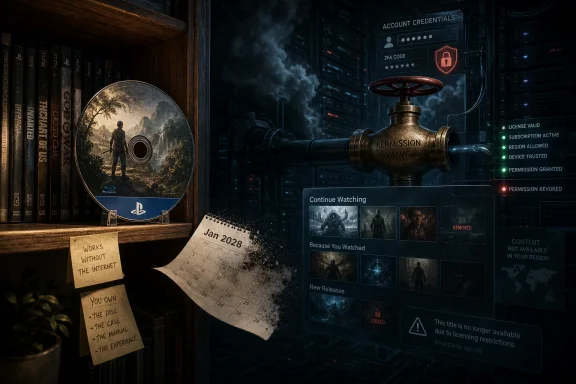 Kojima Turns a Format Change Into an Ownership Argument
The most important thing about Kojima’s intervention is that he did not treat Sony’s decision as nostalgia bait. Speaking at the Il Cinema in Piazza film festival in Italy, according to widely circulated translations amplified by Genki_JPN and reposted by Kojima himself, the Metal Gear and Death Stranding creator framed the issue as a structural change in who controls access to culture.That distinction matters. A disc is not magic, and modern game discs often require patches, authentication, or downloads to become the best version of themselves. But a disc still gives the owner something digital storefronts generally do not: a transferable object, a resale path, a backup of at least some executable content, and a practical obstacle between the platform holder and total revocation.
Kojima’s “turn the tap” metaphor is blunt because it is accurate. Streaming services normalize the idea that a remote server is the real library and the user merely has permission to open the valve. That model is convenient, but it is also politically, commercially, and legally fragile in ways that physical media is not.
Sony’s announcement supplied the calendar. Kojima supplied the diagnosis.
Sony Is Not Killing Discs Because Nobody Likes Them
Sony’s stated rationale is straightforward: consumer preference has moved decisively toward digital media. That is true enough as a market observation. Digital distribution is faster, cleaner, more profitable, easier to patch, easier to discount algorithmically, and far less dependent on manufacturing, shipping, retail shelf space, or secondhand circulation.But “preference” is doing a lot of work here. Consumers often prefer digital because the industry has spent years making digital the default path of least resistance. Consoles ship with giant storefront tiles, subscription libraries, preloads, cloud saves, and seasonal sales; physical releases arrive late, incomplete, or as codes in boxes; retailers shrink their game aisles; publishers learn that a disc sold once may compete with a digital copy sold forever.
The move is therefore not simply a response to demand. It is also an act of market design. Platform holders have taught players to live inside closed digital storefronts, then cited that behavior as proof that the old escape hatches can be sealed.
That does not make Sony irrational. It makes Sony a platform company behaving like a platform company. The uncomfortable part is that the PlayStation brand was built for three decades on the emotional and economic appeal of boxed games, and Sony is now telling its most loyal customers that the next era will be governed by account credentials rather than shelves.
The Disc Was Always More Than a Delivery Mechanism
For many players, the disc debate gets flattened into sentimentality. Collectors like boxes. Older players like shelves. Preservationists like archives. None of that is wrong, but it undersells the harder consumer issue.Physical games created a secondary market that limited platform power. If a publisher kept a launch price too high, used copies offered pressure. If a player finished a game, resale helped fund the next one. If a storefront delisted a title, discs could keep circulating long after business logic had moved on.
Digital-only console ecosystems remove most of that pressure. A PlayStation game bought through the PlayStation Store is not meaningfully yours in the way a disc is yours. You cannot resell it, lend it with the same freedom, preserve it independently, or move it outside the account and hardware rules that Sony sets.
PC gaming made peace with digital distribution because the PC is not one store. Steam dominates, but it coexists with Epic, GOG, itch.io, publisher launchers, direct downloads, modding communities, emulation scenes, and DRM-free installers. Console digital distribution is different because the platform holder is the gate, the shop, the payment rail, the license manager, and often the hardware authenticator.
That is why Kojima’s warning hits harder in the console context. A digital-only PlayStation is not simply a PlayStation without discs. It is a PlayStation in which every new game purchase becomes a relationship with Sony’s servers.
The Movie Deletions Made the Future Feel Less Hypothetical
The timing could hardly be worse for anyone trying to reassure customers that digital ownership is close enough to ownership. Sony recently notified affected PlayStation users in the United Kingdom that hundreds of StudioCanal movies and TV shows previously purchased through PlayStation would become inaccessible in September 2026 after licensing arrangements changed, according to reporting from TechRadar, TechSpot, and Tom’s Hardware.This is precisely the failure mode Kojima described. The customer paid. The interface used purchase language. The library displayed the content. Then a rights deal changed somewhere above the user’s head, and access became conditional in the most literal possible sense.
Defenders of digital licensing will point out that movies and games are not identical products. They are right. A downloaded game may remain installed, while a streamed or licensed video library can be more directly vulnerable to content removal. But that distinction is comforting only until the game requires account authentication, server checks, multiplayer infrastructure, cloud streaming, DLC entitlement validation, or a patch that is no longer available.
The deeper lesson is not that every digital purchase disappears tomorrow. It is that the user rarely controls the conditions that make the purchase usable. That was once a fringe preservationist complaint. Sony’s own media library controversy made it a mainstream consumer story.
Xbox’s Rumored Bridge Still Leads to the Same Shore
Microsoft is watching the same market pressures and reaching many of the same conclusions, even if its public posture is more careful. Reports around the next-generation Xbox strategy, including talk of “Project Helix” hardware and a “Positron” disc-to-digital conversion program, suggest that Microsoft may try to soften the transition by allowing physical discs to become permanent digital licenses tied to a Microsoft account.If such a program materializes, it would be smarter optics than simply cutting the cord. It would acknowledge that players have existing libraries and that a sudden break with physical media would look like confiscation by design. It would also fit Microsoft’s larger ambition to make Xbox less a box under the television than an account, a cloud service, a Windows-adjacent gaming layer, and a Game Pass funnel.
But the bridge still leads to the same shore. Converting a disc to a license may preserve access in the short term, yet it also transforms a transferable object into a permission record. Once that happens, the consumer is back inside the account economy: recoverable, manageable, convenient, and ultimately governed by terms of service.
That is not nothing. For families with scratched discs, shrinking retail shelves, and multiple devices, account-based access can be genuinely better. The problem is that “better” and “owned” are diverging concepts.
Preservation Is Becoming a Policy Problem, Not a Hobbyist Complaint
The games industry has long relied on fans, archivists, modders, and pirates to preserve what the market abandons. That arrangement was always hypocritical, but it worked well enough when physical media, offline executables, and relatively open hardware gave preservationists something to work with. A digital-only console generation narrows that margin.The preservation issue is not merely whether someone can play a famous blockbuster in 2045. It is whether cultural history remains accessible outside the business interests of the companies that originally sold it. Games are software, performance, art, industrial design, licensed music, networking code, and community memory all at once. They are also unusually vulnerable to vanishing when servers shut down or storefront rights expire.
Kojima understands this because his own work sits at the intersection of cinema and software. A film collector can still buy Blu-rays, import discs, preserve editions, and compare cuts. A game collector increasingly buys a container for a license, a launcher, or a partial install awaiting a patch server.
The irony is that the industry has never been more culturally confident. Games dominate entertainment revenue, command major actors, inspire prestige television, and fill museums. Yet the commercial infrastructure beneath them is drifting toward impermanence.
Convenience Has Been Winning Because It Really Is Convenient
None of this means players are fools for buying digital games. The convenience case is overwhelming. Downloads remove friction, preloads beat midnight retail lines, subscription catalogs encourage experimentation, and cloud saves make hardware replacement less traumatic.For many users, digital libraries are also more accessible. Rural players may not live near a stocked game retailer. Disabled users may prefer not to swap discs. Parents may prefer not to manage fragile media. People who move frequently may not want a wall of boxes following them from apartment to apartment.
That is why the debate should not become a morality play between enlightened collectors and lazy digital consumers. The industry did not win the transition by trickery alone. It won because digital solved real problems.
The question is whether solving those problems required surrendering every competing form of ownership. So far, the console industry’s answer seems to be yes.
The Price of Control Will Show Up After the Disc Is Gone
The economic impact will not arrive all at once. Sony will keep running sales. Publishers will still discount older titles. Subscription services will still offer value for players who sample widely. The first years of a disc-less PlayStation era may feel normal, even boring.The harder effects accumulate later. Without physical competition, launch prices face less downward pressure from used copies. Without lending and resale, players have fewer ways to extract residual value from finished games. Without retail inventory, delisted games become harder to obtain legally. Without discs, preservation depends more heavily on platform goodwill.
Platform holders may argue that digital storefront competition still exists between consoles, PCs, and cloud services. That is true at the macro level, but it does little for the player already locked into a specific console library. Once your friends, trophies, saves, purchases, and subscriptions live in one ecosystem, switching is not a clean market choice. It is a migration cost.
This is where Kojima’s warning becomes less philosophical and more practical. The danger is not simply that a company might someday “turn off the tap.” The danger is that users will have so few alternatives left when it does.
Windows Users Have Seen This Movie Before
WindowsForum readers do not need a console war lens to understand the stakes. PC users have spent decades living through the tradeoffs of activation servers, DRM, product subscriptions, cloud sync, storefront lock-in, and software that works only as long as a vendor keeps the backend alive.The Windows ecosystem is messy, but that mess has benefits. Old installers survive. Offline software remains usable. Competing stores exist. Enterprises can image machines, archive packages, control update rings, and demand lifecycle documentation. Even Microsoft, for all its cloud ambitions, still operates in a world where Windows applications can exist beyond one consumer storefront.
Consoles have fewer such escape valves. That is part of their appeal: predictable hardware, controlled compatibility, simplified purchasing, and lower maintenance. But the same control that makes consoles elegant also makes digital-only ownership brittle.
The lesson from Windows is not that physical media must live forever. It is that users need exit ramps. They need offline installers, archival rights, account recovery guarantees, license portability, and clear end-of-life rules before the old media disappears.
The Real Fight Is Over the Meaning of “Buy”
Regulators have begun paying more attention to digital purchase language, and they should. The word “buy” carries expectations that digital licenses often do not meet. If a customer cannot resell, transfer, independently back up, or rely on long-term access, the transaction is not equivalent to buying a physical object.Companies prefer ambiguity because ambiguity sells. “Buy now” sounds better than “license until rights, servers, policies, or account status change.” Consumers understand rentals and subscriptions when they are labeled honestly. What creates anger is the ritual of ownership without the rights of ownership.
Sony’s StudioCanal removals are a case study in that tension. The company can point to licensing terms. Users can point to the purchase button. Both can be technically correct, but only one side loses the movie.
Games will intensify the conflict because they are more expensive, more interactive, and more tied to identity than most digital films. A $70 or $80 game that disappears, breaks, or becomes inaccessible after a server decision is not just a customer service issue. It is a challenge to the industry’s moral vocabulary.
Kojima’s Warning Lands Because He Is Not Anti-Digital
Kojima is not a reactionary outsider shouting at modernity. His recent career depends on cutting-edge engines, platform deals, global digital distribution, and cinematic technologies that would have seemed impossible in the cartridge era. He is also working in a world where cloud infrastructure, subscriptions, and cross-media production are increasingly normal.That makes his discomfort more interesting. He is not saying digital distribution has no value. He is saying that a culture built entirely on remote permission can lose access to itself.
There is a difference between embracing digital tools and accepting digital dispossession. A healthy market could support downloads, streaming, subscriptions, physical editions, archival programs, and DRM-free preservation channels. The industry is instead drifting toward a monoculture in which convenience is used to retire every less-controllable alternative.
That is why his comments have traveled beyond the usual collector circles. Kojima gave mainstream language to a fear many players already had but struggled to frame: the fear that their libraries are becoming interfaces rather than possessions.
The 2028 Deadline Turns a Debate Into a Countdown
Sony’s January 2028 date changes the emotional temperature of the conversation. Before the announcement, the death of physical console games could be discussed as a trend. Now it is a scheduled event for new PlayStation releases.There will be exceptions and edge cases. Existing games may still see reorders. Collector editions may survive in altered forms. Retail boxes may contain codes. Limited-print companies may pivot to art books, soundtrack bundles, or hardware-adjacent memorabilia. But the mainstream function of the PlayStation disc is being wound down.
That countdown will shape buying behavior. Collectors will rush certain releases. Preservationists will prioritize patches and disc builds. Retailers will adjust inventory. Publishers will study whether backlash changes sales. Microsoft and Nintendo will watch closely to see whether Sony pays a price or simply normalizes the next industry step.
The most likely outcome is not a consumer revolt that reverses the decision. It is a grudging adaptation mixed with sharper distrust. Players will keep buying games because players want games. The industry should not mistake that for consent.
A Disc-Less PlayStation Makes the Fine Print the Product
The practical advice now is less romantic than “buy discs forever” and more demanding than “accept the future.” Players need to think about where their libraries live, what happens when accounts are compromised, whether games work offline, whether DLC is preserved, and whether a purchase depends on rights that can expire.Administrators and technically minded users should recognize the pattern from enterprise software. The asset is no longer merely the file; it is the entitlement. The risk is no longer merely physical loss; it is identity, licensing, authentication, vendor continuity, and policy drift.
That shift makes transparency essential. Console makers should publish stronger commitments around purchased game availability, server shutdown notice periods, offline play requirements, and refund or replacement rights when content is withdrawn. If the industry wants the economic benefits of digital-only distribution, it should accept obligations that match the power it gains.
Right now, the bargain is lopsided. Consumers get convenience. Platform holders get control. Kojima’s warning is that control, once centralized, tends to be used.
The Shelf Is Going Away, but the Rights Fight Is Just Starting
The concrete lessons from Sony’s announcement and Kojima’s response are not hard to see. They are uncomfortable because they point in the opposite direction from where the console business wants to go.- Sony’s January 2028 cutoff makes digital-only PlayStation releases a scheduled reality rather than a distant possibility.
- Kojima’s criticism is less about plastic discs than about the loss of durable user control over purchased culture.
- The removal of hundreds of purchased StudioCanal titles from PlayStation libraries shows why licensing language matters to ordinary consumers.
- Microsoft’s rumored disc-to-digital ideas may soften the transition, but they would still convert physical ownership into account-based entitlement.
- PC gaming’s digital shift is not a perfect comparison because open storefront competition, DRM-free options, and modding communities give users more escape routes.
- The next consumer protection battle will center on whether digital “buy” buttons must come with stronger rights, clearer warnings, and enforceable access guarantees.
References
- Primary source: Windows Central
Published: 2026-07-05T14:52:08.780375
Loading…
www.windowscentral.com - Related coverage: tomshardware.com
Sony officially kills the PlayStation disc, ending physical game production in 2028 — shutting down the PlayStation Store on the PlayStation 3 and PS Vita systems | Tom's Hardware
This announcement essentially sounds the death knell for physical media in cutting-edge gaming.www.tomshardware.com - Related coverage: gamesradar.com
PlayStation is ending physical disc production for new games in 2028 as Sony says "general preference for digital media significantly outpaces physical discs" | GamesRadar+
"This is a natural direction" for the companywww.gamesradar.com - Related coverage: tomsguide.com
PlayStation is officially killing physical discs — here's when they disappear and what that means for you | Tom's Guide
Sony is officially ending physical disc versions of brand-new games starting in January 2028. Here's why the company has decided to make this decision.www.tomsguide.com - Related coverage: gematsu.com
Sony Interactive Entertainment to end physical game disc production in January 2028 - Gematsu
Sony Interactive Entertainment will end physical game disc production for all new games releasing on PlayStation consoles starting January 2028…www.gematsu.com - Related coverage: dotesports.com
PlayStation physical discs ending for new games in January 2028
Sony will stop producing physical discs for new PlayStation games from January 2028, with future releases sold digitally through PlayStation Store and retailers.dotesports.com
- Related coverage: shattered.io
Loading…
shattered.io - Related coverage: techradar.com
'This should be illegal': Sony is deleting over 500 purchased movies from PlayStation Store accounts — and it's the ultimate warning to buy 4K Blu-rays instead | TechRadar
'Play has no limits,' Sony says, as it stops people playing TV shows and movies they paid to ownwww.techradar.com - Related coverage: hardwarezone.com.sg
PlayStation ends physical disc production | HardwareZone Singapore
Sony will stop producing physical discs for new PlayStation games from January 2028, signalling a major shift to digital distribution. www.hardwarezone.com.sg
- Related coverage: engadget.com
Sony Will Stop Making Disc-Based PlayStation Games Starting 2028
RIP to physical PlayStation discs.www.engadget.com - Related coverage: newgamenetwork.com
Loading…
www.newgamenetwork.com - Related coverage: as.com
Loading…
as.com