

The Konica Minolta bizhub line is entering 2026 with an unusual combination of maturity and urgency. In North America, where print fleets are being asked to do less “printing” and more secure workflow orchestration, the series has become less about copiers as appliances and more about multifunction infrastructure that sits inside identity, cloud, and compliance strategies. That shift matters because the business case for office MFPs is no longer only pages per minute; it is uptime, integration, security, and service economics. Konica Minolta is clearly positioning bizhub as one of the few legacy hardware platforms that can still claim strategic relevance in a hybrid-work era.
Konica Minolta’s office-printing business did not arrive at this point by accident. The company’s broader digital workplace segment still includes development, manufacture, and sales of MFPs and related consumables, plus IT services and solutions, and its 2025 integrated report says the office unit remained solid even amid restructuring and portfolio changes. That is important context because the bizhub family is not a side project; it is one of the company’s foundational revenue engines and a major part of its continuing workplace strategy.
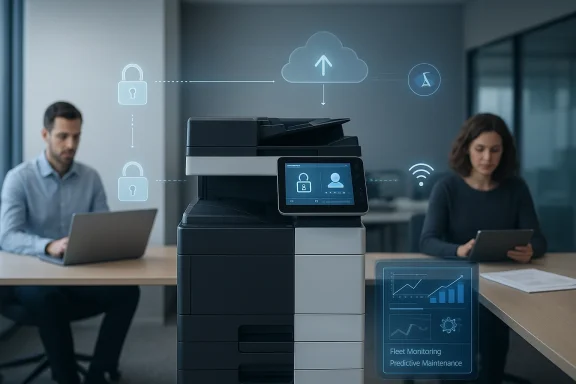
The latest bizhub generation has been shaped by a market that increasingly values secure access and cloud workflow support over basic hardware novelty. Konica Minolta’s North American product pages highlight secure network integration, data encryption, advanced user authentication, mobile connectivity, and cloud-enabled print, fax, and scan features. Those are not add-ons in the modern enterprise printer market; they are the core features buyers use to justify keeping a physical print fleet at all.
That evolution also reflects a broader industry reality. Printing has not disappeared, but it has become less visible and more distributed across departments, remote offices, and compliance-heavy workflows. Healthcare, education, legal, logistics, and municipal customers still need reliable document capture, secure routing, and auditability, even as they shift more data into cloud systems and collaboration suites. Konica Minolta’s bizhub positioning fits that demand very closely, especially for organizations trying to avoid the cost and complexity of a full paperless transformation before they are ready.
A second historical layer is the company’s own reorganization. Konica Minolta has been working through structural reforms and business transfers, while trying to protect profitability in its Digital Workplace business. Its public financial updates note strong demand in the office and professional print businesses and emphasize productivity improvements, cost reductions, and DX promotion in the office unit. In other words, bizhub is being asked to do two jobs at once: remain a dependable hardware franchise and support a more service-heavy, more profitable, more software-linked operating model.
The timing matters because 2026 is also a year of accelerated platform change in adjacent ecosystems. Microsoft’s printing stack is moving toward IPP inbox drivers and Print Support Apps, while older vendor driver models are being phased out or constrained. That trend increases the value of devices that can work well in standards-based environments and offer modern security and management layers. For MFP vendors, the message is blunt: compatibility is becoming a product feature, not a background assumption.
What makes this positioning work is that printing remains an unavoidable part of many regulated or document-centric operations. The device can be the gateway between paper, email, cloud storage, and enterprise content systems. If the machine can authenticate users, encrypt data, and route scans into the right repositories, it becomes part of the organization’s information architecture rather than just its output stack. That is the core business argument behind bizhub in 2026.
The North American market also rewards vendors that can support mixed environments. A large enterprise might run Microsoft 365, SharePoint, Azure-based identity, and third-party cloud archives while still relying on locally installed fax or scan workflows in specific departments. The best MFPs are the ones that do not force a rip-and-replace decision. Konica Minolta’s cloud-enabled and modular messaging is designed around exactly that reality.
This matters because MFPs sit in awkward places in the corporate attack surface. They have network access, stored credentials, scanned documents, and often weak operational oversight compared with laptops or servers. In a world where attackers target identity, email, cloud sync, and edge devices, the printer is no longer a harmless peripheral. Bizhub’s security posture is a response to that uncomfortable truth.
This is where workflow security becomes more important than device security alone. A scan that goes to the wrong SharePoint site, the wrong inbox, or the wrong cloud folder can cause a compliance event without any malware being involved. Businesses increasingly need MFPs that are aware of the business process, not just the page.
For sectors like healthcare and finance, this is not theoretical. A compliant device needs to support retention rules, audit trails, controlled access, and defensible disposal. That is one reason why a printer refresh project now often involves security, privacy, and compliance teams in addition to procurement and facilities.
This matters because cloud migration did not eliminate paper. It changed where documents live after they leave the scanner glass. A machine that can reliably send files into SharePoint-style repositories or other cloud systems reduces manual handling, lowers error rates, and shortens the time between capture and action. In workflow terms, that is where a lot of value sits now.
The ability to bypass local servers is also attractive because it simplifies IT management. Fewer on-premises dependencies can mean lower maintenance overhead and less hardware sprawl. That said, the cloud only helps if configuration, permissions, and retention policies are designed properly. Bad cloud workflows are still bad workflows.
That is also where the competitive battle has shifted. It is no longer enough to print quickly or scan at high resolution. Vendors now have to prove that their devices can live inside Microsoft-centric, Google-centric, and mixed enterprise environments without becoming an integration headache. Bizhub’s pitch is that it can.
This is where the platform language around bizhub becomes more credible. A copier is a copier; an automated document workflow device begins to look like infrastructure. For large offices, that distinction can materially affect labor use, error rates, and turnaround times.
Konica Minolta’s messaging around integrated software and cloud workflow support fits that environment. It positions bizhub as something that lowers friction across the life of the document, not just at the moment of printing. That is a much stronger value proposition in 2026 than the old “faster copier” story.
The reason is simple: device failures are expensive not because of the repair itself, but because they interrupt workflows. In a distributed office environment, a single failed MFP can disrupt a department’s scanning, forms processing, or customer service operations. Predictive maintenance reduces that risk and improves fleet economics.
The environmental angle also overlaps with governance. North American buyers are increasingly under pressure to justify purchases not just on performance, but on lifecycle efficiency and reporting. Office hardware that lowers electricity use or supports paperless workflows can contribute to ESG goals, even if modestly.
It also matters because energy prices, facility costs, and logistics volatility can show up directly in MFP service economics. A machine that consumes less power and requires less intervention is easier to defend to both finance and facilities stakeholders. In that sense, sustainability and cost discipline are aligned, not competing objectives.
Bizhub’s value proposition is strongest in this hybrid zone. The line does not need to promise the end of paper. It needs to promise that paper will be handled cleanly, quickly, and compliantly when it still appears.
The company’s own financial and corporate disclosures reinforce why this matters. Konica Minolta has been working through restructuring, selling non-core businesses, and focusing on profitability in its digital workplace lines. That means bizhub is being asked to do more strategic heavy lifting than ever before.
Bizhub benefits from this model because businesses often prefer local accountability for fleet uptime. When a device is mission-critical, the strength of the service partner can matter more than a marginal feature advantage. That is a structural advantage for established print vendors.
Konica Minolta’s bizhub strategy reflects that shift. The company is not just selling boxes; it is selling a managed document environment. In a mature market, that is the only durable way to defend margin.
That combination matters because printer businesses are often judged too simplistically. They are not high-growth glamour assets, but they can generate recurring service, supplies, and support revenue if managed well. In an era when many investors are chasing software multiples, a disciplined office-hardware and services business can still offer resilience.
At the same time, this is not a risk-free story. Global restructuring, shifts in print volume, and pressure from competitors all make execution critical. If the company can keep the bizhub franchise relevant while tightening profitability, the market may reward it as a steady industrial-technology name rather than a declining legacy vendor.
The reason is not that these sectors resist digitization. It is that they digitize in stages, and each stage needs a reliable bridge. Bizhub’s combination of scanning, cloud routing, security, and managed service support makes it well suited to those transition environments.
SMBs also tend to favor devices that “just work” with their existing cloud tools. Bizhub’s support for cloud-enabled workflows and mobile connectivity helps position it as a business appliance that can keep pace with a modern, lean office stack.
Bizhub’s value in this setting is that it can be deployed as part of a broader managed print architecture. The more it behaves like a policy-enforced endpoint, the easier it is for central IT to justify deployment.
It is also worth watching how Konica Minolta balances hardware with services. The future of office equipment is not purely about selling more devices; it is about attaching software, analytics, support, and workflow value to each installation. If bizhub can help the company do that, the product line will matter not just to office managers, but to investors tracking the health of the company’s transformation.
Source: AD HOC NEWS Konica Minolta bizhub Series: Leading Multifunction Printers for North American Businesses in 2026
 Background
Konica Minolta’s office-printing business did not arrive at this point by accident. The company’s broader digital workplace segment still includes development, manufacture, and sales of MFPs and related consumables, plus IT services and solutions, and its 2025 integrated report says the office unit remained solid even amid restructuring and portfolio changes. That is important context because the bizhub family is not a side project; it is one of the company’s foundational revenue engines and a major part of its continuing workplace strategy.The latest bizhub generation has been shaped by a market that increasingly values secure access and cloud workflow support over basic hardware novelty. Konica Minolta’s North American product pages highlight secure network integration, data encryption, advanced user authentication, mobile connectivity, and cloud-enabled print, fax, and scan features. Those are not add-ons in the modern enterprise printer market; they are the core features buyers use to justify keeping a physical print fleet at all.
That evolution also reflects a broader industry reality. Printing has not disappeared, but it has become less visible and more distributed across departments, remote offices, and compliance-heavy workflows. Healthcare, education, legal, logistics, and municipal customers still need reliable document capture, secure routing, and auditability, even as they shift more data into cloud systems and collaboration suites. Konica Minolta’s bizhub positioning fits that demand very closely, especially for organizations trying to avoid the cost and complexity of a full paperless transformation before they are ready.
A second historical layer is the company’s own reorganization. Konica Minolta has been working through structural reforms and business transfers, while trying to protect profitability in its Digital Workplace business. Its public financial updates note strong demand in the office and professional print businesses and emphasize productivity improvements, cost reductions, and DX promotion in the office unit. In other words, bizhub is being asked to do two jobs at once: remain a dependable hardware franchise and support a more service-heavy, more profitable, more software-linked operating model.
The timing matters because 2026 is also a year of accelerated platform change in adjacent ecosystems. Microsoft’s printing stack is moving toward IPP inbox drivers and Print Support Apps, while older vendor driver models are being phased out or constrained. That trend increases the value of devices that can work well in standards-based environments and offer modern security and management layers. For MFP vendors, the message is blunt: compatibility is becoming a product feature, not a background assumption.
The 2026 Bizhub Positioning
The bizhub series is now being marketed less as a standalone printer line and more as an office productivity platform. Konica Minolta’s North American materials emphasize the i-Series, modular options, cloud workflows, and easier task completion through a redesigned interface. That framing is deliberate because buyers increasingly compare MFPs the way they compare SaaS tools: by workflow fit, control, and administration burden rather than by raw device specs.What makes this positioning work is that printing remains an unavoidable part of many regulated or document-centric operations. The device can be the gateway between paper, email, cloud storage, and enterprise content systems. If the machine can authenticate users, encrypt data, and route scans into the right repositories, it becomes part of the organization’s information architecture rather than just its output stack. That is the core business argument behind bizhub in 2026.
Why the category still matters
There is still a misconception that multifunction printers are legacy equipment on a slow decline. In practice, the category has become more specialized, not less important. Hybrid work has actually increased the need for distributed capture, localized printing, and secure scan-to-cloud processes.- Offices still need document capture.
- Compliance-heavy sectors still need controlled print paths.
- Remote teams still need reliable scan handoff.
- Branch locations still need managed device fleets.
- IT departments still want fewer moving parts.
The North American market also rewards vendors that can support mixed environments. A large enterprise might run Microsoft 365, SharePoint, Azure-based identity, and third-party cloud archives while still relying on locally installed fax or scan workflows in specific departments. The best MFPs are the ones that do not force a rip-and-replace decision. Konica Minolta’s cloud-enabled and modular messaging is designed around exactly that reality.
Security as a Product Feature
Security is now the headline requirement in enterprise printing, not a background checkbox. Konica Minolta’s product and security pages emphasize encryption, user authentication, and self-encrypting data protection on bizhub i-Series devices. The company also references malware-detection partnerships and future SIEM support in its security materials, which signals a much broader ambition than the traditional “secure print release” story.This matters because MFPs sit in awkward places in the corporate attack surface. They have network access, stored credentials, scanned documents, and often weak operational oversight compared with laptops or servers. In a world where attackers target identity, email, cloud sync, and edge devices, the printer is no longer a harmless peripheral. Bizhub’s security posture is a response to that uncomfortable truth.
Identity and access control
The strongest enterprise MFPs now treat identity as the first control point. Konica Minolta’s i-Series messaging highlights advanced authentication and secure network integration, which are crucial in environments where a scan job may contain payroll, legal, or medical information. If the device cannot verify who is using it, the rest of the workflow becomes much harder to trust.This is where workflow security becomes more important than device security alone. A scan that goes to the wrong SharePoint site, the wrong inbox, or the wrong cloud folder can cause a compliance event without any malware being involved. Businesses increasingly need MFPs that are aware of the business process, not just the page.
Encryption and stored-data risk
Konica Minolta’s security documentation notes that bizhub i-Series machines protect data by self-encryption. That is a practical response to a basic operational concern: copied, cached, or scanned data often lingers on the device longer than users realize. The longer a machine keeps sensitive information locally, the more it behaves like a storage endpoint rather than a simple printer.For sectors like healthcare and finance, this is not theoretical. A compliant device needs to support retention rules, audit trails, controlled access, and defensible disposal. That is one reason why a printer refresh project now often involves security, privacy, and compliance teams in addition to procurement and facilities.
Cloud and Hybrid Workflows
The strongest 2026 argument for bizhub is not printing, but scanning and routing. Konica Minolta says its i-Series devices support cloud-enabled print, fax, and scan capabilities that integrate with popular cloud storage services. The company’s U.S. product materials also stress cloud workflow automation and mobile support. That combination helps explain why the category remains relevant in hybrid workplaces: the device bridges paper and software with minimal friction.This matters because cloud migration did not eliminate paper. It changed where documents live after they leave the scanner glass. A machine that can reliably send files into SharePoint-style repositories or other cloud systems reduces manual handling, lowers error rates, and shortens the time between capture and action. In workflow terms, that is where a lot of value sits now.
The real value of scan-to-cloud
For many organizations, scan-to-cloud is the feature that changes a printer from a cost center into a workflow node. A claims office, law firm, or clinic may still print, but the more critical task is converting paper into searchable, shareable, policy-governed digital records. Bizhub’s cloud connectivity pitch is built around that transition.The ability to bypass local servers is also attractive because it simplifies IT management. Fewer on-premises dependencies can mean lower maintenance overhead and less hardware sprawl. That said, the cloud only helps if configuration, permissions, and retention policies are designed properly. Bad cloud workflows are still bad workflows.
Interoperability is the real test
Konica Minolta’s ecosystem strategy matters because no enterprise buys an MFP in a vacuum. The real test is whether the device works with the rest of the stack: identity providers, cloud storage, document management, and endpoint policies. The company’s emphasis on cloud integration, modular add-ons, and third-party software compatibility shows that it understands this reality.That is also where the competitive battle has shifted. It is no longer enough to print quickly or scan at high resolution. Vendors now have to prove that their devices can live inside Microsoft-centric, Google-centric, and mixed enterprise environments without becoming an integration headache. Bizhub’s pitch is that it can.
Automation and Efficiency
One of the biggest changes in the MFP market is the move from manual operation to workflow automation. Konica Minolta has long marketed tools such as its app ecosystem and workflow solutions as productivity accelerators, and the current generation continues that logic. The goal is not simply to move paper faster, but to reduce repetitive human actions around filing, naming, routing, approval, and archiving.This is where the platform language around bizhub becomes more credible. A copier is a copier; an automated document workflow device begins to look like infrastructure. For large offices, that distinction can materially affect labor use, error rates, and turnaround times.
Why automation matters more than speed
Older printer marketing obsessed over pages per minute, first-page-out time, and tray capacity. Those still matter, but they are no longer the buying decision. In modern offices, the bottleneck is usually not raw print throughput; it is the time spent dealing with documents after they have been captured or produced.- Users want one-touch workflows.
- IT wants standardized device behavior.
- Compliance teams want predictable routing.
- Finance teams want lower service overhead.
- Managers want fewer helpdesk tickets.
Konica Minolta’s messaging around integrated software and cloud workflow support fits that environment. It positions bizhub as something that lowers friction across the life of the document, not just at the moment of printing. That is a much stronger value proposition in 2026 than the old “faster copier” story.
Predictive maintenance and fleet intelligence
IoT-style monitoring is another major advantage. The more a printer can report status, usage, and supply needs, the more it helps IT avoid downtime and optimize fleet placement. Konica Minolta has emphasized real-time monitoring and predictive maintenance concepts in its broader product narrative, and those capabilities are increasingly expected in managed print services.The reason is simple: device failures are expensive not because of the repair itself, but because they interrupt workflows. In a distributed office environment, a single failed MFP can disrupt a department’s scanning, forms processing, or customer service operations. Predictive maintenance reduces that risk and improves fleet economics.
Sustainability and Operating Cost
Sustainability is no longer a marketing decoration in enterprise hardware. Konica Minolta’s product pages highlight reduced energy consumption and certifications such as EPEAT on predecessor devices, while the company’s broader corporate materials continue to stress environmental impact and productivity improvements. In procurement terms, this matters because energy use, supplies, and service logistics all feed into total cost of ownership.The environmental angle also overlaps with governance. North American buyers are increasingly under pressure to justify purchases not just on performance, but on lifecycle efficiency and reporting. Office hardware that lowers electricity use or supports paperless workflows can contribute to ESG goals, even if modestly.
Energy efficiency is economic efficiency
The best sustainability argument for bizhub is not philosophical; it is practical. Lower power draw, shorter warm-up times, and fewer service interruptions all reduce operating cost. That matters for distributed businesses that maintain dozens or hundreds of devices across branches and departments.It also matters because energy prices, facility costs, and logistics volatility can show up directly in MFP service economics. A machine that consumes less power and requires less intervention is easier to defend to both finance and facilities stakeholders. In that sense, sustainability and cost discipline are aligned, not competing objectives.
Paperless is not zero paper
A crucial nuance is that digitization has not eliminated paper usage. It has changed the mix. Many organizations now print fewer long documents but scan more records, forms, and signed paperwork into systems of record. That means hardware designed for efficient capture can still be indispensable, even in a so-called paperless office.Bizhub’s value proposition is strongest in this hybrid zone. The line does not need to promise the end of paper. It needs to promise that paper will be handled cleanly, quickly, and compliantly when it still appears.
Market Competition
Konica Minolta competes in a crowded field that includes Canon, Ricoh, Xerox, HP, and others, but the most useful way to think about the market is not as a copier race. It is a contest over who can own the workflow layer between paper, identity, and cloud systems. Konica Minolta’s answer is a combination of device reliability, security, cloud integration, and dealer-supported service.The company’s own financial and corporate disclosures reinforce why this matters. Konica Minolta has been working through restructuring, selling non-core businesses, and focusing on profitability in its digital workplace lines. That means bizhub is being asked to do more strategic heavy lifting than ever before.
Why dealers still matter
Unlike consumer electronics, enterprise MFPs depend heavily on channel partners and service networks. North American market share is shaped as much by dealer relationships, managed print agreements, and field support as by the device spec sheet. That is why a brand with strong distribution can remain highly relevant even without dominating mindshare.Bizhub benefits from this model because businesses often prefer local accountability for fleet uptime. When a device is mission-critical, the strength of the service partner can matter more than a marginal feature advantage. That is a structural advantage for established print vendors.
The cloud competition is not just hardware
The competitive set now includes software ecosystems and subscription services. A printer that ties into cloud storage, identity, analytics, and document workflows can be compared with software platforms more than with old-fashioned office machines. That changes procurement behavior and makes the market harder to win with hardware alone.Konica Minolta’s bizhub strategy reflects that shift. The company is not just selling boxes; it is selling a managed document environment. In a mature market, that is the only durable way to defend margin.
Investor Angle
From an investor standpoint, bizhub is interesting because it combines defensiveness with gradual transformation. Konica Minolta’s 2025 materials point to a business that is still generating meaningful office-unit stability even while undergoing structural reforms and divestitures. The company also states that its office unit is performing solidly and that it is aiming to improve profitability through cost reductions and DX promotion.That combination matters because printer businesses are often judged too simplistically. They are not high-growth glamour assets, but they can generate recurring service, supplies, and support revenue if managed well. In an era when many investors are chasing software multiples, a disciplined office-hardware and services business can still offer resilience.
Why the stock story is nuanced
Konica Minolta’s equity case is not built on explosive expansion. It is built on the possibility of stable cash flow, operational improvement, and a better mix between hardware and digital workplace services. That makes it attractive to value-oriented investors who prefer predictable demand over speculative platform bets.At the same time, this is not a risk-free story. Global restructuring, shifts in print volume, and pressure from competitors all make execution critical. If the company can keep the bizhub franchise relevant while tightening profitability, the market may reward it as a steady industrial-technology name rather than a declining legacy vendor.
What investors should actually watch
A smart investor lens would focus less on logo visibility and more on recurring indicators of operational quality. The key questions are whether services grow faster than hardware, whether margins improve, and whether the company keeps the office line relevant to cloud and security buyers. Those are the levers that determine whether bizhub is a durable franchise or just a surviving one.- Service revenue stability
- Digital workplace mix
- Margin improvement
- Channel strength in North America
- Competitive pricing discipline
- Product refresh cadence
- Security and cloud attach rates
North American Enterprise Use Cases
North American businesses remain the most important practical audience for bizhub’s 2026 story. The line is especially relevant where organizations are distributed geographically, face compliance obligations, and still rely on physical documents for operational continuity. That includes healthcare, legal, government-adjacent operations, education, logistics, and regional corporate offices.The reason is not that these sectors resist digitization. It is that they digitize in stages, and each stage needs a reliable bridge. Bizhub’s combination of scanning, cloud routing, security, and managed service support makes it well suited to those transition environments.
Small and midsize business needs
For SMBs, the appeal is straightforward: reliability, manageable cost, and reduced IT burden. A compact or midrange bizhub can support print, scan, and basic workflow tasks without requiring a dedicated print engineer. That is valuable in businesses where IT teams are small and every additional support call matters.SMBs also tend to favor devices that “just work” with their existing cloud tools. Bizhub’s support for cloud-enabled workflows and mobile connectivity helps position it as a business appliance that can keep pace with a modern, lean office stack.
Enterprise deployment needs
For larger organizations, the issue is fleet governance. Enterprises want standardized security settings, predictable behavior, and integration with identity and document systems. They also want devices that can be monitored and serviced across multiple sites without constant manual intervention.Bizhub’s value in this setting is that it can be deployed as part of a broader managed print architecture. The more it behaves like a policy-enforced endpoint, the easier it is for central IT to justify deployment.
Industry-specific relevance
Certain verticals get extra value from MFPs because their workflows remain document intensive. Legal teams need controlled scanning and archiving. Healthcare teams need sensitive document handling. Education and public-sector environments still juggle forms, records, and restricted access. Bizhub’s security and workflow branding makes sense precisely in these places.- Healthcare document capture
- Legal records handling
- Education administration
- Government office workflows
- Retail branch document processing
- Logistics and supply-chain paperwork
- Financial services compliance flows
Strengths and Opportunities
Konica Minolta’s bizhub strategy has several clear strengths in 2026. It sits at the intersection of legacy reliability and modern workflow demands, which is exactly where the enterprise print market has been drifting. The opportunities are real because many organizations still need to connect paper intake to cloud systems without rearchitecting everything at once.- Security-first positioning gives bizhub relevance in compliance-heavy environments.
- Cloud workflow support keeps the line useful in hybrid workplaces.
- Predictive maintenance can reduce downtime and service cost.
- Managed print services create recurring revenue potential.
- Energy-efficient design aligns with procurement and ESG goals.
- Strong dealer ecosystems help support enterprise deployments.
- Platform integration improves the device’s strategic value beyond printing.
Risks and Concerns
The main risks around bizhub are less about the product itself than about the market it serves. Print volumes continue to face long-term secular pressure, and customers are increasingly asking whether they need more devices or fewer. Even a strong MFP platform can be squeezed if organizations move faster than expected toward digital-native workflows.- Declining print volumes can pressure long-term hardware demand.
- Vendor competition remains intense across hardware and software.
- Cloud complexity can create configuration and governance issues.
- Security expectations rise faster than device refresh cycles.
- Supply chain shocks can still affect manufacturing and delivery.
- Margin pressure may increase if price competition intensifies.
- Legacy perceptions can make it harder to win new buyers.
Looking Ahead
The most important thing to watch is whether Konica Minolta can keep bizhub aligned with the direction of enterprise IT rather than the habits of old print procurement. The market is moving toward standards-based printing, stronger identity enforcement, tighter cloud integration, and simpler administration. If the company continues to map bizhub onto those trends, the line can remain relevant far beyond the usual refresh-cycle conversation.It is also worth watching how Konica Minolta balances hardware with services. The future of office equipment is not purely about selling more devices; it is about attaching software, analytics, support, and workflow value to each installation. If bizhub can help the company do that, the product line will matter not just to office managers, but to investors tracking the health of the company’s transformation.
- Cloud integration depth across Microsoft and other enterprise platforms
- Security feature expansion in future firmware updates
- Dealer and service execution in North America
- Fleet-management analytics and predictive maintenance adoption
- Mix shift toward services and recurring revenue
- Response to Windows printing ecosystem changes
- Demand trends in regulated verticals
Source: AD HOC NEWS Konica Minolta bizhub Series: Leading Multifunction Printers for North American Businesses in 2026

