

KPN and Schwarz Digits announced on May 28, 2026, that they will launch a STACKIT-based sovereign cloud for the Dutch market, with infrastructure hosted in KPN data centers in the Netherlands and availability expected around mid-2027. The move is less a routine cloud reseller deal than a signal that Europe’s cloud sovereignty debate is turning into procurement, contracts, and physical infrastructure. For Dutch public agencies, banks, hospitals, energy firms, and regulated enterprises, the pitch is simple: keep cloud convenience, reduce exposure to non-European jurisdiction, and avoid building a national hyperscaler from scratch. The harder question is whether that promise can survive contact with the scale, software ecosystems, and operational maturity of AWS, Microsoft Azure, and Google Cloud.
For years, “sovereign cloud” has been one of those phrases that could mean almost anything: a data residency feature, a compliance badge, a local support team, a dedicated region, or a political aspiration dressed up as product marketing. The KPN-STACKIT partnership is notable because it is trying to make the phrase concrete. The Dutch version will not merely be a German or Austrian cloud sold into the Netherlands; it is expected to run physically from KPN data centers on Dutch soil.
That matters because cloud sovereignty has moved beyond the old question of where data sits. The more serious argument is about who operates the platform, whose law can reach the operator, which subcontractors are in the chain, and how easily a customer can move away if the provider’s ownership or legal position changes. The Dutch government’s earlier framework agreement with STACKIT made that direction explicit by emphasizing European Economic Area storage, audit rights, and exit provisions if control moves outside the EEA.
KPN’s role gives the project a local anchor. It is not trying to become a full-stack hyperscaler overnight; instead, it is supplying connectivity, Dutch operational presence, and enterprise IT services around a cloud platform built by Schwarz Digits. That is a pragmatic admission that the cloud battle is no longer won merely by owning buildings and fiber. It is won by combining infrastructure, platform services, compliance posture, and enough developer usability that customers do not feel they are being punished for choosing sovereignty.
The result is a very Dutch kind of compromise: not a purely national cloud, not a generic global hyperscaler region, and not a symbolic procurement exercise. It is a European public cloud, run by a European provider, localized through one of the Netherlands’ most important telecom and IT companies. In the current political climate, that may be exactly the middle ground buyers are looking for.
STACKIT grew out of that need. Schwarz Digits has been positioning it as a European alternative to the American hyperscalers, with regions in Germany and Austria and a portfolio of infrastructure and platform services. The company’s sovereign pitch is not simply that its data centers are in Europe, but that its operating model, legal structure, and compliance framework are European by design.
That claim has become more valuable as governments and regulated industries reassess concentration risk. The issue is not that AWS, Azure, or Google Cloud are suddenly unusable. In fact, they remain the benchmark for reliability, breadth, and developer experience. The issue is that the same attributes that made them indispensable also made them systemic dependencies. When a handful of foreign providers underpin public services, financial infrastructure, healthcare systems, and defense-adjacent workloads, procurement stops being a technical choice and becomes a policy decision.
Schwarz Digits appears to understand that opening a cloud region is not enough. The company has been collecting institutional wins, from Dutch government framework access to financial-sector interest, and the KPN deal adds domestic credibility in a market where trust and local integration matter. For a provider trying to graduate from “interesting European alternative” to “credible regulated-sector platform,” those reference points are the product.
That positioning fits the company’s broader cloud strategy. KPN already offers public, private, and hybrid cloud services, and it has aligned itself with open-cloud initiatives that stress interoperability and avoidance of lock-in. By adding STACKIT to the portfolio, KPN can tell enterprise customers that sovereignty does not require abandoning public cloud patterns. It can instead be layered into a familiar managed-services relationship.
This is the part of the market where telecom operators have a second chance. Many European telcos missed the first hyperscaler wave because they treated cloud primarily as hosting with automation. The hyperscalers understood it as a software platform, an ecosystem, and a consumption model. KPN is not repeating the old error by pretending it can out-AWS AWS on global service breadth. It is instead using its domestic trust position to make a European platform more usable for Dutch buyers.
The exclusivity element also matters. The Dutch sovereign STACKIT offering will be sold through KPN and its partners, which gives KPN a more defensible role than a generic reseller margin. It becomes the route into the platform for many Dutch customers, especially those that already depend on KPN for network services, security, workplace IT, or managed infrastructure.
That does not make the bet risk-free. If STACKIT fails to mature quickly enough, KPN will be the local face of customer frustration. If the platform succeeds, KPN gets to occupy a strategically valuable layer between Dutch regulated demand and European cloud supply. That is a good place to be, but it is also a visible one.
Sovereign cloud providers cannot win merely by saying “your data stays in Europe.” That is important, but it is not a substitute for functioning developer platforms. Engineers and administrators choose cloud services because they reduce operational burden. If a sovereign platform restores too much of that burden, it becomes a compliance tax rather than a strategic alternative.
This is where the Dutch deal becomes interesting. KPN and STACKIT are emphasizing open-source foundations, portability, and interoperability. Those words are doing a lot of work. They are meant to reassure buyers that sovereignty will not become a new form of captivity, where customers escape one vendor ecosystem only to become trapped inside a smaller one with fewer escape routes.
But portability in cloud is always messier than the slide deck suggests. Virtual machines are portable in theory. Kubernetes workloads can be portable if teams have disciplined architecture. Object storage can be portable until applications depend on provider-specific eventing, IAM behavior, lifecycle features, or analytics integrations. Databases are portable until operational semantics, extensions, performance tuning, and managed-service behaviors become part of the application itself.
The open-source basis helps, but it does not abolish these frictions. It merely gives customers a better starting position. The practical success of the KPN-STACKIT cloud will depend on whether it can make portability real enough for procurement officers and architects, without forcing developers to give up the managed conveniences that made cloud attractive in the first place.
Still, certification should not be mistaken for competitive parity. Compliance can get a provider into the room; it cannot by itself keep workloads on the platform. Once a customer starts building, the questions become more operational: How good is identity integration? How mature are backup and recovery workflows? How fast are incidents communicated? How predictable is performance? How complete are the APIs? How strong is the ecosystem of integrators, security tools, and independent software vendors?
That distinction is especially important for WindowsForum readers because many enterprise environments are hybrid by nature. They are not clean-room Kubernetes estates populated entirely by cloud-native microservices. They are Active Directory, Entra ID, Windows Server, SQL Server, Linux, VMware remnants, SaaS dependencies, backup appliances, endpoint management, compliance reporting, and years of departmental applications with unclear owners.
A sovereign cloud that wants these workloads must meet administrators where they are. It needs credible migration tooling, documentation, support, identity federation, logging, monitoring, and operational runbooks. It also needs an answer for Microsoft-heavy environments that will not stop being Microsoft-heavy just because the infrastructure provider changes.
The best version of the KPN-STACKIT proposition is not “leave the hyperscalers tomorrow.” It is “give regulated workloads a credible European landing zone, reduce concentration risk, and create leverage in future architecture decisions.” That is less dramatic than a cloud independence revolution, but far more plausible.
The details are politically significant. Data storage within the EEA, audit rights, and termination provisions tied to ownership outside the EEA are not generic procurement boilerplate. They reflect a sharpened awareness that jurisdiction and control matter as much as encryption and region selection. They also show how governments are trying to turn sovereignty from a slogan into contract language.
De Nederlandsche Bank’s reported move toward STACKIT adds another layer. Central banks and financial regulators are especially sensitive to systemic technology dependencies. Their interest sends a message to the wider financial sector: cloud concentration is now a board-level and regulator-level topic, not a back-office infrastructure concern.
That does not mean every Dutch agency or bank will rush to migrate production systems. Public-sector IT moves slowly for good reasons, and regulated migrations are expensive, politically visible, and operationally risky. But framework agreements shape the market before workloads move. They tell vendors where demand is going, tell systems integrators where to build skills, and tell CIOs that sovereign alternatives are becoming acceptable procurement choices.
The KPN deal localizes that signal. A Dutch customer can now look at STACKIT not as a remote European provider, but as a platform being embedded in national infrastructure through KPN. That makes the sovereign cloud story easier to buy, easier to explain internally, and easier to align with existing supplier relationships.
This is a risk-management argument, and it has become stronger as geopolitics has become less predictable. The legal and political concerns around extraterritorial access, government demands, sanctions exposure, and supply-chain dependency may not affect every workload equally. But regulated sectors do not need every risk to materialize before they diversify. They only need enough uncertainty to justify alternatives.
That is why the KPN-STACKIT move is best understood as a diversification play. It gives Dutch organizations another option for workloads where European control, local hosting, and contractual sovereignty are worth paying for. It may also give customers negotiating leverage with incumbent hyperscalers, which remain deeply entrenched and technically formidable.
There is also a cultural shift underway. For much of the cloud era, European buyers often treated American hyperscale capability as an unavoidable fact of life. The new mood is less fatalistic. Governments, banks, and infrastructure operators are asking whether convenience has been purchased at the cost of strategic dependency. They may still choose AWS, Azure, or Google for many workloads, but the decision is becoming more deliberate.
That deliberation is healthy. Cloud monocultures are brittle, even when the providers are excellent. A more plural market gives customers room to classify workloads by risk, legal exposure, performance needs, and innovation requirements. Sovereign cloud will not replace hyperscale cloud across the board. It does not have to.
The most likely early candidates are not the most exotic workloads. Expect backup targets, development environments, government applications with clear data-boundary requirements, sector-specific platforms, and new systems designed with portability in mind. The hardest migrations will be deeply integrated workloads that depend on hyperscaler-native services, complex identity models, proprietary data platforms, or specialized AI and analytics stacks.
KPN’s partner ecosystem will be critical. Enterprise cloud adoption is not just a matter of provisioning an account. Customers need architecture guidance, migration factories, security baselines, landing zones, cost controls, incident processes, and training. If KPN can mobilize Dutch integrators and managed-service partners around STACKIT, the platform has a better chance of becoming usable at scale.
The other challenge is perception. A sovereign cloud cannot feel like a second-class cloud reserved for workloads that are too sensitive for the good tools. If developers experience it as slower, thinner, or harder to automate, they will work around it. If administrators experience it as poorly documented or operationally immature, they will resist it. Sovereignty must be built into a product people actually want to use.
This is where European providers have historically struggled. They often won trust on governance and lost momentum on product velocity. STACKIT’s advantage is that it has a large corporate parent with real infrastructure needs and capital behind it. Its disadvantage is that the hyperscalers have spent nearly two decades compounding platform depth, customer familiarity, and ecosystem gravity.
These are not glamorous questions, but they are the questions that decide whether a platform survives beyond the pilot stage. A government department may like the sovereignty story, but its administrators still need to meet recovery-time objectives. A bank may want European control, but its security team still needs forensic visibility. A hospital may welcome local hosting, but it cannot accept fragile integrations around patient systems.
Microsoft’s footprint complicates the picture. Many Dutch organizations are already anchored in Microsoft 365, Entra ID, Defender, Intune, Windows Server, and SQL Server. Even if infrastructure workloads move to STACKIT, the broader Microsoft estate may remain. That means the KPN-STACKIT offering must coexist with Microsoft rather than pretend customers are starting from scratch.
This coexistence could become a strength if handled well. A sovereign cloud that supports hybrid Microsoft environments, open-source workloads, and regulated data placement could occupy a valuable middle ground. It would not need to displace Azure entirely. It would need to be good enough for the workloads where legal control and provider diversity outweigh the convenience of staying inside one hyperscale ecosystem.
For sysadmins, that likely means more architectural segmentation, not less. Sensitive systems may land in sovereign cloud. Commodity SaaS may remain with global providers. Legacy systems may stay private for years. The future is not one cloud; it is a more intentional mess.
That is particularly true in AI. The cloud market in 2026 is increasingly shaped by access to GPUs, managed AI services, data platforms, model tooling, and developer frameworks. Sovereign providers must decide how much of that stack they can build, how much they can partner for, and where they will deliberately avoid chasing hyperscale breadth. If they cannot answer the AI question, they risk being seen as infrastructure providers in a market moving up the stack.
But the hyperscalers also face a trust ceiling in some European policy circles. Local regions do not fully resolve concerns about ownership, jurisdiction, operational control, and political dependency. Sovereign-cloud variants offered by U.S. firms may satisfy some customers, especially when paired with local partners and strong contractual controls. For others, the provider’s ultimate legal home remains the issue.
That creates room for STACKIT, OVHcloud, Scaleway, Proximus-linked offerings, and other European providers. The opportunity is not to become AWS overnight. It is to capture the workloads and customers for whom sovereignty is a primary requirement, then expand from that beachhead into broader enterprise use.
The danger is overclaiming. If European providers promise hyperscaler equivalence too early, they will disappoint buyers. If they define the market too narrowly as compliance hosting, they will remain niche. The winning path is harder: build a cloud that is sovereign enough for regulators, useful enough for developers, and operationally dependable enough for administrators.
That specificity is useful. It means customers can ask concrete questions about service availability, region architecture, failover, encryption, key management, audit evidence, subcontractors, support models, data transfer, and exit procedures. The sovereign-cloud debate becomes less philosophical when procurement teams can attach it to a service catalog and a migration plan.
It also exposes the project to scrutiny. A Dutch region will need clear documentation on what is actually Dutch, what remains European but not Dutch, and what dependencies exist outside the region. Customers will want to know whether metadata, support access, telemetry, backups, and administrative control planes follow the same sovereignty story as customer data. Serious buyers will not accept “hosted locally” as the end of the conversation.
That scrutiny should be welcomed. Sovereign cloud will only mature if customers pressure providers to define terms precisely. The industry has seen too many labels stretched beyond usefulness: private cloud, hybrid cloud, zero trust, AI-ready, secure by design. Sovereign cloud risks the same fate unless buyers demand proof.
KPN and STACKIT have a chance to make the term more concrete in the Netherlands. The opportunity is substantial, but the margin for vagueness is shrinking.
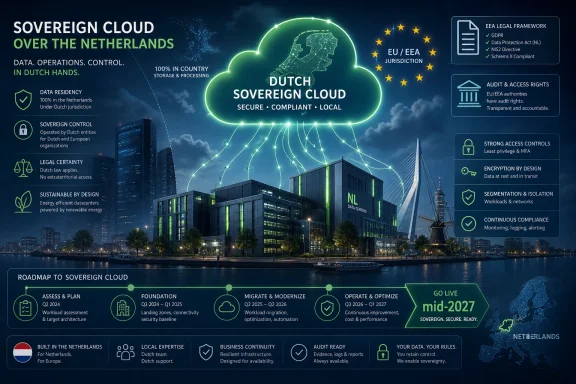 Europe’s Cloud Sovereignty Push Finally Gets a Dutch Address
For years, “sovereign cloud” has been one of those phrases that could mean almost anything: a data residency feature, a compliance badge, a local support team, a dedicated region, or a political aspiration dressed up as product marketing. The KPN-STACKIT partnership is notable because it is trying to make the phrase concrete. The Dutch version will not merely be a German or Austrian cloud sold into the Netherlands; it is expected to run physically from KPN data centers on Dutch soil.That matters because cloud sovereignty has moved beyond the old question of where data sits. The more serious argument is about who operates the platform, whose law can reach the operator, which subcontractors are in the chain, and how easily a customer can move away if the provider’s ownership or legal position changes. The Dutch government’s earlier framework agreement with STACKIT made that direction explicit by emphasizing European Economic Area storage, audit rights, and exit provisions if control moves outside the EEA.
KPN’s role gives the project a local anchor. It is not trying to become a full-stack hyperscaler overnight; instead, it is supplying connectivity, Dutch operational presence, and enterprise IT services around a cloud platform built by Schwarz Digits. That is a pragmatic admission that the cloud battle is no longer won merely by owning buildings and fiber. It is won by combining infrastructure, platform services, compliance posture, and enough developer usability that customers do not feel they are being punished for choosing sovereignty.
The result is a very Dutch kind of compromise: not a purely national cloud, not a generic global hyperscaler region, and not a symbolic procurement exercise. It is a European public cloud, run by a European provider, localized through one of the Netherlands’ most important telecom and IT companies. In the current political climate, that may be exactly the middle ground buyers are looking for.
Schwarz Digits Turns Retail Plumbing Into Strategic Infrastructure
The unlikely protagonist in this story is Schwarz Gruppe, better known to consumers as the owner of Lidl and Kaufland. That retail background can make STACKIT sound like a curiosity, but it is also part of why the company has a plausible claim to cloud seriousness. Large retailers run brutally complex logistics, payments, workforce, analytics, and supply-chain systems at continental scale. If you operate that internally for hundreds of thousands of employees and thousands of stores, you are already in the infrastructure business whether or not the market calls you a cloud company.STACKIT grew out of that need. Schwarz Digits has been positioning it as a European alternative to the American hyperscalers, with regions in Germany and Austria and a portfolio of infrastructure and platform services. The company’s sovereign pitch is not simply that its data centers are in Europe, but that its operating model, legal structure, and compliance framework are European by design.
That claim has become more valuable as governments and regulated industries reassess concentration risk. The issue is not that AWS, Azure, or Google Cloud are suddenly unusable. In fact, they remain the benchmark for reliability, breadth, and developer experience. The issue is that the same attributes that made them indispensable also made them systemic dependencies. When a handful of foreign providers underpin public services, financial infrastructure, healthcare systems, and defense-adjacent workloads, procurement stops being a technical choice and becomes a policy decision.
Schwarz Digits appears to understand that opening a cloud region is not enough. The company has been collecting institutional wins, from Dutch government framework access to financial-sector interest, and the KPN deal adds domestic credibility in a market where trust and local integration matter. For a provider trying to graduate from “interesting European alternative” to “credible regulated-sector platform,” those reference points are the product.
KPN Is Selling Control, Not Just Capacity
KPN’s value in the arrangement is not raw compute. If the Dutch market wanted only cheaper virtual machines, it already has plenty of options. KPN is selling a form of operational assurance: connectivity, managed services, Dutch customer proximity, and a sense that critical workloads are not disappearing into an opaque multinational cloud stack.That positioning fits the company’s broader cloud strategy. KPN already offers public, private, and hybrid cloud services, and it has aligned itself with open-cloud initiatives that stress interoperability and avoidance of lock-in. By adding STACKIT to the portfolio, KPN can tell enterprise customers that sovereignty does not require abandoning public cloud patterns. It can instead be layered into a familiar managed-services relationship.
This is the part of the market where telecom operators have a second chance. Many European telcos missed the first hyperscaler wave because they treated cloud primarily as hosting with automation. The hyperscalers understood it as a software platform, an ecosystem, and a consumption model. KPN is not repeating the old error by pretending it can out-AWS AWS on global service breadth. It is instead using its domestic trust position to make a European platform more usable for Dutch buyers.
The exclusivity element also matters. The Dutch sovereign STACKIT offering will be sold through KPN and its partners, which gives KPN a more defensible role than a generic reseller margin. It becomes the route into the platform for many Dutch customers, especially those that already depend on KPN for network services, security, workplace IT, or managed infrastructure.
That does not make the bet risk-free. If STACKIT fails to mature quickly enough, KPN will be the local face of customer frustration. If the platform succeeds, KPN gets to occupy a strategically valuable layer between Dutch regulated demand and European cloud supply. That is a good place to be, but it is also a visible one.
The Real Competitor Is Not AWS, Azure, or Google Alone
It is tempting to frame the KPN-STACKIT launch as Europe versus the American hyperscalers. That is partly true, but incomplete. The real competitor is the entire operating model that AWS, Azure, and Google Cloud have normalized: instant access to hundreds of services, deep partner ecosystems, global regions, mature DevOps tooling, managed databases, AI platforms, security integrations, observability pipelines, and procurement machinery that large organizations already know how to navigate.Sovereign cloud providers cannot win merely by saying “your data stays in Europe.” That is important, but it is not a substitute for functioning developer platforms. Engineers and administrators choose cloud services because they reduce operational burden. If a sovereign platform restores too much of that burden, it becomes a compliance tax rather than a strategic alternative.
This is where the Dutch deal becomes interesting. KPN and STACKIT are emphasizing open-source foundations, portability, and interoperability. Those words are doing a lot of work. They are meant to reassure buyers that sovereignty will not become a new form of captivity, where customers escape one vendor ecosystem only to become trapped inside a smaller one with fewer escape routes.
But portability in cloud is always messier than the slide deck suggests. Virtual machines are portable in theory. Kubernetes workloads can be portable if teams have disciplined architecture. Object storage can be portable until applications depend on provider-specific eventing, IAM behavior, lifecycle features, or analytics integrations. Databases are portable until operational semantics, extensions, performance tuning, and managed-service behaviors become part of the application itself.
The open-source basis helps, but it does not abolish these frictions. It merely gives customers a better starting position. The practical success of the KPN-STACKIT cloud will depend on whether it can make portability real enough for procurement officers and architects, without forcing developers to give up the managed conveniences that made cloud attractive in the first place.
Compliance Is the Door Opener, Not the Whole Product
STACKIT’s assessment against the BSI C5 criteria gives the platform a useful credential in regulated markets. C5, developed by Germany’s Federal Office for Information Security, is designed to establish baseline expectations for cloud security, transparency, auditability, and operational controls. For public-sector buyers, financial institutions, healthcare organizations, and other risk-heavy sectors, that kind of assurance matters.Still, certification should not be mistaken for competitive parity. Compliance can get a provider into the room; it cannot by itself keep workloads on the platform. Once a customer starts building, the questions become more operational: How good is identity integration? How mature are backup and recovery workflows? How fast are incidents communicated? How predictable is performance? How complete are the APIs? How strong is the ecosystem of integrators, security tools, and independent software vendors?
That distinction is especially important for WindowsForum readers because many enterprise environments are hybrid by nature. They are not clean-room Kubernetes estates populated entirely by cloud-native microservices. They are Active Directory, Entra ID, Windows Server, SQL Server, Linux, VMware remnants, SaaS dependencies, backup appliances, endpoint management, compliance reporting, and years of departmental applications with unclear owners.
A sovereign cloud that wants these workloads must meet administrators where they are. It needs credible migration tooling, documentation, support, identity federation, logging, monitoring, and operational runbooks. It also needs an answer for Microsoft-heavy environments that will not stop being Microsoft-heavy just because the infrastructure provider changes.
The best version of the KPN-STACKIT proposition is not “leave the hyperscalers tomorrow.” It is “give regulated workloads a credible European landing zone, reduce concentration risk, and create leverage in future architecture decisions.” That is less dramatic than a cloud independence revolution, but far more plausible.
The Dutch Government Deal Changed the Signal
The timing of this partnership is not accidental. Earlier in 2026, the Dutch government signed a framework agreement with STACKIT, giving central government organizations a path to buy European cloud services under predefined conditions. That agreement framed cloud choice as part of Dutch digital autonomy, not simply IT modernization.The details are politically significant. Data storage within the EEA, audit rights, and termination provisions tied to ownership outside the EEA are not generic procurement boilerplate. They reflect a sharpened awareness that jurisdiction and control matter as much as encryption and region selection. They also show how governments are trying to turn sovereignty from a slogan into contract language.
De Nederlandsche Bank’s reported move toward STACKIT adds another layer. Central banks and financial regulators are especially sensitive to systemic technology dependencies. Their interest sends a message to the wider financial sector: cloud concentration is now a board-level and regulator-level topic, not a back-office infrastructure concern.
That does not mean every Dutch agency or bank will rush to migrate production systems. Public-sector IT moves slowly for good reasons, and regulated migrations are expensive, politically visible, and operationally risky. But framework agreements shape the market before workloads move. They tell vendors where demand is going, tell systems integrators where to build skills, and tell CIOs that sovereign alternatives are becoming acceptable procurement choices.
The KPN deal localizes that signal. A Dutch customer can now look at STACKIT not as a remote European provider, but as a platform being embedded in national infrastructure through KPN. That makes the sovereign cloud story easier to buy, easier to explain internally, and easier to align with existing supplier relationships.
Sovereignty Has Become a Risk-Management Strategy
The sovereignty debate is often caricatured as anti-American protectionism. That misses the more practical argument. For many European organizations, the goal is not to purge U.S. technology from the estate. It is to avoid a world in which every critical workload, collaboration platform, identity layer, AI service, and backup path is dependent on the same handful of foreign-controlled vendors.This is a risk-management argument, and it has become stronger as geopolitics has become less predictable. The legal and political concerns around extraterritorial access, government demands, sanctions exposure, and supply-chain dependency may not affect every workload equally. But regulated sectors do not need every risk to materialize before they diversify. They only need enough uncertainty to justify alternatives.
That is why the KPN-STACKIT move is best understood as a diversification play. It gives Dutch organizations another option for workloads where European control, local hosting, and contractual sovereignty are worth paying for. It may also give customers negotiating leverage with incumbent hyperscalers, which remain deeply entrenched and technically formidable.
There is also a cultural shift underway. For much of the cloud era, European buyers often treated American hyperscale capability as an unavoidable fact of life. The new mood is less fatalistic. Governments, banks, and infrastructure operators are asking whether convenience has been purchased at the cost of strategic dependency. They may still choose AWS, Azure, or Google for many workloads, but the decision is becoming more deliberate.
That deliberation is healthy. Cloud monocultures are brittle, even when the providers are excellent. A more plural market gives customers room to classify workloads by risk, legal exposure, performance needs, and innovation requirements. Sovereign cloud will not replace hyperscale cloud across the board. It does not have to.
The Hard Part Starts Before the Dutch Region Opens
The Dutch STACKIT region is expected around mid-2027, which gives KPN and Schwarz Digits roughly a year to turn a strategic announcement into a credible enterprise platform. That period matters. Customers will use it to test the German and Austrian regions, evaluate service catalogs, assess compliance evidence, run proofs of concept, and decide which workloads might move when Dutch capacity arrives.The most likely early candidates are not the most exotic workloads. Expect backup targets, development environments, government applications with clear data-boundary requirements, sector-specific platforms, and new systems designed with portability in mind. The hardest migrations will be deeply integrated workloads that depend on hyperscaler-native services, complex identity models, proprietary data platforms, or specialized AI and analytics stacks.
KPN’s partner ecosystem will be critical. Enterprise cloud adoption is not just a matter of provisioning an account. Customers need architecture guidance, migration factories, security baselines, landing zones, cost controls, incident processes, and training. If KPN can mobilize Dutch integrators and managed-service partners around STACKIT, the platform has a better chance of becoming usable at scale.
The other challenge is perception. A sovereign cloud cannot feel like a second-class cloud reserved for workloads that are too sensitive for the good tools. If developers experience it as slower, thinner, or harder to automate, they will work around it. If administrators experience it as poorly documented or operationally immature, they will resist it. Sovereignty must be built into a product people actually want to use.
This is where European providers have historically struggled. They often won trust on governance and lost momentum on product velocity. STACKIT’s advantage is that it has a large corporate parent with real infrastructure needs and capital behind it. Its disadvantage is that the hyperscalers have spent nearly two decades compounding platform depth, customer familiarity, and ecosystem gravity.
Windows Shops Will Judge the Platform by the Boring Stuff
For Windows-heavy organizations, the sovereign-cloud conversation eventually becomes very practical. Can existing identity models be integrated cleanly? Can Windows Server workloads be patched, backed up, monitored, and restored without awkward workarounds? Can SQL Server licensing and operations be handled sensibly? Can endpoint, SIEM, and vulnerability-management tools plug in without a science project?These are not glamorous questions, but they are the questions that decide whether a platform survives beyond the pilot stage. A government department may like the sovereignty story, but its administrators still need to meet recovery-time objectives. A bank may want European control, but its security team still needs forensic visibility. A hospital may welcome local hosting, but it cannot accept fragile integrations around patient systems.
Microsoft’s footprint complicates the picture. Many Dutch organizations are already anchored in Microsoft 365, Entra ID, Defender, Intune, Windows Server, and SQL Server. Even if infrastructure workloads move to STACKIT, the broader Microsoft estate may remain. That means the KPN-STACKIT offering must coexist with Microsoft rather than pretend customers are starting from scratch.
This coexistence could become a strength if handled well. A sovereign cloud that supports hybrid Microsoft environments, open-source workloads, and regulated data placement could occupy a valuable middle ground. It would not need to displace Azure entirely. It would need to be good enough for the workloads where legal control and provider diversity outweigh the convenience of staying inside one hyperscale ecosystem.
For sysadmins, that likely means more architectural segmentation, not less. Sensitive systems may land in sovereign cloud. Commodity SaaS may remain with global providers. Legacy systems may stay private for years. The future is not one cloud; it is a more intentional mess.
The Hyperscalers Are Still the Benchmark
None of this should be read as a declaration that the hyperscalers are finished in Europe. They are not. AWS, Microsoft, and Google have enormous European businesses, deep compliance teams, local regions, sovereign-cloud programs of their own, and relationships with virtually every major enterprise and public institution. They also have an innovation engine that smaller providers struggle to match.That is particularly true in AI. The cloud market in 2026 is increasingly shaped by access to GPUs, managed AI services, data platforms, model tooling, and developer frameworks. Sovereign providers must decide how much of that stack they can build, how much they can partner for, and where they will deliberately avoid chasing hyperscale breadth. If they cannot answer the AI question, they risk being seen as infrastructure providers in a market moving up the stack.
But the hyperscalers also face a trust ceiling in some European policy circles. Local regions do not fully resolve concerns about ownership, jurisdiction, operational control, and political dependency. Sovereign-cloud variants offered by U.S. firms may satisfy some customers, especially when paired with local partners and strong contractual controls. For others, the provider’s ultimate legal home remains the issue.
That creates room for STACKIT, OVHcloud, Scaleway, Proximus-linked offerings, and other European providers. The opportunity is not to become AWS overnight. It is to capture the workloads and customers for whom sovereignty is a primary requirement, then expand from that beachhead into broader enterprise use.
The danger is overclaiming. If European providers promise hyperscaler equivalence too early, they will disappoint buyers. If they define the market too narrowly as compliance hosting, they will remain niche. The winning path is harder: build a cloud that is sovereign enough for regulators, useful enough for developers, and operationally dependable enough for administrators.
The Dutch Region Makes Sovereignty Measurable
The KPN-STACKIT announcement gives Dutch buyers a checklist rather than just a concept. The service is available now through existing STACKIT regions in Germany and Austria, while the Dutch region is expected in mid-2027. The model places STACKIT infrastructure inside KPN data centers in the Netherlands and sells it through KPN and its partners. It targets the sectors where cloud concentration, legal exposure, and operational resilience are already board-level concerns.That specificity is useful. It means customers can ask concrete questions about service availability, region architecture, failover, encryption, key management, audit evidence, subcontractors, support models, data transfer, and exit procedures. The sovereign-cloud debate becomes less philosophical when procurement teams can attach it to a service catalog and a migration plan.
It also exposes the project to scrutiny. A Dutch region will need clear documentation on what is actually Dutch, what remains European but not Dutch, and what dependencies exist outside the region. Customers will want to know whether metadata, support access, telemetry, backups, and administrative control planes follow the same sovereignty story as customer data. Serious buyers will not accept “hosted locally” as the end of the conversation.
That scrutiny should be welcomed. Sovereign cloud will only mature if customers pressure providers to define terms precisely. The industry has seen too many labels stretched beyond usefulness: private cloud, hybrid cloud, zero trust, AI-ready, secure by design. Sovereign cloud risks the same fate unless buyers demand proof.
KPN and STACKIT have a chance to make the term more concrete in the Netherlands. The opportunity is substantial, but the margin for vagueness is shrinking.
The Dutch Cloud Bet Comes Down to Five Practical Tests
The KPN-STACKIT partnership is strategically important because it turns European cloud sovereignty into a local Dutch product roadmap. The announcement is not the finish line; it is the start of a long credibility test that will be judged by architects, procurement officers, regulators, developers, and sysadmins.- The Dutch STACKIT region is expected around mid-2027, while customers can already use existing STACKIT regions in Germany and Austria.
- KPN will provide the Dutch market presence, connectivity, IT services, and partner route, while STACKIT supplies the sovereign cloud infrastructure.
- The strongest early demand is likely to come from government, finance, healthcare, energy, and other regulated sectors with explicit data-control requirements.
- BSI C5 and European data processing help open regulated doors, but customers will still judge the platform by reliability, tooling, support, and migration practicality.
- The offering is best understood as a diversification strategy rather than a wholesale replacement for AWS, Azure, or Google Cloud.
- The project’s credibility will depend on whether sovereignty is matched by usable services, clear contracts, and operational maturity.
References
- Primary source: Techzine Global
Published: 2026-05-28T07:40:22.166927
KPN launches sovereign cloud with STACKIT in the Netherlands
KPN and Schwarz Digits are jointly launching a European sovereign cloud solution for the Dutch market. Through STACKIT, Schwarz Digits’ cloud platform, www.techzine.eu
- Related coverage: stackit.com
GDPR-compliant cloud certificates - STACKIT
By meeting the latest data protection requirements in the cloud environment, we offer you fully comprehensive GDPR protection.stackit.com - Related coverage: rijksoverheid.nl
Rijksoverheid sluit deal met Europees cloudplatform STACKIT | Rijksoverheid.nl
De Rijksoverheid heeft een raamovereenkomst gesloten met het Europese cloudleverancier STACKIT. Hiermee kunnen Rijksorganisaties gebruikmaken van Europese clouddiensten onder vooraf vastgestelde, veilige en gunstige voorwaarden. De overeenkomst...www.rijksoverheid.nl - Related coverage: stackit.de
Cloud knowledge: All the technical terms relating to the STACKIT Cloud
Cloud knowledge easily accessible: Discover informative articles and understandable explanations about cloud computing and the STACKIT Cloud.www.stackit.de - Related coverage: nasdaq.com
Commvault Partners with STACKIT's Sovereign Cloud in Germany and Austria | Nasdaq
--Commvault, a leader in unified resilience at enterprise scale, today announced a partnership with STACKIT that is designed to support European customers' sovereign cloud requirements while delivering exceptional cyber resilience to enterprise organizations. This partnership allows...www.nasdaq.com - Related coverage: overons.kpn
The cloud - KPN
 www.overons.kpn
- Related coverage: bsi.bund.de
Cloud Computing Compliance Controls Catalogue (C5)
Criteria to assess the information security of cloud serviceswww.bsi.bund.de
