

Krones’ recent demonstration that digital twins driven by GPU-accelerated simulation, OpenUSD scene composition, and autonomous AI agents can collapse hours-long CFD cycles into operationally useful minutes marks a clear inflection point for beverage-line automation — but the headline “3–4 hours to under 5 minutes” hides important technical trade-offs and procurement caveats that every buyer must understand before betting production on an autonomous twin.
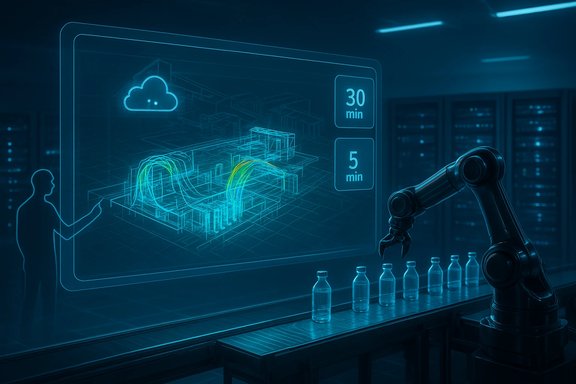
Krones, the German provider of bottling and packaging equipment, announced a multi‑vendor collaboration that pairs physics‑accurate simulation with agentic AI to run optimization loops on filling lines and transfer validated settings back to the real plant. The demonstration, developed together with Ansys (now part of Synopsys), CADFEM, Microsoft Azure, NVIDIA Omniverse/OpenUSD, and integrator SoftServe, was positioned as proof that digital twins can move from engineering artifacts to continuous operational tools. Two public narratives emerged: a vendor/press headline claiming a reduction from three-to-four hour CFD runs to under five minutes in the integrated stack, and an integrator case study that documents a reproducible field result of roughly 30 minutes per simulation cycle after a focused two‑month integration at Krones. Both are visible in the record; they describe different points on the fidelity‑vs‑latency spectrum and should not be conflated.
Krones’ work points the industry toward a plausible future where simulation, visualization, and AI converge to make continuous, physics‑informed optimization part of everyday operations — provided the community insists on the transparency and governance needed to make that future safe, auditable, and economically sustainable.
Source: All-About-Industries Krones Optimizes Simulation in Beverage Production
 Background
Krones, the German provider of bottling and packaging equipment, announced a multi‑vendor collaboration that pairs physics‑accurate simulation with agentic AI to run optimization loops on filling lines and transfer validated settings back to the real plant. The demonstration, developed together with Ansys (now part of Synopsys), CADFEM, Microsoft Azure, NVIDIA Omniverse/OpenUSD, and integrator SoftServe, was positioned as proof that digital twins can move from engineering artifacts to continuous operational tools. Two public narratives emerged: a vendor/press headline claiming a reduction from three-to-four hour CFD runs to under five minutes in the integrated stack, and an integrator case study that documents a reproducible field result of roughly 30 minutes per simulation cycle after a focused two‑month integration at Krones. Both are visible in the record; they describe different points on the fidelity‑vs‑latency spectrum and should not be conflated. Overview: what was announced and who did what
The announcement in brief
- Krones claims digital twins with agentic AI can autonomously run scenario sweeps, reason about results, and suggest or apply optimizations to filling-line controls in near real time.
- Partners in the effort include Ansys (for CFD), NVIDIA (Omniverse/OpenUSD and GPU acceleration), Microsoft Azure (cloud compute and orchestration), CADFEM (solver tuning), SoftServe (systems integration and productionization), and Synopsys (accelerated physics/orchestration where applicable).
Why the beverage industry is a high‑value target
Bottling and liquid‑handling processes combine sensitive multiphase fluid dynamics (free surfaces, splashing, turbulence) with high throughput and low tolerance for rejects. Even small improvements in valve timing, fill profiles, or conveyor alignment can reduce rejects, water use, and energy — so faster, validated simulations that can be tested against real‑time telemetry are materially valuable for CPG and beverage operators. This is the operational promise Krones and its partners frame in their public materials.Technical anatomy: the stack that made the demo possible
The demonstration is an ecosystem play rather than a single product. Understanding each layer clarifies where speedups come from and where risk lives.Ansys Fluent (CFD backbone)
Ansys Fluent supplies the high‑fidelity fluid solver. Recent Fluent releases include GPU‑accelerated solver paths and multi‑GPU scaling that can dramatically shorten compute‑bound parts of CFD runs for compatible physics models. Ansys’ integrations with Omniverse have been explicitly announced as part of this push to make CFD outputs easier to visualize and integrate into twins.Synopsys / “accelerated physics” orchestration
Synopsys described a framework demonstrated at Microsoft Ignite that layers accelerated physics and cloud orchestration on top of GPU‑native solvers to schedule multi‑GPU jobs, minimize orchestration overhead, and pipeline solver outputs into visualization and agent layers. This orchestration is a key performance lever beyond raw GPU throughput.NVIDIA Omniverse + OpenUSD (visualization and interoperability)
OpenUSD (Universal Scene Description) is used as the canonical scene format to combine CAD geometry, sensor telemetry, and CFD overlays into a single, shareable factory model. NVIDIA Omniverse provides the runtime for real‑time rendering and collaborative visualization so engineers, operators and AI agents can inspect volumetric flow fields and metrics in context. OpenUSD reduces friction between CAD/CAE, MES/PLC telemetry, and visualization.Microsoft Azure (cloud compute & Ansys Access)
Azure supplies elastic GPU infrastructure, orchestration primitives (AKS), identity & governance, and services such as Ansys Access on Azure which simplify deployment of Ansys environments in an enterprise tenancy. Cloud bursting and high‑memory GPU SKUs make the minute‑scale ambitions technically possible — at a cost.Integrators and domain expertise: CADFEM & SoftServe
CADFEM provided solver tuning and domain expertise for multiphase filling physics; SoftServe built the integration layer, scenario engine, dashboards, and the productionized pipeline used in the Krones pilot. The integrators’ work — mesh strategies, solver flags, data‑pipeline automation — is what converts a lab demo into a repeatable deployment. SoftServe’s case study documents the two‑month engagement and the fielded outcomes.The performance claim: under 5 minutes — lab bench vs. fielded reality
Two distinct figures appear in public materials:- A headline reduction from 3–4 hours to under 5 minutes, presented in Synopsys’ announcement and amplified in vendor press. This reads as a best‑case benchmark for highly tuned, optimized workflows.
- A ≈30‑minute fielded result documented in SoftServe’s Krones case study after a two‑month integration — a reproducible operational baseline that still represents a large improvement over hours‑long offline runs.
How those time reductions are actually achieved
The compression of wall‑clock simulation time is not magic — it’s engineering. The most important technical levers are:- GPU solver acceleration and multi‑GPU scaling (Ansys Fluent GPU paths). These accelerate core numerical kernels but do not equally accelerate all physics modules.
- Orchestration and job‑packing to eliminate container spin‑up, staging and idle times — this reduces non‑solver latency. Synopsys’ accelerated physics layer is positioned specifically to handle such orchestration.
- Mesh strategy and solver tuning (CADFEM) — coarsening where tolerable, adaptive time stepping, and solver preconditioning to improve convergence per wall‑clock second.
- Surrogate models / reduced‑order models (ROMs) or hybrid physics+ML approaches that emulate CFD results for specific parameter sweeps at much lower cost. These must be validated against full‑fidelity runs.
- Streaming visualization (OpenUSD/Omniverse) that avoids heavy postprocessing and lets operators consume results as they appear.
- Cloud scale (Azure) with high‑memory GPU SKUs (e.g., NVIDIA A100/H100 class or comparable accelerators) and fast NVMe storage to remove I/O bottlenecks. Sub‑5‑minute experiments often assume significant GPU count and fast interconnects.
What the numbers mean for operators: benefits and realistic gains
Even the conservative, integrator‑documented outcome (≈30 minutes per cycle) is operationally meaningful:- Faster troubleshooting and root‑cause analysis within a single shift rather than across days.
- Quicker recipe changes and product introductions (different bottle shapes, viscosities) with reduced production interruption.
- Reduced water and product waste by tuning valve timing and fill set points in silico before applying to the physical line.
- Better collaboration between engineering and operations via shared Omniverse scenes and dashboards — decreasing decision latency and human misunderstanding.
Risks, caveats, and governance — what every procurement and operations team must demand
The same features that enable autonomous optimization introduce operational and commercial risk if unmanaged.Fidelity vs. latency
- Reduced meshes, surrogate models, or relaxed convergence tolerances can produce fast answers that diverge from full‑fidelity physics. Require documented error bounds and validation procedures for any surrogate outputs used for control decisions.
Cloud economics
- Minute‑scale simulations at production cadence require expensive GPU resources. Model cloud hours per shift, cost per simulation cycle on your chosen Azure GPU SKUs, and TCO before committing. Vendors’ under 5 minutes claims rarely include economic analysis for sustained production use.
Security, IP and data governance
- Shipping machine geometry, recipes, and telemetry to cloud providers raises IP exposure. Insist on tenant isolation, end‑to‑end encryption, identity controls (Entra/Azure AD), and contractual IP protections.
Operational safety and automation governance
- Simulations may recommend actuator changes; never allow unsupervised actuation without rigorous safety interlocks, rollback rules, and human‑in‑the‑loop thresholds. Simulations should be advisory until proven in staged safety tests.
Procurement realism: auditable runbooks
- Vendors must provide an auditable runbook: exact mesh cell counts, solver flags, time steps, GPU SKU and counts, storage topology, surrogate model descriptions, and convergence/validation results. Without this, headline numbers are not contract‑grade.
Practical checklist: how to evaluate this capability in a pilot
- Define measurable KPIs: percent scrap reduction, throughput uplift, mean time to changeover, and target simulation cycle time.
- Scope a bounded pilot: one filling line, a constrained parameter sweep (e.g., 3 bottle geometries × 2 viscosities).
- Require the integrator’s runbook: mesh counts, solver flags, turbulence/multiphase models, GPU types and counts, storage topology, and orchestration scripts.
- Run side‑by‑side validations:
- Full‑fidelity Fluent on known HPC (CPU or multi‑GPU) baseline.
- Accelerated pipeline (Synopsys orchestration + Fluent GPU).
- Any surrogate/ML pipeline used for inference.
Compare wall‑clock times, numeric outputs and physical tests to quantify error bounds. - Produce an economic model: simulations per shift × cost per GPU hour × expected credits/discounts.
- Define governance: human sign‑off thresholds, automatic rollback rules, and who may authorize control changes.
- Contractual SLAs: require reproducible benchmark demonstrations and remediation clauses tied to fidelity and latency shortfalls.
Red flags and vendor claims to question directly
- “Under 5 minutes” without a runbook — ask for the lab recipe that produced that number (mesh, GPUs, solver flags, ROM usage).
- Lack of validation data comparing surrogate outputs to full‑fidelity runs and physical experiments.
- Absence of IP and encryption commitments for cloud processing.
- No documented safety interlocks or human‑in‑the‑loop policies for any automated recommendations that affect actuators.
Strategic implications and the near-term outlook
If reproducible, high‑quality, minute‑scale CFD becomes a standard operational capability, the manufacturing world will see structural effects:- Simulation moves from design‑time to runtime, enabling continuous improvement loops where twins learn from live telemetry and recommend immediate optimizations.
- Operators and R&D teams gain a common, visual language through Omniverse/OpenUSD scenes — reducing friction between disciplines.
- A market for verticalized “simulation‑as‑a‑service” will likely emerge for fluid‑sensitive industries (beverage, pharma, chemicals), hosted on cloud fabrics like Azure and packaged by integrators.
Short, medium and long‑term recommendations for operators
- Short term: Run a tightly scoped pilot that includes a third‑party verification of fidelity vs. surrogate outputs and a complete cost model for sustained use.
- Medium term: Build internal processes to continuously validate twins against production telemetry and maintain an auditable model lifecycle (versioning, retraining, re‑validation).
- Long term: Negotiate contractual protections for IP and auditability, consider hybrid on‑prem+cloud architectures for sensitive datasets, and adopt standard error budgets for any automated action derived from the twin.
Final assessment: innovation with necessary prudence
Krones’ agentic digital twin demonstration is an important, credible step toward embedding physics‑based simulation into operational decision loops. The solution leverages mature components — Ansys Fluent for physics, NVIDIA Omniverse/OpenUSD for scene interoperability and visualization, Synopsys’ accelerated orchestration, and Microsoft Azure for elastic GPU scale — combined by specialist integrators to produce a productionized pipeline. The demonstration is real and meaningful; the operational, integrator‑documented figure (~30 minutes) is a defensible baseline for pilots, while the sub‑5‑minute headline should be treated as a best‑case benchmark that requires an auditable runbook to validate. The practical value is clear: faster simulations unlock measurable reductions in waste, faster changeovers, and better cross‑discipline decisioning. The commercial and safety risks are equally real: fidelity trade‑offs, cloud run‑rate costs, IP exposure, and governance for any automated action must be explicitly addressed before production adoption. Demand reproducible benchmarks, clear error budgets, and contractual safeguards — and treat agentic twins as powerful advisors that must be governed as tightly as any other safety‑critical automation system.Krones’ work points the industry toward a plausible future where simulation, visualization, and AI converge to make continuous, physics‑informed optimization part of everyday operations — provided the community insists on the transparency and governance needed to make that future safe, auditable, and economically sustainable.
Source: All-About-Industries Krones Optimizes Simulation in Beverage Production
