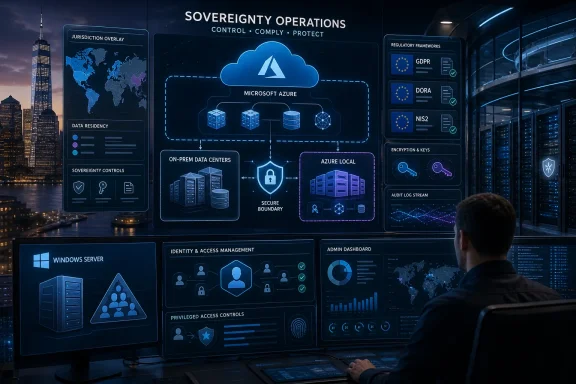
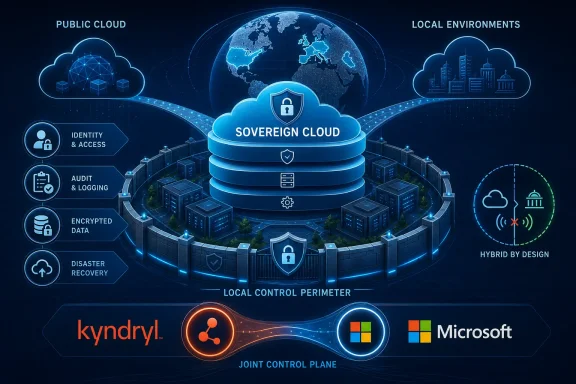
Kyndryl and Microsoft expanded their sovereign cloud collaboration on July 1, 2026, with Kyndryl adding Microsoft Sovereign Cloud capabilities to its advisory, implementation, and managed services for regulated customers using Azure, Microsoft 365, and Azure Local. The move is not just another partner-program press release; it is a signal that sovereignty has become a mainstream design constraint for enterprise IT. Governments, banks, healthcare providers, energy companies, and defense-adjacent suppliers are no longer asking whether cloud can be compliant. They are asking who controls the data, who operates the stack, and what happens when connectivity, jurisdiction, or politics gets ugly.
For years, “sovereign cloud” sounded like a regional marketing label attached to the same global hyperscale architecture. Put a data center in-country, add contractual language around residency, and call the result sovereign enough for procurement. That framing is no longer adequate.
The Kyndryl-Microsoft expansion lands in a market where data location is only one part of the problem. Regulators increasingly care about operational control, administrator access, encryption boundaries, auditability, support personnel, resilience, and whether a workload can continue functioning when the public cloud is unreachable or politically complicated.
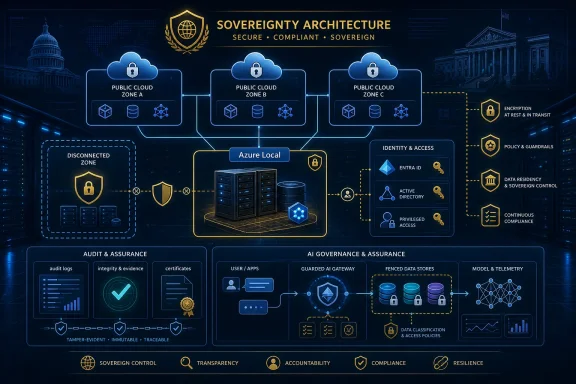
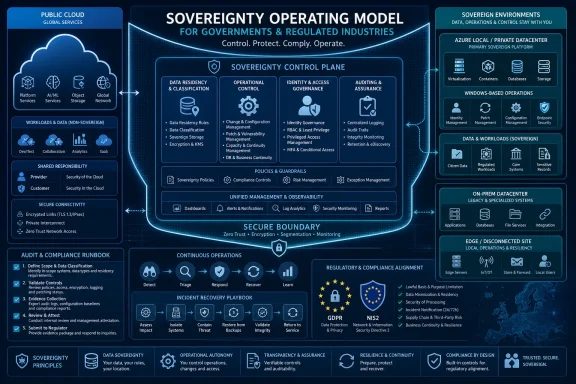
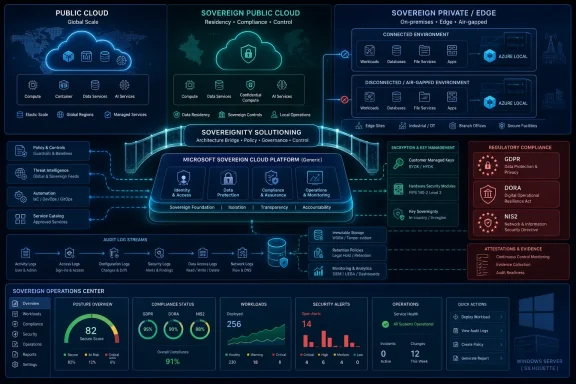
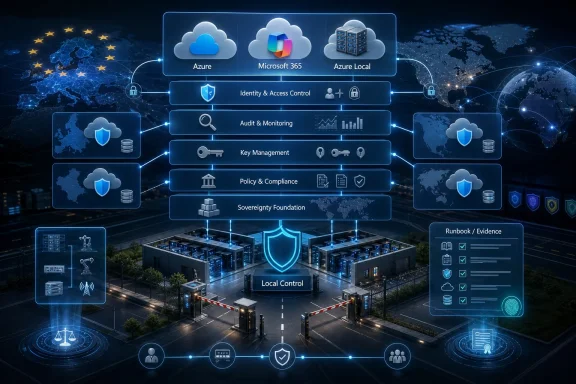
That shift helps explain why this announcement emphasizes both public and private cloud models. Kyndryl says it will help customers assess their sovereignty posture, design compliant architectures, and run environments that use Microsoft Azure, Microsoft 365, and Azure Local in connected or disconnected forms. The promise is less “move everything to Azure” than “choose where the control plane, data plane, and operating responsibilities should sit.”
This is where Kyndryl’s role matters. Microsoft owns the platform, but sovereignty is usually won or lost in implementation: identity design, key management, logging, network segmentation, incident response, update operations, and service desk procedures. Those details are not glamorous, but they are exactly where regulated workloads become either defensible or indefensible.
Azure Local is central to that argument. It gives organizations a way to run Azure-consistent infrastructure on customer-controlled hardware, including scenarios where systems operate inside a sovereign boundary and, in some cases, without continuous cloud connectivity. For IT teams already invested in Azure management, policy, identity, and security tooling, that is a more practical route than rebuilding on an entirely separate stack.
But this is also where the politics get complicated. Sovereign cloud is partly a technical architecture and partly a trust negotiation. A European ministry, a national healthcare system, or a critical infrastructure operator may accept Azure Local for some requirements while still questioning whether a US-headquartered vendor can ever satisfy the highest bar for jurisdictional independence.
Microsoft’s answer has been to expand the spectrum. At one end sit standard Azure regions with stronger residency and governance controls. Further along are sovereign public cloud arrangements, local partner-operated models, Microsoft 365 Local, Azure Local, and disconnected deployments. This gives buyers more knobs to turn, but it also makes the architecture more complex to evaluate.
Kyndryl’s commercial opportunity is in that complexity. The more Microsoft turns sovereignty into a menu of deployment patterns, the more customers need an integrator to map laws, business risk, legacy systems, and operational realities onto a working design.
Many sovereign cloud buyers are not cloud-native startups. They are ministries with decades of applications, banks with mainframes, hospitals with brittle software dependencies, manufacturers with plant-floor systems, and public agencies with procurement cycles longer than most SaaS product roadmaps. Their sovereignty problem is rarely a greenfield deployment.
That makes advisory work and managed operations more important than the press-release phrasing suggests. A customer may need to classify workloads by sensitivity, determine which datasets must remain in-country, decide which administrators can touch which systems, and prove that logs, backups, keys, and disaster recovery copies do not quietly violate the sovereignty model.
Kyndryl is also selling continuity. If a government department or regulated enterprise already uses Kyndryl to run mission-critical infrastructure, the move to a Microsoft sovereign architecture becomes less of a leap. The customer can modernize portions of the estate without fully replacing the operational partner that understands its dependencies.
This is the less romantic version of digital transformation: not a dramatic cloud migration, but a staged rearrangement of control. For many Windows-heavy enterprises, that is the only plausible path.
That matters for WindowsForum readers because Azure Local sits at the intersection of familiar Microsoft infrastructure and cloud-era governance. It gives organizations a way to run workloads closer to the edge, inside their own facilities, or within a jurisdictionally constrained environment while still using Microsoft’s broader management and security model.
The pitch is especially relevant for disconnected or intermittently connected operations. Think defense environments, remote industrial sites, emergency services, energy infrastructure, or government systems that cannot depend on a live connection to a public cloud region. In those settings, “cloud” is less about location and more about operational consistency.
This is a smart Microsoft play. It preserves the Azure model while conceding that not every important workload belongs in a hyperscale region. It also gives Microsoft a stronger answer to competitors and local cloud providers arguing that true sovereignty requires local infrastructure and local operational control.
The risk is that Azure Local becomes another layer of complexity for already stretched IT departments. Running cloud-consistent infrastructure on-premises does not magically eliminate patching, capacity planning, hardware lifecycle management, identity risk, or compliance evidence. It changes who holds the operational burden.
That is why Kyndryl is useful to Microsoft. Sovereign private cloud sounds like a product category, but in practice it is a managed operating discipline.
That is why Microsoft’s sovereign cloud messaging increasingly travels with AI messaging. Regulated customers want the productivity and automation benefits of generative AI, but they do not want sensitive data leaking into opaque processing chains or crossing boundaries they cannot explain to auditors.
Kyndryl’s announcement fits that demand. The company is positioning itself to help customers modernize and adopt AI while preserving data control and compliance. That framing is important because many large organizations do not view sovereignty as a blocker to AI; they view it as a precondition for AI adoption.
This is particularly true in government and regulated industries. A national agency may want AI-assisted casework. A bank may want automated compliance review. A hospital may want clinical workflow automation. None of those uses can proceed responsibly if the institution cannot explain where sensitive data moves and who can access it.
The result is a new kind of architecture conversation. AI is pulling sovereignty out of the legal department and into infrastructure planning, identity governance, endpoint strategy, and application modernization.
This is the uncomfortable middle ground in which most enterprise IT decisions live. A local provider may offer stronger jurisdictional independence but lack the service breadth, tooling, global support, security investment, and AI ecosystem of Microsoft. A hyperscaler may offer unmatched capability but require customers to accept residual legal and political risk.
The Kyndryl-Microsoft model is designed for customers who want a pragmatic compromise. Keep the Microsoft platform where it brings operational value, but use architecture, contracts, operating controls, and deployment location to reduce exposure. That will be enough for many regulated workloads. It will not be enough for all of them.
The distinction matters. Sovereignty is not a binary attribute that a vendor can simply claim. It is a risk posture, and that posture varies by workload. A public information portal, a tax records system, a military planning environment, and a national health dataset do not belong in the same category.
The better Kyndryl and Microsoft can help customers draw those lines, the more credible this offering becomes. The worst version of sovereign cloud would be a label that flattens those distinctions.
That means the humble control plane matters. Who can administer the tenant? Where are logs stored? Which support paths can access diagnostic data? How are privileged accounts monitored? Are encryption keys customer-controlled, locally held, or dependent on a service outside the boundary? Can administrators prove the answer six months later?
These are not abstract governance questions. They are tickets, runbooks, group policies, conditional access rules, role assignments, update rings, retention settings, and incident response procedures. In a sovereign architecture, the paperwork and the implementation must match.
This is where many organizations will struggle. They may buy a sovereign-capable platform but continue operating it with inherited practices from ordinary enterprise IT. That gap can become fatal in an audit or, worse, during an incident.
Kyndryl’s managed services pitch is therefore not just about convenience. It is about reducing the gap between the architecture diagram and the daily reality of operating Microsoft infrastructure under regulatory pressure.
Kyndryl brings credibility in that role because it operates close to the customer’s infrastructure and process. It can translate Microsoft’s product capabilities into local control models, compliance evidence, and operational support. That is exactly the work hyperscalers often prefer partners to handle.
This partner-led model also gives Microsoft strategic flexibility. In markets where customers are comfortable with Microsoft-operated cloud, Azure remains the obvious answer. In markets where customers want more local operational separation, Microsoft can point to partner-supported sovereign models. In environments that require private or disconnected deployments, Azure Local becomes the bridge.
The trade-off is accountability. When a sovereign cloud deployment involves Microsoft, Kyndryl, local hardware, customer operations, and possibly additional regulators or national partners, customers need absolute clarity on who is responsible for what. Ambiguity is the enemy of compliance.
A well-designed sovereign cloud contract should be boringly explicit. It should define operational boundaries, access rights, update responsibilities, incident handling, data flows, audit evidence, subcontractors, and failure modes. If the customer cannot explain the model without vendor slides, the model is not mature enough.
Governments across regions are reassessing cloud dependence. Financial regulators want stronger operational resilience. Healthcare systems are scrutinizing sensitive data handling. Energy, telecom, and transportation operators face national security requirements. Even private companies are rethinking where strategic data should live as geopolitical risk becomes a board-level concern.
That is why the Kyndryl-Microsoft announcement matters beyond one geography. It reflects a broader normalization of sovereignty as a cloud buying criterion. Enterprises are no longer treating it as a niche requirement for a few public-sector deals.
The stock-market reaction around Kyndryl’s shares is a small but telling signal. Investors see sovereign cloud, AI modernization, and regulated workload migration as growth opportunities for services firms. Kyndryl does not need to own the hyperscale platform to benefit. It needs to be the company customers call when the hyperscale platform must be made acceptable to regulators.
That is a good business to be in, provided customers keep spending through slower modernization cycles and more cautious procurement.
A CIO wants confidence that cloud modernization will not trigger regulatory backlash. A CISO wants confidence that privileged access and telemetry flows are controlled. A data protection officer wants confidence that residency claims survive scrutiny. A minister or board member wants confidence that a foreign policy dispute will not strand essential services.
No vendor can provide absolute certainty. What Kyndryl and Microsoft can provide is a structured path for reducing uncertainty. That includes assessment, architecture, implementation, operations, and the ability to choose between public cloud, private cloud, connected, and disconnected models.
The danger is that confidence becomes complacency. Sovereign cloud cannot be treated as a one-time certification badge. Laws change, cloud services evolve, AI features introduce new data flows, and operational teams drift from documented procedures.
A credible sovereign cloud program must be continuously governed. That is tedious, expensive, and necessary.
Customers evaluating the Kyndryl-Microsoft approach should focus less on the headline and more on the operational details that determine whether the deployment actually meets their risk model.
 Sovereign Cloud Moves From Slogan to Operating Model
For years, “sovereign cloud” sounded like a regional marketing label attached to the same global hyperscale architecture. Put a data center in-country, add contractual language around residency, and call the result sovereign enough for procurement. That framing is no longer adequate.The Kyndryl-Microsoft expansion lands in a market where data location is only one part of the problem. Regulators increasingly care about operational control, administrator access, encryption boundaries, auditability, support personnel, resilience, and whether a workload can continue functioning when the public cloud is unreachable or politically complicated.
That shift helps explain why this announcement emphasizes both public and private cloud models. Kyndryl says it will help customers assess their sovereignty posture, design compliant architectures, and run environments that use Microsoft Azure, Microsoft 365, and Azure Local in connected or disconnected forms. The promise is less “move everything to Azure” than “choose where the control plane, data plane, and operating responsibilities should sit.”
This is where Kyndryl’s role matters. Microsoft owns the platform, but sovereignty is usually won or lost in implementation: identity design, key management, logging, network segmentation, incident response, update operations, and service desk procedures. Those details are not glamorous, but they are exactly where regulated workloads become either defensible or indefensible.
Microsoft Wants Sovereignty Without Surrendering the Cloud
Microsoft’s pitch is carefully balanced. It wants to reassure customers that they can gain more control without abandoning the Microsoft ecosystem. That means bringing cloud-consistent infrastructure closer to the customer, not necessarily pushing customers toward a wholesale retreat from Azure.Azure Local is central to that argument. It gives organizations a way to run Azure-consistent infrastructure on customer-controlled hardware, including scenarios where systems operate inside a sovereign boundary and, in some cases, without continuous cloud connectivity. For IT teams already invested in Azure management, policy, identity, and security tooling, that is a more practical route than rebuilding on an entirely separate stack.
But this is also where the politics get complicated. Sovereign cloud is partly a technical architecture and partly a trust negotiation. A European ministry, a national healthcare system, or a critical infrastructure operator may accept Azure Local for some requirements while still questioning whether a US-headquartered vendor can ever satisfy the highest bar for jurisdictional independence.
Microsoft’s answer has been to expand the spectrum. At one end sit standard Azure regions with stronger residency and governance controls. Further along are sovereign public cloud arrangements, local partner-operated models, Microsoft 365 Local, Azure Local, and disconnected deployments. This gives buyers more knobs to turn, but it also makes the architecture more complex to evaluate.
Kyndryl’s commercial opportunity is in that complexity. The more Microsoft turns sovereignty into a menu of deployment patterns, the more customers need an integrator to map laws, business risk, legacy systems, and operational realities onto a working design.
Kyndryl Sells the Unfashionable Part of Cloud: Operations
Kyndryl’s advantage is not that it has a shinier cloud story than Microsoft. It does not. Its advantage is that it inherited and rebuilt a business around the messy operational estates that large organizations actually run.Many sovereign cloud buyers are not cloud-native startups. They are ministries with decades of applications, banks with mainframes, hospitals with brittle software dependencies, manufacturers with plant-floor systems, and public agencies with procurement cycles longer than most SaaS product roadmaps. Their sovereignty problem is rarely a greenfield deployment.
That makes advisory work and managed operations more important than the press-release phrasing suggests. A customer may need to classify workloads by sensitivity, determine which datasets must remain in-country, decide which administrators can touch which systems, and prove that logs, backups, keys, and disaster recovery copies do not quietly violate the sovereignty model.
Kyndryl is also selling continuity. If a government department or regulated enterprise already uses Kyndryl to run mission-critical infrastructure, the move to a Microsoft sovereign architecture becomes less of a leap. The customer can modernize portions of the estate without fully replacing the operational partner that understands its dependencies.
This is the less romantic version of digital transformation: not a dramatic cloud migration, but a staged rearrangement of control. For many Windows-heavy enterprises, that is the only plausible path.
Azure Local Becomes the Strategic Middle Ground
The most interesting piece of Microsoft’s sovereignty strategy is not the public cloud region. It is Azure Local, because it lets Microsoft compete for workloads that might otherwise be declared off-limits to hyperscale cloud.That matters for WindowsForum readers because Azure Local sits at the intersection of familiar Microsoft infrastructure and cloud-era governance. It gives organizations a way to run workloads closer to the edge, inside their own facilities, or within a jurisdictionally constrained environment while still using Microsoft’s broader management and security model.
The pitch is especially relevant for disconnected or intermittently connected operations. Think defense environments, remote industrial sites, emergency services, energy infrastructure, or government systems that cannot depend on a live connection to a public cloud region. In those settings, “cloud” is less about location and more about operational consistency.
This is a smart Microsoft play. It preserves the Azure model while conceding that not every important workload belongs in a hyperscale region. It also gives Microsoft a stronger answer to competitors and local cloud providers arguing that true sovereignty requires local infrastructure and local operational control.
The risk is that Azure Local becomes another layer of complexity for already stretched IT departments. Running cloud-consistent infrastructure on-premises does not magically eliminate patching, capacity planning, hardware lifecycle management, identity risk, or compliance evidence. It changes who holds the operational burden.
That is why Kyndryl is useful to Microsoft. Sovereign private cloud sounds like a product category, but in practice it is a managed operating discipline.
AI Turns Sovereignty Into a Boardroom Problem
The sovereign cloud discussion has intensified because AI changes the perceived blast radius of cloud adoption. Data that once sat in controlled repositories may now feed retrieval systems, model tuning, copilots, analytics pipelines, and automated decision workflows. The governance question is no longer just where the database lives. It is where data is processed, embedded, inferred from, logged, retained, and exposed through assistants.That is why Microsoft’s sovereign cloud messaging increasingly travels with AI messaging. Regulated customers want the productivity and automation benefits of generative AI, but they do not want sensitive data leaking into opaque processing chains or crossing boundaries they cannot explain to auditors.
Kyndryl’s announcement fits that demand. The company is positioning itself to help customers modernize and adopt AI while preserving data control and compliance. That framing is important because many large organizations do not view sovereignty as a blocker to AI; they view it as a precondition for AI adoption.
This is particularly true in government and regulated industries. A national agency may want AI-assisted casework. A bank may want automated compliance review. A hospital may want clinical workflow automation. None of those uses can proceed responsibly if the institution cannot explain where sensitive data moves and who can access it.
The result is a new kind of architecture conversation. AI is pulling sovereignty out of the legal department and into infrastructure planning, identity governance, endpoint strategy, and application modernization.
The Jurisdiction Problem Has Not Gone Away
No serious analysis of sovereign cloud can ignore the unresolved legal tension around foreign-headquartered providers. Microsoft can offer more local control, more local processing, stronger encryption, disconnected operations, and partner-operated models. Those are meaningful improvements. They do not automatically erase concerns about jurisdiction, lawful access, or geopolitical leverage.This is the uncomfortable middle ground in which most enterprise IT decisions live. A local provider may offer stronger jurisdictional independence but lack the service breadth, tooling, global support, security investment, and AI ecosystem of Microsoft. A hyperscaler may offer unmatched capability but require customers to accept residual legal and political risk.
The Kyndryl-Microsoft model is designed for customers who want a pragmatic compromise. Keep the Microsoft platform where it brings operational value, but use architecture, contracts, operating controls, and deployment location to reduce exposure. That will be enough for many regulated workloads. It will not be enough for all of them.
The distinction matters. Sovereignty is not a binary attribute that a vendor can simply claim. It is a risk posture, and that posture varies by workload. A public information portal, a tax records system, a military planning environment, and a national health dataset do not belong in the same category.
The better Kyndryl and Microsoft can help customers draw those lines, the more credible this offering becomes. The worst version of sovereign cloud would be a label that flattens those distinctions.
Windows Administrators Inherit the Control Plane
For Windows administrators, the sovereign cloud trend will feel less like a new product launch and more like a new set of constraints imposed on familiar systems. Identity, device management, patching, logging, backup, endpoint security, and Microsoft 365 governance all become part of the sovereignty argument.That means the humble control plane matters. Who can administer the tenant? Where are logs stored? Which support paths can access diagnostic data? How are privileged accounts monitored? Are encryption keys customer-controlled, locally held, or dependent on a service outside the boundary? Can administrators prove the answer six months later?
These are not abstract governance questions. They are tickets, runbooks, group policies, conditional access rules, role assignments, update rings, retention settings, and incident response procedures. In a sovereign architecture, the paperwork and the implementation must match.
This is where many organizations will struggle. They may buy a sovereign-capable platform but continue operating it with inherited practices from ordinary enterprise IT. That gap can become fatal in an audit or, worse, during an incident.
Kyndryl’s managed services pitch is therefore not just about convenience. It is about reducing the gap between the architecture diagram and the daily reality of operating Microsoft infrastructure under regulatory pressure.
The Partner Ecosystem Becomes Microsoft’s Sovereignty Shield
Microsoft cannot solve sovereignty alone because sovereignty often requires local trust. That trust may come from national operators, regional service providers, audited managed service partners, or companies with long-standing relationships in government and critical industries.Kyndryl brings credibility in that role because it operates close to the customer’s infrastructure and process. It can translate Microsoft’s product capabilities into local control models, compliance evidence, and operational support. That is exactly the work hyperscalers often prefer partners to handle.
This partner-led model also gives Microsoft strategic flexibility. In markets where customers are comfortable with Microsoft-operated cloud, Azure remains the obvious answer. In markets where customers want more local operational separation, Microsoft can point to partner-supported sovereign models. In environments that require private or disconnected deployments, Azure Local becomes the bridge.
The trade-off is accountability. When a sovereign cloud deployment involves Microsoft, Kyndryl, local hardware, customer operations, and possibly additional regulators or national partners, customers need absolute clarity on who is responsible for what. Ambiguity is the enemy of compliance.
A well-designed sovereign cloud contract should be boringly explicit. It should define operational boundaries, access rights, update responsibilities, incident handling, data flows, audit evidence, subcontractors, and failure modes. If the customer cannot explain the model without vendor slides, the model is not mature enough.
The Market Is Bigger Than Europe, But Europe Sets the Tone
Europe has become the loudest arena for sovereign cloud because of its regulatory environment, its history of privacy enforcement, and its political anxiety over dependency on foreign technology providers. But the demand is not confined to Europe.Governments across regions are reassessing cloud dependence. Financial regulators want stronger operational resilience. Healthcare systems are scrutinizing sensitive data handling. Energy, telecom, and transportation operators face national security requirements. Even private companies are rethinking where strategic data should live as geopolitical risk becomes a board-level concern.
That is why the Kyndryl-Microsoft announcement matters beyond one geography. It reflects a broader normalization of sovereignty as a cloud buying criterion. Enterprises are no longer treating it as a niche requirement for a few public-sector deals.
The stock-market reaction around Kyndryl’s shares is a small but telling signal. Investors see sovereign cloud, AI modernization, and regulated workload migration as growth opportunities for services firms. Kyndryl does not need to own the hyperscale platform to benefit. It needs to be the company customers call when the hyperscale platform must be made acceptable to regulators.
That is a good business to be in, provided customers keep spending through slower modernization cycles and more cautious procurement.
The Real Product Is Confidence
The official language around the partnership emphasizes design, implementation, operations, data control, and compliance. Beneath that, the product being sold is confidence.A CIO wants confidence that cloud modernization will not trigger regulatory backlash. A CISO wants confidence that privileged access and telemetry flows are controlled. A data protection officer wants confidence that residency claims survive scrutiny. A minister or board member wants confidence that a foreign policy dispute will not strand essential services.
No vendor can provide absolute certainty. What Kyndryl and Microsoft can provide is a structured path for reducing uncertainty. That includes assessment, architecture, implementation, operations, and the ability to choose between public cloud, private cloud, connected, and disconnected models.
The danger is that confidence becomes complacency. Sovereign cloud cannot be treated as a one-time certification badge. Laws change, cloud services evolve, AI features introduce new data flows, and operational teams drift from documented procedures.
A credible sovereign cloud program must be continuously governed. That is tedious, expensive, and necessary.
The Fine Print Is Where Sovereignty Lives
The most concrete lesson from this announcement is that sovereign cloud is not a single SKU. It is a negotiated architecture.Customers evaluating the Kyndryl-Microsoft approach should focus less on the headline and more on the operational details that determine whether the deployment actually meets their risk model.
- Customers should classify workloads by sensitivity before choosing a sovereign cloud pattern, because not every application needs the same residency, isolation, or operational-control requirements.
- Azure Local is strategically important because it extends Microsoft’s cloud model into customer-controlled and potentially disconnected environments.
- Kyndryl’s value depends on its ability to turn Microsoft’s sovereignty capabilities into auditable runbooks, controls, and day-to-day operations.
- AI adoption makes sovereignty more urgent because sensitive data can move through prompts, embeddings, logs, model workflows, and automated agents.
- Legal jurisdiction remains a residual risk for foreign-headquartered cloud providers, even when technical controls significantly improve.
- The strongest sovereign cloud programs will treat compliance as a living operating model rather than a procurement checkbox.
References
- Primary source: Pluang
Published: 2026-07-01T14:30:25.216792
Kyndryl and Microsoft expand sovereign cloud se... | Pluang
Kyndryl has partnered with Microsoft to enhance its sovereignty solutioning by integrating Microsoft Sovereign Cloud capabilities. This collaboration helps organizations design and operate cloud systems that meet strict data residency and regulatory requirements, supporting modernization and AI...pluang.com - Related coverage: kyndryl.com
Kyndryl and Microsoft to expand Sovereignty Solutioning
Kyndryl and Microsoft partner to help organizations address data sovereignty with cloud solutions that support AI, compliance and resilience.www.kyndryl.com - Official source: blogs.microsoft.com
Microsoft Sovereign Private Cloud scales to thousands of nodes with Azure Local - The Official Microsoft Blog
Today, I am pleased to announce that Azure Local now scales to support deployments of up to thousands of servers within a single sovereign environment, allowing organizations to run much larger workloads locally across large-footprint datacenters, industrial environments and edge locations while...blogs.microsoft.com - Official source: news.microsoft.com
- Related coverage: investors.kyndryl.com

Kyndryl and Microsoft Collaborate to Enable Adaptive Cloud Services | Kyndryl Holdings, Inc.
Kyndryl Distributed Cloud services utilizing the Microsoft adaptive cloud approach help businesses streamline cloud operations with customized solutions NEW YORK , May 13, 2025 /PRNewswire/ -- Kyndryl (NYSE: KD), a leading provider of mission-critical enterprise technology services, today
investors.kyndryl.com
- Official source: azure.microsoft.com

- Official source: microsoft.com
Microsoft Sovereign Cloud | Microsoft AI
Empower digital resilience and digital and operational sovereignty with trusted, comprehensive cloud solutions from Microsoft. Discover Microsoft Sovereign Cloud.www.microsoft.com
- Related coverage: prnewswire.com

Armada to Deliver Sovereign AI at the Edge with Microsoft Azure Local
/PRNewswire/ -- Armada today unveiled a collaboration with Microsoft, forging an edge computing solution that unites Microsoft Azure Local with Armada's...
www.prnewswire.com
- Related coverage: itpro.com
Satya Nadella talks up Microsoft's sovereign cloud credentials as firm announces general availability for Azure Local Disconnected, new capabilities for Foundry Local | IT Pro
Microsoft has expanded its Sovereign Cloud for AI and regulated environments, as CEO Satya Nadella hypes up the full extent of AI support the firm now offers.www.itpro.com - Related coverage: techradar.com
Microsoft strengthens its in-country data processing push with more sovereignty options | TechRadar
Even more countries will get local Copilot processingwww.techradar.com - Related coverage: capgemini.com
- Official source: info.microsoft.com
Young smart busy professional business woman using digital tablet in office.
Young smart busy professional business woman executive, female company worker or manager holding digital tablet using pad technology device working standing in modern corporate office.info.microsoft.com