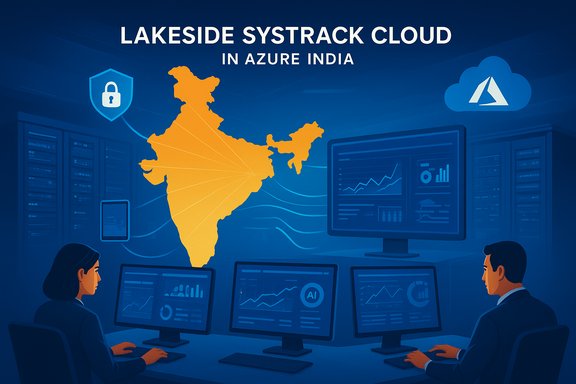
Lakeside Launches SysTrack Cloud Region in Azure India for Low Latency DEX

  • Thread Author
Lakeside Software’s launch of a dedicated SysTrack Cloud region in Microsoft Azure’s India footprint is a pragmatic expansion aimed at lowering latency, improving data residency controls, and giving enterprise IT teams in India and nearby markets a locally hosted option for Digital Employee Experience (DEX) telemetry and analytics.

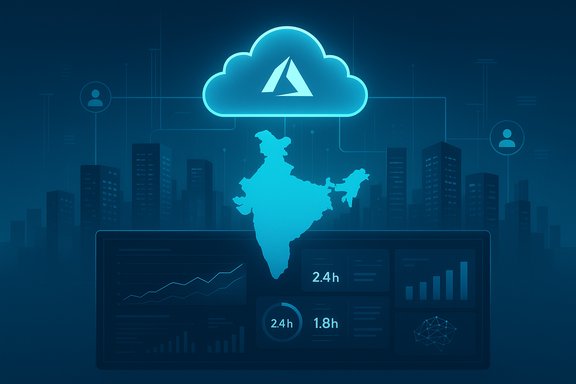
Azure cloud analytics for India with dashboards over a city skyline.Background / Overview​

Lakeside Software builds SysTrack, an AI-driven Digital Employee Experience (DEX) platform that collects endpoint telemetry, analyzes performance, and drives proactive remediation to reduce IT friction and costs. The vendor announced the availability of a SysTrack Cloud region in Azure India on November 5, 2025, positioning the new region as immediately available to SysTrack Cloud customers and as a response to customer demand for lower latency, in-country data residency, and easier scalability for DEX workloads.
Three market forces underlie the timing and rationale of the move:
  • Hyperscaler expansion and increased local capacity in India, which makes regional hosting practical and cost-effective.
  • Rising procurement and compliance pressure around where telemetry and analytics are stored and processed.
  • An elevated level of digital maturity among Indian workplaces that creates demand for more sophisticated DEX tooling.
The announcement is accompanied by partner endorsements from Kyndryl, Lenovo, and SPNX, which emphasize locality, faster troubleshooting, and the ability to scale AI-driven DEX without compromise. Lakeside’s public collateral also reiterates a vendor ROI claim — that SysTrack can help save roughly 20% on annual IT costs per employee — a figure repeated in marketing materials but flagged internally by analysts as directional and in need of empirical validation during pilots.

What Lakeside announced — essentials and positioning​

The core elements of Lakeside’s announcement are straightforward:
  • A dedicated SysTrack Cloud region in Azure India is now live and available to SysTrack Cloud customers.
  • The region aims to reduce telemetry ingestion latency and keep telemetry and analytics in-country when required by procurement or regulation.
  • Strategic partners are positioned to accelerate deployments, managed services, and integration into existing workplace programs.
Lakeside’s messaging couples operational benefits (faster diagnostics, lower round-trip times) with procurement benefits (a locality option for customers who require or prefer in-country hosting). The vendor frames the expansion as a response to tangible customer needs in India and neighboring markets.

Why this matters: Latency, compliance, and scale​

Latency and user experience​

DEX telemetry and interactive remediation workflows are sensitive to network latency. Putting ingestion, analytics, and remediation endpoints physically closer to users reduces round-trip times for agent‑server communication and interactive support sessions. That improvement can translate into measurable gains in Mean Time To Detection (MTTD) and Mean Time To Resolution (MTTR) for end-user incidents, and better real-time dashboards for support teams.

Data residency and procurement​

India’s regulatory and procurement environment increasingly favors locality for telemetry and analytics—especially in regulated sectors. Hosting telemetry in an India region simplifies procurement conversations and may satisfy baseline data‑residency requirements, but region labels alone are not a legal panacea; specific contractual guarantees about backups, key management, and support access are the decisive controls. IT leaders must insist on auditable evidence for in‑country processing beyond the marketing claim.

Scalability and cost control​

A local region reduces long-haul network dependencies and can lower internal egress costs associated with telemetry flows. That makes it easier to scale DEX footprints without incurring cross‑region transfer penalties and can simplify capacity planning for large enterprise deployments. However, service parity across regions varies; new regions sometimes roll out services in phases, and certain VM SKUs or managed services may arrive later. Confirming availability of required Azure services and SKUs is essential.

Partner perspectives and what they reveal​

Lakeside’s press materials include endorsements from Kyndryl, Lenovo, and SPNX. These partner quotes reinforce three recurring selling points: locality, faster issue isolation, and managed-service enablement for Indian customers.
  • Kyndryl emphasized that “high‑fidelity employee insights” benefit from being closer to users, enabling faster and more confident DEX initiatives.
  • Lenovo highlighted in‑country data residency and faster issue isolation as measurable improvements in employee experience, without additional operational complexity.
  • SPNX stressed the timing relative to India’s broader digital transformation push and evolving data protection frameworks, noting customers’ desire to keep telemetry in‑country and scale AI‑driven DEX initiatives.
These endorsements indicate Lakeside’s go‑to‑market focus on channel partners and managed offerings in India. That approach lowers the barrier to adoption for enterprises that prefer a partner‑run model and accelerates integration with existing managed workplace services.

Technical verification: what to confirm before you migrate workloads​

The announcement raises several technical and operational questions that enterprise buyers must validate with Lakeside and Microsoft before routing production telemetry to the India region:
  • Confirm the exact Azure programmatic region name and physical locality (for example, which Azure region — Central India, South India, West India — is being used) and whether Lakeside plans to support multiple Indian regions. New regions may differ in service parity and AZ counts.
  • Verify Availability Zone topology and supported SKUs for the chosen region. Ask specifically about Azure VM SKUs, managed database services (Azure SQL, Cosmos), blob storage tiers, and any GPU SKUs needed for inference or analytics. Service parity is often staged.
  • Obtain a signed data flow diagram that shows exactly where telemetry is collected, processed, stored, and backed up (including any cross‑region replication or failover triggers). The diagram must be auditable and referenced in contract language.
  • Determine encryption and key management: Are encryption keys customer‑managed? Are keys stored and managed exclusively inside India? How are support engineers’ access rights controlled? These controls determine the real legal and compliance posture, not just the physical location of storage.
  • Request the SLA, exception policy, and capacity guarantees: What happens during region‑level outages or capacity constraints? Will telemetry failover cross borders? What are performance guarantees for telemetry ingestion and query latency?
  • Confirm connectivity options for low-latency ingress (ExpressRoute, direct peering locations, or local peering fabric) and evaluate how endpoint traffic (offices, remote workers, mobile) will route to the new region in practice.
These verifications are routine procurement hygiene but are crucial when telemetry and employee data are involved. Marketing statements and region labels are helpful starting points, but they are not substitutes for contractually enforceable controls.

A practical 90‑day pilot plan for IT teams​

Moving telemetry to a new region should be a measured, data‑driven process. Below is a focused 90‑day plan to validate Lakeside’s claims and protect compliance posture.
  • Day 0–15: Requirements and procurement
  • Map regulatory obligations (data residency, sectoral rules) and identify which telemetry categories require in‑country processing.
  • Open technical workshops with Lakeside and Microsoft; request region‑specific documentation, SLAs, and a signed data flow diagram.
  • Day 15–45: Pilot planning and network prep
  • Configure ExpressRoute or direct peering where possible.
  • Select a representative pilot cohort of endpoints (mix of office, remote, mobile) and mission‑critical applications.
  • Define KPI baselines: MTTD, MTTR, dashboard refresh times, agent action latencies, and ticket volumes.
  • Day 45–75: Pilot execution and measurement
  • Route SysTrack agents for the pilot cohort to the Azure India region.
  • Measure ingestion latency, dashboard responsiveness, incident detection times, and support-session interactivity.
  • Collect cost data for storage, compute, and egress with local hosting.
  • Day 75–90: Review and decisions
  • Compare pilot results against success criteria.
  • Negotiate contractual clauses based on pilot findings (key locality, audit rights, exception handling).
  • Decide on phased rollout, MSP enablement, or hybrid architectures for global benchmarking.
This plan balances quick verification with contractual safeguards, allowing procurement teams to convert vendor claims into measured operational outcomes.

Strengths — where Lakeside’s India region can deliver clear value​

  • Tangible locality gains: For interactive DEX scenarios—live diagnostics, agent-initiated remediation, and real‑time dashboards—deploying SysTrack near users should reduce latency and improve user experience metrics.
  • Procurement enablement: The ability to host telemetry inside India simplifies buying decisions for regulated customers or public sector procurement teams that require in‑country hosting options.
  • Partner and channel leverage: Lakeside’s partner quotes and the presence of established managed‑service players create multiple adoption pathways (self-managed, partner managed, MSP-delivered DEX-as-a-Service). That reduces friction for enterprise buyers.
  • Scalable local AI: Local telemetry datasets make it easier to run near‑real‑time inference and automation inside India, improving turnaround for agentic remediation and operational automation.

Risks and caveats — what buyers must not gloss over​

  • Vendor ROI claims need proof: Lakeside’s marketing figure of “save 20% on annual IT costs per employee” is a vendor-supplied metric used in corporate materials and needs empirical validation in customer environments. Insist on methodology, customer references, and pilot data before incorporating such figures into business cases.
  • Region labels ≠ sovereignty: Hosting in an India region reduces cross‑border transfer but does not automatically control personnel access, backup replication, or lawful access. Ask for contractual controls that bind the vendor and cloud provider to specific operational constraints.
  • Feature parity and capacity caveats: Newer Azure regions sometimes lag older ones in service availability or specific SKUs. Confirm that every Azure service SysTrack depends on is available in the chosen India region.
  • Operational fragmentation: Multi‑region vendor footprints can increase complexity—multiple subscriptions, varied monitoring endpoints, and additional DR testing are common operational taxes. Plan for centralized governance and multi-region runbooks if you adopt localized instances.
  • Regulatory evolution: India’s data protection and digital governance landscape is still evolving. Local hosting reduces immediate friction, but future rules (e.g., encryption key locality mandates) could require changes to deployment architecture. Design for flexibility.

Practical checklist: questions to ask Lakeside and Microsoft​

  • What is the exact Azure programmatic region name (e.g., "Central India" or specific region code)?
  • Which Availability Zones are available, and which VM SKUs and managed services are supported today?
  • Provide a signed data flow diagram showing collection, processing, storage, backup, and any cross‑region replication points.
  • Where are encryption keys held and who controls them? Do keys remain in India under customer control?
  • What are the SLAs and the documented exception policy describing cross‑region routing during capacity or outage events?
  • Can Lakeside provide anonymized pilot data or a joint proof‑of‑value with defined KPIs tied to the 20% savings claim?

How to architect for compliance and global benchmarking​

Many global organizations will opt for a hybrid approach: keep India-region telemetry for Indian employees while aggregating non‑sensitive, anonymized metrics to a global analytics pool for benchmarking. That requires careful pipeline design—dual writes, selective aggregation, or anonymized forwarding—to balance compliance with global visibility. Insist on role separation, tenant‑level controls, and robust audit logging to prove where data resides and who accessed it.

Final assessment and recommendations​

Lakeside’s opening of a SysTrack Cloud region in Azure India is a timely and pragmatic move that aligns with hyperscaler expansion, partner‑led GTM, and a maturing Indian digital workplace market. For organizations that need lower latency or in‑country hosting, the region provides a crucial architectural option that can accelerate DEX initiatives and reduce certain operational costs.
However, the headline benefits are conditional. Buyers should:
  • Treat vendor ROI figures (for example, the 20% IT cost savings per employee) as directional until reproduced in a controlled pilot.
  • Demand contractual, auditable evidence for in‑country processing, key locality, and support access constraints.
  • Validate service parity and capacity for every Azure service SysTrack requires in the chosen India region.
When those verifications are completed and a pilot reproduces promised outcomes (reduced MTTD/MTTR, measurable ticket volume reductions, and acceptable cost deltas), Lakeside’s India region can be an important lever for improving employee experience and operational efficiency in India. The difference between a successful deployment and disappointment will come down to rigorous pilots, contractually enforceable controls, and a clear operational plan for global benchmarking and failover.

Lakeside’s announcement is a concrete signal that DEX vendors and hyperscalers are converging on locality as a product differentiator. For IT leaders, the opportunity is real—but realizing it requires the usual mix of technical validation, contractual rigor, and disciplined pilot programs to turn marketing claims into measurable outcomes.

Source: TheWire.in Lakeside Software Expands Global Footprint with New SysTrack Cloud Region in Azure India - The Wire
 

Lakeside Software’s launch of a dedicated SysTrack Cloud region on Microsoft Azure in India marks a significant step for digital employee experience (DEX) platforms aiming to serve Indian enterprises with lower latency, stronger data residency controls, and tighter Microsoft cloud integration — a move that promises faster troubleshooting, better compliance posture, and closer alignment with India’s evolving data governance landscape.

Lakeside SysTrack Cloud in Azure India with the India map, cloud icons, and analytics dashboards.Background​

Lakeside Software is a long-standing vendor in the digital employee experience space, best known for its SysTrack platform — an AI-driven telemetry and analytics service designed to give IT teams deep visibility into endpoint performance, application behavior, and employee-facing IT issues. The company has steadily expanded its cloud footprint over recent years, embedding SysTrack natively on Microsoft Azure and distributing local cloud instances across multiple geographies.
The new India cloud region is part of that global expansion strategy. The product pitch centers on three practical outcomes for local customers: lower network latency by hosting telemetry and analytics closer to users, improved ability to meet data residency or regulatory requirements, and integrated operations with Azure-native services and tooling used widely by enterprise customers.
This announcement arrives amid two broader trends shaping enterprise IT in India:
  • A surge in digital maturity among Indian workplaces, where surveys report a high level of adoption for modern collaboration and productivity tooling.
  • An accelerating and increasingly granular regulatory landscape around personal data and sector-specific localization rules that encourage — or require — in-country data storage for select classes of information.

What Lakeside is offering: the essentials​

SysTrack Cloud in Azure India — the practical changes​

  • Regional hosting: Enterprises can now deploy SysTrack Cloud environments that run inside Microsoft Azure’s India footprint rather than routing telemetry out to distant regions. This reduces round-trip times for telemetry ingestion and analytics.
  • Data locality and residency: Local instances give organizations options to keep telemetry and associated metadata inside Indian jurisdiction — an important consideration for compliance programs and contractual obligations.
  • Performance and scale: Lower latency and regional Azure capacity aim to improve time-to-insight for IT operations use cases such as incident triage, root-cause analysis, and agentic AI workflows that depend on fresh telemetry.
  • Partner integrations: Lakeside’s ecosystem partners in India — including major systems integrators and device vendors — position the move as enabling managed workplace services, faster issue isolation, and easier scaling of DEX initiatives.

Core platform capabilities (as positioned by the vendor)​

  • High-fidelity endpoint telemetry: Deep signals from endpoints including OS, application performance, network behavior and user experience metrics, aggregated and correlated for IT use.
  • AI-driven insights and automation: Predictive and prescriptive capabilities intended to reduce mean time to resolution and proactively surface issues before they impact workers.
  • Cloud-native delivery on Azure: Integration with Azure services for scalability, security controls, and streamlined procurement through cloud marketplaces.
  • Extensible operations: APIs, dashboards and mobile access points to allow IT teams and managed service providers to operate SysTrack data in localized workflows.
Note: a number of these capabilities are vendor-provided descriptions; actual outcomes will vary by implementation, environment complexity, and integration choices.

Why the India region matters: technical and business rationale​

Lower latency, faster investigations​

Placing telemetry ingestion and indexing in-region reduces network hops between the endpoint and the cloud service. For performance-sensitive telemetry — particularly when agents stream frequent samples or large volumes of diagnostic logs — regional proximity reduces collection lag and accelerates analytics pipelines.
  • Reduced ingestion latency enables near-real-time alerts and quicker troubleshooting.
  • Faster query response times make the platform more usable for frontline IT analysts during incident windows.
  • For agentic or interactive AI features that require prompt context from endpoints, regional compute reduces perceived delay.

Data residency, compliance, and regulatory risk mitigation​

India’s regulatory posture toward data has matured into a hybrid model: while sweeping mandatory localization for all personal data is not universally enforced, the central government retains authority to restrict transfers, and several sectors already impose strict in-country storage rules (payments, insurance, health, securities). Offering a local cloud region helps organizations align with these requirements and reduces the operational friction of justifying cross-border telemetry flows.

Integration with Microsoft Azure ecosystem​

Many Indian enterprises already run substantial workloads on Azure; a SysTrack deployment natively hosted on Azure India provides:
  • Easier identity and access integration with Azure AD and Microsoft security tooling.
  • More straightforward networking configurations (ExpressRoute, Azure virtual networks) for hybrid endpoint fleets.
  • Simpler procurement and billing via Azure Marketplace or enterprise agreements.

Managed services and partner enablement​

Local managed service providers and device OEMs can package Lakeside’s SysTrack within broader workplace offerings. Close proximity of the platform to customer infrastructure improves the effectiveness of managed IT operations and supports outcome-based contracts where SLAs are tied to resolution times.

Strengths and strategic positives​

  • Tactical alignment with customer needs: The India region directly addresses two high-priority customer asks — lower latency and data residency — making the solution more attractive to larger enterprises and regulated sectors.
  • Improved user experience for Indian employees: Faster diagnostics and reduced time-to-resolution lead to less employee downtime and improved productivity metrics tied to digital experience.
  • Stronger partner playbook: Local presence enables tighter collaboration with systems integrators and OEMs who already operate in-country, accelerating sales cycles for managed workplace services.
  • Azure-native architecture: Running on Azure helps leverage the cloud provider’s security posture, compliance attestations, and networking options that enterprises already trust.
  • Market timing: With Indian organizations accelerating digital transformation efforts and regulators moving to finalize operational rules, the timing supports customers setting up compliant telemetry strategies.

Risks, caveats, and things IT leaders should watch​

1. Marketing claims vs. measurable outcomes​

Vendors routinely include ROI figures and performance claims in product announcements. Those numbers — for example, projected IT cost savings per employee or telemetry rates — are typically drawn from vendor studies or modeled scenarios. IT leaders should treat headline savings as directional rather than guaranteed, and insist on proof points from pilot deployments before committing to broad rollouts.

2. Regulatory nuance and future-proofing​

India’s data protection framework is evolving. While current central legislation allows the government to regulate cross-border data flows and notify specific restrictions, the practical contours of enforcement are still settling in. Additionally, sectoral regulators (RBI, IRDAI, SEBI, healthcare directives) already impose localization for specific datasets. Organizations should:
  • Map telemetry elements to regulatory data categories (personal, sensitive, critical).
  • Confirm whether any telemetry includes regulated fields (IDs, financial identifiers, health attributes).
  • Negotiate contractual commitments around data residency, data export approvals, and audit access.

3. Data minimization and privacy design​

Telemetry systems can collect extensive metadata that may include personal identifiers tied to end-users. Data governance must be deliberate: minimize collection to what is necessary for operations, implement strong pseudonymization/encryption at rest and in transit, and retain only what the compliance posture requires.

4. Network architecture and costs​

Regional hosting lowers latency but also changes network flows and cost dynamics. Organizations must plan ExpressRoute/Private Link or VPN topologies, egress/ingress costs, and ensure resilient connectivity to the new region. Hybrid fleets spread across geos still need clear routing and optimization policies.

5. Vendor lock-in and integration complexity​

Deep dependency on a single vendor’s telemetry and analytics can create operational lock-in. Consider:
  • Exportability of raw telemetry for third-party analysis.
  • API completeness and long-term retention options.
  • Multi-cloud or on-prem scenarios for critical workloads.

6. Security and supply chain considerations​

Regional availability does not substitute for security hygiene. Customers must validate:
  • Encryption and key management options (customer-managed keys vs. provider-managed).
  • SOC/ISO attestations of the vendor and underlying cloud infrastructure.
  • Incident response SLAs and data breach notification commitments.

Practical guidance: how IT teams should evaluate this offering​

Checklist before piloting SysTrack in Azure India​

  • Inventory telemetry: identify which endpoint signals will be collected and whether they contain regulated data.
  • Legal review: confirm contractual language for data residency, cross-border transfers, and audit rights.
  • Network assessment: measure latency from representative user locations to the targeted Azure India region and model expected ingestion throughput.
  • Security validation: request technical documentation on encryption, key management, role-based access controls, and security certifications.
  • Integration mapping: verify compatibility with existing ITSM, observability, and SIEM tools.
  • Cost model: obtain transparent costing for agent licensing, cloud compute/storage, and egress charges under expected telemetry volumes.
  • Proof-of-concept (PoC): define measurable KPIs for the PoC — mean time to resolution, reduction in user-impacting incidents, and analyst time saved.

1. Start with a scoped pilot​

A controlled pilot across a few representative business units (different OS images, locations, workstyles) will let you measure performance and operational impact without exposing the entire estate to change risk.

2. Validate data governance and retention policies​

Ensure you can configure data retention, anonymization, and deletion policies that align with internal policy and regulatory obligations. Confirm audit logging is available for administrative and access events.

3. Negotiate contractual protections​

Ask for specific commitments in the contract:
  • Explicit data residency guarantees for telemetry stored in the India region.
  • Defined SLAs for data export and lawful requests.
  • Exit provisions and data export assistance should the relationship end.

4. Plan for vendor and cloud interoperability​

Design for interoperability: ensure telemetry can be exported to other analytics systems, and consider data lake patterns that allow combined analysis with other operational datasets.

The partner angle: what Kyndryl, Lenovo, and local integrators bring​

Bringing the platform in-region improves joint go-to-market and delivery models:
  • Managed services firms can embed Lakeside telemetry as a long-running observability layer, powering outcome-based productivity SLAs.
  • Device OEMs and managed workplace vendors can tightly integrate endpoint lifecycle actions — from device provisioning to remediation — using local telemetry.
  • Local consulting and systems integrators help map telemetry to business processes and compliance needs, reducing the burden on centralized IT teams.
These partners add delivery scale, accelerate time-to-value, and can help with customization, local support, and compliance documentation required by regulated customers.

Strategic implications for Indian enterprises and multinational customers​

For Indian enterprises​

A local cloud region lowers barriers to adopting advanced DEX tooling. Organizations can accelerate digital workplace initiatives, shorten incident resolution times, and retain tighter control over sensitive telemetry. For regulated industries, regional hosting streamlines compliance and reduces legal uncertainty around cross-border transfers.

For global companies operating in India​

Multinationals should treat the India region as an option in a broader data strategy. For telemetry that must remain in-country or where latency materially impacts user experience, local hosting is attractive. However, for global analytics that require a single pane-of-glass across geographies, companies must architect for hybrid ingestion and cross-region analytics while keeping compliance and data flow justifications well documented.

Critical analysis: is regionalization enough?​

Regional presence is a meaningful step, but it is not a panacea. The move addresses latency and residency at the infrastructure level, yet several systemic considerations remain:
  • Privacy by design: The technical capability to host data in-country must be paired with strong privacy engineering to avoid over-collection of personal data embedded in telemetry.
  • Operational maturity: Organizations with immature incident response and observability processes will not automatically convert regional availability into improved employee experience — people, process and tooling must evolve together.
  • Regulatory volatility: Rules governing data residency and AI usage continue to evolve; enterprises must assume additional operational controls will be required over time.
  • Ecosystem lock-in risk: Running deeply integrated analytics on a vendor-managed cloud instance can make switching costs material; design for extractability and data portability early.

Decision matrix: when to adopt the in‑region SysTrack Cloud​

  • Regulatory drivers present (payments, healthcare, insurance, government) — High priority for in-region deployment.
  • Endpoint population with high latency sensitivity (real-time agentic AI, rapid remediation workflows) — Favor in-region to reduce delays.
  • Existing heavy Azure usage across infrastructure and identity — Strong fit for Azure-native SysTrack for easier integration.
  • Requirement for vendor independence and raw data portability — Proceed with caution; negotiate data export and interoperability guarantees.
  • Cost-sensitive small deployments with limited telemetry volumes — Evaluate total cost of ownership, including regional cloud pricing and licensing.

Final assessment and recommendations​

Lakeside Software’s rollout of a SysTrack Cloud region in Azure India is a strategically sensible move that aligns product topology with customer expectations around latency, data locality, and cloud integration. For Indian enterprises and global organizations with significant local footprints, it materially reduces a set of operational and compliance frictions that previously complicated adoption of DEX tooling.
However, IT leaders must approach adoption pragmatically: validate vendor claims through controlled pilots, codify telemetry governance and retention, and negotiate contractual protections that address data residency, exportability, and breach notification. Importantly, while regional hosting solves technical proximity, durable gains in employee experience depend on process maturity, security design, and measurement discipline.
Actionable next steps for IT teams evaluating the offering:
  • Convene a cross-functional evaluation team (IT ops, security, legal, procurement).
  • Run a short, results-oriented pilot with defined KPIs around MTTR, incident rate, and analyst time saved.
  • Confirm telemetry mapping to data classes and check regulatory impacts for sector-specific rules.
  • Require exportable datasets and export formats as part of contractual terms.
  • Monitor the evolving regulatory landscape and revisit architecture choices annually.
Lakeside’s in-region expansion reduces friction for customers who need localized telemetry and closer Azure integration. The move will likely accelerate managed DEX adoption in India, but success depends on disciplined governance, careful architecture, and realistic expectations about the measurable benefits telemetry can deliver.

Source: Devdiscourse https://www.devdiscourse.com/articl...ital-experiences-with-new-azure-india-region/
 

Back
Top