

Microsoft Finds a Better Copilot Story Than Inbox Summaries
For most of its short commercial life, Microsoft 365 Copilot has been sold with a suspiciously frictionless promise: fewer emails, cleaner meeting notes, faster drafts, and a more productive knowledge worker. That pitch has always had a measurement problem. Saving ten minutes in Outlook is useful, but it is also slippery, easily swallowed by another meeting or another Teams thread.
Lancashire’s social-care deployment gives Microsoft a much sharper story. The administrative burden in social work is visible, repetitive, and expensive. Practitioners interview residents, visit homes, coordinate with schools or health services, take notes, and then translate those notes into formats that satisfy internal standards, statutory obligations, and safeguarding processes.
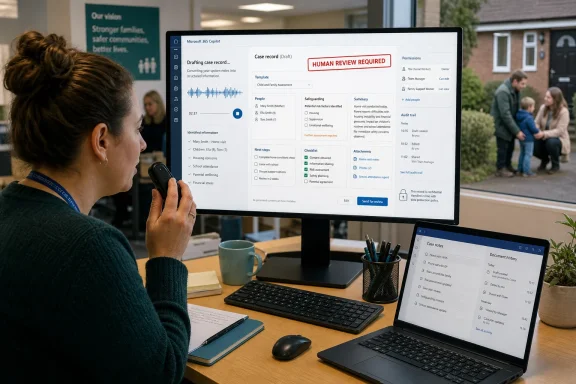
According to Lancashire County Council’s own account, staff can now record visit notes using Microsoft Teams or Facilitator, with Microsoft 365 Copilot converting those records into structured case documentation. That output is not treated as final. Social workers review, correct, and approve the material before it enters the formal record or informs any decision.
That distinction matters. Microsoft is not being invited to be the social worker. It is being used as a drafting layer between lived interaction and bureaucratic documentation, which is precisely where generative AI is strongest and also where it can do real damage if governance is weak.
The Real Innovation Is Not the Model, but the Workflow
The Lancashire example is easy to misunderstand if viewed as an AI breakthrough. The model is not diagnosing need, making safeguarding calls, or deciding who receives support. The more important change is procedural: the council has taken a workflow that previously required staff to reconstruct a visit after the fact and moved much of the drafting closer to the point of interaction.
Microsoft UK Stories describes the old pattern as one of duplication. A practitioner would capture notes during a visit, then later re-enter or reshape the same information into multiple systems or templates. In children’s services, where families may interact with schools, health services, charities, and statutory agencies, that kind of rekeying is not just inefficient. It can fragment the story of a case.
This is where Copilot’s usefulness becomes more plausible. Generative AI is not being asked to invent content; it is being asked to convert practitioner-provided material into a structured first draft. If the input is a spoken account of a visit and the output is a document aligned with Lancashire’s templates and language, then the productivity gain is not magical. It is a reduction in translation work.
That is also why frontline design matters. Lancashire says it built prompts and workflows around existing templates and reporting requirements, with staff involved in shaping the tools they would use. That is the difference between an AI pilot that looks impressive in a demo and one that survives Monday morning.
The 225,000-Hour Number Is Both Powerful and Incomplete
The headline figure — at least 225,000 hours saved annually — is enormous. It is also the number that deserves the most scrutiny. Lancashire has separately said that more than 6,500 staff, roughly 68 percent of its workforce, have been supported to use tools such as Microsoft 365 Copilot, and earlier council updates put expected savings above 200,000 hours a year on routine tasks.
Those numbers should be read as estimated capacity gains, not as audited proof that residents have already received 225,000 extra hours of care. In public-sector technology projects, “hours saved” often means time no longer spent on a particular task, not necessarily time that cleanly reappears as new service capacity. A social worker who saves 45 minutes on documentation may spend that time on a family, on another case, on training, or simply on making an impossible workload slightly less impossible.
That does not make the figure meaningless. It means the interesting question is not whether the number is exactly right, but whether the time saved lands where the council says it should: more direct contact with residents and families. Brett Aspden, Lancashire’s Mental Health Social Care Lead, framed the issue bluntly in Microsoft’s account and in Healthcare Digital: paperwork and admin have historically stood between practitioners and the people they support.
The more useful benchmark may be task-specific. Lancashire said in March that complex assessments such as social circumstance reports, which once could take up to two days to complete, had been reduced to around three or four hours with Copilot and carefully designed prompts. That is the kind of claim administrators can test, observe, and refine.
Human Review Is the Thin Line Between Assistance and Automation
Lancashire’s most important sentence may be the least flashy one: staff review all AI-generated output before finalising decisions. In social care, that is not a compliance footnote. It is the ethical center of the deployment.
Case records are not ordinary documents. They can affect safeguarding interventions, care packages, family support, legal processes, and a resident’s future interactions with the state. A hallucinated detail, a softened risk, or a misattributed statement can have consequences far beyond a bad meeting recap.
That is why the council’s insistence that practitioners retain responsibility is essential but not sufficient on its own. Human review only works when humans have enough time, training, and authority to challenge the draft. If Copilot creates a polished document that appears complete, the danger is not that staff blindly trust a robot; it is that a high-pressure environment normalizes skim-approval.
The best AI governance in this context will treat the generated draft as a potentially useful but untrusted artifact. The practitioner remains the author of record. The model’s job is to reduce blank-page labor, not to become an invisible decision-maker inside the case-management process.
The Public Sector Wants AI That Looks Boring
The Lancashire case also helps explain why Microsoft has been so aggressive in courting local government. Councils are drowning in demand, constrained by budgets, and loaded with document-heavy processes. They are exactly the kind of organizations where AI’s first practical value may come not from replacing staff, but from compressing the paperwork around staff.
Microsoft has already promoted Copilot deployments in other UK local authorities, including Oxfordshire and Kent, while Welsh councils have been experimenting with Copilot in housing, social care, risk assessments, and citizen correspondence. These are not glamorous AI use cases. They are the public-sector equivalent of clearing a blocked pipe.
That boringness is the point. The public does not need a council chatbot that performs empathy. It needs assessments completed faster, records kept consistently, residents not forced to repeat the same story to different teams, and professionals with enough breathing room to make good judgments.
For Microsoft, this is a better enterprise narrative than the generic productivity pitch. Copilot becomes less of a premium office assistant and more of an operational tool embedded in the way public services already document work. That makes the software stickier, harder to dismiss, and more politically defensible.
The Risks Move From the Demo Room to the Records Room
The more sensitive the workflow, the less impressive the demo should be allowed to become. In social care, a beautifully formatted AI-generated report is only valuable if it is accurate, proportionate, and traceable. The risk is not just hallucination; it is subtle distortion.
A model may compress nuance. It may turn uncertainty into confidence. It may omit context that a practitioner would have preserved. It may reproduce patterns in previous documentation that reflect institutional habits rather than the realities of a particular family or resident.
There is also the problem of data governance. Social-care records are among the most sensitive documents a local authority holds. Microsoft 365 Copilot operates inside enterprise permissions, but that does not eliminate the need for careful configuration, retention policies, access controls, audit trails, and staff training.
For WindowsForum’s IT-pro readership, this is where the Lancashire story becomes less about AI enthusiasm and more about tenant hygiene. A Copilot rollout in a social-care environment depends on the boring foundations: identity, permissions, data classification, endpoint security, logging, and clear rules about what can be recorded, transcribed, summarized, and stored.
The Windows and Microsoft 365 Stack Is Becoming Public Infrastructure
There is a broader platform story here. Microsoft is positioning Copilot not as a separate AI product but as an ambient layer across Microsoft 365. That makes sense commercially, but it also means the Windows and Microsoft 365 stack is increasingly part of how public institutions perform core functions.
For local government, that is both convenient and constraining. The convenience is obvious: staff already use Teams, Outlook, Word, SharePoint, and Microsoft identity services. Adding Copilot to an existing workflow is less disruptive than procuring a specialized AI platform from scratch.
The constraint is that public services become more dependent on Microsoft’s product roadmap, licensing model, and security posture. If a council builds productivity gains around Copilot, it is also building operational expectations around Copilot’s availability, pricing, and future behavior. That is not inherently wrong, but it should be treated as a strategic dependency.
This is the old enterprise software bargain in a new form. Microsoft offers integration and scale; organizations trade some control for lower friction. In social care, the stakes of that bargain are higher because the output touches vulnerable people, not just quarterly reports.
Lancashire Shows Where AI Productivity Finally Becomes Measurable
One reason AI productivity debates often feel circular is that the work being measured is vague. Did Copilot make a marketing manager more productive? Maybe. Did it save a project manager enough time to justify the license? Possibly. Did those savings become real organizational capacity? Hard to say.
Social care offers a more concrete test. If assessment reports move from days to hours, if practitioners spend less time rewriting visit notes, if families repeat themselves less often, and if documentation quality improves without weakening oversight, then the benefit is not abstract. It is operational.
That does not mean every council can copy Lancashire and collect the same results. Lancashire appears to have invested in training, prompt design, and frontline involvement. The council’s Digital Innovation team worked with services rather than simply dropping a tool into the tenant and calling it transformation.
The lesson for other organizations is uncomfortable but useful: Copilot does not remove the need for process design. It exposes whether the process was designed well enough to automate around. Bad templates, unclear policies, and chaotic permissions will not become good governance because a language model is attached to them.
Staff Trust Will Decide Whether the Rollout Lasts
The strongest evidence in Lancashire’s favor is not the hour-saving estimate, but the way practitioners are described as using the system. Microsoft’s account says some staff in services became better at writing prompts than digital teams or Microsoft personnel. That is a small detail with large implications.
Technology imposed on frontline workers tends to become shelfware, workaround fuel, or another admin burden. Technology shaped by frontline workers has a chance of becoming invisible infrastructure. In social care, that difference matters because staff already operate under emotional load, legal scrutiny, and chronic time pressure.
If workers see Copilot as management surveillance, adoption will sour. If they see it as a tool that genuinely reduces the after-hours documentation grind, it will spread. The human factor is not a soft issue here; it is the deployment model.
There is also a morale argument. Social workers do not enter the profession to perfect templates. If AI can strip some of the clerical weight out of the job without stripping out professional judgment, it may help retention as much as productivity.
The Real Test Is Whether Residents Notice
Public-sector AI projects often talk about efficiency first and citizens second. Lancashire’s framing wisely reverses that, at least rhetorically. The council says the goal is more face-to-face, relationship-based care, not merely faster paperwork.
Residents should be the measure. Do families feel listened to? Are assessments completed sooner? Are records more consistent across teams? Are practitioners better prepared because the previous interaction was captured clearly? Are complaints reduced because documentation is more accurate?
These outcomes are harder to publish than a headline hour-saving figure, but they are more important. A council could save 225,000 hours and still fail residents if the saved time is absorbed into backlogs without improving the service experience. Conversely, even a smaller verified saving could be transformative if it lands directly in front-line contact.
The best future reporting from Lancashire would therefore move beyond capacity estimates. It would show how the reclaimed time changes caseload handling, waiting times, staff stress, documentation quality, and resident outcomes. That is where the Copilot story either matures or becomes another productivity press release.
The Lancashire Lesson Is Smaller Than the Hype and Bigger Than the Pilot
Lancashire’s Copilot deployment should neither be dismissed as vendor marketing nor swallowed whole as proof that AI has solved social care. It is more interesting than either caricature. It shows a plausible, bounded, high-impact use of generative AI in a service where administrative friction has real human cost.
The boundaries are what make it credible. The AI drafts; the professional decides. The tool structures information; the practitioner owns the record. The workflow saves time; the council must prove that time improves care.
For Microsoft, Lancashire supplies a public-sector case study with emotional force and operational specificity. For councils and IT departments, it supplies a harder checklist. The technology is only one layer; the rest is governance, training, permissions, auditability, staff trust, and disciplined measurement.
The 225,000 Hours Are a Promise Lancashire Now Has to Prove
The concrete lessons from Lancashire are less about generative AI in the abstract than about where it is allowed to sit inside a sensitive public workflow.
- Lancashire County Council is using Microsoft 365 Copilot with tools such as Teams and Facilitator to turn spoken social-care notes into structured draft documentation.
- The council estimates that its AI use cases could save at least 225,000 staff hours a year, though that should be understood as a capacity estimate rather than an independently audited outcome measure.
- Social workers remain responsible for reviewing AI-generated content and making final professional judgments, which is essential in safeguarding and care contexts.
- The strongest use case is not replacing practitioners but reducing duplicate documentation, template work, and the administrative reconstruction of visits.
- Other councils should treat Lancashire’s rollout as a workflow and governance model, not merely as evidence that buying Copilot licenses will automatically produce savings.
- The next meaningful test is whether residents and families experience faster, more consistent, and more human support as a result of the reclaimed time.
The future of AI in public services will not be decided by the most theatrical demos, but by quiet deployments like this one, where the software is useful precisely because it stays in its lane. Lancashire’s experiment suggests that Microsoft’s AI can matter when it attacks the dullest part of the job and leaves the human part to humans. If the council can now show that those 225,000 hours become better care rather than just better spreadsheets, Copilot will have earned a more serious place in the public-sector technology stack.
References
- How Microsoft AI Can Save 225,000 Social Care Hours Annually Healthcare Digital · 2026-07-07T10:07:08.323350
- ukstories.microsoft.com ukstories.microsoft.com