

LC Waikiki’s move from a legacy Dynamics AX installation to Microsoft Dynamics 365 Finance and Supply Chain Management is a textbook example of how large, fast-growing retail organizations can modernize core ERP systems to support scale, agility, and data-driven decision making. The Istanbul-based retailer—operating roughly 1,300 stores across some 60 countries and employing approximately 55,000 people—chose a cloud-first, modular Microsoft stack to unify financials, automate processes, and surface analytics across a global operation that serves millions of weekly customers. The change is framed as an effort not just to replace aging systems, but to build an “intelligent and connected enterprise” that leverages Power Platform automation and Azure analytics to turn transactional volume into actionable insight.
For IT and business leaders considering a similar path, the following practical steps will improve the odds of success:
Conclusion
LC Waikiki’s ERP modernization is an instructive, high-scale example of retail digital transformation. By aligning Dynamics 365 Finance and Supply Chain Management with the Power Platform and Azure Synapse, the company built a pathway from transactional systems to analytics and automation. The approach balances local regulatory needs and global operational scale while providing an extensible platform for future AI-driven capabilities. For retailers seeking similar outcomes, the lesson is clear: pick an architecture that separates transactional integrity from analytical scale, prioritize adoption and change management, and keep governance tight as you unleash new data-driven capabilities.
Source: Microsoft LC Waikiki finds the right fit for innovation with Dynamics 365 | Microsoft Customer Stories
 Background
Why LC Waikiki needed a new ERP
LC Waikiki’s growth trajectory—reported revenue jumping to roughly ₺207 billion in 2024 (a roughly 54–55% year-on-year increase across multiple news reports)—created pressure on legacy infrastructure built on Dynamics AX. As transaction volumes, store counts, and international operations grew, the limitations of monolithic on-prem ERP systems became apparent: slow reporting cycles, brittle integrations, and the operational overhead of maintaining country-specific customizations. Public reporting and industry coverage confirm the scale of LC Waikiki’s expansion and the urgency to modernize core systems to sustain growth.The strategic goal: scale, performance, and local compliance
LC Waikiki’s leadership framed the migration as more than a technology refresh. They required a solution that could:- Support high transaction volumes and seasonal spikes,
- Provide a single pane of glass for financial and supply chain controls,
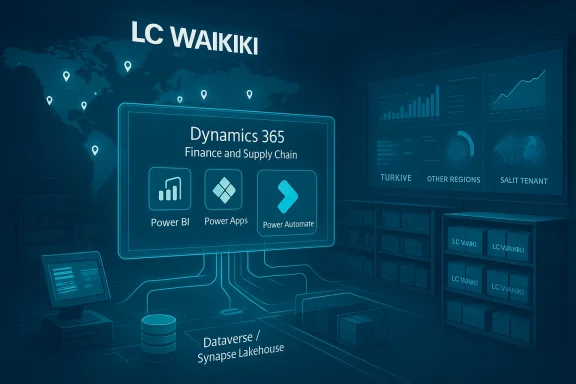
- Enable regional governance and data separation where required (for example, Türkiye on a dedicated tenant, other regions on a different instance),
- Unlock automation, analytics, and rapid application development through the Power Platform and Azure services.
Implementation overview
Platform selection: Dynamics 365 Finance + Supply Chain Management
LC Waikiki selected Dynamics 365 Finance and Dynamics 365 Supply Chain Management as the ERP core. These modules are designed to handle global financials, multi-ledger accounting, procurement, inventory, distribution, and manufacturing/sourcing processes at scale—requirements that align closely with LC Waikiki’s omni‑channel retail model and large SKU volumes. Dynamics 365’s cloud-native architecture, continuous updates, and built-in integration points with the Microsoft Power Platform made it a natural match. Microsoft’s product guidance and release cadence emphasize AI, automation, and closer integration with Power Platform tooling—capabilities LC Waikiki wanted to harness.Execution partners and scope
The migration was executed with the help of Microsoft technologies and partner expertise (partner case studies indicate implementations combining Dynamics 365 Finance, Supply Chain, and Commerce with Power Platform solutions). The scope included:- Financial management modernization (general ledger, consolidation, period close automation),
- Supply chain modernization (inventory visibility, demand planning, and logistics),
- Integration of point-of-sale and e‑commerce transactional streams,
- Low-code automation and custom business portals via Power Apps, Power Automate, and Power BI,
- Advanced analytics and data warehousing through Azure Synapse Analytics (or equivalent analytics fabric).
User experience and adoption
A significant motivator for LC Waikiki was user productivity: Dynamics 365’s web-based, role-centric workspaces allow finance and supply chain users to access task lists, KPIs, and actions from a single dashboard. The idea is to reduce context switching and enable faster decision cycles for merchandising, replenishment, and store operations teams. Power BI dashboards and embedded reporting were used to create interactive operational scorecards so teams can act on near-real-time insights. Microsoft product materials and partner deployments show this approach reliably reduces the time for insight-to-action in retail contexts.Technology stack and data architecture
Core components implemented
- Dynamics 365 Finance — financial accounting, period close, and multi-entity consolidation.
- Dynamics 365 Supply Chain Management — inventory control, procurement, and warehouse management.
- Power Platform (Power BI, Power Apps, Power Automate) — reporting, low-code apps, and process automation.
- Azure Synapse Analytics (or Synapse Link) — analytical lakehouse / data warehouse and large-scale analytics.
- Dataverse and Synapse Link (where Dynamics stores data in Dataverse, Synapse Link can continuously replicate operational tables to Synapse for analytics).
Data flows and analytics
Operational data from Dynamics 365 and point-of-sale systems flows into Dataverse and is mirrored into an analytical store through Synapse Link. From there:- Power BI consumes Synapse data for enterprise dashboards and executive reporting,
- Synapse enables advanced analytics, ad hoc queries, and ML experimentation,
- Power Automate triggers cross-system workflows (for example, exception handling in inventory replenishment),
- Power Apps deliver role-specific portals and task interfaces to store managers, finance users, and supply chain planners.
Business impact — what LC Waikiki aimed to achieve and early outcomes
Operational benefits
- Faster financial close and consolidation — automated processes and standardized financial controls help accelerate close cycles across many legal entities.
- Improved inventory visibility and demand forecasting — supply chain modules, integrated sales data, and analytics improve replenishment accuracy and reduce stockouts.
- Centralized reporting with actionable KPIs — Power BI dashboards provide merchandising and store leadership with real‑time metrics to react faster to trends.
- Reduced manual reconciliation and improved cost control — automation in revenue and cost calculations reduces human error and shortens reconciliation time.
Scale and resilience
LC Waikiki reports handling very high volumes of commerce across physical and digital channels; modernization was explicitly positioned to support more than a million daily transactions and to maintain performance during peak retail moments. That kind of throughput drives the need for careful tenant design, scaled compute for Synapse queries, and robust integration patterns to prevent transactional backpressure on the ERP. Note: the specific figure of “more than one million transactions daily” appears in Microsoft’s customer narrative; independent confirmation of that precise number beyond company reporting is not publicly available at present and should be treated as vendor-supplied telemetry. Where vendor or single-source telemetry is used, readers should consider independent validation as part of procurement due diligence.Critical analysis — strengths, trade-offs, and risks
Strengths and why this architecture makes sense
- Cloud-native ERP: Moving to Dynamics 365 Finance & SCM removes much of the operational burden that comes with on-prem upgrades and patching, while enabling Microsoft-managed scale and continuous feature improvements. Dynamics 365’s roadmap prioritizes AI and Copilot integrations that can add productivity over time.
- Tight Power Platform integration: Embedding Power BI, Power Apps, and Power Automate reduces integration complexity and enables rapid development of role-specific workflows and dashboards. These tools lower time-to-value for operational innovations.
- Analytics-first approach: Using Azure Synapse (or Synapse Link) to decouple analytics from transactional workloads is an industry-proven pattern. It enables petabyte-scale queries and ML readiness without overloading ERP transaction throughput.
- Operational separation for compliance: The decision to run Türkiye on a dedicated instance while consolidating other regions separately is a pragmatic way to balance data sovereignty, regulatory requirements, and localized performance needs.
Trade-offs and the hard parts
- Tenant and licensing complexity: Running multiple Dynamics instances increases administrative overhead and licensing complexity. Organizations must forecast account provisioning, license types, and cross-tenant integrations carefully.
- Integration engineering: While Dataverse and Synapse Link reduce traditional ETL needs, complex legacy POS systems, third-party logistics platforms, and country-specific fiscal reporting systems still require integration engineering. Expect considerable effort for fault-tolerant, idempotent data flows and reconciliation logic.
- Change management: Millions of customers and thousands of store employees mean user training, process redesign, and staged rollouts are essential. Retailers must invest in adoption programs and contingency operational plans during cutover windows.
- Cost management at scale: Azure Synapse and Power BI Premium licensing can scale cost quickly as analytics demand grows. Without governance and capacity planning (e.g., reserved SQL pools, Power BI capacity sizing), cloud spend can overrun expected budgets.
Risks and mitigation
- Risk: Operational disruption during cutover — Mitigation: parallel-run strategies, phased rollouts by country or business unit, and thorough cutover rehearsals.
- Risk: Data consistency and reconciliation issues — Mitigation: implement ledgered reconciliation processes and monitoring, message brokers for reliable integration, and strong observability for data pipelines.
- Risk: Vendor lock‑in and future-proofing — Mitigation: keep data export paths open (e.g., data lake exports), maintain API contracts, and document business logic outside proprietary custom code.
- Risk: Security and compliance across regions — Mitigation: tenant segmentation, data residency controls, and centralized policy enforcement through Azure-native security tooling.
Operational lessons for retail CIOs and IT leaders
Practical recommendations based on LC Waikiki’s approach
- Design for separation where required: if a country has unique regulatory needs or dominant transactional weight, plan a dedicated tenant or instance to isolate performance and compliance concerns.
- Use Synapse Link for Dataverse (or a comparable lakehouse approach) to minimize ETL headaches and enable near-real-time analytics while protecting transactional systems from heavy read loads.
- Treat automation and reporting as first-class deliverables: embed Power Platform solutions into user workflows during the ERP rollout rather than as afterthoughts.
- Build a governance and cost-management practice around analytics capacity to prevent runaway spend from large Synapse workloads and Power BI Premium capacities.
- Plan for continuous operations: ERP modernizations are ongoing. Adopt a product-centric operating model for the ERP and analytics stack—including roadmap planning for AI features like Copilot and agentic automation as these capabilities mature.
Implementation checklist (short)
- Inventory legacy integrations and classify by criticality.
- Architect tenant topology by region and performance boundaries.
- Define data model mappings and identify Dataverse entities to be mirrored.
- Establish Power BI governance (workspaces, datasets, refresh cadence).
- Run phased pilot (non-critical region or business unit) and measure KPIs before broad rollout.
Vendor claims and verification — what’s independently provable and what needs caution
- Verifiable: LC Waikiki’s scale—~1,300 stores, presence in 60+ countries, and a workforce of ~55,000—is corroborated by several independent news reports and public references. Reported revenue of roughly ₺207 billion in 2024 is widely referenced in media reporting summarizing company statements.
- Verifiable: The technical fit—Dynamics 365 Finance & Supply Chain Management combined with Power Platform and Azure Synapse—is consistent with Microsoft’s documented architecture patterns and partner case studies for large retailers. Microsoft technical guidance explains Power BI + Synapse integration and Synapse Link patterns for Dataverse data.
- Caveat (single-source claims): Specific operational telemetry (for example, “more than one million transactions daily”) and internal KPIs quoted in vendor case studies are often provided by the customer or vendor and may not be independently audited. When making procurement or architectural decisions, treat single-source performance metrics as directional and request operational baselines, SLAs, and load reports during vendor evaluation.
The future-state: AI, Copilot, and intelligent operations
Microsoft’s Dynamics 365 roadmap emphasizes AI, Copilot extensions, and automation within Finance and Supply Chain modules. For a retailer like LC Waikiki, these trendlines translate into:- AI-assisted close and reconciliation to reduce month-end cycles,
- Demand forecasting and supply optimization augmented by ML models trained on Synapse datasets,
- Conversational copilots embedded into finance and supply chain workspaces to accelerate query-to-action and reduce hero analyst dependence.
Final assessment and recommendations
LC Waikiki’s migration to Dynamics 365 Finance and Supply Chain Management, paired with Power Platform and Azure Synapse, is an archetypal modern retail ERP modernization: it addresses scale, provides an analytics-ready platform, and creates the foundation for higher automation and AI. The project leverages Microsoft’s integrated tooling to reduce time-to-insight and enable rapid app development for operational teams.For IT and business leaders considering a similar path, the following practical steps will improve the odds of success:
- Treat the initiative as a business transformation, not just a technology upgrade. Ensure finance, merchandising, supply chain, and store operations co-own the program.
- Plan tenant topologies and data residency early. The twin-tenant approach LC Waikiki used—separating its home market from international regions—can help with regulatory, tax, and performance segregation.
- Invest in data and integration engineering. Synapse Link and Dataverse reduce some ETL burden, but legacy POS and logistics systems still need resilient, observable integrations.
- Start small, measure early, and scale. Pilot advanced analytics and Power Platform automation in specific teams to build momentum and refine governance.
- Build cost governance guardrails for cloud analytics consumption and Power BI capacity to prevent unanticipated spend.
Conclusion
LC Waikiki’s ERP modernization is an instructive, high-scale example of retail digital transformation. By aligning Dynamics 365 Finance and Supply Chain Management with the Power Platform and Azure Synapse, the company built a pathway from transactional systems to analytics and automation. The approach balances local regulatory needs and global operational scale while providing an extensible platform for future AI-driven capabilities. For retailers seeking similar outcomes, the lesson is clear: pick an architecture that separates transactional integrity from analytical scale, prioritize adoption and change management, and keep governance tight as you unleash new data-driven capabilities.
Source: Microsoft LC Waikiki finds the right fit for innovation with Dynamics 365 | Microsoft Customer Stories
