

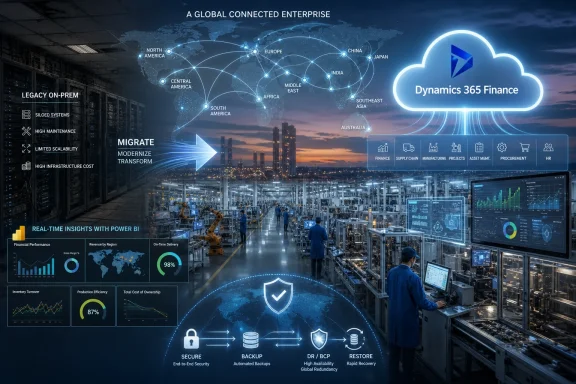
Iriso Electronics, a Japanese connector manufacturer with operations across 10 countries and regions, has moved its core ERP environment to Microsoft Dynamics 365 Finance after beginning a modernization program driven by 2027 support deadlines, cloud resiliency goals, and the need for better global data visibility. The company’s story is not simply another vendor case study about a successful SaaS migration. It is a useful snapshot of where manufacturing IT is headed: away from carefully preserved on-premises systems that embody decades of process knowledge, and toward cloud platforms that promise standardization, analytics, and operational resilience in one architectural bargain.
That bargain is attractive because companies like Iriso do not have the luxury of treating ERP as back-office plumbing anymore. In automotive electronics, industrial equipment, and consumer device supply chains, the system of record increasingly shapes how fast a manufacturer can respond to customers, how clearly it can account for profit and loss, and how confidently it can operate across borders. Iriso’s Dynamics 365 move shows Microsoft pressing its advantage in a market where modernization is less about replacing screens and more about replacing operating assumptions.
Support deadlines have a way of turning vague modernization ambitions into budgeted projects. Iriso had relied on ERP technology for its global core systems for almost 20 years, and the impending end of maintenance support in 2027 gave its Information Systems Department a hard date around which to organize the future. That is the kind of deadline IT leaders dislike but secretly need: it forces the conversation out of “someday” and into “what can we still safely run three years from now?”
The company could have chosen the familiar route. Patch the existing system, extend what could be extended, and absorb the cost of keeping an aging environment alive for another cycle. Many manufacturers do exactly that because ERP replacement is expensive, disruptive, and politically fraught. A system that has been running for two decades is never just software; it is a map of exceptions, compromises, local practices, and tribal knowledge.
Iriso’s management apparently concluded that prolonging the old model would not solve the structural problem. The company’s existing ERP had become difficult to upgrade because it operated continuously, supporting global activity around the clock. That 24/7 burden is common in multinational manufacturing: there is always a plant, warehouse, sales office, or finance team somewhere that needs the system online.
The more interesting point is that Iriso did not frame the problem as merely technical obsolescence. It linked ERP renewal to business continuity, data use, internal controls, and process standardization. That is the right lens. An old ERP system may keep producing invoices and work orders, but if it blocks timely analytics, complicates disaster recovery, and consumes scarce IT labor, it becomes a strategic constraint disguised as stability.
That calculation is changing. The costs of maintaining high availability, disaster recovery, security hardening, and regular upgrades have risen faster than many internal IT teams can absorb. For a company with limited information systems resources, the question is no longer whether on-premises gives more control in theory. It is whether the organization can actually exercise that control at the standard the business now requires.
Iriso’s comments about DR and business continuity are especially telling. Building and operating a disaster recovery environment for an on-premises or IaaS-based ERP stack can be expensive, complex, and easy to defer. Cloud SaaS does not eliminate resilience planning, but it changes the baseline. Instead of designing every layer yourself, the customer inherits much of the provider’s architecture and must focus on configuration, process, governance, and recovery procedures.
That is why Dynamics 365 Finance was positioned as more than an application replacement. Microsoft’s pitch is that ERP, Azure infrastructure, Power BI analytics, Office integration, and deployment support can work as a coherent platform. For Iriso, the appeal was not merely that Dynamics 365 ran in the cloud. It was that the cloud model reduced the number of operational problems the company had to own alone.
There is a trade-off here, and it should not be understated. SaaS ERP customers accept a different kind of dependency: vendor release cycles, licensing models, platform assumptions, and limits on deep customization. But for many manufacturers, the old alternative has become less romantic. A heavily customized on-premises ERP can feel independent until a security issue, hardware refresh, support deadline, or staffing shortage exposes how much fragility has accumulated.
A single instance can make global governance cleaner. It can support common master data, shared processes, centralized controls, and more consistent reporting. It can also make intercompany transactions faster and less dependent on reconciliation rituals that turn month-end close into an archaeological exercise.
But the migration challenge is brutal. Iriso could not simply move one subsidiary at a time and learn from each go-live. Because intercompany transactions were automated in real time across the environment, the company faced what project teams politely call a big bang migration. Everyone moves together, or the architecture itself starts working against the rollout plan.
That choice explains why Iriso used a waterfall model despite the fashion for agile delivery. In a large ERP migration with a tightly coupled global instance, phased experimentation has limits. Requirements, testing, cutover planning, and operational readiness need enough discipline that the business can cross the bridge in one coordinated motion.
The company reportedly spent about two years repeatedly testing data migration before cutover. That detail matters more than any marketing phrase about digital transformation. ERP modernization succeeds or fails in the unglamorous middle: data quality, interface behavior, user readiness, performance testing, exception handling, and the ability to rehearse the move until the organization no longer treats go-live as a heroic improvisation.
Still, it would be a mistake to read this as proof that vendor support can make ERP replacement easy. Iriso’s own account points to the familiar pain: business departments not accustomed to a major IT project, difficulty coordinating people and schedules, rework during testing, and a heavy reliance on systems integrators. These are not side effects. They are the project.
FastTrack can reduce avoidable mistakes, especially around architecture, performance, sizing assumptions, and readiness gates. It can also provide credibility when internal teams need outside validation to move forward. In a SaaS environment, where customers do not control every layer, guidance from the platform owner is particularly valuable.
But the deepest work still belongs to the customer. Iriso had to define how its group companies would operate in the new system, how manufacturing cost management and interface processing would fit, and how departments would adapt to changed processes. Microsoft and partners can help steer that journey, but they cannot decide what kind of operating company Iriso wants to become.
That is the core lesson for other ERP customers watching from the sidelines. Cloud migration shifts the burden; it does not erase it. Infrastructure risk may move toward the provider, but process risk, data risk, and organizational readiness remain firmly inside the enterprise.
That model is increasingly untenable in manufacturing. A company serving automotive, industrial, and consumer equipment markets needs faster insight into sales, inventory, production, purchasing, and finance. It needs to compare performance across sites and understand profitability in ways that map to business accountability, not just accounting structures.
Dynamics 365’s integration with Power BI and Azure gave Iriso a path toward self-service analytics. The significance is not that executives get prettier dashboards. It is that business users can begin asking operational questions without filing every request through the IT department’s reporting queue.
Self-service BI is also where governance becomes harder. Giving departments more freedom to analyze data only works if master data, security models, semantic definitions, and reporting standards are strong enough to prevent the company from producing multiple competing versions of the truth. ERP modernization can enable better analytics, but it also exposes whether the organization has the discipline to use analytics responsibly.
Iriso’s goal of visualizing and analyzing data horizontally across the business is the right ambition. The strongest ERP programs do not simply move transactions into the cloud; they create a data foundation that lets management see across functional silos. For a global manufacturer, that may be the difference between reacting to local reports and managing the enterprise as an integrated system.
That roadmap is where the story becomes more important than a single Dynamics 365 deployment. ERP has long been the financial and transactional backbone of manufacturing, but the next wave of value comes from connecting ERP to the shop floor, engineering, quality, and customer-facing processes. The result is not one monolithic system, but a more integrated operating fabric.
MES integration would bring production execution closer to enterprise planning and financial accountability. PLM integration would connect design decisions to downstream costs earlier in the product lifecycle. Power BI can expose performance patterns, while Copilot and other generative AI tools may eventually help users navigate processes, summarize exceptions, or accelerate analysis.
The danger is platform sprawl under a different name. A company can modernize from on-premises ERP into a cloud ecosystem and still end up with fragmented workflows if integration is treated as an afterthought. The difference is that Microsoft is trying to make its stack the default integration plane: Dynamics 365 for operations, Azure for data and infrastructure, Power BI for analytics, Office for productivity, and Copilot for AI-assisted work.
For customers already invested in Microsoft’s productivity stack, that is a compelling proposition. It lowers friction and gives IT departments a familiar governance umbrella. For competitors, it is also the strategic threat: Microsoft does not need to win every best-of-breed comparison if it can win the architecture conversation.
Iriso’s selection criteria reflected the practical version of that strategy. The company evaluated cost, functionality, implementation ease, post-implementation support, global language and country support, operating costs, BI, DR, and support systems. Dynamics 365 won not simply because it had ERP features, but because it aligned with a broader cloud and productivity environment.
This is where Microsoft’s advantage differs from traditional ERP incumbency. The company can sell a cloud operating model, not just a module list. Its credibility comes from Azure scale, Office ubiquity, Power BI adoption, partner ecosystems, and the promise that future AI capabilities will appear inside tools employees already use.
That does not mean every manufacturer should default to Dynamics 365. ERP selection remains brutally context-specific, and the wrong fit can saddle a company with expensive workarounds. But Iriso’s decision shows how the evaluation matrix has changed. The question is no longer just “Which ERP best models our business today?” It is also “Which platform gives us the best chance of evolving without another generational replacement?”
For Microsoft, customer stories like Iriso’s are designed to answer that second question. The company wants Dynamics 365 to be seen as a modernization platform for manufacturers that need global standardization without building a private cloud empire around their ERP.
Iriso’s project required reviewing organizational definitions, business processes, and data linkages. That sounds administrative until one recognizes what it means in practice. ERP forces decisions about who owns data, which process variations are legitimate, how exceptions are handled, and whether local autonomy must yield to global comparability.
This is why cloud ERP is often as much a management program as an IT program. SaaS platforms encourage customers to align with standard capabilities because excessive customization undermines upgradeability and increases operational drag. That can be healthy if it eliminates unnecessary complexity. It can be damaging if it suppresses business practices that genuinely differentiate the company.
Iriso appears to have treated standardization as a way to strengthen accountability and global operations rather than merely simplify IT. That distinction matters. Standardization for IT convenience alone can create resentment. Standardization tied to better decision-making, internal control, customer service, and cross-border management has a stronger business case.
The company’s smooth April 2024 go-live suggests that early involvement from business departments helped. Users are more likely to absorb change when they have participated in requirements, selection, testing, and readiness work. ERP programs fail when the business is treated as an audience for transformation rather than a co-author of it.
A manufacturer cannot deliver that experience if sales, inventory, production, purchasing, and finance operate through disconnected reporting layers. The front office can only be as responsive as the systems behind it. ERP modernization, in that sense, becomes a customer experience project even when no customer ever logs into the ERP.
This is especially important in automotive supply chains, where timing, quality, traceability, and accountability are unforgiving. Tier 1 relationships demand reliability, but electrification and the growth of connected devices are also changing product complexity. Suppliers that can manage variation, cost, and delivery visibility more effectively have a better chance of being chosen repeatedly.
Iriso’s business is connectors, a category that sounds simple only to people outside electronics manufacturing. As devices become more electrified, automated, and sensor-rich, the humble connector becomes part of a larger reliability and design conversation. The ERP layer matters because it supports the commercial and operational discipline behind those engineering commitments.
That is why the company’s modernization should not be read as a back-office cleanup exercise. It is part of a broader effort to make Iriso more responsive in markets where manufacturing excellence increasingly includes information excellence.
An assistant that summarizes bad data produces faster confusion. An AI layer over fragmented processes can make inconsistency easier to access, not easier to resolve. Before companies can safely rely on AI for operational decisions, they need clean transactional foundations, governed data models, and processes stable enough for automation to help rather than hallucinate order.
That is why Iriso’s ERP move matters to its AI plans. Dynamics 365, Power BI, Azure, and Office integration create a more coherent substrate for future AI use. If the company can standardize production data, connect MES and PLM, and govern analytics well, Copilot-style interfaces may eventually become more than a productivity flourish.
The near-term value is likely to be modest and practical. Users may get help navigating workflows, summarizing records, drafting communications, or identifying anomalies. Over time, the richer prize is decision support: understanding cost impacts, production constraints, supply risks, and customer commitments across a more integrated data estate.
Microsoft’s challenge is to keep that promise grounded. Enterprise customers have heard many waves of automation rhetoric before. AI will not rescue a weak ERP program, but a strong ERP modernization can create conditions where AI becomes operationally useful rather than performative.
The concrete lessons are not glamorous, which is why they are valuable.
That bargain is attractive because companies like Iriso do not have the luxury of treating ERP as back-office plumbing anymore. In automotive electronics, industrial equipment, and consumer device supply chains, the system of record increasingly shapes how fast a manufacturer can respond to customers, how clearly it can account for profit and loss, and how confidently it can operate across borders. Iriso’s Dynamics 365 move shows Microsoft pressing its advantage in a market where modernization is less about replacing screens and more about replacing operating assumptions.
 The ERP Deadline Became a Business Strategy
Support deadlines have a way of turning vague modernization ambitions into budgeted projects. Iriso had relied on ERP technology for its global core systems for almost 20 years, and the impending end of maintenance support in 2027 gave its Information Systems Department a hard date around which to organize the future. That is the kind of deadline IT leaders dislike but secretly need: it forces the conversation out of “someday” and into “what can we still safely run three years from now?”The company could have chosen the familiar route. Patch the existing system, extend what could be extended, and absorb the cost of keeping an aging environment alive for another cycle. Many manufacturers do exactly that because ERP replacement is expensive, disruptive, and politically fraught. A system that has been running for two decades is never just software; it is a map of exceptions, compromises, local practices, and tribal knowledge.
Iriso’s management apparently concluded that prolonging the old model would not solve the structural problem. The company’s existing ERP had become difficult to upgrade because it operated continuously, supporting global activity around the clock. That 24/7 burden is common in multinational manufacturing: there is always a plant, warehouse, sales office, or finance team somewhere that needs the system online.
The more interesting point is that Iriso did not frame the problem as merely technical obsolescence. It linked ERP renewal to business continuity, data use, internal controls, and process standardization. That is the right lens. An old ERP system may keep producing invoices and work orders, but if it blocks timely analytics, complicates disaster recovery, and consumes scarce IT labor, it becomes a strategic constraint disguised as stability.
SaaS Won Because Infrastructure Had Become the Wrong Fight
Iriso’s move from on-premises ERP to a SaaS-based Dynamics 365 Finance environment reflects a broader shift in manufacturing IT priorities. For years, large industrial companies treated control over infrastructure as a form of risk management. Owning the servers, managing the patch windows, and tuning the system locally felt safer than trusting a cloud provider with the core.That calculation is changing. The costs of maintaining high availability, disaster recovery, security hardening, and regular upgrades have risen faster than many internal IT teams can absorb. For a company with limited information systems resources, the question is no longer whether on-premises gives more control in theory. It is whether the organization can actually exercise that control at the standard the business now requires.
Iriso’s comments about DR and business continuity are especially telling. Building and operating a disaster recovery environment for an on-premises or IaaS-based ERP stack can be expensive, complex, and easy to defer. Cloud SaaS does not eliminate resilience planning, but it changes the baseline. Instead of designing every layer yourself, the customer inherits much of the provider’s architecture and must focus on configuration, process, governance, and recovery procedures.
That is why Dynamics 365 Finance was positioned as more than an application replacement. Microsoft’s pitch is that ERP, Azure infrastructure, Power BI analytics, Office integration, and deployment support can work as a coherent platform. For Iriso, the appeal was not merely that Dynamics 365 ran in the cloud. It was that the cloud model reduced the number of operational problems the company had to own alone.
There is a trade-off here, and it should not be understated. SaaS ERP customers accept a different kind of dependency: vendor release cycles, licensing models, platform assumptions, and limits on deep customization. But for many manufacturers, the old alternative has become less romantic. A heavily customized on-premises ERP can feel independent until a security issue, hardware refresh, support deadline, or staffing shortage exposes how much fragility has accumulated.
A Single Global Instance Raised the Stakes
Iriso’s ERP environment was not a simple country-by-country replacement. The company operates 11 group companies under a single system instance, a structure designed to unify and automate transactions and accounting processes. That architecture brings real benefits, but it also turns migration into a high-wire act.A single instance can make global governance cleaner. It can support common master data, shared processes, centralized controls, and more consistent reporting. It can also make intercompany transactions faster and less dependent on reconciliation rituals that turn month-end close into an archaeological exercise.
But the migration challenge is brutal. Iriso could not simply move one subsidiary at a time and learn from each go-live. Because intercompany transactions were automated in real time across the environment, the company faced what project teams politely call a big bang migration. Everyone moves together, or the architecture itself starts working against the rollout plan.
That choice explains why Iriso used a waterfall model despite the fashion for agile delivery. In a large ERP migration with a tightly coupled global instance, phased experimentation has limits. Requirements, testing, cutover planning, and operational readiness need enough discipline that the business can cross the bridge in one coordinated motion.
The company reportedly spent about two years repeatedly testing data migration before cutover. That detail matters more than any marketing phrase about digital transformation. ERP modernization succeeds or fails in the unglamorous middle: data quality, interface behavior, user readiness, performance testing, exception handling, and the ability to rehearse the move until the organization no longer treats go-live as a heroic improvisation.
FastTrack Was the Safety Net, Not the Parachute
Microsoft’s FastTrack program appears throughout the Iriso story as an enabling force, offering guidance, best practices, blueprint reviews, production readiness assessments, and post-go-live support. That fits the way Microsoft wants enterprise customers to see Dynamics 365: not as a product thrown over the wall, but as a guided transformation backed by reference patterns and cloud deployment experience.Still, it would be a mistake to read this as proof that vendor support can make ERP replacement easy. Iriso’s own account points to the familiar pain: business departments not accustomed to a major IT project, difficulty coordinating people and schedules, rework during testing, and a heavy reliance on systems integrators. These are not side effects. They are the project.
FastTrack can reduce avoidable mistakes, especially around architecture, performance, sizing assumptions, and readiness gates. It can also provide credibility when internal teams need outside validation to move forward. In a SaaS environment, where customers do not control every layer, guidance from the platform owner is particularly valuable.
But the deepest work still belongs to the customer. Iriso had to define how its group companies would operate in the new system, how manufacturing cost management and interface processing would fit, and how departments would adapt to changed processes. Microsoft and partners can help steer that journey, but they cannot decide what kind of operating company Iriso wants to become.
That is the core lesson for other ERP customers watching from the sidelines. Cloud migration shifts the burden; it does not erase it. Infrastructure risk may move toward the provider, but process risk, data risk, and organizational readiness remain firmly inside the enterprise.
The Real Prize Was Data That Moves at Business Speed
One of Iriso’s pre-migration frustrations was the lack of embedded BI capability in its existing ERP environment. The Information Systems Department relied on stylized reports, which is a familiar symptom of older enterprise systems. Reports exist, but they are rigid, slow to change, and too dependent on IT intervention.That model is increasingly untenable in manufacturing. A company serving automotive, industrial, and consumer equipment markets needs faster insight into sales, inventory, production, purchasing, and finance. It needs to compare performance across sites and understand profitability in ways that map to business accountability, not just accounting structures.
Dynamics 365’s integration with Power BI and Azure gave Iriso a path toward self-service analytics. The significance is not that executives get prettier dashboards. It is that business users can begin asking operational questions without filing every request through the IT department’s reporting queue.
Self-service BI is also where governance becomes harder. Giving departments more freedom to analyze data only works if master data, security models, semantic definitions, and reporting standards are strong enough to prevent the company from producing multiple competing versions of the truth. ERP modernization can enable better analytics, but it also exposes whether the organization has the discipline to use analytics responsibly.
Iriso’s goal of visualizing and analyzing data horizontally across the business is the right ambition. The strongest ERP programs do not simply move transactions into the cloud; they create a data foundation that lets management see across functional silos. For a global manufacturer, that may be the difference between reacting to local reports and managing the enterprise as an integrated system.
Manufacturing Modernization Is Moving Up the Stack
Iriso’s next ambitions extend beyond finance and core ERP. The company has discussed standardizing operations across the group, improving data sharing, strengthening internal controls and DR/BCP, introducing common MES capabilities at production plants, visualizing equipment and line status, and linking PLM tools to cost management from the design stage.That roadmap is where the story becomes more important than a single Dynamics 365 deployment. ERP has long been the financial and transactional backbone of manufacturing, but the next wave of value comes from connecting ERP to the shop floor, engineering, quality, and customer-facing processes. The result is not one monolithic system, but a more integrated operating fabric.
MES integration would bring production execution closer to enterprise planning and financial accountability. PLM integration would connect design decisions to downstream costs earlier in the product lifecycle. Power BI can expose performance patterns, while Copilot and other generative AI tools may eventually help users navigate processes, summarize exceptions, or accelerate analysis.
The danger is platform sprawl under a different name. A company can modernize from on-premises ERP into a cloud ecosystem and still end up with fragmented workflows if integration is treated as an afterthought. The difference is that Microsoft is trying to make its stack the default integration plane: Dynamics 365 for operations, Azure for data and infrastructure, Power BI for analytics, Office for productivity, and Copilot for AI-assisted work.
For customers already invested in Microsoft’s productivity stack, that is a compelling proposition. It lowers friction and gives IT departments a familiar governance umbrella. For competitors, it is also the strategic threat: Microsoft does not need to win every best-of-breed comparison if it can win the architecture conversation.
The Microsoft Stack Is Becoming the Manufacturing Default Option
Microsoft’s enterprise pitch has become remarkably consistent across industries. Move the core workload into the cloud, connect it to the data platform, expose insights through Power BI, integrate workflows with Office, and layer AI into the user experience over time. In manufacturing, Dynamics 365 Finance gives that pitch a serious foothold because ERP sits so close to the money.Iriso’s selection criteria reflected the practical version of that strategy. The company evaluated cost, functionality, implementation ease, post-implementation support, global language and country support, operating costs, BI, DR, and support systems. Dynamics 365 won not simply because it had ERP features, but because it aligned with a broader cloud and productivity environment.
This is where Microsoft’s advantage differs from traditional ERP incumbency. The company can sell a cloud operating model, not just a module list. Its credibility comes from Azure scale, Office ubiquity, Power BI adoption, partner ecosystems, and the promise that future AI capabilities will appear inside tools employees already use.
That does not mean every manufacturer should default to Dynamics 365. ERP selection remains brutally context-specific, and the wrong fit can saddle a company with expensive workarounds. But Iriso’s decision shows how the evaluation matrix has changed. The question is no longer just “Which ERP best models our business today?” It is also “Which platform gives us the best chance of evolving without another generational replacement?”
For Microsoft, customer stories like Iriso’s are designed to answer that second question. The company wants Dynamics 365 to be seen as a modernization platform for manufacturers that need global standardization without building a private cloud empire around their ERP.
Standardization Is the Uncomfortable Part of Transformation
Every ERP modernization story celebrates standardization, but standardization is usually where the politics live. Local practices often exist for good reasons: customer requirements, regulatory constraints, plant history, regional sales habits, or the accumulated survival instincts of teams that learned how to get work done despite imperfect systems.Iriso’s project required reviewing organizational definitions, business processes, and data linkages. That sounds administrative until one recognizes what it means in practice. ERP forces decisions about who owns data, which process variations are legitimate, how exceptions are handled, and whether local autonomy must yield to global comparability.
This is why cloud ERP is often as much a management program as an IT program. SaaS platforms encourage customers to align with standard capabilities because excessive customization undermines upgradeability and increases operational drag. That can be healthy if it eliminates unnecessary complexity. It can be damaging if it suppresses business practices that genuinely differentiate the company.
Iriso appears to have treated standardization as a way to strengthen accountability and global operations rather than merely simplify IT. That distinction matters. Standardization for IT convenience alone can create resentment. Standardization tied to better decision-making, internal control, customer service, and cross-border management has a stronger business case.
The company’s smooth April 2024 go-live suggests that early involvement from business departments helped. Users are more likely to absorb change when they have participated in requirements, selection, testing, and readiness work. ERP programs fail when the business is treated as an audience for transformation rather than a co-author of it.
Customer Service Now Depends on the Back Office
Iriso’s stated benefits include enhanced customer service and support for specific business cases, including self-service options. That may seem far removed from ERP plumbing, but it reflects a real shift in manufacturing expectations. Customers increasingly expect suppliers to provide accurate status, flexible responses, and rapid answers grounded in current operational data.A manufacturer cannot deliver that experience if sales, inventory, production, purchasing, and finance operate through disconnected reporting layers. The front office can only be as responsive as the systems behind it. ERP modernization, in that sense, becomes a customer experience project even when no customer ever logs into the ERP.
This is especially important in automotive supply chains, where timing, quality, traceability, and accountability are unforgiving. Tier 1 relationships demand reliability, but electrification and the growth of connected devices are also changing product complexity. Suppliers that can manage variation, cost, and delivery visibility more effectively have a better chance of being chosen repeatedly.
Iriso’s business is connectors, a category that sounds simple only to people outside electronics manufacturing. As devices become more electrified, automated, and sensor-rich, the humble connector becomes part of a larger reliability and design conversation. The ERP layer matters because it supports the commercial and operational discipline behind those engineering commitments.
That is why the company’s modernization should not be read as a back-office cleanup exercise. It is part of a broader effort to make Iriso more responsive in markets where manufacturing excellence increasingly includes information excellence.
AI Is the Future Hook, but ERP Is the Foundation
Iriso’s mention of generative AI tools such as Microsoft Copilot is unsurprising. No enterprise modernization roadmap in 2026 is complete without some AI ambition, and Microsoft has made Copilot the forward-facing symbol of its cloud stack. The more sober point is that AI is only useful if the underlying systems and data are ready.An assistant that summarizes bad data produces faster confusion. An AI layer over fragmented processes can make inconsistency easier to access, not easier to resolve. Before companies can safely rely on AI for operational decisions, they need clean transactional foundations, governed data models, and processes stable enough for automation to help rather than hallucinate order.
That is why Iriso’s ERP move matters to its AI plans. Dynamics 365, Power BI, Azure, and Office integration create a more coherent substrate for future AI use. If the company can standardize production data, connect MES and PLM, and govern analytics well, Copilot-style interfaces may eventually become more than a productivity flourish.
The near-term value is likely to be modest and practical. Users may get help navigating workflows, summarizing records, drafting communications, or identifying anomalies. Over time, the richer prize is decision support: understanding cost impacts, production constraints, supply risks, and customer commitments across a more integrated data estate.
Microsoft’s challenge is to keep that promise grounded. Enterprise customers have heard many waves of automation rhetoric before. AI will not rescue a weak ERP program, but a strong ERP modernization can create conditions where AI becomes operationally useful rather than performative.
The Iriso Migration Shows Where the ERP Market Is Bending
Iriso’s Dynamics 365 project offers a compact view of the pressures reshaping enterprise software in manufacturing. The support deadline was the trigger, but the broader movement was toward cloud operations, integrated analytics, stronger business continuity, and global standardization. The company did not merely replace an aging system; it used the replacement to reset expectations for how the business should run.The concrete lessons are not glamorous, which is why they are valuable.
- A support deadline can become a modernization opportunity when leadership ties it to resilience, data, controls, and operating-model change.
- A single global ERP instance can improve governance and automation, but it raises migration risk and demands disciplined testing.
- SaaS reduces infrastructure burden, but customers still own process design, data quality, user readiness, and internal accountability.
- Power BI and self-service analytics are only as strong as the data definitions and governance that support them.
- Manufacturing ERP modernization increasingly points toward MES, PLM, AI, and shop-floor integration rather than stopping at finance.
- Microsoft’s advantage is not just Dynamics 365 Finance, but the surrounding cloud, analytics, productivity, partner, and AI ecosystem.
References
- Primary source: Microsoft
Published: 2026-05-21T18:30:08.743246
Iriso connects growth and modernization with Dynamics 365 | Microsoft Customer Stories
Iriso uses Dynamics 365 Finance to modernize ERP, unify global operations, and improve business visibility.www.microsoft.com
