

Leah, the London-based enterprise agentic AI company formerly associated with ContractPodAi, announced in late May 2026 that it has earned Microsoft’s Solutions Partner with certified software designation for Financial Services within the Microsoft AI Cloud Partner Program. The news sounds like partner-channel housekeeping, but it lands in a much larger argument about where enterprise AI is headed. Microsoft is turning its ecosystem into a governed distribution layer for AI software, while vendors like Leah are trying to prove that autonomous business execution can live inside the cloud estates regulated companies already trust.
The phrase “Solutions Partner with certified software” is not the kind of wording that sets pulses racing outside a procurement office. It is, however, exactly the kind of wording that matters when a bank, insurer, asset manager, or multinational enterprise wants to buy AI without explaining to its board why the new system sits outside its Microsoft-controlled identity, security, compliance, and data perimeter.
Leah’s designation does not mean Microsoft is guaranteeing the effectiveness of Leah’s platform. Microsoft’s own partner-program language is careful on that point: the certification is tied to interoperability with Microsoft products and is based in part on the solution owner’s self-attestation. That distinction matters, because enterprise buyers often treat a Microsoft partner badge as shorthand for safety, when the fine print says something narrower.
Still, narrow does not mean meaningless. Interoperability with Microsoft Azure, Microsoft 365, or Dynamics 365 is not a decorative feature for large financial institutions. It is the difference between a tool that can be governed through familiar controls and one that becomes another exception in an already overloaded risk register.
Leah’s win is therefore less about a logo and more about distribution. In the Microsoft ecosystem, partner recognition helps software surface in marketplace, co-sell, and procurement channels where enterprise IT already spends its time. For an AI company selling into regulated industries, that can be as important as the model architecture itself.
That is a big claim, and the market is rightly suspicious of big claims in AI. The last several years have produced a cottage industry of copilots, assistants, workflow bots, and enterprise search layers, many of which promised transformation and delivered another pane of glass. Leah’s argument is that commercial operations are not suffering from a lack of chat interfaces; they are suffering from fragmented context.
Contracts sit in one system. Supplier obligations sit in another. Finance data sits somewhere else. Risk reviews happen in email, spreadsheet trackers, and legal ticketing queues. The “agentic” promise is that software can understand the relationships among those artifacts and act on them, not merely summarize them.
That is why the financial-services designation matters. Banks and insurers are not short of software. They are short of governed execution across processes that touch legal exposure, regulatory reporting, vendor risk, audit readiness, and spend control. If Leah can plausibly sit inside the Microsoft Cloud environment those institutions already use, the buyer’s conversation shifts from “Is this another AI experiment?” to “Can this be part of our operating model?”
Leah’s announcement leans into exactly that terrain. Its CEO, Sarvarth Misra, framed the designation around mounting commercial complexity: regulatory exposure, supplier obligations, and contract risk compounding across the enterprise. That is a useful framing because it avoids the consumer-AI fantasy of an agent simply “doing work” in a vacuum.
In financial services, work is evidence. A procurement decision may need to be explainable months later. A contract variation may affect capital, compliance, or operational resilience. A supplier obligation may become material when a regulator asks who performs a critical function and under what terms.
The attractive version of agentic AI is not a rogue digital employee racing ahead of controls. It is a system that can move faster because controls, policies, permissions, and records are part of the execution fabric. The terrifying version is the same system without the governance layer.
Leah’s Microsoft designation does not answer all of those questions. It does, however, place the company in a channel where those questions are expected. That is a more serious venue than the AI hype circuit.
The certified software designation fits that pattern. It rewards software companies for aligning with Microsoft Marketplace readiness, interoperability, customer success requirements, and technical criteria. For Industry AI designations, the program also ties partner solutions to specific vertical scenarios.
This is Microsoft acting like a platform company in the fullest sense. It does not need to build every vertical AI application itself. It needs to ensure that the best-funded, most enterprise-ready vertical AI vendors depend on Azure, Microsoft 365, Dynamics, Entra identity, Purview governance, Teams surfaces, and marketplace procurement.
That is the strategic backdrop to Leah’s announcement. Microsoft gets a growing bench of AI partners that make its cloud stickier in industries with deep pockets and difficult compliance needs. Leah gets a credibility signal and a route into customers already standardizing on Microsoft’s stack.
For WindowsForum readers, the interesting point is not merely corporate partnership theater. It is that the Microsoft Cloud is becoming the control plane for a widening set of business processes that used to live in specialist SaaS products. Windows endpoints, Microsoft 365 identities, Teams workflows, Azure-hosted services, and security telemetry are all part of the same gravity well.
That is not legal boilerplate to ignore. It is the operating manual for how to read this kind of announcement. Microsoft is not saying, “We have audited every Leah workflow and certify that it will safely run your financial-services back office.” It is saying the solution has met program requirements around interoperability and designation criteria.
That distinction should shape how enterprise IT evaluates any certified software badge. The badge may reduce friction in procurement. It may support marketplace discovery. It may indicate the vendor has done the work to fit into Microsoft’s technical and commercial ecosystem. It does not replace due diligence.
For regulated buyers, due diligence still means security review, data residency analysis, model-risk assessment, contractual review, business-continuity planning, access-control validation, and auditability testing. It also means understanding exactly where Leah’s agents act autonomously, where humans approve, how exceptions are escalated, and how evidence is retained.
This is the difference between trust and trust theater. A partner designation can be part of the former only if buyers treat it as an input, not a conclusion.
The old SaaS model captured data and routed tasks. The newer AI model promises to interpret that data and complete work. In practice, the hardest part is not generating text or extracting clauses; it is coordinating decisions across functions that have different incentives, systems, vocabularies, and risk tolerances.
Legal wants enforceability and reduced exposure. Procurement wants supplier performance and commercial leverage. Finance wants controls, recognition, and auditability. Shared services wants scale and repeatability. The same contract can mean different things to each group.
Leah’s thesis is that an agentic platform can preserve shared context across those domains. If that works, a supplier negotiation is not just a procurement event, a contract is not just a legal document, and an invoice dispute is not just a finance ticket. They become connected commercial signals.
That is why the company’s “one connected system” language matters. It is not just branding. It is a bet that enterprise AI value will come less from isolated assistants and more from cross-functional execution.
Leah’s announcement name-checks relationships with Microsoft, Google, OpenAI, Anthropic, PwC, and KPMG. That is the shape of the modern AI enterprise go-to-market motion. Foundation models, cloud platforms, consulting firms, and specialist software vendors are assembling into ecosystems because no single company can credibly own the entire transformation stack.
Microsoft’s marketplace and co-sell machinery are especially powerful here. When a solution is easier for Microsoft field sellers to identify, position, and transact, it becomes more visible to customers already spending heavily on Microsoft Cloud. The commercial advantage is not abstract; it can affect deal flow.
For IT leaders, this means the AI vendor shortlist may increasingly be pre-filtered by cloud marketplace logic. That can simplify purchasing and governance, but it can also narrow the field toward vendors that best align with hyperscaler incentives. The danger is that “easy to buy through Microsoft” becomes confused with “best fit for the business.”
Leah’s designation should therefore be read in two ways. It is a milestone for Leah, and it is another example of Microsoft’s partner ecosystem becoming a gatekeeper for enterprise AI adoption.
If AI agents are going to access contracts, supplier files, financial records, or internal policies, identity becomes the first control boundary. If agents are going to create, modify, route, or approve business artifacts, audit logging becomes non-negotiable. If agents are going to summarize or act on regulated information, data-loss prevention and sensitivity labels matter.
The administrator’s job will not be to “install Leah” in the old desktop-software sense. It will be to understand where an external AI platform connects to the Microsoft tenant, what permissions it needs, what data it reads, what actions it can take, and how those actions are monitored. That is a cloud-era version of application control, but with higher stakes.
The same logic applies to incident response. If an agent takes an action based on stale policy, poisoned input, compromised credentials, or misconfigured permissions, the investigation will cross SaaS logs, identity logs, endpoint telemetry, and business-system records. The clean separation between “business application” and “IT infrastructure” keeps eroding.
This is where Microsoft’s ecosystem strategy becomes operationally relevant. The more AI platforms integrate with Microsoft Cloud, the more Windows and Microsoft 365 administrators become part of AI governance, whether their job titles say so or not.
That is why auditability may become the defining feature of serious agentic platforms. Not the largest context window. Not the slickest chatbot. Not even the most impressive demo of autonomous execution. The winning systems will be the ones that can show what happened, why it happened, who authorized it, which data was used, which policy applied, and how the outcome can be challenged or reversed.
Leah’s announcement uses the language of complexity becoming “commercial intelligence.” That is the right ambition, but commercial intelligence without traceability is just another risk source. The financial-services buyer will want to know whether an agent’s recommendation is reproducible, whether approvals are explicit, and whether exceptions are visible before they become incidents.
Microsoft’s role here is both enabling and constraining. Azure and Microsoft 365 provide a familiar governance substrate, but they do not magically make every partner application safe. Customers must still map the end-to-end control chain from user identity to AI action to business record.
The next phase of enterprise AI competition will therefore be less glamorous than the first. It will involve controls, logs, policy bindings, model selection, data boundaries, and contractual liability. That is where agentic AI either grows up or gets trapped in pilot purgatory.
A system that only stores and routes information can be evaluated largely as a data processor and workflow engine. A system that interprets information and acts on it has to be evaluated as a decision participant. That changes the risk model.
Buyers need to ask what autonomy means in each workflow. Does the agent draft, recommend, approve, execute, notify, negotiate, or merely prepare work for a human? Can the system distinguish between low-risk routine execution and high-risk decisions requiring escalation? Are role-based permissions inherited from Microsoft identity systems or managed separately inside the vendor platform?
They also need to understand model dependencies. Leah says it works with major AI partners, but enterprise customers should care which models are used for which tasks, how prompts and outputs are handled, whether customer data is retained, and how model changes are tested. “AI-native” is a starting point, not an answer.
This is where Microsoft certification can reduce some uncertainty while leaving the central governance questions intact. It confirms that a vendor has entered the Microsoft partner framework for a specific designation. It does not eliminate the need to scrutinize the vendor’s architecture, controls, and operational claims.
This has obvious benefits. Enterprises drowning in AI pitches need filters. Microsoft’s marketplace, partner designations, and co-sell programs can help separate hobby-grade integrations from vendors that have at least done the work to fit into enterprise cloud buying patterns.
But the sorting machine also reflects Microsoft’s incentives. Microsoft wants cloud consumption, marketplace transactions, partner attach, and AI workloads that deepen reliance on its platform. That does not make the program illegitimate; it simply means buyers should understand the commercial machinery behind the technical language.
Leah appears to understand that machinery. Its move from legal AI and CLM heritage toward a broader agentic operating system fits the market’s hunger for AI platforms that can claim cross-functional relevance. Its Microsoft designation gives that story a more enterprise-friendly wrapper.
The interesting test will be whether customers experience Leah as a platform that genuinely reduces complexity or as another layer added to an already dense stack. The answer will vary by implementation, integration quality, governance discipline, and the realism of the workflows chosen first.
The most successful deployments will likely start with bounded workflows where the value is clear and the blast radius is controlled. Contract review, obligation tracking, supplier-risk triage, policy-guided intake, and finance-adjacent document workflows are more plausible early targets than fully autonomous commercial decision-making.
That does not make the ambition small. It makes it deployable. Enterprise AI will not become trusted because vendors insist that agents can do everything. It will become trusted when agents reliably do specific things under observable controls.
Leah’s Microsoft milestone should therefore be treated as a signpost. It points toward a world in which AI agents become part of the Microsoft-centered enterprise fabric, especially in industries that cannot afford improvisation. It does not prove that the destination has been reached.
For Microsoft-heavy organizations, the announcement should prompt a more mature AI procurement conversation. The question is not whether a vendor says “agentic.” The question is whether its agents can operate inside the organization’s existing control model without creating invisible work, invisible risk, or invisible data movement.
 Microsoft’s Badge Is Really a Market Signal
The phrase “Solutions Partner with certified software” is not the kind of wording that sets pulses racing outside a procurement office. It is, however, exactly the kind of wording that matters when a bank, insurer, asset manager, or multinational enterprise wants to buy AI without explaining to its board why the new system sits outside its Microsoft-controlled identity, security, compliance, and data perimeter.Leah’s designation does not mean Microsoft is guaranteeing the effectiveness of Leah’s platform. Microsoft’s own partner-program language is careful on that point: the certification is tied to interoperability with Microsoft products and is based in part on the solution owner’s self-attestation. That distinction matters, because enterprise buyers often treat a Microsoft partner badge as shorthand for safety, when the fine print says something narrower.
Still, narrow does not mean meaningless. Interoperability with Microsoft Azure, Microsoft 365, or Dynamics 365 is not a decorative feature for large financial institutions. It is the difference between a tool that can be governed through familiar controls and one that becomes another exception in an already overloaded risk register.
Leah’s win is therefore less about a logo and more about distribution. In the Microsoft ecosystem, partner recognition helps software surface in marketplace, co-sell, and procurement channels where enterprise IT already spends its time. For an AI company selling into regulated industries, that can be as important as the model architecture itself.
The Agentic Pitch Has Reached the Procurement Desk
Leah describes itself as an AI-native enterprise agentic operating system for legal, contracting, procurement, finance, and shared services. That positioning is not accidental. The company is trying to move beyond the now-familiar “AI assistant” frame and into the more ambitious claim that software agents can coordinate and execute commercial work across departments.That is a big claim, and the market is rightly suspicious of big claims in AI. The last several years have produced a cottage industry of copilots, assistants, workflow bots, and enterprise search layers, many of which promised transformation and delivered another pane of glass. Leah’s argument is that commercial operations are not suffering from a lack of chat interfaces; they are suffering from fragmented context.
Contracts sit in one system. Supplier obligations sit in another. Finance data sits somewhere else. Risk reviews happen in email, spreadsheet trackers, and legal ticketing queues. The “agentic” promise is that software can understand the relationships among those artifacts and act on them, not merely summarize them.
That is why the financial-services designation matters. Banks and insurers are not short of software. They are short of governed execution across processes that touch legal exposure, regulatory reporting, vendor risk, audit readiness, and spend control. If Leah can plausibly sit inside the Microsoft Cloud environment those institutions already use, the buyer’s conversation shifts from “Is this another AI experiment?” to “Can this be part of our operating model?”
Financial Services Is the Hard Mode for Enterprise AI
Every vendor wants to say it serves regulated industries. Financial services is where that boast gets tested. A workflow that looks elegant in a demo can become a liability when it touches customer data, contractual obligations, model governance, audit trails, outsourcing risk, or supervisory expectations.Leah’s announcement leans into exactly that terrain. Its CEO, Sarvarth Misra, framed the designation around mounting commercial complexity: regulatory exposure, supplier obligations, and contract risk compounding across the enterprise. That is a useful framing because it avoids the consumer-AI fantasy of an agent simply “doing work” in a vacuum.
In financial services, work is evidence. A procurement decision may need to be explainable months later. A contract variation may affect capital, compliance, or operational resilience. A supplier obligation may become material when a regulator asks who performs a critical function and under what terms.
The attractive version of agentic AI is not a rogue digital employee racing ahead of controls. It is a system that can move faster because controls, policies, permissions, and records are part of the execution fabric. The terrifying version is the same system without the governance layer.
Leah’s Microsoft designation does not answer all of those questions. It does, however, place the company in a channel where those questions are expected. That is a more serious venue than the AI hype circuit.
Microsoft Wants the AI Boom to Run Through Its Trust Stack
Microsoft’s partner program has evolved with the company’s own strategy. The old partner world was heavily tied to licensing, implementation, support, and cloud migration. The new one is increasingly about making Microsoft Cloud the default place where AI software is built, bought, governed, and sold.The certified software designation fits that pattern. It rewards software companies for aligning with Microsoft Marketplace readiness, interoperability, customer success requirements, and technical criteria. For Industry AI designations, the program also ties partner solutions to specific vertical scenarios.
This is Microsoft acting like a platform company in the fullest sense. It does not need to build every vertical AI application itself. It needs to ensure that the best-funded, most enterprise-ready vertical AI vendors depend on Azure, Microsoft 365, Dynamics, Entra identity, Purview governance, Teams surfaces, and marketplace procurement.
That is the strategic backdrop to Leah’s announcement. Microsoft gets a growing bench of AI partners that make its cloud stickier in industries with deep pockets and difficult compliance needs. Leah gets a credibility signal and a route into customers already standardizing on Microsoft’s stack.
For WindowsForum readers, the interesting point is not merely corporate partnership theater. It is that the Microsoft Cloud is becoming the control plane for a widening set of business processes that used to live in specialist SaaS products. Windows endpoints, Microsoft 365 identities, Teams workflows, Azure-hosted services, and security telemetry are all part of the same gravity well.
The Fine Print Is the Most Important Part
The supplied announcement includes two notes that deserve more attention than the celebratory quotes. Microsoft says “Solutions Partner” should not be interpreted as an offer, endorsement, guarantee, proof of effectiveness or functionality, commitment, representation, or warranty. It also says the certified software designation is specific to interoperability with Microsoft products and based on self-attestation by the solution owner.That is not legal boilerplate to ignore. It is the operating manual for how to read this kind of announcement. Microsoft is not saying, “We have audited every Leah workflow and certify that it will safely run your financial-services back office.” It is saying the solution has met program requirements around interoperability and designation criteria.
That distinction should shape how enterprise IT evaluates any certified software badge. The badge may reduce friction in procurement. It may support marketplace discovery. It may indicate the vendor has done the work to fit into Microsoft’s technical and commercial ecosystem. It does not replace due diligence.
For regulated buyers, due diligence still means security review, data residency analysis, model-risk assessment, contractual review, business-continuity planning, access-control validation, and auditability testing. It also means understanding exactly where Leah’s agents act autonomously, where humans approve, how exceptions are escalated, and how evidence is retained.
This is the difference between trust and trust theater. A partner designation can be part of the former only if buyers treat it as an input, not a conclusion.
Leah Is Selling an Operating System, Not Another Legal Tool
Leah’s roots are in contract lifecycle management and legal AI, but its current pitch is broader. The company now talks about an enterprise agentic operating system spanning legal, procurement, finance, HR, IT, and shared services. That shift mirrors a wider transformation in enterprise software: the center of gravity is moving from systems of record to systems of action.The old SaaS model captured data and routed tasks. The newer AI model promises to interpret that data and complete work. In practice, the hardest part is not generating text or extracting clauses; it is coordinating decisions across functions that have different incentives, systems, vocabularies, and risk tolerances.
Legal wants enforceability and reduced exposure. Procurement wants supplier performance and commercial leverage. Finance wants controls, recognition, and auditability. Shared services wants scale and repeatability. The same contract can mean different things to each group.
Leah’s thesis is that an agentic platform can preserve shared context across those domains. If that works, a supplier negotiation is not just a procurement event, a contract is not just a legal document, and an invoice dispute is not just a finance ticket. They become connected commercial signals.
That is why the company’s “one connected system” language matters. It is not just branding. It is a bet that enterprise AI value will come less from isolated assistants and more from cross-functional execution.
The Channel May Matter as Much as the Technology
Enterprise software is not won solely on product merit. It is won through procurement pathways, platform alliances, implementation partners, security reviews, analyst validation, and the quiet confidence of buyers who do not want to be first in line for a failure.Leah’s announcement name-checks relationships with Microsoft, Google, OpenAI, Anthropic, PwC, and KPMG. That is the shape of the modern AI enterprise go-to-market motion. Foundation models, cloud platforms, consulting firms, and specialist software vendors are assembling into ecosystems because no single company can credibly own the entire transformation stack.
Microsoft’s marketplace and co-sell machinery are especially powerful here. When a solution is easier for Microsoft field sellers to identify, position, and transact, it becomes more visible to customers already spending heavily on Microsoft Cloud. The commercial advantage is not abstract; it can affect deal flow.
For IT leaders, this means the AI vendor shortlist may increasingly be pre-filtered by cloud marketplace logic. That can simplify purchasing and governance, but it can also narrow the field toward vendors that best align with hyperscaler incentives. The danger is that “easy to buy through Microsoft” becomes confused with “best fit for the business.”
Leah’s designation should therefore be read in two ways. It is a milestone for Leah, and it is another example of Microsoft’s partner ecosystem becoming a gatekeeper for enterprise AI adoption.
Windows Shops Will Feel This Through Identity, Compliance, and Workflow
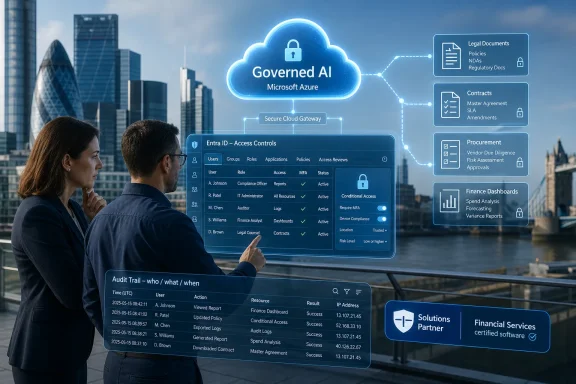
A financial-services agentic platform may sound distant from the concerns of a Windows administrator. It is not. The practical reality of enterprise AI is that much of it will ride on the infrastructure Windows shops already manage: Entra ID, Microsoft 365, Teams, SharePoint, Azure, Defender, Purview, and endpoint management.If AI agents are going to access contracts, supplier files, financial records, or internal policies, identity becomes the first control boundary. If agents are going to create, modify, route, or approve business artifacts, audit logging becomes non-negotiable. If agents are going to summarize or act on regulated information, data-loss prevention and sensitivity labels matter.
The administrator’s job will not be to “install Leah” in the old desktop-software sense. It will be to understand where an external AI platform connects to the Microsoft tenant, what permissions it needs, what data it reads, what actions it can take, and how those actions are monitored. That is a cloud-era version of application control, but with higher stakes.
The same logic applies to incident response. If an agent takes an action based on stale policy, poisoned input, compromised credentials, or misconfigured permissions, the investigation will cross SaaS logs, identity logs, endpoint telemetry, and business-system records. The clean separation between “business application” and “IT infrastructure” keeps eroding.
This is where Microsoft’s ecosystem strategy becomes operationally relevant. The more AI platforms integrate with Microsoft Cloud, the more Windows and Microsoft 365 administrators become part of AI governance, whether their job titles say so or not.
The Agentic Era Will Be Audited Before It Is Trusted
The strongest case for agentic enterprise software is speed. The strongest case against it is accountability. In regulated sectors, accountability usually wins unless speed can bring its own evidence.That is why auditability may become the defining feature of serious agentic platforms. Not the largest context window. Not the slickest chatbot. Not even the most impressive demo of autonomous execution. The winning systems will be the ones that can show what happened, why it happened, who authorized it, which data was used, which policy applied, and how the outcome can be challenged or reversed.
Leah’s announcement uses the language of complexity becoming “commercial intelligence.” That is the right ambition, but commercial intelligence without traceability is just another risk source. The financial-services buyer will want to know whether an agent’s recommendation is reproducible, whether approvals are explicit, and whether exceptions are visible before they become incidents.
Microsoft’s role here is both enabling and constraining. Azure and Microsoft 365 provide a familiar governance substrate, but they do not magically make every partner application safe. Customers must still map the end-to-end control chain from user identity to AI action to business record.
The next phase of enterprise AI competition will therefore be less glamorous than the first. It will involve controls, logs, policy bindings, model selection, data boundaries, and contractual liability. That is where agentic AI either grows up or gets trapped in pilot purgatory.
The Old SaaS Buying Checklist Is No Longer Enough
For years, enterprise SaaS reviews followed a recognizable pattern: security questionnaire, SOC report, data-processing agreement, SSO support, uptime history, admin controls, API documentation, and reference calls. Agentic AI stretches that checklist.A system that only stores and routes information can be evaluated largely as a data processor and workflow engine. A system that interprets information and acts on it has to be evaluated as a decision participant. That changes the risk model.
Buyers need to ask what autonomy means in each workflow. Does the agent draft, recommend, approve, execute, notify, negotiate, or merely prepare work for a human? Can the system distinguish between low-risk routine execution and high-risk decisions requiring escalation? Are role-based permissions inherited from Microsoft identity systems or managed separately inside the vendor platform?
They also need to understand model dependencies. Leah says it works with major AI partners, but enterprise customers should care which models are used for which tasks, how prompts and outputs are handled, whether customer data is retained, and how model changes are tested. “AI-native” is a starting point, not an answer.
This is where Microsoft certification can reduce some uncertainty while leaving the central governance questions intact. It confirms that a vendor has entered the Microsoft partner framework for a specific designation. It does not eliminate the need to scrutinize the vendor’s architecture, controls, and operational claims.
Microsoft’s Partner Economy Is Becoming an AI Sorting Machine
The Microsoft AI Cloud Partner Program is not just a badge factory. It is becoming a sorting machine for the enterprise AI market. Vendors that can align with Microsoft’s technical, marketplace, and industry requirements gain a route into a massive installed base. Vendors that cannot may still succeed, but they will face a harder road in Microsoft-standardized environments.This has obvious benefits. Enterprises drowning in AI pitches need filters. Microsoft’s marketplace, partner designations, and co-sell programs can help separate hobby-grade integrations from vendors that have at least done the work to fit into enterprise cloud buying patterns.
But the sorting machine also reflects Microsoft’s incentives. Microsoft wants cloud consumption, marketplace transactions, partner attach, and AI workloads that deepen reliance on its platform. That does not make the program illegitimate; it simply means buyers should understand the commercial machinery behind the technical language.
Leah appears to understand that machinery. Its move from legal AI and CLM heritage toward a broader agentic operating system fits the market’s hunger for AI platforms that can claim cross-functional relevance. Its Microsoft designation gives that story a more enterprise-friendly wrapper.
The interesting test will be whether customers experience Leah as a platform that genuinely reduces complexity or as another layer added to an already dense stack. The answer will vary by implementation, integration quality, governance discipline, and the realism of the workflows chosen first.
The Badge Opens the Door; It Does Not Close the Deal
Leah’s designation is a credible step, but it is not a verdict. The company still has to prove that agentic execution can survive contact with real enterprise process complexity. That means messy data, partial integrations, conflicting policies, skeptical legal teams, cautious CISOs, and business units that want speed until they are asked to own the risk.The most successful deployments will likely start with bounded workflows where the value is clear and the blast radius is controlled. Contract review, obligation tracking, supplier-risk triage, policy-guided intake, and finance-adjacent document workflows are more plausible early targets than fully autonomous commercial decision-making.
That does not make the ambition small. It makes it deployable. Enterprise AI will not become trusted because vendors insist that agents can do everything. It will become trusted when agents reliably do specific things under observable controls.
Leah’s Microsoft milestone should therefore be treated as a signpost. It points toward a world in which AI agents become part of the Microsoft-centered enterprise fabric, especially in industries that cannot afford improvisation. It does not prove that the destination has been reached.
The Practical Read for Microsoft-Centric Enterprises
The useful way to read this announcement is neither cynicism nor cheerleading. Leah has earned a Microsoft partner designation that matters commercially and may matter operationally, especially for financial-services customers already invested in Microsoft Cloud. But the designation’s own fine print makes clear that customers remain responsible for evaluating fit, function, risk, and governance.For Microsoft-heavy organizations, the announcement should prompt a more mature AI procurement conversation. The question is not whether a vendor says “agentic.” The question is whether its agents can operate inside the organization’s existing control model without creating invisible work, invisible risk, or invisible data movement.
- Leah’s designation is primarily a Microsoft ecosystem and interoperability milestone, not a blanket Microsoft endorsement of every platform capability.
- Financial-services buyers should treat the badge as useful procurement evidence, while still running full security, compliance, model-risk, and operational reviews.
- The strategic value of Leah’s platform depends on whether it can connect legal, procurement, finance, and shared-services workflows without erasing accountability.
- Microsoft’s partner program is increasingly shaping which AI vendors become visible and convenient for enterprise customers to buy.
- Windows, Microsoft 365, Azure, and security administrators will be drawn into agentic AI governance because identity, permissions, logs, and data controls sit in their world.
- The most credible agentic deployments will begin with bounded, auditable workflows before expanding into broader autonomous execution.
References
- Primary source: Legal Reader
Published: 2026-06-09T17:45:11.753605
Leah Earns the Solutions Partner With Certified Software Designation - Legal Reader
Leah, a Microsoft partner, announced it earned the Solutions Partner* with certified software** designation within the Microsoft AI Cloud Partner Program.www.legalreader.com - Official source: learn.microsoft.com
Introduction to Solutions Partner with certified software designations - Partner Center | Microsoft Learn
Learn about Solutions Partner with certified software designations.learn.microsoft.com - Official source: partner.microsoft.com
Differentiate your capabilities with Solutions Partner designations
Attain a Solutions Partner designation and drive success with badging and benefits that help you stand out to customers.partner.microsoft.com
- Official source: microsoft.com
Your request has been blocked. This could be due to several reasons.
www.microsoft.com
- Related coverage: insightpartners.com
Leah | Investment | Insight Partners
A pioneer in the tech transformation space, Leah, formerly ContractPodAI, is now one of the world’s fastest growing legal tech companies. www.insightpartners.com
- Related coverage: businesswire.com
- Related coverage: sdcexec.com
ContractPodAi Launches Agentic Operating System | Supply & Demand Chain Executive
Leah Agentic OS enables organizations to build, orchestrate, and deploy intelligent agents across functions such as legal, procurement, finance, HR, and IT. www.sdcexec.com
- Related coverage: catalogartifact.azureedge.net
- Related coverage: 45519527.fs1.hubspotusercontent-na1.net
