Leicester Rolls Out Microsoft 365 Copilot to 21,000+ Students: AI Literacy as Campus Standard

The University of Leicester has announced a Microsoft collaboration to provide full Microsoft 365 Copilot access to more than 21,000 students and 4,000 staff, making it one of the first UK universities to deploy the AI assistant across an entire academic community. The move is not just another campus software rollout; it is a bet that AI literacy should become baseline infrastructure, like email, Wi-Fi, and the learning management system. Leicester is framing the decision as inclusive access, but the deeper story is that higher education is being pushed into a new procurement and governance era before the pedagogy has fully caught up.

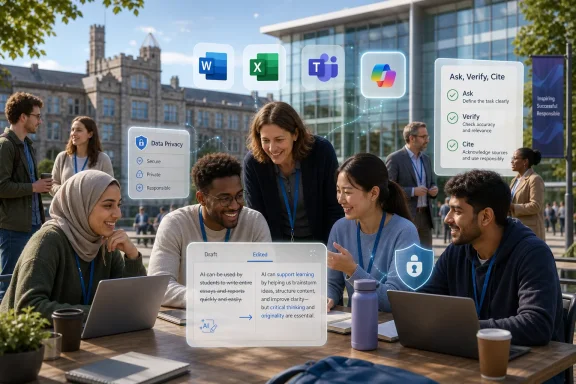
Students collaborate on a campus walkway as AI security and data-governance icons overlay the scene at UK University.Leicester Turns AI From Optional Add-On Into Campus Plumbing​

For the past two years, universities have treated generative AI as a problem to contain, a productivity tool to pilot, or a policy headache to defer. Leicester’s Microsoft 365 Copilot rollout does something more consequential: it makes AI a default part of institutional life. That changes the politics of adoption immediately.
A limited trial lets a university say it is exploring AI. A universal deployment says the institution expects students and staff to live with it, learn it, and be judged in a world where it exists. That is a much stronger claim, and it carries stronger obligations.
Leicester is not moving in isolation. The University of Manchester announced earlier in 2026 that it would provide Microsoft 365 Copilot access and training to its full community of roughly 65,000 students and staff, calling itself the first university in the world to do so. Leicester’s announcement places it in the early wave of UK institutions willing to turn enterprise AI from a specialist perk into a campus-wide entitlement.
That distinction matters. In most workplaces, access to powerful AI tools still depends on department budget, job role, or managerial enthusiasm. Leicester’s pitch is that every student and every staff member should be able to use the same core technology. In the language of education policy, this is about equity; in the language of IT, it is about standardisation.

Microsoft Finds Its New Showcase Campus​

Microsoft has spent the last year pushing the idea of the frontier organisation: a workplace redesigned around Copilot, agents, and AI-assisted workflows. The company’s education story is now following the same script. Universities are being invited not merely to license Copilot, but to become living demonstrations of what Microsoft thinks AI-normal institutions should look like.
Leicester’s “Microsoft Frontier university” framing is therefore more than marketing decoration. It signals early access, close vendor alignment, and a willingness to absorb Microsoft’s newest productivity assumptions into teaching, research, and administration. For Microsoft, that is valuable terrain.
Higher education is a particularly attractive market for this strategy because it touches students before they enter the workforce. If Copilot becomes familiar during seminars, group projects, dissertation planning, lab administration, and employability training, Microsoft gets more than a subscription relationship. It gets a generation of graduates trained to see AI inside Microsoft 365 as the natural interface for knowledge work.
That is why this story belongs on the same shelf as Windows, Office, Teams, and Azure adoption in education. The product being sold is not only a chatbot. It is a workflow habit.

The Equity Argument Is Stronger Than the Productivity Pitch​

The most persuasive part of Leicester’s announcement is not that Copilot may help draft emails, summarise meetings, or generate first-pass documents. Those are useful but familiar claims. The stronger argument is that unequal AI access is already becoming a new form of academic and professional advantage.
Students with paid accounts, better devices, stronger digital confidence, or family experience in professional workplaces are already more likely to experiment with AI effectively. Students without those advantages may either avoid the tools, misuse them, or rely on free consumer services with weaker privacy protections and less institutional guidance. A university-wide rollout can narrow that gap.
That does not mean it automatically will. Access is a precondition, not an outcome. If Leicester simply turns on the licenses and leaves students to discover Copilot through trial, error, and social media folklore, the most confident users will still benefit first. The announcement’s emphasis on future-ready skills will only become real if training, assessment redesign, and staff development receive the same seriousness as procurement.
Still, the equity case is real. In a world where employers increasingly expect graduates to work alongside AI, denying broad access risks making AI literacy a private good purchased outside the university. Leicester is trying to make it a public institutional capability.

The Classroom Problem Is No Longer Whether Students Use AI​

For lecturers, the arrival of Copilot across the full student body changes the default assumption. The old model — some students may be using generative AI, so assessments need detection, deterrence, and declarations — was already unstable. A universal rollout makes it untenable.
Once the university itself provides the tool, the question shifts from “Did the student use AI?” to “Was the use appropriate, transparent, and educationally meaningful?” That is a harder question but a better one. It forces departments to define what they actually want students to learn.
Some assignments will need to become more resistant to outsourcing. Others will need to become more explicit about AI-assisted drafting, critique, iteration, and verification. A literature review, for example, cannot simply become a prompt-and-polish exercise. But asking students to compare AI-generated summaries against primary sources, identify omissions, and defend their judgement may be more relevant than pretending the tool does not exist.
This is where universities will discover that AI adoption is not mainly an IT programme. It is curriculum reform under another name.

Staff Will Feel the Change Before Students Do​

The public story naturally emphasises students, employability, and graduate skills. Internally, though, staff may experience the Copilot rollout first and most intensely. Microsoft 365 Copilot is embedded in the daily machinery of university work: Outlook, Teams, Word, Excel, PowerPoint, SharePoint, and the wider Microsoft 365 graph.
That means the earliest visible changes may appear in meeting culture, committee work, policy drafting, recruitment paperwork, student support administration, and research project coordination. These are not glamorous areas, but they are exactly where universities accumulate friction. If Copilot can reduce some of that drag, staff may welcome it.
But there is a trap here. Productivity tools in large organisations often begin as helpers and end as accelerants. If AI makes it easier to generate documents, minutes, slides, reports, and consultation drafts, it may also increase the volume of those artefacts. A university can become more efficient at producing bureaucracy without becoming less bureaucratic.
Leicester’s leadership language about augmentation is therefore important. The test will be whether Copilot gives staff time back, or simply raises expectations for faster output.

The Security Story Is Better Than Consumer AI, But Not Simple​

One reason universities are gravitating toward Microsoft 365 Copilot is that it sits inside an enterprise identity, compliance, and data governance environment. Compared with students and staff pasting sensitive material into unmanaged consumer tools, a tenant-controlled Copilot deployment is plainly easier for IT to supervise.
That does not make it risk-free. Copilot’s usefulness depends on its ability to reason over organisational content that users are already allowed to access. If permissions are messy, SharePoint sites are overexposed, old Teams workspaces contain forgotten files, or sensitive documents are broadly readable, Copilot can make those problems more visible and more consequential.
This is the unglamorous prerequisite behind every serious Copilot deployment: information governance. Universities are sprawling, federated institutions with long-lived data, complex collaborations, external partners, visiting researchers, student societies, professional services teams, and uneven document hygiene. Copilot does not create all of those risks, but it can compress discovery time.
For sysadmins, the Leicester story should therefore read less like “AI arrives on campus” and more like “permissions, retention, labelling, and data classification just became urgent.” The assistant is only as safe as the environment it is allowed to search.

Microsoft’s Education Strategy Is Also a Platform Strategy​

Microsoft has long understood education as a route into the enterprise. Windows and Office became defaults partly because students learned them early and employers expected them later. Copilot extends that logic into AI.
The company is not alone in chasing this terrain. OpenAI, Google, Anthropic, and a growing set of education technology vendors all want to define how students use generative AI. But Microsoft has an advantage that matters enormously in universities: it already owns much of the productivity stack. Copilot does not need to persuade users to visit a separate destination; it appears inside the tools they already use.
That embeddedness is powerful. It is also why universities should be clear-eyed about dependency. Once teaching workflows, staff processes, training materials, and graduate skills programmes are designed around one vendor’s AI layer, switching becomes harder. The cost is not only licensing; it is institutional habit.
This does not mean Leicester is wrong to choose Microsoft. It means the university should treat the relationship as strategic infrastructure, not a software convenience. The difference is accountability.

The Manchester Precedent Raises the Bar​

Manchester’s earlier announcement matters because it established a benchmark Leicester cannot avoid. Manchester paired its access promise with training for all students and staff, and described the deployment as a responsible, large-scale adoption of AI in higher education. That combination — access plus training — is the standard others will now be measured against.
Leicester’s announcement stresses inclusive access, future-ready skills, and integration across teaching, learning, research, and professional services. It also links Copilot to a wider employability agenda, including work-related learning on undergraduate degrees. That gives the rollout a broader educational frame.
The key question is execution. If training is optional, generic, or limited to “how to prompt Copilot,” the programme will fall short. Students need to learn when AI output is unreliable, how to cite or disclose assistance, how to protect confidential material, how to avoid laundering bias into polished prose, and how to preserve their own intellectual agency.
Staff need an equally serious programme. Many academics are being asked to redesign assessment, advise students, protect research integrity, and experiment with AI in their own work at the same time. A university cannot declare an AI future and then leave departments to improvise it alone.

Assessment Will Become the Stress Test​

Every campus-wide AI rollout eventually collides with assessment. Universities can tolerate uncertainty in staff workflows for a while. They cannot tolerate a loss of confidence in the meaning of a degree.
Generative AI unsettles assessment because it attacks the middle layer of academic work: summarising, drafting, paraphrasing, structuring, coding, translating, and generating plausible explanations. Those are not trivial tasks. In many courses, they are part of what students are meant to practise.
The wrong response is to retreat entirely into surveillance. AI detection remains unreliable, and an enforcement-first culture can damage trust between students and staff. The better response is to redesign assessments so that process, judgement, oral defence, authentic context, data interpretation, and reflective critique matter more.
That is easy to say and hard to scale. Large modules with hundreds of students rely on standardised assessment for good reasons. Staff workloads are already heavy. External accreditation requirements may constrain change. Leicester’s Copilot rollout will therefore succeed or fail partly on whether the university invests in the hidden labour of assessment redesign.

Research Gains Will Come With New Frictions​

For researchers, Copilot can be attractive in mundane but meaningful ways. It can help organise notes, draft administrative text, prepare slides, summarise meetings, explore datasets in Excel, and manage collaboration across documents and Teams. In research groups drowning in coordination work, those efficiencies matter.
But research also raises sharper questions than ordinary office productivity. What material can be safely processed? How should AI assistance be acknowledged? Can unpublished findings, grant drafts, ethics materials, interview notes, or commercially sensitive collaborations be used with Copilot? The answer may differ by discipline, funder, partner, and data classification.
The risk is not that AI will suddenly replace research judgement. The risk is that convenience will blur boundaries that universities normally take pains to define. A secure enterprise AI environment reduces some hazards, but it does not eliminate the need for disciplinary norms.
Leicester’s “safe and secure environment” language is reassuring only if it is backed by clear rules. Researchers will need guidance that is specific enough to use, not policy prose so broad that everyone interprets it differently.

Students Need More Than a License​

The employability argument is obvious: graduates who can use AI well may be better prepared for workplaces where AI assistance is normal. But “use AI well” is doing a lot of work. It is not the same as asking Copilot to rewrite a paragraph or summarise a Teams meeting.
Real AI literacy includes knowing how to frame a task, evaluate an answer, check sources, preserve confidentiality, recognise hallucination, and decide when not to use the tool at all. It also includes understanding how AI systems reshape labour. A student who becomes faster at producing generic output has not necessarily become more capable.
This is where Leicester’s broader curriculum commitments matter. The university says every undergraduate degree includes employer-informed, work-related learning, and it wants research-inspired education embedded across its teaching. If Copilot is integrated into those experiences thoughtfully, students could graduate with a practical understanding of AI as a workplace instrument.
If not, the rollout risks becoming a campus-wide productivity veneer: impressive in demos, uneven in learning value, and most useful to those who already know how to take advantage of it.

The Digital Divide Moves Up the Stack​

Universities used to worry about whether students had laptops, broadband, and access to core software. Those concerns have not disappeared. But AI introduces a new divide that is less visible: the difference between people who can direct intelligent systems effectively and people who are directed by them.
Leicester’s universal access model tackles one part of that divide by removing the paywall. That is significant. A student should not need a personal subscription to participate in the AI-shaped parts of modern learning.
But access alone does not equal confidence. Some students will arrive with extensive experience using AI tools. Others will be anxious, sceptical, or unsure where legitimate assistance ends and misconduct begins. International students may have different prior exposure. Disabled students may find AI transformative for accessibility, while also needing assurance that support tools are recognised and protected.
A serious rollout must therefore be inclusive in practice, not just in licensing. That means training designed for different starting points, explicit academic integrity guidance, accessibility-aware implementation, and routes for students to ask basic questions without fear of being accused of cheating.

IT Departments Inherit the Hardest Part​

For WindowsForum readers, the operational implications may be the most interesting part of the story. A campus-wide Copilot deployment is not a switch thrown in the Microsoft 365 admin center and forgotten. It is a governance programme with a user interface.
Administrators must think about licensing, identity, conditional access, data loss prevention, sensitivity labels, SharePoint permissions, Teams sprawl, audit logs, retention policies, third-party integrations, and support workflows. They must also prepare for a new class of helpdesk ticket: not “Word crashed,” but “Copilot surfaced something I do not think I should see,” or “Copilot gave a wrong answer based on old departmental guidance.”
That is a different support culture. It requires IT, information governance, legal, academic quality, HR, and teaching teams to work together more closely than many institutions are used to. AI makes organisational seams visible.
The irony is that Copilot’s friendly interface can conceal administrative complexity. To the user, it is a button in familiar software. To the institution, it is a new way of querying its collective memory.

The Real Competition Is Over Defaults​

The Leicester announcement is easy to read as a local university technology story. It is bigger than that. It is part of a contest over defaults in education.
If Microsoft succeeds, the default AI experience for many students will be Copilot inside Microsoft 365. If Google succeeds elsewhere, it may be Gemini inside Workspace. If OpenAI’s education efforts expand, some universities may build around ChatGPT Edu or API-driven custom platforms. Each path carries different assumptions about data, pedagogy, integration, and vendor power.
Universities should not pretend these choices are neutral. The tools students use shape how they think about writing, research, collaboration, and authority. An AI assistant embedded in Office encourages certain kinds of productivity. A standalone research assistant encourages others. A discipline-specific tool may encourage still others.
Leicester’s choice may be pragmatic and sensible, especially if Microsoft 365 is already deeply embedded across the institution. But the choice should still be debated as an educational decision, not only an IT procurement outcome.

Leicester’s Bet Comes With a Governance Deadline​

The most important date in any AI rollout is not the announcement day. It is the moment users begin relying on the system before the institution has finished adapting around it. Leicester now has to close that gap.
Policy must become practice quickly. Students need to know what is allowed in coursework. Staff need to know how to redesign tasks and manage disclosures. Researchers need boundaries for sensitive material. Administrators need escalation routes for security and data issues. Leaders need metrics that measure more than adoption numbers.
Counting active users will be tempting because it is easy. But high usage does not prove educational value. The better measures will be harder: reduced administrative burden, improved student confidence, clearer assessment standards, fewer unmanaged AI tools, stronger digital skills, and evidence that students can critique AI output rather than merely produce more of it.
That is the burden of being early. Leicester gets the reputational benefit of moving fast, but it also becomes a case study others will inspect.
The Copilot Campus Will Be Judged by What It Refuses to Automate​

The Leicester rollout is a milestone because it moves AI from the margins of university life into the default toolkit. The concrete implications are already visible.
  • Leicester is giving Microsoft 365 Copilot access to its full community of more than 21,000 students and 4,000 staff.
  • The university is positioning the deployment as part of a wider future-skills agenda rather than a narrow productivity upgrade.
  • The move follows Manchester’s earlier whole-community Copilot announcement and confirms that UK higher education is becoming a showcase market for Microsoft’s AI strategy.
  • The hardest work will be assessment redesign, information governance, staff training, and clear student guidance.
  • The equity argument is credible only if universal access is matched by universal support and discipline-specific teaching.
  • The deployment will test whether Copilot reduces institutional friction or simply helps universities produce more work faster.
Leicester’s collaboration with Microsoft may prove to be a smart early move, especially if it gives students and staff a secure, common foundation for AI literacy before unmanaged tools fill the vacuum. But the university’s real achievement will not be measured by how many people can click the Copilot icon. It will be measured by whether Leicester can teach a generation to use AI without surrendering judgement to it — and whether the rest of higher education learns from both the successes and the mistakes that follow.

References​

  1. Primary source: Microsoft UK Stories
    Published: Wed, 03 Jun 2026 06:58:30 GMT
  2. Related coverage: manchester.ac.uk
  3. Official source: blogs.microsoft.com
  4. Official source: news.microsoft.com
  5. Official source: devblogs.microsoft.com
  6. Official source: support.microsoft.com
  1. Official source: techcommunity.microsoft.com
  2. Official source: learn.microsoft.com
  3. Official source: adoption.microsoft.com
  4. Related coverage: comsupport.fau.edu
  5. Related coverage: uhi.ac.uk
 

The University of Leicester has given Microsoft 365 Copilot access to more than 4,000 staff and 21,000 students in Leicester, England, making it one of the first UK universities to deploy Microsoft’s agentic AI productivity suite across an entire campus community. The move is not just another software rollout. It is a bet that AI literacy is becoming as basic to higher education as email, search, and the learning management system. It also makes the university a live test case for what happens when generative AI stops being a side tool and becomes part of the institutional operating system.

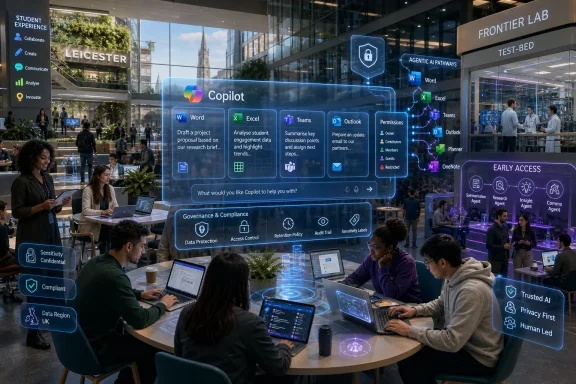
Students collaborate in a modern lab as an augmented “Copilot” AI dashboard overlays on screens and signs.Leicester Turns Copilot From Pilot Project Into Campus Infrastructure​

For most universities, generative AI has lived in an awkward middle ground since late 2022. Students used it whether policy allowed it or not, academics debated whether it was a plagiarism engine or a research assistant, and IT departments tried to draw lines around tools that were already bleeding into daily work. Leicester’s decision cuts through that ambiguity: Copilot is now part of the university’s standard toolkit.
That matters because Microsoft 365 Copilot is not a chatbot floating outside the institution. It is wired into Word, Excel, PowerPoint, Outlook, Teams, and the Microsoft Graph permissions model that underpins modern Microsoft 365 tenants. In practical terms, it sits where university work already happens: lecture notes, meeting transcripts, email threads, research plans, spreadsheets, student support workflows, and departmental documents.
The university is framing the rollout as a skills and productivity initiative, not simply an IT upgrade. Professor Sir Nishan Canagarajah, Leicester’s president and vice chancellor, has argued that working effectively with AI will become an essential skill for graduates and staff alike. That language is important. Leicester is not treating AI as an optional enhancement for the technically curious; it is treating AI fluency as employability infrastructure.
The scale is also notable. A campus-wide deployment changes the social dynamics of AI adoption. When only a few departments or early adopters have access, AI becomes uneven, experimental, and often invisible. When every student and member of staff gets access, it becomes something closer to a shared environment — and that forces harder conversations about assessment, training, governance, cost, and fairness.

Microsoft’s Education Pitch Has Moved From Software Licensing to Workforce Formation​

Microsoft has spent decades embedding itself in education through Windows, Office, Teams, Azure, and identity management. Copilot extends that strategy, but with a sharper claim: the company is no longer just selling productivity software to universities; it is selling preparation for an AI-shaped workplace.
That is why Leicester’s announcement leans heavily on future-ready skills. The university already promises undergraduates 100 hours of employer-informed, work-related learning during their degree. Copilot now becomes part of that wider employability story. The message to students is that AI-assisted work will not be a novelty by the time they graduate; it will be an expectation.
There is a strong argument behind that position. If graduates are entering workplaces where Microsoft 365 Copilot, GitHub Copilot, Copilot Studio agents, and similar tools are already being deployed, then banning or ignoring AI in university settings risks creating a training gap. Students from wealthier backgrounds may still buy access to premium AI services privately, while others are left with limited or consumer-grade tools. A university-wide license can, at least in theory, make access more equitable.
But the argument has another side. When a university standardizes on one vendor’s AI stack, it is not merely teaching “AI literacy” in the abstract. It is teaching AI through Microsoft’s interfaces, assumptions, data boundaries, and commercial roadmap. That may be sensible, given Microsoft’s dominance in enterprise productivity software, but it is still a form of dependency. The more higher education builds AI skills around a single ecosystem, the more Microsoft becomes not just a supplier but a curriculum-shaping force.
Leicester is not alone here. The University of Manchester announced a major Microsoft 365 Copilot rollout earlier this year, offering access and training to its entire community of roughly 65,000 students and staff. Microsoft wants these examples to signal momentum: large, complex institutions are moving beyond pilots and into universal provision.

The “Frontier” Label Is the Most Interesting Part of the Story​

Leicester’s status as one of the first Microsoft Frontier universities is more than a marketing flourish. Microsoft’s Frontier program is designed to give organizations access to experimental and emerging Copilot features before they become generally available. In business language, this is early access. In university language, it is closer to turning part of the campus into a live lab.
Frontier features are managed at the tenant level, which means IT administrators decide whether the organization participates and how access is controlled. The program is explicitly about preview capabilities, including new agentic AI features that may change before general release. That creates a tension universities know well: innovation is attractive, but experimental systems need boundaries.
The phrase agentic AI deserves scrutiny. In Microsoft’s framing, Copilot is increasingly moving from a tool that answers prompts to a system that can coordinate tasks, use context, invoke agents, and automate pieces of work. In a university, that could mean summarizing Teams meetings, drafting committee papers, helping researchers review literature, building course materials, triaging student enquiries, or assisting professional services teams with repetitive workflows.
Those are plausible gains. They are also governance headaches. A chatbot that produces a bad paragraph is one kind of risk. An AI agent that acts across documents, workflows, or student-facing systems is another. Universities are full of sensitive boundaries: student records, disability accommodations, unpublished research, HR matters, disciplinary processes, safeguarding concerns, and confidential committee material.
Leicester’s earlier Microsoft work suggests it understands that AI adoption is not just about prompts. The university has already used Dynamics 365, Power Platform, Defender, Copilot Studio, and Microsoft Unified support as part of its digital transformation. Its “Citizen” AI agent handled thousands of student queries during Welcome Week and provided round-the-clock support for routine information. The Copilot rollout, then, is not a cold start. It is the next layer on an already Microsoft-heavy digital campus.

The Productivity Case Is Real, But Universities Are Not Ordinary Offices​

The easiest case for Microsoft 365 Copilot is the one Microsoft has made since launch: knowledge workers lose time to meetings, email, document drafting, summarization, and repetitive information handling. Universities are full of that work. Academic life may be romanticized as lectures, research, and debate, but much of it is administration wrapped in committee structures.
For staff, Copilot could help summarize meetings, draft first-pass documents, turn notes into action lists, compare versions of policies, or extract themes from long email threads. For students, it could help plan assignments, revise drafts, explain concepts, summarize readings they are permitted to use, and structure presentations. For researchers, it may assist with project planning, grant preparation, coding support, literature triage, and communication with collaborators.
Yet universities are not normal white-collar offices. The same output can be productive assistance in one context and academic misconduct in another. A student using Copilot to improve a cover letter is not the same as a student using it to generate an assessed essay. An academic using it to summarize public literature is not the same as feeding it confidential peer-review material or unpublished participant data.
That distinction will have to be taught, not assumed. The mere presence of enterprise controls does not solve academic integrity. Nor does it answer the pedagogical question of what students should still learn to do unaided. If Copilot can draft an essay outline, generate a literature summary, and polish prose, universities must decide which parts of that workflow demonstrate learning and which parts merely demonstrate tool access.
This is where Leicester’s rollout could become genuinely interesting. A universal deployment gives the university the chance to redesign assessment around AI reality rather than police a fantasy of AI absence. Oral defenses, process logs, in-class work, reflective commentary, practical tasks, and discipline-specific AI use policies may become more important than detection tools. The hard work is not catching students using AI; it is deciding when AI use is legitimate evidence of competence.

The Security Story Is Better Than Consumer AI, But It Is Not Magic​

Microsoft’s strongest argument to universities is that Copilot inside Microsoft 365 is safer than students and staff pasting institutional data into random consumer AI tools. That argument has weight. Microsoft says Microsoft 365 Copilot respects existing permissions, grounds responses in data users are already allowed to access, keeps prompts and responses within Microsoft 365 service boundaries, and does not use organizational prompts, responses, or Microsoft Graph data to train foundation models.
For IT administrators, that is a meaningful distinction. A university that already runs Microsoft 365 has identity, compliance, retention, audit, eDiscovery, and data loss prevention tools in the same ecosystem. Copilot interactions can be governed through Microsoft Purview and related controls in ways that consumer chatbot use cannot. From a risk-management perspective, bringing AI into the managed tenant is often preferable to pretending unmanaged use is not happening.
But “Copilot respects permissions” is not the same as “Copilot is risk-free.” Microsoft 365 tenants are notorious for permission sprawl. SharePoint sites, Teams channels, legacy document libraries, poorly named groups, external sharing settings, and inherited permissions can expose more than organizations realize. Copilot does not need to hack around those controls to create a problem; it can surface what the user already had access to but never knew existed.
That is the classic Copilot readiness issue. Before broad deployment, organizations need to review oversharing, sensitivity labels, retention policies, guest access, and information architecture. Universities face an especially messy version of this challenge because they are open by design. They collaborate across institutions, host visiting researchers, employ temporary staff, enroll students across multiple cohorts, and run semi-autonomous departments with their own data habits.
Frontier features add another layer. Experimental AI capabilities may evolve quickly, and agents can introduce different data-handling considerations depending on what they connect to and what actions they can perform. Leicester’s IT and governance teams will need to keep the deployment from becoming a permissions archaeology project conducted after the fact.

Equity Is the Best Argument for Universal Access​

The strongest social argument for Leicester’s decision is not productivity. It is equity. If AI assistance is becoming part of how professional work gets done, then universities face a choice: either provide managed access to all students or allow ability to pay to determine who gets the best tools.
Universal access reduces that divide. It means a student who cannot afford a premium AI subscription can still learn how to use advanced assistance in familiar productivity apps. It also means staff can teach with a more consistent baseline, instead of designing policies around a chaotic mix of free-tier chatbots, browser extensions, mobile apps, and paid tools.
This does not make the equity problem disappear. Students still differ in confidence, discipline-specific expectations, disability needs, language background, and access to high-quality guidance. Some will use Copilot as a tutor, editor, coach, and planner. Others may avoid it out of fear of misconduct rules or because they do not understand what it can do. Providing the license is only the beginning.
Training will determine whether this becomes democratizing or merely another digital divide. The students who benefit most may not be the ones who already know how to prompt a model, check outputs, and work around hallucinations. They may be the ones who learn, in structured ways, how to ask better questions, verify claims, protect data, disclose assistance, and use AI without surrendering judgment.
For staff, equity has another dimension: workload. Professional services teams often carry the administrative burden of transformation while academics debate its intellectual implications. If Copilot is used to reduce repetitive tasks and improve service quality, it could help. If it becomes yet another system staff are expected to master on top of existing work, it will feel less like augmentation and more like intensification.

The Campus Becomes a Test Bed for Microsoft’s Agentic Future​

Microsoft’s wider AI strategy is moving rapidly from chat to agents. Copilot is increasingly positioned as the interface through which users delegate work, coordinate across apps, and interact with specialized assistants. The company’s “Frontier” language is meant to make that future feel exciting. It also reveals how much is still unsettled.
Higher education is an attractive proving ground because it contains almost every kind of knowledge work. Universities teach, research, recruit, advise, assess, govern, publish, fundraise, manage estates, run help desks, process applications, and support students through complex life events. If Microsoft can show Copilot working across that environment, it strengthens the case for similar deployments in government, healthcare, law, and large enterprises.
Leicester, in turn, gets early access and close proximity to Microsoft’s roadmap. That can be valuable. Institutions that learn early may shape best practices, influence feature development, and build internal expertise before their peers. They may also discover failure modes earlier: where Copilot saves time, where it produces plausible nonsense, where users overtrust it, where policies lag, and where costs exceed enthusiasm.
The vendor-institution relationship therefore deserves careful attention. Microsoft will naturally highlight success stories: hours saved, queries handled, adoption rates, positive sentiment, and future-ready students. The university will naturally want to present itself as innovative. The more useful measure will be what changes after the launch glow fades: whether assessment adapts, whether permissions are cleaned up, whether staff workloads improve, whether students learn responsible use, and whether AI becomes embedded in genuinely better services.
This is the difference between a rollout and a transformation. A rollout provisions licenses. A transformation changes habits, rules, expectations, and accountability. Leicester has announced the first part. The second part will be slower, more political, and more important.

Windows IT Should Read This as an Enterprise AI Story​

For WindowsForum readers, the Leicester announcement may look at first like an education-sector story. It is also a preview of the enterprise AI deployment pattern coming to many Microsoft-heavy organizations. The same questions now facing Leicester are the ones facing businesses, councils, hospitals, and nonprofits that have standardized on Microsoft 365.
The technical center of gravity is familiar: Entra ID, Microsoft 365 admin center, Teams, SharePoint, OneDrive, Exchange Online, Purview, Defender, Power Platform, and Graph. Copilot does not replace that estate. It makes the quality of that estate more visible. Messy permissions, stale files, weak labeling, poor retention, and unclear ownership become AI problems because Copilot can reason over the clutter.
That is why IT departments should resist treating Copilot as a pure user-productivity feature. It is an information governance accelerant. If the tenant is well structured, Copilot can amplify useful knowledge. If the tenant is chaotic, it can amplify that chaos with unnerving fluency.
The education sector adds one more lesson: adoption is cultural. Users do not become effective with AI because a license appears in the app launcher. They need examples tied to their work, clear boundaries, and permission to experiment without being punished for every imperfect output. They also need to know when not to use it. In many organizations, the most valuable Copilot training may be less about prompt syntax and more about judgment.

The Leicester Rollout Will Be Judged by Governance, Not Headlines​

The next phase should be less glamorous than the announcement. Leicester will need operating rules that are specific enough to help but flexible enough to survive fast-moving technology. That means policies for teaching, research, administration, student support, data protection, procurement, accessibility, and misconduct cannot live in separate silos.
Academic departments will need discipline-level guidance. Using Copilot in computer science, law, medicine, history, business, and creative writing raises different issues. A blanket rule will either be too permissive to protect learning or too restrictive to reflect real professional practice. The best policies will likely distinguish between brainstorming, drafting, editing, analysis, citation, coding, and final assessed work.
Research governance may be even harder. Copilot can be useful for summarizing, planning, and drafting, but researchers must think carefully about confidential data, participant information, unpublished findings, intellectual property, and funder requirements. Even where Microsoft’s enterprise protections are stronger than consumer services, not every category of research material should be casually fed into an AI assistant.
Professional services teams will need measurement that goes beyond anecdote. If Copilot saves time, where does that time go? Does it improve student support, reduce backlogs, shorten response times, or merely increase the expected volume of work? AI productivity claims often evaporate when organizations fail to redesign processes around the tool.
Students will need clarity most of all. Universities cannot say “AI is an essential workplace skill” in one breath and “AI use may be misconduct” in the next without explaining the boundary. The institutions that handle this well will teach disclosure, verification, and responsible collaboration with AI as part of academic practice.

The Real Exam Starts After the Licenses Land​

Leicester’s deployment is concrete enough to matter, but its significance will depend on execution. The university has the advantage of an existing Microsoft partnership, prior AI agent work, and a clear public argument that AI skills belong inside higher education rather than outside it. The risks are equally concrete: vendor lock-in, permission sprawl, assessment confusion, uneven training, and the temptation to mistake access for competence.
  • Leicester is giving Microsoft 365 Copilot to more than 25,000 students and staff, moving AI assistance from optional experiment to shared campus infrastructure.
  • The university’s Microsoft Frontier status means some users may encounter emerging Copilot capabilities before general availability, making governance and change management especially important.
  • Microsoft’s enterprise data protections make Copilot safer than unmanaged consumer AI use, but they do not eliminate risks from overshared files, weak permissions, or poor data hygiene.
  • The strongest educational case for universal access is equity, because it gives all students exposure to workplace-grade AI tools rather than leaving premium access to those who can pay.
  • The hardest policy challenge will be assessment, because universities must distinguish legitimate AI-supported learning from work that no longer demonstrates the student’s own competence.
  • The rollout will be a useful signal for Windows and Microsoft 365 administrators everywhere, because Copilot exposes the strengths and weaknesses of the tenant it inhabits.
Leicester’s move is best understood as an early answer to a question every Microsoft-based institution will soon face: whether to keep treating generative AI as an external disruption or absorb it into the managed digital estate. The university has chosen absorption, with all the benefits and obligations that implies. If it pairs access with serious governance, training, and assessment reform, it may help define what responsible campus AI looks like. If not, it will prove the opposite lesson just as clearly: that the future of work cannot be licensed into existence.

References​

  1. Primary source: Technology Record
    Published: Wed, 03 Jun 2026 09:30:34 GMT
  2. Related coverage: manchester.ac.uk
  3. Official source: microsoft.com
  4. Related coverage: nottingham.ac.uk
  5. Related coverage: info.lse.ac.uk
  6. Official source: adoption.microsoft.com
 

The University of Leicester is rolling out Microsoft 365 Copilot to more than 21,000 students and 4,000 staff in June 2026, making it one of the first UK universities to give its whole campus community institution-wide access to Microsoft’s AI assistant. The move is being framed as an inclusion play, a skills agenda, and a technology partnership all at once. That combination is exactly why it matters. Leicester is not merely buying software; it is helping define what “AI literacy” will mean when the tool in question is embedded inside Word, Outlook, Teams, PowerPoint, and the rest of the Microsoft productivity stack.
The headline version is simple: everyone gets Copilot. The more interesting version is messier. Universities are no longer debating whether students will use generative AI, because that argument has already been lost to reality. The fight now is over who controls the interface, the rules, the assessment model, and the institutional memory that AI systems are allowed to touch.

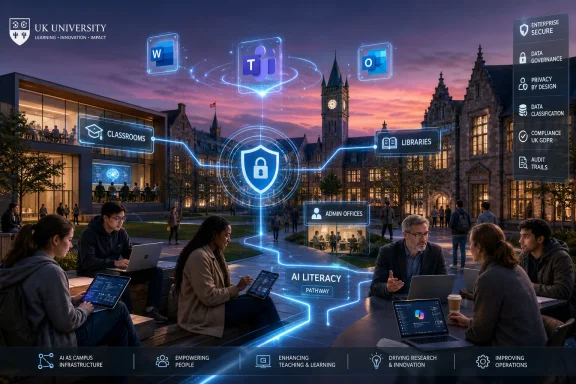
Students on campus use digital productivity and security icons across a split work-and-classroom scene.Leicester Chooses Access Over Abstinence​

Leicester’s decision lands at a moment when higher education has largely moved beyond the first wave of panic about ChatGPT and plagiarism. The emergency phase was defensive: detection tools, assessment redesigns, academic integrity statements, and hurried guidance telling students what they could and could not paste into a chatbot. The new phase is operational. Institutions are deciding whether generative AI is an external nuisance to be policed or an internal utility to be provisioned.
By giving Copilot to all students and staff, Leicester is choosing the utility model. That matters because unequal access has been one of the quiet problems in the AI-in-education debate. Students with disposable income can already pay for premium AI tools; students without it are left with free-tier limits, weaker models, or whatever happens to be available on a given day. A university-wide deployment tries to flatten that difference by making access part of the institutional environment rather than an individual purchase.
That is a defensible position, especially for a university that wants to talk about employability and social mobility. If employers expect graduates to use AI in routine office work, then a university that withholds access may be protecting an older academic model at the expense of its students’ future workplace fluency. The argument is not that Copilot is magic. It is that refusing to teach with such tools may become as artificial as refusing to teach spreadsheets because calculators once made arithmetic easier.
But access is also the easiest part of the policy. Licences can be bought, accounts can be enabled, launch emails can be sent, and executives can describe the deployment as transformational. The harder question is whether the institution can build a culture in which students understand when AI is useful, when it is misleading, when it is ethically inappropriate, and when it quietly changes the nature of the work being assessed.

Microsoft Gets a Campus, Leicester Gets a Platform​

The University of Leicester is being described as one of Microsoft’s early “Frontier” universities, which is a revealing label. Microsoft’s Frontier programme is not just a badge of prestige; it is an early-access channel for experimental Copilot features and agent-style capabilities before they are generally available. That gives participating organisations proximity to Microsoft’s product roadmap, but it also makes them part of a feedback loop.
For Microsoft, universities are uniquely attractive proving grounds. They contain almost every kind of knowledge worker in miniature: administrators, finance teams, researchers, lecturers, students, support staff, communications teams, and IT departments. A university is messy in ways that resemble the real world more than a polished enterprise demo. If Copilot can be normalised across that environment, Microsoft gets a powerful story to tell other institutions.
For Leicester, the appeal is obvious. A full Copilot deployment allows the university to position itself as early, ambitious, and aligned with the direction of the labour market. It can promise students that they are not merely learning about AI in abstraction but using it inside the tools they will encounter after graduation. It can offer staff assistance with drafting, summarising, meeting notes, document analysis, and the thousand small bureaucratic tasks that accumulate in any large organisation.
The risk is that vendor alignment becomes institutional strategy by another name. Microsoft’s interests and Leicester’s interests overlap, but they are not identical. Microsoft wants Copilot to become the default interface for work. Leicester should want students and staff to become capable, critical, independent users of AI systems, including systems that are not made by Microsoft. Those goals can coexist, but only if the university treats Copilot as a curriculum object as well as a productivity tool.

The Real Curriculum Is Hidden Inside the Workflow​

The most important feature of Microsoft 365 Copilot is not that it can generate text. Students already have plenty of tools that can do that. Its importance is that it sits inside the workflow where academic and administrative work already happens.
That changes the psychology of AI use. A standalone chatbot feels like a separate destination: you go to it, ask for something, and bring the output back. Copilot is designed to feel ambient. It can summarise email threads, draft documents, suggest slide structures, analyse spreadsheets, recap meetings, and help users navigate information already stored inside Microsoft 365.
This is why the deployment is more consequential than simply “students get a chatbot.” If configured broadly, Copilot becomes a layer over institutional knowledge. For staff, that may mean faster access to documents, policies, meeting histories, and project materials. For students, it may mean a writing companion, study aid, presentation coach, and research organiser that lives inside the same applications used for coursework.
That convenience is powerful. It is also pedagogically disruptive. If a student uses Copilot to outline an essay, summarise readings, revise prose, and generate a presentation, where exactly is the learning happening? The answer may be “through all of it” if the student is interrogating the output, checking claims, improving structure, and developing judgement. The answer may be “hardly anywhere” if the student is delegating the cognitive work the assignment was designed to measure.
Universities cannot resolve that ambiguity with a single acceptable-use policy. They will need discipline-specific norms. Using Copilot to clean up a lab report is not the same as using it to interpret a poem. Summarising meeting notes for a group project is not the same as generating a legal argument. A computing student, a historian, a medical researcher, and a business undergraduate will all need different forms of AI literacy.

The Inclusion Argument Is Strongest When It Admits the Risks​

Leicester’s most persuasive argument is that universal access avoids a two-tier AI culture. That argument deserves to be taken seriously. A campus where some students use paid AI tools extensively while others are warned away from them is not a level playing field. It rewards confidence, money, and informal networks.
Institutional provision can make AI use more visible and governable. If students are going to use these systems anyway, a university-supported tool gives staff a better chance of teaching responsible use, setting expectations, and providing consistent guidance. It may also reduce the temptation to paste sensitive academic or personal material into consumer services with unclear data protections.
But inclusion is not solved by a licence. Students will differ sharply in how well they use Copilot. Some will arrive with strong prompting habits, good digital confidence, and a clear sense of when AI output is weak. Others will treat the tool as an oracle or avoid it because they fear breaking rules. Universal availability reduces one barrier while exposing another: the gap between access and capability.
That gap is where the university’s work begins. AI literacy cannot mean a one-hour induction video and a few prompt examples. It must include source evaluation, hallucination detection, data handling, authorship norms, disciplinary expectations, and the ability to explain one’s own process. The real measure of success will be whether Leicester can make those practices ordinary across courses, not whether it can announce that every account has been enabled.

Assessment Becomes the Stress Test​

Every AI rollout in education eventually runs into assessment. Universities can talk about future-ready skills, but degrees still depend on evaluating what students know and can do. Generative AI complicates that relationship because it can assist with precisely the kinds of outputs universities have traditionally assessed: essays, reports, summaries, presentations, code, and reflections.
The lazy conclusion is that AI makes assessment impossible. It does not. It does, however, make some older assessment assumptions much weaker. If a take-home essay is meant to assess a student’s unaided ability to structure an argument, then AI assistance matters. If the same essay is meant to assess the student’s ability to research, critique, revise, and defend a position in an AI-saturated world, then banning AI may be the less realistic option.
Leicester’s deployment will therefore need a more mature assessment language than “allowed” or “not allowed.” Staff will need ways to specify whether AI can be used for brainstorming, editing, summarising, coding, translation, data analysis, or final composition. Students will need to know what must be declared and what counts as unacceptable delegation. The institution will need consistency without pretending that every discipline faces the same risks.
This is where universities often struggle. Central policy can set principles, but assessment lives at module level. One lecturer may encourage Copilot as a drafting partner; another may ban it for a particular task; a third may require students to submit prompts and reflections. That variation can be educationally legitimate, but only if it is communicated clearly. Otherwise students experience AI policy as a trapdoor.

Staff Are Not Just Supervisors of Student AI Use​

Much of the public conversation about AI in universities focuses on students, cheating, and graduate skills. That misses half the story. Leicester is also rolling Copilot out to around 4,000 staff, and staff use may prove just as consequential as student use.
Professional services teams are obvious candidates for Copilot productivity claims. Universities run on email, meetings, reports, forms, compliance processes, student support workflows, and policy documents. An assistant that can summarise long threads, draft first-pass responses, or extract action items from meetings may save real time, especially in overstretched departments.
Academic staff may use the tool differently. Copilot could help draft lecture outlines, produce quiz questions, summarise feedback themes, reformat documents, or manage administrative overload. For researchers, the value may lie in literature organisation, grant drafting support, coding assistance, and collaboration management, though any serious research use will need careful attention to accuracy, confidentiality, and intellectual property.
The danger is that productivity tooling becomes a quiet ratchet. If Copilot saves staff time, universities may bank the saving rather than reduce workload. If staff can produce more emails, documents, and teaching materials, expectations may rise accordingly. The history of office software is not a story of workers becoming less busy; it is often a story of organisations asking for more because the tools make more possible.

The Data Boundary Is Where Trust Will Be Won or Lost​

Microsoft’s advantage in higher education is not merely brand recognition. It is tenancy. Many universities already live inside Microsoft 365, with identity, email, documents, Teams, SharePoint, OneDrive, compliance controls, and administrative workflows bound together. Copilot’s pitch is that AI can be added to that environment with enterprise-grade controls rather than bolted on from outside.
That matters because university data is sensitive in unusually varied ways. Student records, disability information, safeguarding concerns, research data, unpublished manuscripts, grant applications, HR material, financial documents, and confidential committee papers may all pass through Microsoft systems. An AI assistant with access to that environment must be governed with more care than a browser-based writing tool.
The most immediate issue is permissions. Copilot can only be as safe as the access controls beneath it. If SharePoint sites, Teams channels, or document libraries are over-permissive, AI search and summarisation can make bad permissions more visible and more damaging. In that sense, Copilot does not create every governance problem; it reveals the ones an organisation has tolerated.
This is a familiar enterprise lesson, but universities have their own complications. Academic culture often favours autonomy, informal sharing, and decentralised practice. Departments may have different habits, legacy repositories, and local workarounds. A campus-wide AI deployment turns information hygiene from an IT concern into an institutional prerequisite.

The UK Policy Climate Is Moving in Leicester’s Direction​

Leicester’s announcement fits a broader UK shift from AI anxiety toward managed adoption. Government departments, schools, universities, and employers are all trying to work out how to use generative AI without losing control of standards, privacy, or professional judgement. The direction of travel is clear even where the details remain unsettled: AI is being treated less as a novelty and more as infrastructure.
Education is a particularly visible part of that shift. Policymakers have explored AI for administrative burden, lesson planning, accessibility, and support for students with special educational needs and disabilities. Employers, meanwhile, increasingly complain that graduates need stronger practical AI skills. Universities are being squeezed from both sides: they must protect academic standards while proving that their graduates are ready for workplaces already experimenting with AI.
That pressure makes Leicester’s move less radical than it might have seemed two years ago. The institution is not leaping into an empty field. Other universities have deployed Copilot Chat, piloted Microsoft 365 Copilot with staff, or announced broad AI training programmes. The University of Manchester has also moved aggressively, with plans to provide Copilot access and training across its large student and staff community by summer 2026.
Leicester’s distinction is its positioning: whole-community access, Microsoft collaboration, and Frontier status. That combination puts it near the front of the adoption curve, but not outside the mainstream. The question is no longer whether universities will integrate AI. It is whether they do so deliberately enough to avoid becoming passive distribution channels for whichever platform vendor gets there first.

Copilot Is a Windows Story Because Microsoft Wants Work to Stay Inside Its Stack​

For WindowsForum readers, this is not just an education story. It is a Microsoft platform story. Copilot is the connective tissue in Microsoft’s current strategy, spanning Windows, Microsoft 365, Edge, Teams, security products, developer tooling, and Azure. The company is trying to make AI feel less like a separate product and more like the default way users interact with software.
A university-wide Copilot rollout reinforces that ambition. Students who spend years using Copilot inside Word, PowerPoint, Outlook, and Teams may carry those habits into the workplace. Staff who build administrative processes around Copilot may deepen their dependence on Microsoft 365. IT departments that configure governance, training, and support around Microsoft’s AI layer may find it harder to evaluate alternatives later.
This is not inherently sinister; platform integration is what Microsoft does. The company has always understood that defaults matter. Windows became powerful not only because it was capable, but because it was where users already were. Office became dominant not only because of features, but because documents, workflows, and institutional expectations accumulated around it.
Copilot is the same strategy updated for the AI era. If Microsoft can make its assistant the normal interface for everyday work, then the battle over AI adoption shifts from model benchmarks to workflow capture. Leicester’s rollout is a small but symbolically useful piece of that strategy: a generation of students learning AI through Microsoft’s lens.

The Vendor Case Needs Independent Evidence​

Microsoft and university leaders will naturally emphasise opportunity. The language of transformation is now standard in AI announcements, and Leicester’s launch follows the pattern: future-ready graduates, inclusive access, world-leading ambition, and staff empowered by new tools. None of that is meaningless. None of it is proof.
The evidence problem around generative AI productivity remains unresolved. Some organisations report meaningful time savings from Copilot, particularly around summarisation, drafting, meeting follow-up, and information retrieval. Other studies and surveys have found more modest gains, uneven adoption, or productivity benefits that depend heavily on job role, training, and workflow maturity. The difference between a helpful assistant and an expensive distraction is often implementation.
Universities should be especially careful with claims about learning outcomes. A tool may help students produce more polished work without making them better thinkers. It may help staff draft feedback faster without improving feedback quality. It may reduce administrative friction in one department while creating new oversight burdens in another. The relevant question is not whether people feel more efficient, but whether the institution can measure better outcomes.
Leicester has an opportunity here. If it tracks usage thoughtfully, studies student confidence and performance, evaluates staff workload, and publishes credible findings, it could contribute something valuable beyond marketing. If it merely repeats adoption numbers and satisfaction quotes, the rollout will become another entry in the long catalogue of technology-in-education promises that sounded better at launch than in practice.

The Campus AI Experiment Now Has a Scorecard​

Leicester’s Copilot deployment should be judged by what changes after the announcement, not by the scale of the announcement itself. A university can enable AI access in a semester; it takes much longer to build institutional judgement. The useful scorecard is practical, not ideological.
  • Leicester is making a deliberate bet that universal AI access is fairer than leaving students and staff to navigate paid and free tools on their own.
  • Microsoft gains a high-visibility education partner at a time when Copilot needs proof that it can become everyday infrastructure rather than an optional productivity add-on.
  • The hardest work will be assessment reform, because universities must distinguish legitimate AI-assisted learning from outsourcing the intellectual task.
  • Staff adoption may matter as much as student adoption, especially if Copilot changes administrative workload, teaching preparation, and research support.
  • The deployment will test the university’s data governance, because AI assistants amplify the consequences of weak permissions and poorly managed document stores.
  • Leicester’s success should be measured in learning quality, staff workload, student confidence, and employability outcomes, not just licence activation or usage statistics.

The Degree of the Future Is Being Negotiated in Office Apps​

The symbolic power of Leicester’s move is that it treats AI competence as a campus-wide expectation rather than a specialist module. That is probably where higher education is heading. Students will not experience AI as a discrete subject called “prompt engineering”; they will experience it as a layer inside writing, research, collaboration, administration, design, analysis, and communication.
That shift will make some academics uncomfortable, and not without reason. Universities are supposed to preserve forms of thinking that are not reducible to workplace productivity. A degree should not become a Microsoft certification with seminars attached. If every intellectual activity is reframed as a workflow to be accelerated, higher education loses something essential.
Yet the opposite posture is equally weak. Pretending that students can be educated for the 2030s while keeping AI at the margins is not intellectual seriousness; it is avoidance. The task is to teach students to use AI without becoming intellectually dependent on it, to benefit from automation without surrendering authorship, and to understand platform power rather than simply inhabit it.
Leicester has chosen to run that experiment in the open, across the whole institution, with Microsoft deeply involved. That is brave, commercially convenient, pedagogically risky, and probably unavoidable. The university’s real test will not be whether Copilot can draft a better email or summarise a lecture transcript. It will be whether Leicester can produce graduates who know when to trust the machine, when to challenge it, and when to close the laptop and think for themselves.

References​

  1. Primary source: Resultsense
    Published: Thu, 04 Jun 2026 07:04:21 GMT
  2. Official source: support.microsoft.com
  3. Official source: ukstories.microsoft.com
  4. Official source: microsoft.com
  5. Official source: learn.microsoft.com
  6. Related coverage: its.uiowa.edu
  1. Related coverage: info.lse.ac.uk
  2. Official source: techcommunity.microsoft.com
  3. Related coverage: comsupport.fau.edu
  4. Related coverage: it.uw.edu
  5. Related coverage: help.uis.cam.ac.uk
 

The University of Leicester will provide Microsoft 365 Copilot access to all students and staff from September 2026, making it one of the first Microsoft Frontier Universities in the UK and placing generative AI directly inside the daily tools of a 25,000-person academic community. That is not merely another campus software deal. It is a signal that AI in higher education is moving from optional experiment to institutional infrastructure. The bet is that students should not just learn about AI, but learn with it, against it, and around it before they enter workplaces already being reshaped by the same tools.

Students collaborate in a modern campus library as digital icons and network security overlays float above.Leicester Turns Copilot From Perk Into Campus Plumbing​

For the last two years, universities have treated generative AI with a mixture of fascination, suspicion, and bureaucratic improvisation. Staff have rewritten assessment rules, students have quietly tested chatbots, and IT departments have tried to separate consumer-grade experimentation from systems that can be governed, audited, and supported. Leicester’s move cuts through that ambiguity by making Microsoft 365 Copilot a baseline service rather than a privilege for selected departments or pilot groups.
That matters because Microsoft 365 is already the workbench for much of university life. Essays are drafted in Word, presentations are built in PowerPoint, group projects live in Teams, meetings generate transcripts, and administrative work flows through Outlook and SharePoint. Embedding Copilot into that environment changes the practical question from “Should students use AI?” to “How should students use AI inside the same productivity stack they will encounter after graduation?”
The university’s language is deliberately expansive. It frames the rollout as a way to build digital fluency, confidence, creativity, inclusion, and employability. This is higher education speaking in the dialect of workforce readiness, but the substance is real: a graduate who has never used AI tools critically may soon look as underprepared as a graduate who once left university without spreadsheet skills.
The phrase “Citizens of Change” gives the announcement its civic varnish, but the harder edge is institutional competitiveness. Universities are competing for students, industry partnerships, and relevance in an economy where AI literacy is becoming a proxy for modernity. Leicester is not just adopting Copilot; it is publicly branding itself as a university that wants to normalize AI before normalization is forced upon it.

The Frontier Label Is Microsoft’s Quiet Power Play​

The most interesting phrase in the announcement is not “Copilot.” It is “Frontier University.” Microsoft’s Frontier program is designed around early access to emerging Copilot capabilities, including experimental features and agent-like tools that may change before wider release. In plain terms, Microsoft wants selected organizations to become proving grounds for the next generation of AI-in-Microsoft-365 experiences.
That creates an obvious advantage for Leicester. Students and staff get earlier exposure to tools that may become standard in commercial and public-sector workplaces. Researchers and professional services teams can explore new productivity patterns before competitors have fully adjusted. The university can also claim a role in shaping AI through feedback rather than passively receiving whatever the vendor ships.
But the Frontier label also reveals Microsoft’s strategic logic. The company does not want AI to be a website students visit when they need help. It wants AI to be a layer inside the documents, calendars, inboxes, chats, and workflows where institutional work already happens. Higher education is especially attractive because today’s students become tomorrow’s enterprise users, managers, developers, policymakers, and procurement decision-makers.
This is how platform habits are formed. A student who learns to summarize literature, plan projects, draft presentations, and interrogate meeting notes with Copilot is likely to carry those expectations into the workplace. Microsoft’s long game is not simply licensing revenue from one university; it is the cultivation of an AI-native Microsoft 365 workforce.

Inclusion Is the Strongest Argument, and the Easiest to Oversell​

Leicester’s most persuasive claim is that universal access removes barriers. If AI tools are useful, then rationing them by department, income, course, or staff role risks reproducing existing inequalities. A privately subscribed student with the latest tools gains an advantage over a student relying on free, rate-limited, or less secure services. A lecturer with access to AI-supported planning may save hours that a colleague elsewhere still spends manually.
Universal provision at least gives the university a fighting chance to make AI literacy a shared educational entitlement. It means training can be standardized, expectations can be made explicit, and support can be offered without pretending that only a minority of users will experiment. It also allows the institution to steer users toward a managed environment rather than scattering them across consumer tools with uneven privacy guarantees.
Still, inclusion is not achieved by licensing alone. The students who benefit most from Copilot may be those who already know how to ask good questions, evaluate weak answers, and understand the structure of an argument before asking a model to improve one. The risk is that AI becomes another amplifier: helpful to confident users, confusing to vulnerable ones, and invisible in its failures unless teaching practices adapt.
A serious rollout has to teach students when not to use Copilot. It has to make clear that a polished paragraph is not the same as understanding, that generated references require checking, and that automation can conceal gaps in reasoning. If Leicester gets this right, Copilot becomes a scaffold. If it gets it wrong, it becomes a veneer.

Academic Integrity Moves From Detection to Design​

Universities initially responded to generative AI as though the central problem was cheating. That was understandable, but it was also too narrow. Detection tools have proven unreliable, student use is difficult to police consistently, and a blanket ban makes less sense when employers are adopting AI assistants in exactly the tools students are expected to master.
Leicester’s announcement points toward a more durable model: AI embedded in teaching and assessment, governed by principles around ethics, inclusion, and academic integrity. That implies a shift from asking whether AI was used to asking how it was used, whether its use was permitted, and whether the student can demonstrate the learning outcome independently. The assessment design challenge becomes more important than the surveillance challenge.
This will be uncomfortable. Some assignments that worked well in a pre-Copilot world will become weaker measures of learning. Generic essays, routine summaries, and templated reflections are especially exposed. Oral defenses, process logs, applied projects, version histories, in-class work, and discipline-specific critique may become more important because they test judgment, not just output.
The better universities will not pretend that AI can be uninvented. They will define boundaries by context. A programming course may allow Copilot for debugging but require students to explain the code. A history module may allow AI for brainstorming but prohibit fabricated citations. A professional communication assignment may explicitly assess how students revise machine-generated drafts.
That is harder than issuing a prohibition, but it is closer to reality. The question is not whether students can press a button. The question is whether they can remain intellectually accountable after pressing it.

The Sysadmin Story Is About Permissions, Not Prompts​

For WindowsForum’s IT pro audience, the headline is not that Copilot can summarize documents or draft emails. The operational story is permissions. Microsoft 365 Copilot is powerful precisely because it can use organizational context through Microsoft Graph, surfacing information from documents, mail, meetings, chats, and other Microsoft 365 data that a user is already allowed to access.
That “already allowed” clause is doing a lot of work. Copilot does not magically grant new permissions, but it can make overexposed information dramatically easier to find. A forgotten SharePoint folder, a loosely permissioned Teams channel, or an inherited access group may become more consequential when an AI assistant can synthesize the contents in seconds.
Before a campus-wide rollout, the unglamorous jobs matter most. Identity hygiene, conditional access, sensitivity labels, retention policies, data loss prevention, guest access reviews, SharePoint permissions, and audit readiness all move from back-office maintenance to AI governance. Copilot adoption punishes messy information architecture because it makes the mess conversational.
This is where the difference between a consumer chatbot and a managed enterprise service becomes important. Microsoft says Microsoft 365 Copilot prompts, responses, and Microsoft Graph data are not used to train foundation models, and that interactions sit within Microsoft 365’s commercial compliance boundary. That is meaningful for universities handling student records, research data, HR information, and confidential committee work.
But those protections are not a substitute for local governance. If a department has stored sensitive material in the wrong place, Copilot may faithfully respect the permissions while still producing an outcome the organization regrets. AI governance starts with the boring question every admin already knows: who can see what?

Staff Productivity Is the Easier Win​

The near-term benefits may show up first among staff rather than students. Universities are document-heavy institutions, and professional services teams spend enormous time producing minutes, reports, schedules, briefings, emails, policy drafts, and committee papers. Copilot’s strongest current use cases often live in that territory: summarizing meetings, drafting routine communications, extracting action items, and turning scattered notes into first drafts.
For academics, the gains are more uneven but still plausible. Copilot can help outline lecture material, convert ideas into slides, summarize long email threads, prepare student-facing explanations, or refine administrative writing. It may be less useful for original scholarship, specialist interpretation, or anything requiring deep disciplinary judgment, but even a modest reduction in clerical friction would be welcome in a sector where workload is a chronic grievance.
Leicester’s sustainability claim also belongs here. The university argues that integrating AI where it adds real value can reduce waste and free time for more meaningful work. That is credible if AI trims duplicated effort, shortens meetings, and reduces rework. It is less credible if every generated output creates a new layer of checking, correction, and governance overhead.
The productivity case will stand or fall on workflow design. Giving everyone a Copilot button is easy. Teaching departments how to redesign recurring tasks around it is harder. The institutions that benefit most will be those that treat AI adoption as process change, not software deployment.

Students Need AI Fluency, Not AI Dependence​

The strongest educational case for Leicester’s move is that students need structured exposure to AI before they are judged by employers who assume it. Microsoft 365 Copilot is not an exotic research system; it is the kind of workplace assistant graduates may encounter in law firms, hospitals, councils, charities, banks, schools, consultancies, and software companies. Familiarity with its strengths and limits is becoming part of professional literacy.
But fluency is not dependence. A student who uses Copilot to challenge an argument, compare drafts, explain a formula, or organize revision may be learning effectively. A student who outsources comprehension to Copilot may be weakening the very skills higher education is meant to build. The distinction is pedagogical, not technical.
Universities will need to teach prompting as a form of inquiry rather than incantation. Good AI use begins with knowing what you want, what evidence counts, what assumptions are embedded in the answer, and how to verify the result. That is not a departure from academic tradition. It is a new interface for old intellectual habits: skepticism, attribution, argument, and revision.
The danger is that AI fluency becomes a shallow employability badge. “Our graduates can use Copilot” is not enough. The more ambitious goal is that Leicester graduates can supervise AI output, identify hallucinations, protect sensitive data, disclose assistance appropriately, and decide when human work is ethically or professionally required.

Microsoft Wins Even If the Pedagogy Is Complicated​

There is no need to be cynical to notice that Microsoft benefits enormously from deals like this. Higher education gives the company legitimacy, scale, and feedback in an environment that blends enterprise IT, research culture, and youth adoption. Every campus-wide rollout strengthens the argument that Microsoft 365 Copilot is not a novelty but the default AI layer for knowledge work.
The company is also defending the productivity suite itself. If AI becomes the primary interface for work, the vendor that controls the documents, emails, calendars, meetings, and identity layer has a structural advantage. Copilot is not just competing with other chatbots; it is making the case that the most useful AI is the one already embedded where your files and colleagues are.
For universities, that creates a dependency question. Microsoft 365 is already deeply entrenched across the sector, but AI deepens the relationship. Teaching practices, staff workflows, governance models, and student expectations may become aligned around one vendor’s interpretation of responsible AI and productivity. That does not make the decision wrong, but it does make it consequential.
Leicester can mitigate that by teaching transferable AI literacy rather than Copilot buttonology. Students should understand model limitations, data protection, prompt design, verification, bias, accessibility, and professional accountability in ways that apply beyond Microsoft’s ecosystem. Otherwise, the university risks confusing platform familiarity with education.

The Real Test Begins After the Launch Banner Comes Down​

September 2026 gives Leicester time to do the work that determines whether this is a genuine transformation or a procurement announcement with better branding. Training has to be role-specific. Students, lecturers, researchers, professional services staff, administrators, and IT teams will not need the same guidance, and they will not face the same risks.
The university will also need clear policy language that people can actually use. Academic integrity rules should distinguish between permitted assistance, required disclosure, prohibited substitution, and discipline-specific exceptions. Staff guidance should cover confidential data, records management, meeting summaries, accessibility, and human review of AI-generated material.
There is also an evaluation problem. If Copilot is meant to improve learning, productivity, inclusion, and sustainability, the university should measure those claims rather than rely on anecdotes. Usage statistics alone will not prove success. The more useful evidence will be whether students demonstrate stronger AI judgment, whether staff workload changes measurably, and whether support requests reveal hidden confusion or inequity.
The best outcome would be a public, iterative model. Universities learn in communities, and Leicester’s status as an early mover gives it a chance to share what works and what fails. That would be more valuable than a glossy case study, because the sector does not need another AI slogan. It needs implementation evidence.

Leicester’s Copilot Bet Comes Down to Five Practical Tests​

The announcement is bold, but its success will be judged by execution rather than vocabulary. For students and staff, the difference between empowerment and dependency will come down to policy, training, assessment design, and data governance.
  • Leicester will make Microsoft 365 Copilot available to all students and staff from September 2026, turning AI access into a campus-wide entitlement rather than a limited pilot.
  • The Frontier University status gives Leicester early exposure to emerging Microsoft AI features, but it also ties the institution more closely to Microsoft’s productivity ecosystem.
  • The academic integrity challenge is shifting away from unreliable AI detection and toward assessment designs that require process, judgment, and defensible learning.
  • IT administrators should treat Copilot readiness as a permissions, compliance, and information-governance project before treating it as a productivity upgrade.
  • The strongest educational outcome would be transferable AI literacy, where students learn to critique and supervise AI systems rather than merely operate one vendor’s assistant.
  • The rollout will need evidence of real impact on workload, inclusion, learning quality, and risk management if it is to become more than a symbolic embrace of AI.
Leicester is right to move beyond the fiction that universities can keep generative AI at the edge of academic life. The harder and more important task is to make AI visible, governed, teachable, and contestable inside the institution itself. If the university can pair universal access with intellectual discipline, it may produce graduates who are not merely faster with software, but better prepared to question the automated systems that will increasingly shape their work.

References​

  1. Primary source: University of Leicester
    Published: 2026-06-04T01:12:08.633020
  2. Official source: support.microsoft.com
  3. Official source: microsoft.com
  4. Official source: ukstories.microsoft.com
  5. Related coverage: resultsense.com
  6. Official source: learn.microsoft.com
 

The University of Leicester said on June 3, 2026, that it is giving full Microsoft 365 Copilot access to more than 21,000 students and 4,000 staff, making it one of the first UK universities to deploy Microsoft’s workplace AI assistant across an entire campus community. The announcement is more than another education-sector logo win for Microsoft. It is a signal that the university AI debate is moving from “should students use generative AI?” to “which institution controls the version they use?” For Windows and Microsoft 365 administrators, Leicester is a useful glimpse of what broad Copilot normalization looks like when the deployment target is not a department, but a whole academic population.

People collaborate in an office with cloud-and-security icons over a city campus at sunset.Leicester Turns Copilot From Optional Tool Into Campus Infrastructure​

Leicester’s move matters because Microsoft 365 Copilot is not being framed as a specialist research tool or a productivity booster for a narrow group of professional-services staff. The university is describing it as an institution-wide capability, embedded across teaching, learning, research, and operations.
That distinction changes the politics of adoption. A limited pilot can be treated as experimentation; a whole-campus rollout becomes part of the digital estate. Once Copilot sits inside Word, Excel, Outlook, Teams, and other Microsoft 365 workflows for tens of thousands of users, it becomes less like an app and more like plumbing.
The university’s leadership is making an explicit employability argument. Leicester says the rollout will sit alongside 100 hours of employer-informed, work-related learning on every undergraduate degree, as well as research-inspired education across the institution. In other words, Copilot is being attached to the graduate-skills agenda, not just the IT modernization agenda.
That is a smart framing, and it is also a revealing one. Universities have spent the last two years trying to police, permit, detect, ignore, or redesign around generative AI. Leicester’s announcement suggests a different answer: make AI access official, make it universal, and make the institutional version the default.

The Equity Argument Is Doing Heavy Lifting​

Microsoft and Leicester are leaning hard on the language of inclusive access. The university says the collaboration is intended to give students and staff AI tools in a safe and secure environment. Microsoft says the decision reflects a commitment to future-ready skills.
That argument is not window dressing. If generative AI is already becoming part of professional work, then unequal access on campus becomes a real problem. Students with paid subscriptions, newer hardware, better technical confidence, or more digitally connected peer groups can gain advantages that universities may not be able to see, let alone govern.
A university-wide deployment attempts to flatten that unevenness. Everyone gets the same institutional starting point. The official tool comes with the promise of enterprise-grade controls, identity management, and a usage environment that is at least legible to administrators.
But equity through standardization has a second edge. When the standard tool is Microsoft’s, the institution is not just democratizing AI access; it is choosing the default interface through which students learn what AI work looks like. That default will shape habits, expectations, and even the vocabulary students carry into employment.

Microsoft’s Campus Strategy Is Becoming a Land Grab for Workflow​

Leicester is not an isolated event. The University of Manchester announced in January 2026 that it would provide Microsoft 365 Copilot access and training to all 65,000 students and staff, describing the arrangement as a world-first university-wide rollout. Manchester’s deployment is due to complete by summer 2026.
Leicester is smaller, but strategically important. It shows Microsoft’s higher-education pitch moving from flagship announcement to repeatable pattern: whole institution, all students, all staff, skills agenda, responsible-use language, and deep integration into the Microsoft 365 stack.
This is the play Microsoft understands best. It does not need every student to open a separate AI website every morning. It needs AI assistance to appear where institutional work already happens: the inbox, the meeting transcript, the essay draft, the spreadsheet, the grant proposal, the Teams channel, the policy document.
That is why Copilot’s university story is not really about chatbots. It is about workflow capture. If students learn AI through Microsoft 365, and staff redesign administrative processes around Copilot, Microsoft’s position inside higher education becomes harder to dislodge.

The Frontier Label Carries Both Ambition and Obligation​

Leicester is being described as one of the first Microsoft Frontier universities. The label is designed to imply early leadership, and in marketing terms it does its job. It places Leicester near the front of a sector-wide shift rather than in the middle of an ordinary software licensing story.
But being early also creates obligations. A campus-wide AI rollout touches assessment design, research practice, data governance, accessibility, staff workload, procurement transparency, cybersecurity, records retention, and academic integrity. Those are not side issues; they are the operating conditions for responsible deployment.
Vice-Chancellor Professor Sir Nishan Canagarajah’s public comments present the initiative as a transformative moment and a chance to “future-proof” the university and its people. That is the right level of ambition for an institution-wide change. The test will be whether the governance effort matches the rhetoric.
The risk for any early adopter is that success gets measured by seats provisioned rather than practices changed. Copilot access is the easy part. The harder part is redesigning teaching, support, and policy so that AI use becomes productive without becoming invisible.

Training Will Decide Whether This Is Adoption or Just Allocation​

Manchester’s announcement explicitly bundled access with training. Leicester’s statement, as reported, emphasizes access, employability, and embedding across the institution. The practical question is how much structured training will accompany the rollout and how deeply it will be tailored to different roles.
A first-year undergraduate, a doctoral researcher, a finance administrator, a lecturer, a careers adviser, and a data-protection officer do not need the same Copilot guidance. They need different examples, different boundaries, and different warnings. Generic “prompt better” training will not be enough.
For students, the central issue is not merely whether Copilot can summarize a paper or polish a draft. It is whether they understand when assistance becomes substitution, when a generated answer must be checked, and when using AI undermines the learning task itself. Universities cannot solve that with a licensing agreement.
For staff, the issue is equally complex. Copilot can reduce friction in meetings, documents, email triage, and analysis, but it can also encourage premature automation of tasks that require judgment. The more powerful the tool becomes, the more important it is that staff know when not to use it.

Safe and Secure Is a Claim That Needs Continuous Proof​

Leicester says the collaboration gives users access to AI tools in a safe and secure environment. That phrase will be familiar to Microsoft 365 administrators, because it is the standard enterprise argument for using Copilot rather than unmanaged consumer AI services.
There is logic behind it. Institutional Microsoft 365 environments already have identity, permissions, compliance, audit, and data-loss controls. Copilot’s usefulness depends partly on its ability to reason over organizational data, and that makes governance of underlying permissions crucial.
But “secure” is not a magic property conferred by a brand name. If SharePoint permissions are messy, if Teams sprawl is uncontrolled, if old documents are overshared, or if sensitive data sits in places it should not, Copilot can make those pre-existing governance failures more visible and more consequential. AI does not create bad access hygiene, but it can accelerate the consequences.
That is why Copilot rollouts often become information-governance projects in disguise. Before an organization asks what AI can find, it has to ask what users are already allowed to find. Universities, with their mixture of open collaboration, sensitive student records, research data, and decentralized departments, are especially challenging environments.

Academic Integrity Becomes a Design Problem, Not a Detection Problem​

The first wave of university AI policy was dominated by detection. Could staff identify AI-written work? Could institutions ban certain tools? Could assessment rules be updated quickly enough to keep up?
Leicester’s rollout points toward a more durable reality. If the institution itself provides Copilot, then AI use is not an external contaminant. It is part of the official learning environment. That forces departments to decide which uses are legitimate, which are prohibited, and which are simply part of modern knowledge work.
The old model of academic integrity assumed a relatively clear boundary between the student’s work and the tool’s assistance. Generative AI blurs that boundary. It can brainstorm, summarize, translate, structure, critique, calculate, rewrite, and simulate feedback. Some of those uses may support learning; others may replace it.
The answer cannot be one campus-wide rule for every assignment. A programming exercise, a reflective essay, a lab report, a literature review, and a group presentation each test different skills. The arrival of universal Copilot access makes assessment design a front-line technology policy issue.

The Productivity Promise Will Be Real but Uneven​

Microsoft’s Copilot pitch in education rests partly on productivity. Staff can reduce time spent on repetitive tasks. Students can organize work more effectively. Researchers can process material faster. Administrators can draft, summarize, and coordinate with less friction.
Some of that will be true. Anyone who has spent an afternoon untangling meeting notes, converting bullet points into formal prose, or searching through long email threads can see the appeal. In professional services, the productivity gains may be clearer and easier to measure than in teaching.
But campus-wide productivity claims should be treated carefully. Generative AI often saves time for confident users while adding verification work, policy complexity, or support burden elsewhere. A lecturer may receive cleaner student drafts but spend more time designing AI-resilient assessment. An administrator may draft documents faster but need new review processes to catch invented details or tone-deaf phrasing.
The practical lesson for IT leaders is that Copilot adoption is not self-justifying. Usage metrics are not the same as value. A university should measure where Copilot improves outcomes, where it merely shifts work around, and where it introduces new risks.

Vendor Lock-In Arrives Wearing a Skills Badge​

The strongest argument for Leicester’s decision is that students need experience with AI tools already entering the workplace. The strongest critique is that “workplace AI” is being equated, in practice, with Microsoft’s workplace AI.
That is not an irrational choice. Microsoft 365 is deeply embedded across education, government, and business. For many graduates, Outlook, Teams, Excel, PowerPoint, SharePoint, and Word will be the working environment they inherit. Teaching AI skills inside that environment has obvious pragmatic value.
Still, universities should be wary of allowing one vendor’s interface to define AI literacy. Copilot competence is useful, but it is not the same as understanding model limitations, data provenance, prompt sensitivity, automation bias, privacy trade-offs, or the economics of platform dependency. Those are broader skills than any product can provide.
The best version of Leicester’s rollout would use Copilot as the accessible baseline while teaching students to think critically across tools and systems. The weaker version would treat Microsoft fluency as a substitute for AI literacy. The difference will matter long after the first wave of licenses is activated.

The Windows Angle Is Bigger Than the Desktop​

For WindowsForum readers, this story is not just about one UK university. It is about the direction of Microsoft’s platform strategy and the administrative reality that follows. Copilot is becoming the connective tissue across Microsoft’s productivity, identity, security, and cloud estate.
In practical terms, that means AI adoption will increasingly land on the desks of the same teams that already manage Microsoft 365, Entra ID, Teams, endpoint policy, data retention, and compliance. The AI project will not remain in an innovation office. It will become part of ordinary service management.
That shift will expose familiar tensions. Users will want broad functionality. Security teams will want containment. Academics will want flexibility. Procurement teams will want cost control. Senior leadership will want transformation narratives. IT will be expected to make all of it work.
Leicester’s rollout is therefore a preview of a broader enterprise pattern. The first question is “Can we give everyone Copilot?” The second, harder question is “Can we govern what happens after we do?”

Microsoft Wins When AI Becomes Ordinary​

The most important thing about Leicester’s announcement may be its ordinariness. Not long ago, giving generative AI access to every student and staff member would have sounded radical. Now it is being packaged as responsible modernization.
That is exactly the normalization Microsoft wants. Copilot does not have to be perfect to become entrenched. It has to be available, integrated, sanctioned, and close enough to useful that users begin to expect it in everyday work.
Universities are powerful venues for that normalization because they shape both present institutions and future workers. A student who spends three years using Copilot to plan, draft, summarize, and collaborate will enter the workforce with assumptions about AI assistance already formed. Employers will not have to introduce the concept from scratch.
There is also a feedback loop. As more universities deploy Copilot, Microsoft can point to higher education as evidence that responsible, large-scale AI access is achievable. That, in turn, helps sell the same idea to public-sector bodies, regulated industries, and enterprises still weighing the risks.

Leicester’s Copilot Moment Leaves IT With the Hard Part​

The concrete implications of Leicester’s rollout are less glamorous than the announcement but more important. The university has made a platform choice; now it has to turn that choice into a working institutional practice. That means administrators, academic departments, and students will need rules that are specific enough to matter and flexible enough to survive the next product update.
The lesson for other campuses is not simply to copy Leicester or Manchester. It is to recognize that AI access decisions are becoming infrastructure decisions. Once a university makes a tool universal, the governance questions become unavoidable.
  • Leicester is giving Microsoft 365 Copilot access to more than 25,000 students and staff across teaching, learning, research, and professional services.
  • The rollout follows Manchester’s January 2026 announcement of Copilot access and training for 65,000 students and staff, with completion planned for summer 2026.
  • The strongest case for campus-wide Copilot is equitable access to workplace-relevant AI tools inside a managed Microsoft 365 environment.
  • The biggest operational risk is that weak permissions, unclear assessment rules, and uneven training will be amplified rather than solved by AI.
  • The long-term educational test is whether students learn broad AI judgment or merely become fluent in one vendor’s assistant.
Leicester’s decision is best understood as an early marker of where higher education is heading: away from treating generative AI as an external disruption and toward absorbing it into the managed digital campus. That may prove sensible, even necessary, but it will not be neutral. The institutions that move first will help define the norms everyone else inherits, and the real measure of success will not be how quickly Copilot appears in the ribbon, but whether universities can teach people to use powerful tools without surrendering judgment to them.

References​

  1. Primary source: EdTech Innovation Hub
    Published: Thu, 04 Jun 2026 23:45:29 GMT
  2. Related coverage: manchester.ac.uk
  3. Related coverage: resultsense.com
  4. Official source: ukstories.microsoft.com
  5. Official source: microsoft.com
  6. Related coverage: windowsforum.com
 

Back
Top