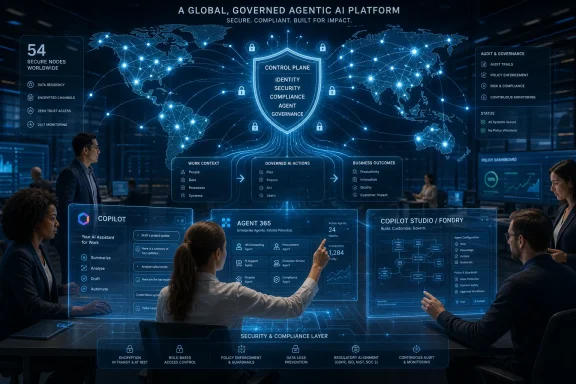
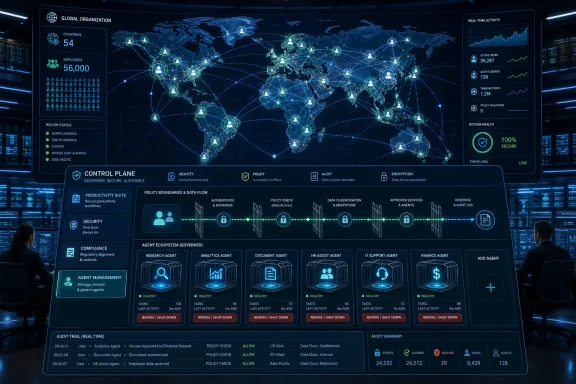
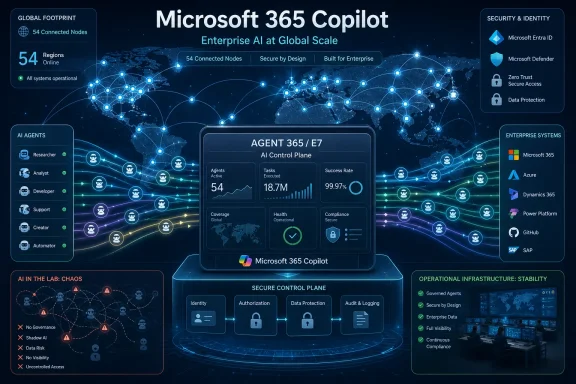
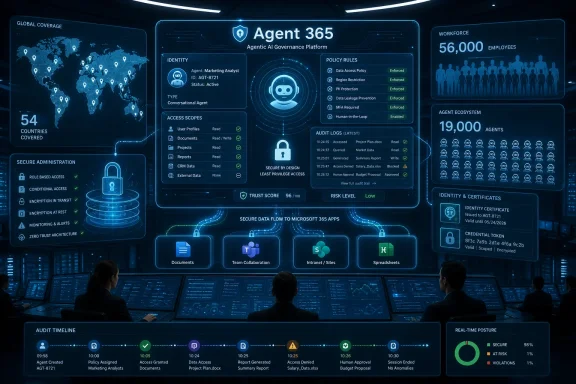
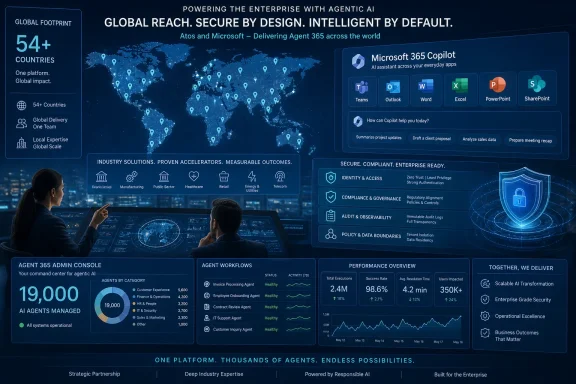
Atos Group and Microsoft announced on June 9, 2026, that Atos will deploy Microsoft 365 Copilot to 56,000 employees in 54 countries while expanding its use of Microsoft 365 E7, Agent 365, Copilot Studio, and Microsoft Foundry for enterprise AI services. This is not another pilot dressed up as transformation theater. It is Microsoft’s clearest enterprise proof point yet for a new thesis: agentic AI only becomes a serious business platform when identity, security, compliance, and software distribution are sold as one stack. For Atos, the move is equally strategic, because a global services firm cannot credibly sell governed AI at scale unless it first proves it can survive the blast radius inside its own estate.
The headline number is simple enough: 56,000 Atos employees will get Microsoft 365 Copilot across Outlook, Teams, Word, Excel, PowerPoint, and SharePoint. That is the sort of deployment Microsoft has wanted to showcase since Copilot moved from executive demo to line-item budget request. It puts the assistant not just in the hands of consultants and engineers, but across a professional-services workforce that is itself expected to advise clients on the same technology.
But the more important detail is not Copilot. It is Microsoft 365 E7, the new premium enterprise bundle Microsoft introduced this year as its so-called Frontier Suite. E7 combines Microsoft 365 E5, Microsoft 365 Copilot, and Agent 365 into a single package, wrapping productivity AI together with security, compliance, identity, and agent governance.
That bundling matters because the enterprise AI fight is shifting. The first wave was about who had the best chatbot. The second was about whose chatbot could read the most documents without causing a privacy incident. The third is about whether software agents can act across a company without turning every tenant into a sprawling, ungoverned automation experiment.
Atos is buying into that third wave. It is not merely handing employees a prompt box and hoping productivity emerges. It is standardizing on Microsoft’s control plane for the agents, identities, devices, permissions, content stores, and compliance boundaries that make those prompts safe enough to use in regulated work.
That is exactly where agentic AI creates a management problem. A conventional chatbot answers a question. An agent can carry out a task, retrieve information, invoke tools, use credentials, write to systems, and hand work to other agents. The moment software starts acting on behalf of users or operating with its own identity, IT departments need something more durable than trust, screenshots, and vendor promises.
Atos says it will use Agent 365 to govern a fast-growing population of 19,000 AI agents. That number is the quiet shock in the announcement. The company is not talking about a few sanctioned productivity assistants; it is describing an emerging machine workforce large enough to require its own administrative discipline.
The governance challenge is also more complicated than licensing. Some agents act for users. Some run under their own credentials. Some come from vendors or clients. Some may be built in Copilot Studio, others in Microsoft Foundry, and still others may sit outside the neat boundaries of Microsoft 365. A serious control layer has to inventory them, evaluate their permissions, enforce policy, monitor behavior, and give security teams a way to respond when something misfires.
That is why Microsoft’s preferred AI sales motion now looks less like “buy Copilot” and more like “standardize your AI estate around the Microsoft identity and security model.” It is a familiar playbook. The company won the enterprise desktop by making Windows and Office the default environment for work. It won a large slice of enterprise cloud by connecting Azure, Entra, Defender, Purview, and Intune into a management story. Now it is trying to make agentic AI feel like the next logical layer in that same administrative universe.
That is also why the announcement leans heavily on security and sovereignty. Atos is a European-headquartered services firm with customers who care about where data flows, who controls infrastructure, and which legal regimes apply. For those buyers, agentic AI is not simply a productivity feature. It is a new class of operational dependency.
Atos has spent the last several years navigating a painful corporate reset, including restructuring, a narrower go-forward perimeter, and a clearer division between services under the Atos brand and products and systems under Eviden. The company’s latest public materials describe a business still significant in scale but operating under sharper financial and strategic constraints than in its older, more sprawling form. A workforce-wide AI deployment therefore serves two purposes: it modernizes internal delivery, and it signals to the market that Atos wants to be seen as a practitioner of governed AI rather than a legacy outsourcer attaching “AI” to a slide deck.
That signal is useful, but it is not proof by itself. The hard part is not announcing that every employee has Copilot. The hard part is changing how delivery teams estimate work, how consultants draft client artifacts, how engineers troubleshoot systems, how sales teams assemble proposals, and how regulated clients audit the work product. Productivity gains in enterprise software are often declared centrally and discovered unevenly at the edge.
The pitch is obvious. If a company already depends on Microsoft 365, already uses Entra for identity, already has Defender in the security stack, already manages devices through Intune, and already relies on Purview for compliance and data governance, then E7 presents AI as an extension of existing architecture rather than a separate platform bet. Microsoft is not asking customers to trust a new universe. It is asking them to deepen the one they are already in.
That is powerful for administrators. Fragmented AI adoption is exhausting. One team wants a meeting assistant. Another builds a workflow bot. A third connects a model to a customer database. A vendor ships embedded AI into a SaaS tool. Suddenly, the security team has to answer basic questions that should not be hard: which agents exist, what can they access, which data can they read, who approved them, and how do we shut them down?
Microsoft’s answer is to make agent governance look like familiar tenant governance. That does not solve every problem, but it changes the shape of the problem. Instead of treating AI as a thousand exceptions, the organization can treat it as another class of workload inside its identity, endpoint, information protection, and audit model.
The risk, of course, is lock-in. The more an enterprise relies on Microsoft as the broker for work context, agent identity, compliance policy, and productivity tooling, the harder it becomes to move critical AI workflows elsewhere. CIOs may accept that tradeoff, especially if the alternative is ungoverned sprawl. But they should understand that E7 is not merely a bundle; it is a strategy for making Microsoft the administrative substrate of enterprise AI.
That context is the point. A Copilot that cannot see the right documents, meetings, and relationships is a polished autocomplete engine. A Copilot that can reason across the Microsoft 365 environment becomes something closer to a work broker. It can summarize a project, infer stakeholders, prepare a meeting, draft a response, and potentially trigger downstream work.
For WindowsForum readers who live in admin centers and PowerShell sessions, this is where the excitement and anxiety meet. Context makes AI useful, but context also creates exposure. The better the model understands the enterprise, the more important it becomes to ensure that permissions, sensitivity labels, retention policies, and access reviews are correct before AI starts amplifying old mistakes.
Many organizations still carry years of SharePoint drift, Teams sprawl, over-permissive groups, stale accounts, and poorly classified documents. Copilot does not invent those weaknesses, but it can make them newly visible. An employee who previously would never find a confidential file may now be able to surface a summary if the permissions model says they are allowed to see it.
That is why Microsoft and Atos are presenting governance as foundational rather than decorative. The old approach to collaboration cleanup was easy to postpone because the harm was often hidden. Agentic AI changes the urgency. If software can act across your work graph, the work graph has to be treated as critical infrastructure.
Microsoft has spent years trying to make its cloud acceptable to those customers through data boundary commitments, regional cloud investments, compliance certifications, and partnerships. Atos brings services credibility in precisely the sectors where sovereign technology narratives resonate. Together, they are trying to make agentic AI sound less like Silicon Valley experimentation and more like governed industrial infrastructure.
The phrase “agentic AI for mission-critical environments” also deserves scrutiny. Mission-critical environments are not impressed by a model that performs well in a demo but fails unpredictably under operational pressure. They require observability, rollback, human escalation, separation of duties, audit trails, and well-defined responsibility when something goes wrong.
That last point remains unresolved across the industry. If an agent drafts a bad contract clause, exposes sensitive information, approves an incorrect workflow, or takes action based on a hallucinated premise, responsibility will not rest neatly with the software. It will move through the vendor, integrator, customer, administrator, data owner, and end user. That liability chain is precisely why large systems integrators see opportunity. The world will need not just AI tools, but operating models, controls, and blame maps.
A real redesign changes incentives, workflows, governance, training, measurement, and management expectations. It determines which tasks should be automated, which should remain human-led, and which should be restructured because AI has altered the cost of coordination. It also decides what counts as quality in a world where first drafts, meeting notes, research briefs, and slide outlines can be generated instantly.
Professional services firms are unusually exposed to this question because much of their work product is knowledge packaging. Consultants write proposals, summarize workshops, produce architecture documents, generate status reports, prepare executive briefings, and translate technical work into client-facing narratives. These are exactly the tasks Copilot is designed to accelerate.
But acceleration creates its own management burden. If every employee can produce more drafts, the bottleneck may move to review. If every consultant can generate a polished artifact, the differentiator becomes judgment, originality, and domain expertise. If agents can complete routine delivery tasks, firms must decide whether the savings flow to clients, margins, or expanded scope.
The productivity story therefore cuts both ways. Atos may become more efficient, but its clients will eventually ask why AI-assisted work should be billed like pre-AI work. That pressure is coming for the entire consulting and systems integration sector. The firms that embrace AI earliest may gain delivery leverage, but they also train customers to expect faster, cheaper, and more transparent execution.
Admins will need to know which users have Copilot, which agents exist, which connectors are enabled, which data sources are available, and how agent actions are logged. They will need to coordinate with legal teams on retention and eDiscovery, with security teams on detection and response, and with business units on acceptable use. The work will be less glamorous than Microsoft’s product videos, but it will determine whether the deployment is trusted.
The introduction of agents with their own credentials is especially significant. Traditional user-centric security models assume that a person’s identity is the primary unit of access. Service accounts complicated that model, and agents will complicate it further. If an agent can act persistently, independently, or across systems, it needs lifecycle management as strict as any privileged identity.
That means joiner-mover-leaver processes for agents, not just humans. It means access reviews that include non-human actors. It means conditional access policies, monitoring, and least-privilege assumptions that account for software workers. The industry is only beginning to normalize this discipline, and large deployments like Atos will surface the rough edges.
Microsoft’s advantage is that many of these controls already exist in adjacent form. Entra knows identities. Defender watches threats. Purview handles information governance. Intune manages devices and endpoints. Agent 365’s promise is to extend those muscles to agents before the unmanaged population becomes too large to control.
Atos, for its part, needs to show that it belongs in the top tier of AI transformation partners. The company is not alone. Accenture, Capgemini, Kyndryl, IBM, Deloitte, and others are all racing to turn generative and agentic AI into repeatable service lines. The difference between a press release and a durable practice will be whether these firms can industrialize delivery instead of staffing bespoke experiments.
Microsoft’s partner strategy appears to be converging around repeatability. Copilot Studio gives organizations a way to build agents. Microsoft Foundry provides a broader platform for AI development and operations. Agent 365 supplies governance. E7 wraps the commercial and security story. A services partner can then package assessment, migration, development, and managed operations around those pieces.
That is a cleaner story than the fragmented AI market of 2023 and 2024, when enterprises often had to stitch together foundation models, vector databases, orchestration frameworks, cloud services, security tooling, and custom governance. The simplification is attractive, particularly for customers that already standardize on Microsoft. It may also reduce room for independent AI infrastructure vendors unless they can prove better performance, lower cost, or stronger portability.
How many employees will use Copilot daily after the launch excitement fades? Which roles will see measurable productivity gains? How much rework will AI-generated content require? Will agents reduce operational risk or introduce new forms of silent failure? How will Atos measure quality, customer satisfaction, security incidents, and margin impact over time?
These are not cynical questions. They are the questions that determine whether agentic AI becomes enterprise infrastructure or another expensive layer of software underutilization. Microsoft has learned from previous enterprise adoption waves that seat deployment and business value are not the same thing. The company can count licenses quickly; customers feel outcomes slowly.
Atos’ position as a services firm makes the measurement problem both easier and harder. Easier, because professional-services workflows produce artifacts, tickets, proposals, documentation, and project metrics that can be compared over time. Harder, because knowledge work is messy, client-specific, and vulnerable to false precision. A faster slide deck is not always a better recommendation.
The most useful signal will not be whether Atos employees can summarize meetings or draft emails. It will be whether the company can shorten delivery cycles, improve consistency, reduce support burden, and create new services clients will pay for. That evidence will take quarters, not launch-day quotes.
That ambition will be welcomed by some IT leaders and resisted by others. The case for Microsoft is operational coherence. One vendor, one identity layer, one admin model, one security ecosystem, one set of compliance hooks. The case against Microsoft is concentration. One vendor, one roadmap, one pricing strategy, one set of architectural assumptions.
Both arguments are valid. In heavily regulated enterprises, consolidation can be a security advantage. In innovation-heavy environments, it can become a constraint. The right answer will depend less on abstract platform purity than on whether Microsoft can make its agent governance genuinely interoperable and whether customers can avoid building workflows so tightly coupled to one vendor that future bargaining power disappears.
For now, Atos has made its choice. It is betting that the fastest path to production agentic AI runs through Microsoft’s existing enterprise estate, not around it. That bet is rational, especially for a company that must reassure clients about security and sovereignty while also moving quickly enough to remain competitive.
That should sound familiar to anyone who has managed Microsoft 365 at scale. The organizations that will benefit most from agentic AI are likely to be the ones that already know where their data is, have cleaned up permissions, understand their compliance obligations, and can enforce policy consistently. The organizations that have treated collaboration platforms as digital junk drawers may find that AI makes old disorder newly expensive.
There is also a cultural readiness test. Employees need to understand when AI is a drafting partner, when it is an automation engine, and when it is not appropriate at all. Managers need to avoid measuring adoption by prompt volume alone. Security teams need to distinguish normal agent behavior from suspicious activity. Legal teams need to decide how AI-generated work should be retained, reviewed, and disclosed.
This is the unglamorous center of the story. The next phase of AI work will be less about surprise and more about administration. That may disappoint people who want every AI announcement to feel revolutionary, but it is exactly what makes the technology enterprise-relevant.
The announcement also lets Microsoft position E7 as more than an upsell. By tying Copilot, Agent 365, Entra, Defender, Intune, and Purview together, Microsoft is arguing that secure agentic AI is not a feature you bolt on after procurement. It is an architecture you choose at the beginning.
Atos benefits because it can now point to its own estate when advising customers. That does not guarantee success, but it gives the company a stronger claim than firms selling AI transformation from the outside. If Atos can show measurable internal gains and disciplined governance, it will have a more credible story in the crowded AI services market.
The danger for both companies is that expectations are now explicit. A workforce-wide deployment invites workforce-wide judgment. If employees find Copilot useful but agents cumbersome, if governance slows development too much, if clients remain hesitant, or if savings are hard to prove, the deployment could become a cautionary tale about ambition exceeding readiness. At this scale, success and friction will both be visible.
 Microsoft Turns Copilot From a Seat License Into an Operating Model
The headline number is simple enough: 56,000 Atos employees will get Microsoft 365 Copilot across Outlook, Teams, Word, Excel, PowerPoint, and SharePoint. That is the sort of deployment Microsoft has wanted to showcase since Copilot moved from executive demo to line-item budget request. It puts the assistant not just in the hands of consultants and engineers, but across a professional-services workforce that is itself expected to advise clients on the same technology.But the more important detail is not Copilot. It is Microsoft 365 E7, the new premium enterprise bundle Microsoft introduced this year as its so-called Frontier Suite. E7 combines Microsoft 365 E5, Microsoft 365 Copilot, and Agent 365 into a single package, wrapping productivity AI together with security, compliance, identity, and agent governance.
That bundling matters because the enterprise AI fight is shifting. The first wave was about who had the best chatbot. The second was about whose chatbot could read the most documents without causing a privacy incident. The third is about whether software agents can act across a company without turning every tenant into a sprawling, ungoverned automation experiment.
Atos is buying into that third wave. It is not merely handing employees a prompt box and hoping productivity emerges. It is standardizing on Microsoft’s control plane for the agents, identities, devices, permissions, content stores, and compliance boundaries that make those prompts safe enough to use in regulated work.
The Real Product Is the Control Plane
Microsoft’s language around Agent 365 is telling. It describes the product less as an application than as a control plane for observing, governing, and securing AI agents across the enterprise. That framing borrows from cloud infrastructure, where the control plane is the part of the system that tells everything else what is allowed to happen.That is exactly where agentic AI creates a management problem. A conventional chatbot answers a question. An agent can carry out a task, retrieve information, invoke tools, use credentials, write to systems, and hand work to other agents. The moment software starts acting on behalf of users or operating with its own identity, IT departments need something more durable than trust, screenshots, and vendor promises.
Atos says it will use Agent 365 to govern a fast-growing population of 19,000 AI agents. That number is the quiet shock in the announcement. The company is not talking about a few sanctioned productivity assistants; it is describing an emerging machine workforce large enough to require its own administrative discipline.
The governance challenge is also more complicated than licensing. Some agents act for users. Some run under their own credentials. Some come from vendors or clients. Some may be built in Copilot Studio, others in Microsoft Foundry, and still others may sit outside the neat boundaries of Microsoft 365. A serious control layer has to inventory them, evaluate their permissions, enforce policy, monitor behavior, and give security teams a way to respond when something misfires.
That is why Microsoft’s preferred AI sales motion now looks less like “buy Copilot” and more like “standardize your AI estate around the Microsoft identity and security model.” It is a familiar playbook. The company won the enterprise desktop by making Windows and Office the default environment for work. It won a large slice of enterprise cloud by connecting Azure, Entra, Defender, Purview, and Intune into a management story. Now it is trying to make agentic AI feel like the next logical layer in that same administrative universe.
Atos Becomes Client Zero Because It Has to Be
Atos calls itself “Client Zero” in this rollout, and the phrase is doing real work. The company is both customer and reseller, internal adopter and external adviser. If it can prove that agentic AI can be deployed across its own workforce, it gets a sales story for clients in defense, finance, healthcare, public administration, and other markets where “move fast and break things” reads less like inspiration than negligence.That is also why the announcement leans heavily on security and sovereignty. Atos is a European-headquartered services firm with customers who care about where data flows, who controls infrastructure, and which legal regimes apply. For those buyers, agentic AI is not simply a productivity feature. It is a new class of operational dependency.
Atos has spent the last several years navigating a painful corporate reset, including restructuring, a narrower go-forward perimeter, and a clearer division between services under the Atos brand and products and systems under Eviden. The company’s latest public materials describe a business still significant in scale but operating under sharper financial and strategic constraints than in its older, more sprawling form. A workforce-wide AI deployment therefore serves two purposes: it modernizes internal delivery, and it signals to the market that Atos wants to be seen as a practitioner of governed AI rather than a legacy outsourcer attaching “AI” to a slide deck.
That signal is useful, but it is not proof by itself. The hard part is not announcing that every employee has Copilot. The hard part is changing how delivery teams estimate work, how consultants draft client artifacts, how engineers troubleshoot systems, how sales teams assemble proposals, and how regulated clients audit the work product. Productivity gains in enterprise software are often declared centrally and discovered unevenly at the edge.
The E7 Bet Is a Bet on Fewer Procurement Arguments
Microsoft 365 E7 is a packaging move, but packaging is never trivial in enterprise software. By bundling E5, Copilot, and Agent 365, Microsoft is reducing the number of separate conversations a CIO has to have about security, compliance, AI, and governance. It is also raising the ceiling on what Microsoft can charge for the workplace stack.The pitch is obvious. If a company already depends on Microsoft 365, already uses Entra for identity, already has Defender in the security stack, already manages devices through Intune, and already relies on Purview for compliance and data governance, then E7 presents AI as an extension of existing architecture rather than a separate platform bet. Microsoft is not asking customers to trust a new universe. It is asking them to deepen the one they are already in.
That is powerful for administrators. Fragmented AI adoption is exhausting. One team wants a meeting assistant. Another builds a workflow bot. A third connects a model to a customer database. A vendor ships embedded AI into a SaaS tool. Suddenly, the security team has to answer basic questions that should not be hard: which agents exist, what can they access, which data can they read, who approved them, and how do we shut them down?
Microsoft’s answer is to make agent governance look like familiar tenant governance. That does not solve every problem, but it changes the shape of the problem. Instead of treating AI as a thousand exceptions, the organization can treat it as another class of workload inside its identity, endpoint, information protection, and audit model.
The risk, of course, is lock-in. The more an enterprise relies on Microsoft as the broker for work context, agent identity, compliance policy, and productivity tooling, the harder it becomes to move critical AI workflows elsewhere. CIOs may accept that tradeoff, especially if the alternative is ungoverned sprawl. But they should understand that E7 is not merely a bundle; it is a strategy for making Microsoft the administrative substrate of enterprise AI.
Work IQ Makes the Graph More Valuable and More Dangerous
Work IQ is Microsoft’s name for the workplace intelligence layer that gives agents context about people, files, meetings, emails, organizational relationships, and work patterns. In plain English, it is the difference between a generic model that can write plausible business prose and an enterprise assistant that knows enough about your business to be useful.That context is the point. A Copilot that cannot see the right documents, meetings, and relationships is a polished autocomplete engine. A Copilot that can reason across the Microsoft 365 environment becomes something closer to a work broker. It can summarize a project, infer stakeholders, prepare a meeting, draft a response, and potentially trigger downstream work.
For WindowsForum readers who live in admin centers and PowerShell sessions, this is where the excitement and anxiety meet. Context makes AI useful, but context also creates exposure. The better the model understands the enterprise, the more important it becomes to ensure that permissions, sensitivity labels, retention policies, and access reviews are correct before AI starts amplifying old mistakes.
Many organizations still carry years of SharePoint drift, Teams sprawl, over-permissive groups, stale accounts, and poorly classified documents. Copilot does not invent those weaknesses, but it can make them newly visible. An employee who previously would never find a confidential file may now be able to surface a summary if the permissions model says they are allowed to see it.
That is why Microsoft and Atos are presenting governance as foundational rather than decorative. The old approach to collaboration cleanup was easy to postpone because the harm was often hidden. Agentic AI changes the urgency. If software can act across your work graph, the work graph has to be treated as critical infrastructure.
Sovereignty Becomes the Enterprise AI Sales Language
Atos’ mention of Sovereign Agentic AI studios is not an accidental flourish. European customers, public-sector buyers, and regulated industries increasingly want AI capabilities that preserve control over data, decision-making, residency, and accountability. “Sovereign” has become one of the most important words in the European cloud and AI market because it condenses legal, political, and operational concerns into a single procurement demand.Microsoft has spent years trying to make its cloud acceptable to those customers through data boundary commitments, regional cloud investments, compliance certifications, and partnerships. Atos brings services credibility in precisely the sectors where sovereign technology narratives resonate. Together, they are trying to make agentic AI sound less like Silicon Valley experimentation and more like governed industrial infrastructure.
The phrase “agentic AI for mission-critical environments” also deserves scrutiny. Mission-critical environments are not impressed by a model that performs well in a demo but fails unpredictably under operational pressure. They require observability, rollback, human escalation, separation of duties, audit trails, and well-defined responsibility when something goes wrong.
That last point remains unresolved across the industry. If an agent drafts a bad contract clause, exposes sensitive information, approves an incorrect workflow, or takes action based on a hallucinated premise, responsibility will not rest neatly with the software. It will move through the vendor, integrator, customer, administrator, data owner, and end user. That liability chain is precisely why large systems integrators see opportunity. The world will need not just AI tools, but operating models, controls, and blame maps.
Copilot at Every Desk Does Not Automatically Redesign Work
Microsoft’s Jared Spataro framed the Atos rollout as part of a new era in which ambitious companies redesign work from the ground up around AI. That is the right aspiration, but it is also where enterprise software rhetoric tends to outrun reality. Giving everyone an AI assistant is not the same as redesigning work.A real redesign changes incentives, workflows, governance, training, measurement, and management expectations. It determines which tasks should be automated, which should remain human-led, and which should be restructured because AI has altered the cost of coordination. It also decides what counts as quality in a world where first drafts, meeting notes, research briefs, and slide outlines can be generated instantly.
Professional services firms are unusually exposed to this question because much of their work product is knowledge packaging. Consultants write proposals, summarize workshops, produce architecture documents, generate status reports, prepare executive briefings, and translate technical work into client-facing narratives. These are exactly the tasks Copilot is designed to accelerate.
But acceleration creates its own management burden. If every employee can produce more drafts, the bottleneck may move to review. If every consultant can generate a polished artifact, the differentiator becomes judgment, originality, and domain expertise. If agents can complete routine delivery tasks, firms must decide whether the savings flow to clients, margins, or expanded scope.
The productivity story therefore cuts both ways. Atos may become more efficient, but its clients will eventually ask why AI-assisted work should be billed like pre-AI work. That pressure is coming for the entire consulting and systems integration sector. The firms that embrace AI earliest may gain delivery leverage, but they also train customers to expect faster, cheaper, and more transparent execution.
Windows Administrators Will Meet Agents Through Policy Before Magic
For many Windows and Microsoft 365 administrators, agentic AI will not arrive as a philosophical debate. It will arrive as a policy assignment, a licensing change, a compliance review, a user complaint, and a security exception request. The Atos rollout is interesting because it previews the operational shape of that future.Admins will need to know which users have Copilot, which agents exist, which connectors are enabled, which data sources are available, and how agent actions are logged. They will need to coordinate with legal teams on retention and eDiscovery, with security teams on detection and response, and with business units on acceptable use. The work will be less glamorous than Microsoft’s product videos, but it will determine whether the deployment is trusted.
The introduction of agents with their own credentials is especially significant. Traditional user-centric security models assume that a person’s identity is the primary unit of access. Service accounts complicated that model, and agents will complicate it further. If an agent can act persistently, independently, or across systems, it needs lifecycle management as strict as any privileged identity.
That means joiner-mover-leaver processes for agents, not just humans. It means access reviews that include non-human actors. It means conditional access policies, monitoring, and least-privilege assumptions that account for software workers. The industry is only beginning to normalize this discipline, and large deployments like Atos will surface the rough edges.
Microsoft’s advantage is that many of these controls already exist in adjacent form. Entra knows identities. Defender watches threats. Purview handles information governance. Intune manages devices and endpoints. Agent 365’s promise is to extend those muscles to agents before the unmanaged population becomes too large to control.
The Competitive Message Is Aimed at Integrators as Much as Customers
This announcement is also a partner-market maneuver. Microsoft needs global systems integrators to convert AI enthusiasm into billable transformation. Customers may buy Copilot licenses directly, but complex deployments require assessment, data governance, workflow redesign, security architecture, user training, and industry-specific integration. That is integrator territory.Atos, for its part, needs to show that it belongs in the top tier of AI transformation partners. The company is not alone. Accenture, Capgemini, Kyndryl, IBM, Deloitte, and others are all racing to turn generative and agentic AI into repeatable service lines. The difference between a press release and a durable practice will be whether these firms can industrialize delivery instead of staffing bespoke experiments.
Microsoft’s partner strategy appears to be converging around repeatability. Copilot Studio gives organizations a way to build agents. Microsoft Foundry provides a broader platform for AI development and operations. Agent 365 supplies governance. E7 wraps the commercial and security story. A services partner can then package assessment, migration, development, and managed operations around those pieces.
That is a cleaner story than the fragmented AI market of 2023 and 2024, when enterprises often had to stitch together foundation models, vector databases, orchestration frameworks, cloud services, security tooling, and custom governance. The simplification is attractive, particularly for customers that already standardize on Microsoft. It may also reduce room for independent AI infrastructure vendors unless they can prove better performance, lower cost, or stronger portability.
The Numbers Are Large Enough to Matter, but Not Enough to Settle the Debate
A 56,000-person deployment is substantial. So is a 19,000-agent governance target. Those figures give Microsoft and Atos a credible scale story, especially because Atos operates across dozens of countries and regulated sectors. But the numbers do not automatically answer the questions enterprise buyers care about most.How many employees will use Copilot daily after the launch excitement fades? Which roles will see measurable productivity gains? How much rework will AI-generated content require? Will agents reduce operational risk or introduce new forms of silent failure? How will Atos measure quality, customer satisfaction, security incidents, and margin impact over time?
These are not cynical questions. They are the questions that determine whether agentic AI becomes enterprise infrastructure or another expensive layer of software underutilization. Microsoft has learned from previous enterprise adoption waves that seat deployment and business value are not the same thing. The company can count licenses quickly; customers feel outcomes slowly.
Atos’ position as a services firm makes the measurement problem both easier and harder. Easier, because professional-services workflows produce artifacts, tickets, proposals, documentation, and project metrics that can be compared over time. Harder, because knowledge work is messy, client-specific, and vulnerable to false precision. A faster slide deck is not always a better recommendation.
The most useful signal will not be whether Atos employees can summarize meetings or draft emails. It will be whether the company can shorten delivery cycles, improve consistency, reduce support burden, and create new services clients will pay for. That evidence will take quarters, not launch-day quotes.
The Atos Deal Shows Where Microsoft Wants the AI Stack to Harden
The Atos-Microsoft expansion is a useful marker because it shows the enterprise AI stack hardening around four layers: the assistant employees touch, the agent tools developers use, the organizational context that grounds the work, and the governance plane that keeps the whole system inside policy. Microsoft wants to own or orchestrate all four.That ambition will be welcomed by some IT leaders and resisted by others. The case for Microsoft is operational coherence. One vendor, one identity layer, one admin model, one security ecosystem, one set of compliance hooks. The case against Microsoft is concentration. One vendor, one roadmap, one pricing strategy, one set of architectural assumptions.
Both arguments are valid. In heavily regulated enterprises, consolidation can be a security advantage. In innovation-heavy environments, it can become a constraint. The right answer will depend less on abstract platform purity than on whether Microsoft can make its agent governance genuinely interoperable and whether customers can avoid building workflows so tightly coupled to one vendor that future bargaining power disappears.
For now, Atos has made its choice. It is betting that the fastest path to production agentic AI runs through Microsoft’s existing enterprise estate, not around it. That bet is rational, especially for a company that must reassure clients about security and sovereignty while also moving quickly enough to remain competitive.
The Practical Lesson Is That AI Readiness Starts Before the AI Rollout
The most concrete lesson from the Atos announcement is that enterprise AI readiness is not primarily a model-selection exercise. It is a governance, identity, data, and operating-model exercise. Copilot may be the visible product, but the deployment depends on the plumbing most users never see.That should sound familiar to anyone who has managed Microsoft 365 at scale. The organizations that will benefit most from agentic AI are likely to be the ones that already know where their data is, have cleaned up permissions, understand their compliance obligations, and can enforce policy consistently. The organizations that have treated collaboration platforms as digital junk drawers may find that AI makes old disorder newly expensive.
There is also a cultural readiness test. Employees need to understand when AI is a drafting partner, when it is an automation engine, and when it is not appropriate at all. Managers need to avoid measuring adoption by prompt volume alone. Security teams need to distinguish normal agent behavior from suspicious activity. Legal teams need to decide how AI-generated work should be retained, reviewed, and disclosed.
This is the unglamorous center of the story. The next phase of AI work will be less about surprise and more about administration. That may disappoint people who want every AI announcement to feel revolutionary, but it is exactly what makes the technology enterprise-relevant.
Atos Hands Microsoft the Case Study It Needed
Atos’ deployment gives Microsoft a case study with unusually convenient ingredients: a large global workforce, regulated-industry exposure, European sovereignty concerns, a systems integrator’s client-facing business model, and a declared move from pilot to production. It is the kind of customer story that can be reused in boardrooms where AI ambition is high but tolerance for risk is limited.The announcement also lets Microsoft position E7 as more than an upsell. By tying Copilot, Agent 365, Entra, Defender, Intune, and Purview together, Microsoft is arguing that secure agentic AI is not a feature you bolt on after procurement. It is an architecture you choose at the beginning.
Atos benefits because it can now point to its own estate when advising customers. That does not guarantee success, but it gives the company a stronger claim than firms selling AI transformation from the outside. If Atos can show measurable internal gains and disciplined governance, it will have a more credible story in the crowded AI services market.
The danger for both companies is that expectations are now explicit. A workforce-wide deployment invites workforce-wide judgment. If employees find Copilot useful but agents cumbersome, if governance slows development too much, if clients remain hesitant, or if savings are hard to prove, the deployment could become a cautionary tale about ambition exceeding readiness. At this scale, success and friction will both be visible.
The Copilot Era Gets Its Enterprise Stress Test
The Atos rollout reduces a sprawling announcement to a few practical facts that matter for WindowsForum readers, Microsoft 365 administrators, and enterprise technology buyers.- Atos is deploying Microsoft 365 Copilot to 56,000 employees across 54 countries, making this a full-company production rollout rather than a limited departmental pilot.
- Microsoft 365 E7 is the strategic center of the deal because it bundles Copilot, E5-class security and compliance, and Agent 365 governance into one enterprise platform.
- Atos plans to govern a population of 19,000 AI agents, which shows how quickly non-human digital workers can become an administrative category of their own.
- The deployment depends on Microsoft’s broader security and management stack, including Entra, Defender, Intune, and Purview, not just the Copilot user experience.
- Atos is using its internal transformation as a client-facing proof point for regulated industries that want agentic AI without surrendering governance, auditability, or sovereignty.
- The real test will be measured in adoption, workflow redesign, risk reduction, and client delivery outcomes, not in the number of Copilot seats assigned on launch day.
References
- Primary source: Microsoft Source
Published: Tue, 09 Jun 2026 12:05:11 GMT
- Related coverage: windowscentral.com
"Agents are only as good as the context we give them": Microsoft IQ connects AI agents to your workspace data and the web | Windows Central
The newly unveiled Microsoft IQ data stack and Scout assistant turn generic AI into a personalized workplace tool.www.windowscentral.com - Related coverage: tomsguide.com
Biggest Microsoft Build 2026 announcements — agentic AI, RTX Spark Dev Box, GitHub Copilot app, new MAI models, and more | Tom's Guide
All the big news from Microsoft's AI-focused eventwww.tomsguide.com - Related coverage: atosgroup.com
Atos Group - Q1 2026 performance | Atos Group
Atos Group, a global leader of AI-powered digital transformation, today announces its Q1 2026 performance. www.atosgroup.com
- Official source: devblogs.microsoft.com
Work IQ: Production‑ready intelligence for every agent - Microsoft 365 Developer Blog
Work IQ provides a workplace intelligence layer that enables agents to access and reason over organizational data, context, and tools, continuously building a semantic understanding across Microsoft 365 and external systems with built-in, permission-aware governance.devblogs.microsoft.com - Official source: blogs.microsoft.com
Introducing the First Frontier Suite built on Intelligence + Trust - The Official Microsoft Blog
Today Microsoft is announcing: Wave 3 of Microsoft 365 Copilot Expanded model diversity with Claude and next-gen OpenAI models available today General availability of Agent 365 on May 1 for $15 per user General availability of the new Microsoft 365 E7: The Frontier Suite on May 1 for $99 per...blogs.microsoft.com

- Official source: learn.microsoft.com
May 2026 announcements - Partner Center announcements | Microsoft Learn
May 2026 announcements for Microsoft Partner Center including new capabilities, promotions, offers, markets, or changes to existing offers.learn.microsoft.com - Official source: microsoft.com
Microsoft 365 Roadmap | Microsoft 365
The Microsoft 365 Roadmap lists updates that are currently planned for applicable subscribers. Check here for more information on the status of new features and updates.www.microsoft.com
- Related coverage: windowsforum.com
Microsoft Work IQ: The AI Context Infrastructure Behind M365 Copilot | Windows Forum
Microsoft is positioning Work IQ as the shared intelligence layer behind Microsoft 365 Copilot and AI agents, using Microsoft Graph data from Teams...windowsforum.com - Related coverage: techradar.com
Microsoft 365 confirms new premium tier focused on AI and productivity | TechRadar
Microsoft adds new E7 plan to cope with AI usagewww.techradar.com - Related coverage: itpro.com
Everything you need to know about the new E7 Microsoft 365 tier, including features, pricing, and release date | IT Pro
The new premium bundle for Microsoft 365 adds AI capabilities to traditional tierswww.itpro.com - Related coverage: atos.net