

A surprising new twist in the handheld-PC arms race has emerged: reports indicate Lenovo may ship a SteamOS-powered version of the Legion Go 2 at CES 2026, offering Valve’s handheld-optimized Linux experience as an alternative to Windows on a top-tier AMD-powered device. If true, this would extend Valve’s SteamOS strategy beyond the Steam Deck and the early third‑party Legion Go S experiment — and it would place a high‑end 8.8‑inch OLED, Ryzen Z2 Extreme handheld squarely into the crosshairs of both SteamOS advocates and Windows‑first buyers.
Valve’s SteamOS has evolved from a niche experiment for Valve’s own Steam Deck into a platform Valve is actively pushing onto third‑party handhelds. Over the last two years the company released SteamOS updates, tooling and a compatibility program so that non‑Valve hardware could join a broader SteamOS ecosystem with a predictable compatibility label for games. That push produced the first licensed third‑party SteamOS handhelds, and OEMs have since experimented with dual‑OS strategies: Windows for maximum compatibility with PC software, and SteamOS where a console‑like, gamepad‑first experience is preferred.
Lenovo’s entry into the handheld space has been one of the most consequential. The original Legion Go established the detachable‑controller formula and a high‑resolution display; subsequent models (including a smaller SteamOS‑first Legion Go S and the more powerful Legion Go 2 prototype) pushed the platform upward in performance and ambition. The Legion Go 2 moved the product from prototype to a polished premium handheld with an OLED display, a larger battery, and AMD’s Ryzen Z2 family — components that make it a logical candidate for an alternate SteamOS SKU.
This reported SteamOS variant — pitched for CES 2026 — is being framed as a “Powered by SteamOS” offering on hardware otherwise identical to Lenovo’s Legion Go 2 hardware. That combination places significant technical, commercial and ecosystem questions on the table.
That said, the proposal is not without substantial caveats. Compatibility, anti‑cheat support, developer buy‑in and clear lifecycle support are the gating factors that will determine whether a SteamOS Legion Go 2 is a niche curiosity or a mainstream alternative to Windows handhelds. For buyers, the choice will come down to what they value most: the wide compatibility of Windows or the handheld‑tailored experience of SteamOS.
At the coming CES, the headline will be less about a single SKU and more about whether the handheld ecosystem can sustain meaningful diversity without fragmenting user expectations. If Lenovo and Valve present a clear roadmap — verified game lists, synchronized updates, and a predictable support model — a SteamOS Legion Go 2 could be a powerful statement that portable PC gaming is moving toward an era of deliberate platform choice rather than one‑size‑fits‑all compromises.
Key things to watch at CES 2026:
Source: TechPowerUp SteamOS-Powered Lenovo Legion Go 2 On the Cards for CES 2026 | TechPowerUp}
 Background / Overview
Valve’s SteamOS has evolved from a niche experiment for Valve’s own Steam Deck into a platform Valve is actively pushing onto third‑party handhelds. Over the last two years the company released SteamOS updates, tooling and a compatibility program so that non‑Valve hardware could join a broader SteamOS ecosystem with a predictable compatibility label for games. That push produced the first licensed third‑party SteamOS handhelds, and OEMs have since experimented with dual‑OS strategies: Windows for maximum compatibility with PC software, and SteamOS where a console‑like, gamepad‑first experience is preferred.Lenovo’s entry into the handheld space has been one of the most consequential. The original Legion Go established the detachable‑controller formula and a high‑resolution display; subsequent models (including a smaller SteamOS‑first Legion Go S and the more powerful Legion Go 2 prototype) pushed the platform upward in performance and ambition. The Legion Go 2 moved the product from prototype to a polished premium handheld with an OLED display, a larger battery, and AMD’s Ryzen Z2 family — components that make it a logical candidate for an alternate SteamOS SKU.
This reported SteamOS variant — pitched for CES 2026 — is being framed as a “Powered by SteamOS” offering on hardware otherwise identical to Lenovo’s Legion Go 2 hardware. That combination places significant technical, commercial and ecosystem questions on the table.
What’s being claimed: the SteamOS Legion Go 2 proposition
- Operating system: a variant of the Legion Go 2 running SteamOS out of the box rather than Windows 11, marketed to users who prefer a console‑like UI, lower system overhead, and Valve’s Proton compatibility layer.
- Core hardware: AMD Ryzen Z2 Extreme (top‑end Z2 family silicon), the same SoC options already available in the Legion Go 2 Windows models.
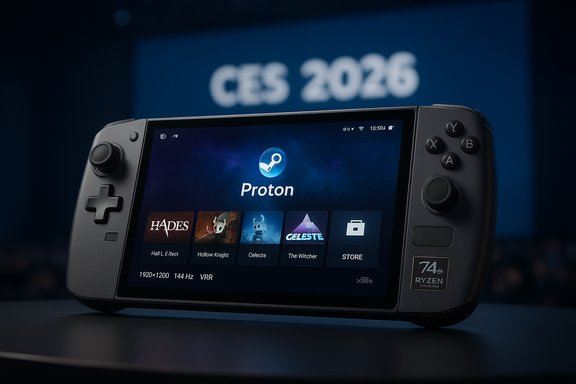
- Display: an 8.8‑inch OLED touchscreen with a WUXGA (1920×1200) panel, 144 Hz refresh rate and VRR (variable refresh rate).
- Memory and storage: configurations up to 32 GB LPDDR5X, and storage options reportedly up to 2 TB PCIe Gen4 SSD, plus a microSD slot for expansion.
- Battery: a 74 Whr pack — a substantial capacity for a handheld, intended to offset the power draw of RDNA 3.5‑era graphics.
- Controls and features: revised TrueStrike detachable controllers, Hall‑effect sticks, assignable grip buttons, a trackpad/mouse mode, and the usual USB‑C/USB4 ports and audio combo jack.
- Timing: an announcement or availability window centered on CES 2026 (January), positioning Lenovo to use the major trade show for marketing momentum.
Why SteamOS matters on premium handheld hardware
The practical appeal of SteamOS for handheld PCs
SteamOS delivers a game‑focused UI and kernel/userland stack tuned for handheld controls and battery life. On devices designed primarily for gaming — especially those with detachable controllers and gamepad‑first ergonomics — a SteamOS build reduces the friction players experience on Windows (sleep issues, background processes, and a desktop UI that’s not optimized for thumbsticks). Benefits for users include:- A console‑style home and store experience for Steam purchases, game discovery, and library browsing.
- Standardized Proton tooling and the SteamOS compatibility program, which can show whether a title will run on SteamOS (including middleware/anti‑cheat support).
- Potentially better system stability and sleep/resume behavior compared with out‑of‑the‑box Windows on handheld hardware.
Why OEMs and Valve are experimenting with multi‑OS strategies
OEMs can sell multiple SKUs with the same hardware but different OSes, targeting distinct user segments: those who want the familiarity of Windows and the broader app compatibility, and those who prefer a dedicated, handheld‑optimized experience. Valve benefits from broadening SteamOS adoption because it:- Increases the installed base of devices that can deliver a predictable Steam experience.
- Scales the impact of the SteamOS compatibility label (the more devices it covers, the more useful that label becomes).
- Pushes the Proton and Linux game‑compatibility ecosystem to attract more developer attention and testing.
Hardware analysis: why the Legion Go 2 is a credible SteamOS candidate
The Legion Go 2 is already one of the most capable handheld PCs available. Its core hardware choices make a SteamOS option credible — and technically sensible.- Ryzen Z2 Extreme: This is AMD’s handheld‑oriented Zen 5 family, with integrated RDNA 3.5 graphics. It offers strong CPU and iGPU performance for portable devices. On a handheld, performance is as much about sustained clocks and thermal headroom as peak numbers; Lenovo’s cooling and ergonomics matter a great deal here.
- 8.8‑inch OLED, 144 Hz, 1920×1200: Dropping resolution from earlier ultra‑high PPI panels to a 1920×1200 OLED at 144 Hz is a pragmatic choice. Lower native resolution reduces GPU load, improves sustained frame rates, and leverages OLED’s deep blacks and HDR capability. VRR support is beneficial for smoothing variable frame rates in demanding titles.
- 32 GB LPDDR5X and PCIe 4.0 SSD options: High bandwidth RAM and Gen4 storage help with game streaming, fast texture streaming, and overall responsiveness — especially with modern open‑world titles that load assets aggressively.
- 74 Whr battery: This is a large capacity for an 8–9‑inch handheld and is necessary to sustain long sessions when the Z2 Extreme is driving demanding games. Expect trade‑offs: higher weight and thermal management needs.
- Detachable controllers and trackpad: Lenovo’s modular controller approach — improved D‑pad, Hall‑effect sticks, and mouse mode — remains a standout feature, especially for genres that require precise inputs.
Software, compatibility, and anti‑cheat: the crux of the matter
A handheld’s attractiveness is only as good as the games it runs smoothly. That’s where SteamOS’s compatibility program and Proton matter — and where the risk vectors are clearest.- SteamOS compatibility labeling: Valve extended its Steam Deck verification system to cover SteamOS devices beyond the Deck. That gives buyers a quick visual indicator of whether a title will likely run and whether middleware, DRM and anti‑cheat components are supported. For a premium device like the Legion Go 2, broad compatibility is essential to justify the price premium.
- Proton and performance parity: Proton has matured dramatically, but it remains a translation layer. Some titles perform nearly identically on Proton as they do on Windows; others require developer patches or specific driver tweaks. Performance and stability can vary by title and by GPU driver stack.
- Anti‑cheat and middleware: Anti‑cheat tools have historically been an obstacle to Linux adoption for gaming; the landscape improved in 2024–2025 as major vendors adapted solutions compatible with Proton and Linux kernels. Nevertheless, some titles still depend on Windows‑only components. Official Valve/partner support and testing at launch would be a strong signal that high‑profile games will not be blocked on a SteamOS Legion Go 2.
- Non‑Steam platforms: A SteamOS handheld will always be most appealing to users who live in Steam. Running other store launchers (Epic, EA, Ubisoft) can be possible via Proton and containers, but the experience is less predictable than native Windows. Hybrid buyers who rely on Windows‑only launchers or apps may find a SteamOS SKU limiting.
Market and competitive impact
Offering a SteamOS variant of a high‑end handheld like the Legion Go 2 would reverberate across the portable PC market.- Price positioning: The Legion Go 2 is positioned as a premium handheld. If Lenovo ships a SteamOS SKU at the same price band as the Windows models, some buyers will be attracted by the OS while others will weigh the Windows compatibility premium. Price sensitivity in the handheld market is high; the Steam Deck’s success was rooted in delivering excellent value at a midrange price.
- Competition: High‑performance competitors (Asus ROG Ally series, MSI Claw, Valve’s own products) are increasingly defining two camps — Windows‑first handhelds often integrating special full‑screen experiences and Microsoft/Xbox integrations, and SteamOS devices backed by Proton and Valve compatibility tooling. A SteamOS Legion Go 2 would pit Lenovo’s high‑end hardware directly against Valve’s platform ambitions.
- Fragmentation risk: Multiple OS SKUs for the same hardware could fragment both support and review ecosystems. Reviewers must test both OSes; OEMs must maintain separate firmware and driver stacks. Consumers might be confused by which SKU to buy if the OS choice alters game compatibility materially.
Supply chain, timing and Lenovo’s commercial calculus
Shipping a SteamOS variant at CES 2026 would be a strategic marketing play: the show is high‑visibility and gives Lenovo a platform to show SteamOS on a premium device in a way that might attract mainstream press attention. But there are practical considerations:- Manufacturing and inventory: Maintaining parallel OS SKUs increases logistical complexity. Lenovo must be confident it can produce enough units and support them in software.
- Firmware and driver validation: A SteamOS SKU requires validated Linux drivers for the Z2 family, power management tuning, and controller firmware that integrates with SteamOS features like quick resume and library integration.
- After‑sales support: Technical support teams must be trained to handle two very different OS ecosystems. Updates for SteamOS devices may come from Valve as well as Lenovo, and clarity on that shared responsibility matters for buyers.
- Timing vs demand: Lenovo has experienced high demand and some logistical adjustments with earlier Legion handheld launches. Announcing a SteamOS 2.0 variant at CES will create new demand vectors; the company must avoid overpromising availability that it cannot meet.
Strengths, weaknesses and the likely user experience
Strengths
- Optimized UI for handhelds: SteamOS delivers a cleaner, more intuitive handheld experience than a desktop‑focused Windows layout.
- Reduced system overhead: Linux tends to have fewer background processes and lower latency for gamepad input in some configurations.
- Valve’s compatibility program: Buyers get a clearer indication of which titles are likely to work, reducing purchase risk for gamers.
- High‑end hardware match: The Legion Go 2’s OLED, 144 Hz panel, 32 GB RAM and Z2 Extreme SoC make for one of the best hardware platforms to run PC games in handheld form factor.
Weaknesses and risks
- Game compatibility gaps remain: Not every title will be validated or perform identically under Proton; Windows‑only middleware remains a problem for a minority of big names.
- Anti‑cheat uncertainty: While anti‑cheat has improved, edge cases persist; a SteamOS SKU must be explicit about which competitive titles are supported.
- App and utility availability: Gamers who use Windows‑only tools, mod managers, or third‑party launchers will be constrained or require more advanced tinkering.
- Support complexity: Two OS SKUs double the support and QA burden for Lenovo and partners.
Practical advice for buyers (and what to watch for at CES)
- Expect Lenovo (or Valve) to clarify the SteamOS compatibility list if a SteamOS Legion Go 2 is announced. Look for a published list of verified titles and anti‑cheat status for major multiplayer games.
- Assess the SKU differences carefully: identical hardware with different OSes can imply important tradeoffs. If you rely on non‑Steam launchers or Windows‑only apps, Windows remains the safer choice.
- Pay attention to battery life benchmarks under real‑world gaming loads for both OSes — SteamOS may yield better endurance in some usage patterns due to lower background activity and kernel/power stack differences.
- Watch for update and recovery policy: who issues firmware updates? Will Lenovo and Valve provide synchronized updates for drivers and OS patches?
Conclusion: cautious optimism, not inevitability
A SteamOS‑powered Legion Go 2 at CES 2026 would be an important step in the continued normalization of SteamOS as a first‑class option on premium handheld hardware. The move would signal that Valve’s platform ambitions extend beyond the Steam Deck and that OEMs see a market for a console‑centric handheld experience even in the high end.That said, the proposal is not without substantial caveats. Compatibility, anti‑cheat support, developer buy‑in and clear lifecycle support are the gating factors that will determine whether a SteamOS Legion Go 2 is a niche curiosity or a mainstream alternative to Windows handhelds. For buyers, the choice will come down to what they value most: the wide compatibility of Windows or the handheld‑tailored experience of SteamOS.
At the coming CES, the headline will be less about a single SKU and more about whether the handheld ecosystem can sustain meaningful diversity without fragmenting user expectations. If Lenovo and Valve present a clear roadmap — verified game lists, synchronized updates, and a predictable support model — a SteamOS Legion Go 2 could be a powerful statement that portable PC gaming is moving toward an era of deliberate platform choice rather than one‑size‑fits‑all compromises.
Key things to watch at CES 2026:
- Official confirmation from Lenovo about a SteamOS Legion Go 2 SKU and exact availability windows.
- A published SteamOS compatibility/verification list for the Legion Go 2 hardware.
- Details about who will own firmware/driver updates and how Valve and Lenovo will coordinate.
- Pricing and SKUs — whether the SteamOS option is priced to undercut Windows variants or positioned as a premium alternative.
Source: TechPowerUp SteamOS-Powered Lenovo Legion Go 2 On the Cards for CES 2026 | TechPowerUp}
