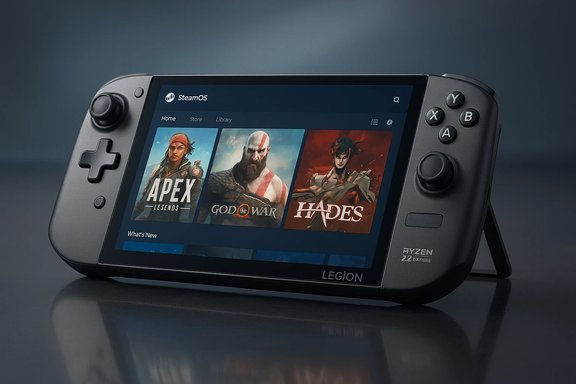
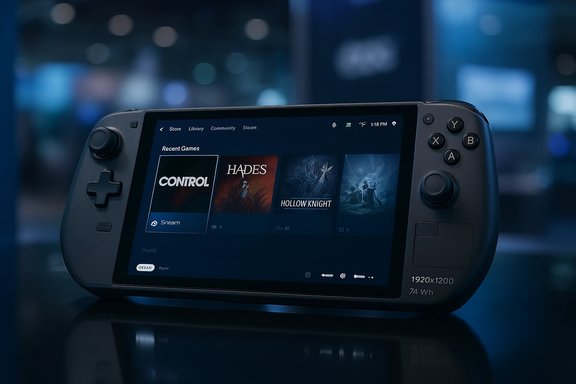
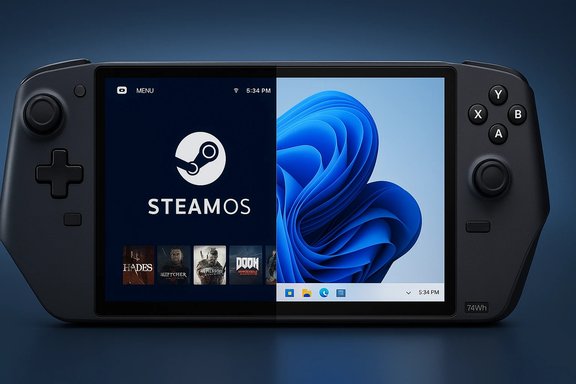
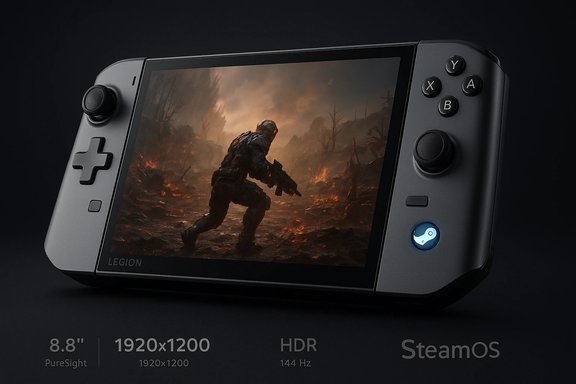
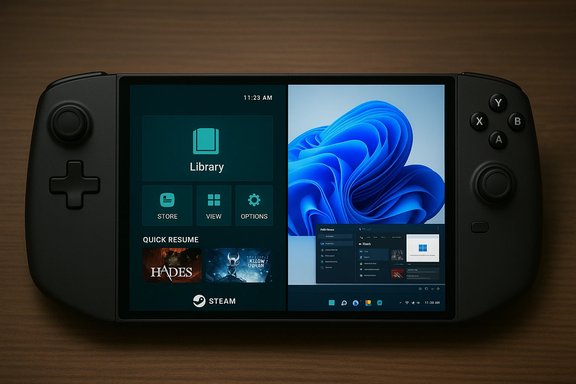
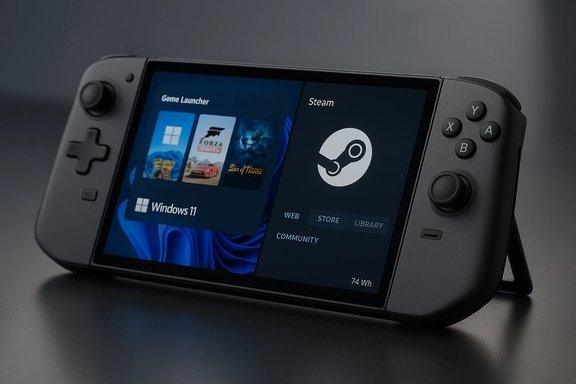
Lenovo’s decision to ship a factory‑installed SteamOS build on the Legion Go 2 — if the reports and early hands‑on checks hold — is the clearest sign yet that the handheld PC market is splitting along software lines, not just hardware specs: the same premium chassis and AMD Ryzen Z2 Extreme silicon can now be marketed two ways — as a Windows 11 portable PC or as a console‑style, controller‑first SteamOS device.
Since Lenovo entered the handheld PC fray it has pursued a multi‑pronged strategy: ambitious hardware, detachable controllers, and both Windows and SteamOS software experiments. The Legion Go 2 (also styled Legion Go Gen 2) arrived in 2025 as a high‑end Windows handheld carrying an 8.8‑inch PureSight OLED, a beefy 74Wh battery, and options that include AMD’s Ryzen Z2 Extreme APU with up to 32GB LPDDR5X and 2TB of NVMe storage. Independent hands‑on reviews and retailer listings confirm the core hardware baseline that makes any SteamOS variant technically feasible. Valve’s SteamOS has matured from a Deck‑only experiment into a platform intended for third‑party OEMs: Valve extended compatibility tooling and a verification/labeling system so games can be marked for SteamOS compatibility on non‑Valve hardware. That broader push is what enables OEMs to consider shipping premium handhelds like Lenovo’s with SteamOS out of the box.
However, execution is everything. The practical gains from SteamOS depend on mature anti‑cheat support, vendor driver reliability for AMD’s Z2 silicon, and strong post‑sale firmware coordination between Lenovo and Valve. Until Lenovo’s product pages and Valve’s compatibility lists publish a SteamOS Legion Go 2 SKU and a sustained support plan, the story should be read as strategically plausible and promising — not fully confirmed.
In short: the Legion Go 2 hardware is ready for a SteamOS pivot, and early hands‑on reports suggest tangible runtime benefits from that swap. The commercial and ecosystem consequences are significant and mostly positive for Steam‑centric handheld users — but buyers should demand concrete SKU pages, compatibility verification, and independent review data before treating a reported June launch and a $1,200 MSRP as finalized.
Source: Gizmodo https://gizmodo.com/lenovos-legion-go-2-now-comes-with-steamos-2000704396/
 Background / Overview
Since Lenovo entered the handheld PC fray it has pursued a multi‑pronged strategy: ambitious hardware, detachable controllers, and both Windows and SteamOS software experiments. The Legion Go 2 (also styled Legion Go Gen 2) arrived in 2025 as a high‑end Windows handheld carrying an 8.8‑inch PureSight OLED, a beefy 74Wh battery, and options that include AMD’s Ryzen Z2 Extreme APU with up to 32GB LPDDR5X and 2TB of NVMe storage. Independent hands‑on reviews and retailer listings confirm the core hardware baseline that makes any SteamOS variant technically feasible. Valve’s SteamOS has matured from a Deck‑only experiment into a platform intended for third‑party OEMs: Valve extended compatibility tooling and a verification/labeling system so games can be marked for SteamOS compatibility on non‑Valve hardware. That broader push is what enables OEMs to consider shipping premium handhelds like Lenovo’s with SteamOS out of the box. What the new reports say
The headline claim
Gizmodo reported on January 4, 2026 that Lenovo will offer the Legion Go 2 preinstalled with SteamOS, retaining the top‑end hardware (AMD Ryzen Z2 Extreme, 32GB RAM, up to 2TB storage) while shipping a more console‑like OS and trimming the Windows SKU’s price from roughly $1,350 to a reported $1,200 for the SteamOS build. That piece also included hands‑on comparisons between Windows and a SteamOS‑like Linux image (Bazzite), showing modest FPS gains in several titles when the lighter Linux stack was used.Conflicting signals in the press
Not every outlet agrees that the Legion Go 2 will be a SteamOS shipping model. Some coverage and community reporting — including detailed launch coverage and retailer SKU notes — emphasize that Lenovo launched the Legion Go 2 as a Windows 11 device in 2025 and that shipping the high‑end Gen‑2 model with SteamOS remains a reported change rather than a universally confirmed fact. Some outlets that followed Lenovo’s launch earlier maintained the Windows‑only position for the flagship Leap to market. That divergence is important: the SteamOS story is now being reported from multiple sources, but it still includes elements that should be treated as confirmed only once Lenovo or Valve publish formal SKU lists and firmware/compatibility notes.Hardware baseline: what’s verified
The practical reason the SteamOS rumor is plausible: the Legion Go 2 hardware is well‑documented and capable.- Display: 8.8‑inch PureSight OLED, WUXGA 1920×1200, up to 144Hz with VRR and HDR capability.
- Processor: AMD Ryzen Z2 family, with the Z2 Extreme option targeted at high performance in handheld TDP envelopes.
- Memory & Storage: Configurations supporting up to 32GB LPDDR5X and M.2 PCIe Gen4 SSDs up to 2TB; microSD expansion options in some SKUs.
- Battery & Cooling: A large 74Wh battery and a beefier chassis for improved cooling compared with Lenovo’s earlier handhelds.
- Controls & I/O: Detachable TrueStrike controllers with Hall‑effect sticks, dual USB‑C/USB4 ports, and a 3.5mm combo jack — all features that map well to SteamOS’s controller‑first workflow.
Why SteamOS matters on handheld hardware
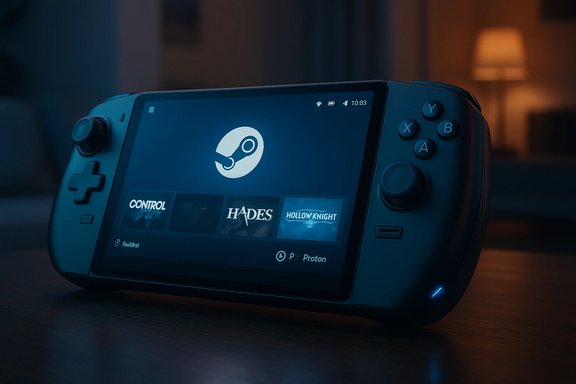
SteamOS brings three practical advantages for handheld users that often outweigh the broader flexibility of a Windows 11 install:- Controller‑first UI and UX: SteamOS boots into a living‑room style interface that’s navigable by thumbsticks and buttons, reducing the friction of a desktop environment on a tiny touchscreen.
- Lower background overhead: A trimmed Linux stack typically runs fewer background services than a full desktop Windows image, which can free CPU and GPU headroom during sustained gaming sessions and marginally improve thermal and battery behavior.
- Proton and compatibility tooling: Valve’s Proton compatibility layer and its “verification” program give OEMs and buyers a clearer idea of which titles should run cleanly on a SteamOS device; Valve has extended this work to cover third‑party SteamOS hardware and added a SteamOS compatibility labeling system for the store.
The practical tradeoffs: what you gain and what you lose
Gains with a SteamOS Legion Go 2
- Cleaner, console‑like experience: Instant access to Steam library, controller UI, and quick resume behavior tuned for handheld use.
- Potential sustained frame‑rate improvements: Lower OS overhead and tailored drivers can yield steadier framerates in long sessions.
- Possible lower MSRP: Removing a Windows license and positioning the device as a SteamOS product gives OEM pricing headroom; early reports indicate a sub‑$1,300 price for the SteamOS flagship SKU versus a higher Windows price.
Losses and compromises
- Game storefront and account fragmentation: SteamOS is centered on Steam. Titles purchased through Xbox/Windows ecosystems or DRM‑dependent launchers are harder to access; workarounds exist (Proton + third‑party launchers), but they add friction and sometimes break features.
- Anti‑cheat and multiplayer risk: Some anti‑cheat systems rely on Windows drivers or kernel‑level mechanisms. While Valve has prioritized anti‑cheat compatibility the last few years, not every competitive title is guaranteed to run on Linux/Proton without concessions. That remains a major risk for players of competitive online games.
- Vendor support and firmware nuance: Shipping SteamOS as a factory image requires coordinated firmware distribution, driver work, and long‑term OS updates. If Lenovo and Valve don’t commit to a synchronized support cadence for Legion Go 2 SteamOS units, early adopters may face a patchwork of updates and fixes.
Conflicting coverage and why verification matters
Multiple outlets now report a SteamOS Legion Go 2, but the timeline and details vary. Gizmodo reported a June launch and a $1,200 MSRP for the SteamOS Legion Go 2, explicitly noting gaming performance gains in their side‑by‑side checks with a Linux image. At the same time, some coverage tied to Lenovo’s earlier launch cycle insisted the high‑end Gen‑2 model shipped with Windows 11 and did not initially include a SteamOS SKU. Those conflicting signals matter: until Lenovo’s product pages and Valve’s compatibility lists explicitly list a SteamOS Legion Go 2 SKU and a support roadmap, buyers should treat launch date, MSRP, and SKU mapping as provisional.Business and market implications
For Lenovo
Offering a SteamOS Legion Go 2 is a low‑risk, high‑reward pivot if executed well. The hardware is in market and validated; the steamOS SKU lets Lenovo address a persistent user complaint about Windows overhead on handhelds and opens a separate pricing and marketing lane to capture console‑style handheld buyers without retooling the product. But the real burden is operational: Lenovo must coordinate driver support, warranty policies, and compatibility materials differently for a SteamOS device. That means real engineering work on Linux kernel modules, firmware packaging, and Valve‑OEM coordination.For Valve
More OEM SteamOS partners accelerate Valve’s platform strategy: broader hardware variety makes SteamOS less dependent on the Deck and positions Proton and Valve’s verification labels as the portable gaming ecosystem’s de‑facto standards. That strengthens Valve’s leverage with developers and improves the user experience across non‑Valve hardware — but it also raises expectations for quality control and coordinated anti‑cheat solutions.For Microsoft
A successful third‑party SteamOS Legion Go 2 remains a partial threat: it shifts a segment of portable PC buyers away from Windows handhelds and potentially reduces the reach of Windows-exclusive services like Game Pass when users prefer a simple, Steam‑first handheld experience. Microsoft’s response has been to streamline Windows for handhelds (e.g., the Xbox Full‑Screen Experience) and to push OEM partners toward a better tray‑to‑thumb UX on Windows devices — but that work is ongoing and uneven across vendors.Technical caveats and red flags
- Anti‑cheat compatibility is variable: Some competitive games with kernel‑level anti‑cheat may remain unplayable or require developer updates to function on Proton/SteamOS. Buyers should check compatibility labels for their core titles.
- Driver maturity for AMD Z2 Extreme: While AMD’s Z2 family is designed for advanced handheld thermal envelopes, vendor‑tuned Mesa drivers and firmware are essential for delivering consistent performance on SteamOS. Delays or gaps in driver releases can reduce the promised benefits.
- Support model differences: The warranty and service model for a Linux‑shipped device can differ (and sometimes limit) certain types of user modifications; buyers who plan to dual‑boot or tinker should verify Lenovo’s policy for SteamOS SKUs.
What to look for at launch (and when to be skeptical)
- Official SKU pages that list a SteamOS Legion Go 2 model number and detailed specs. Labels and SKU strings matter; a product image or press mention alone is not an SKU confirmation.
- A Valve/Lenovo support or compatibility page that lists specific game verification outcomes for the Legion Go 2. This shows Valve’s buy‑in for anti‑cheat, store labels, and update channels.
- Firmware and driver download pages for SteamOS users from Lenovo, with clear recovery instructions and a defined update cadence.
- Independent reviews that include sustained‑load thermals, battery tests, and online multiplayer checks (anti‑cheat behavior). Those tests separate marketing claims from real‑world performance.
Buying guidance: a short checklist for prospective buyers
- Confirm your primary titles are listed as SteamOS Compatible or show a clear Proton path. Competitive multiplayer players should be extra cautious.
- If you need Windows apps, modding tools, or Game Pass integration, the Windows SKU is still the safer choice.
- For pure Steam players who value battery life and a console‑like UI, the SteamOS edition (if Lenovo ships it) is likely the better buy.
- Compare warranty and return policies between the Windows and SteamOS SKUs — vendor support can differ by factory image.
- Wait for independent reviews that test thermal throttling, 1% low frame rates, and long session battery life before committing at full MSRP.
Strategic conclusion: why this matters for the handheld market
Lenovo shipping the Legion Go 2 with SteamOS would mark the next phase in handheld PC evolution: hardware convergence with software differentiation. OEMs are learning that hardware alone won’t win the handheld war; the OS image — and the ecosystem commitments behind it — determine who gets the pick‑up‑and‑play audience. Valve benefits from a growing hardware pool that reinforces Proton and verification as industry standards, Lenovo benefits by widening its addressable market without reengineering, and Microsoft gets a clearer product‑level reason to accelerate handheld UX work on Windows.However, execution is everything. The practical gains from SteamOS depend on mature anti‑cheat support, vendor driver reliability for AMD’s Z2 silicon, and strong post‑sale firmware coordination between Lenovo and Valve. Until Lenovo’s product pages and Valve’s compatibility lists publish a SteamOS Legion Go 2 SKU and a sustained support plan, the story should be read as strategically plausible and promising — not fully confirmed.
In short: the Legion Go 2 hardware is ready for a SteamOS pivot, and early hands‑on reports suggest tangible runtime benefits from that swap. The commercial and ecosystem consequences are significant and mostly positive for Steam‑centric handheld users — but buyers should demand concrete SKU pages, compatibility verification, and independent review data before treating a reported June launch and a $1,200 MSRP as finalized.
Source: Gizmodo https://gizmodo.com/lenovos-legion-go-2-now-comes-with-steamos-2000704396/