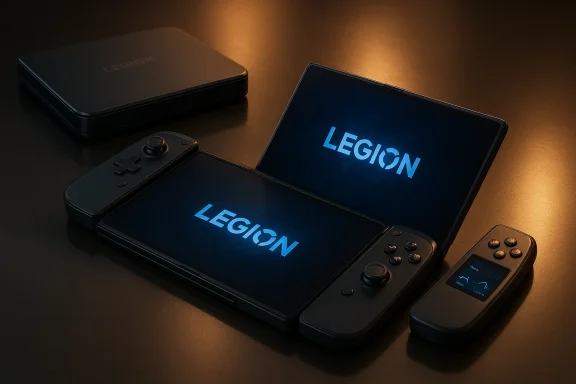
Lenovo’s Legion Go Fold Concept promises to redraw the boundaries between handheld gaming and full Windows PC use by folding an 11.6-inch POLED into a pocketable 7.7-inch handheld — but it is very much a concept at this stage, and the details we have are a mix of plausible engineering choices and hard-to-solve trade-offs that will determine whether a device like this ever reaches store shelves.
Lenovo has steadily pushed the envelope in the handheld PC space with the Legion family, moving from the original Legion Go to larger, higher-performance variants that blur the line between consoles and portable PCs. The idea of expanding that concept with a foldable display is an obvious — and audacious — next step: give players the portability of a small handheld and the immersion of a large-screen device without forcing them to own two separate systems.
The device making headlines right now is described as the Lenovo Legion Go Fold Concept, expected to be shown by Lenovo at Mobile World Congress (MWC) in Barcelona on March 2, 2026. According to the reports that surfaced, the product is a proof-of-concept rather than a commercial product; it’s meant to demonstrate what a hybrid gaming / PC form factor could look like rather than to announce an immediate retail launch.
On the other hand, industry observers expected newer Panther Lake (or more recent mobile silicon) to be the path for next-generation handheld PCs. The choice to use a Lunar-Lake Ultra 7 part suggests either that the concept’s development started earlier (before Panther Lake was ready) or that Lenovo prioritized known thermal-tuning and platform stability over the bleeding edge. For a concept device that will be shown publicly at a trade show, that’s not surprising — but it does have consequences:
These are the exact reasons many manufacturers show fancy concept hardware at trade shows and then either delay, significantly rework, or cancel retail plans: the leap from prototype to mass-market reliability and price is steep.
If Lenovo intends to move from concept to market, expect iterations: larger batteries, tuned silicon choices, and simplified mechanical designs that prioritize reliability and battery life over headline specs. The ultimate success of such a product depends not just on hardware ingenuity but on realistic trade-offs that deliver a good user experience across all claimed modes.
Lenovo’s concept points to a compelling direction: a world where foldable displays unlock genuinely new form factors for PC gaming rather than just shrinking or stretching existing designs. But the moment of truth for any foldable gaming handheld will come when real, widely available units are tested over months of use — not in a polished demo at a trade show. Until then, the Legion Go Fold should be regarded as a promising, risky glimpse of what could be, and a useful provocation to the industry to think harder about how Windows, drivers, and silicon must evolve to match the creativity shaping hardware.
Source: Windows Latest Exclusive: Lenovo Legion Go Fold is a handheld with foldable display, doubles as a PC
 Background
Lenovo has steadily pushed the envelope in the handheld PC space with the Legion family, moving from the original Legion Go to larger, higher-performance variants that blur the line between consoles and portable PCs. The idea of expanding that concept with a foldable display is an obvious — and audacious — next step: give players the portability of a small handheld and the immersion of a large-screen device without forcing them to own two separate systems.The device making headlines right now is described as the Lenovo Legion Go Fold Concept, expected to be shown by Lenovo at Mobile World Congress (MWC) in Barcelona on March 2, 2026. According to the reports that surfaced, the product is a proof-of-concept rather than a commercial product; it’s meant to demonstrate what a hybrid gaming / PC form factor could look like rather than to announce an immediate retail launch.
What the Legion Go Fold Concept claims to be
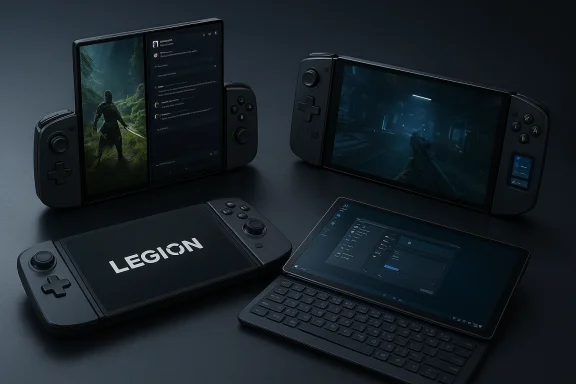
At its core the Legion Go Fold Concept is a multi-mode foldable POLED Windows handheld that can be used in four main ways:- Standard Handheld Mode (folded) — the device folds to a compact 7.7-inch display that pairs with detachable wireless controllers on either side, matching the handheld footprint gamers already know.
- Vertical Split-Screen Mode (partially unfolded upright) — the panel unfolds and is used vertically, allowing one half of the screen to serve as the game view while the other half displays a stream, chat, or companion app.
- Horizon Full Screen Mode (fully unfolded, horizontal) — the display expands to 11.6 inches and, with controllers attached to either side, becomes a large-screen handheld.
- Expanded Desktop Mode (docked) — the unfolded device docks with an included wireless keyboard that has a built-in touchpad, converting the system into a laptop-style desktop substitute; the right-side controller can act as a vertical mouse and contains a small secondary screen/touchpad for telemetry and quick controls.
Hardware summary and the headline specs
The most frequently cited sheet of claimed specifications for the concept contains the following highlights:- Processor: Intel Core Ultra 7 258V (Lunar Lake generation)
- Memory: 32 GB RAM
- Display: POLED foldable — folds from 7.7" to 11.6"
- Battery: 48 Whr
- Controllers: Detachable wireless controllers; the right controller reportedly includes a small touchable display that doubles as a touchpad and performance readout; it can operate as a vertical mouse in FPS mode
- Included accessory: Wireless keyboard with touchpad for Expanded Desktop Mode
- Usage modes: Standard Handheld, Vertical Split-Screen, Horizon Full Screen, Expanded Desktop
Design and user modes — why the form factor matters
Four modes, four user intents
Lenovo’s concept maps directly to four distinct user intents, and that’s important because every design choice will be judged against how well it fulfills these intents.- Quick play sessions: The folded 7.7-inch Handheld Mode targets gamers who want a pocketable device for short sessions or commuting. Smaller display, lower thermal headroom, and conservative power draw are expectations here.
- Large-screen handheld immersion: The 11.6-inch Horizon Full Screen Mode aims for fuller immersion without docking to a TV — it’s for players who want a big view but still want the mobility of a handheld.
- Stream + play workflows: Vertical Split-Screen Mode is built for creators or streamers who juggle gameplay and broadcast/communication windows simultaneously.
- Productivity and extended sessions: Expanded Desktop Mode targets someone who wants to use the same hardware for typing, browsing, or light productivity — effectively replacing a secondary laptop.
Ergonomics and controller design
The detachable controllers that clamp onto either side of the panel are crucial in this design. The right controller doubling as a vertical mouse and carrying a tiny touchscreen are clever touches that reuse hardware for multiple purposes. But every addition of mechanical complexity (detachable latches, fold hinge durability, controller docking connectors) increases cost and mechanical failure surface area — a serious concern for a commercial product that’s meant to be carried and flexed repeatedly.Processing choices: Intel Core Ultra 7 258V and what it implies
The reported use of an Intel Core Ultra 7 258V (a Lunar Lake part) is notable. On one hand, an Intel Ultra-series processor can offer robust single-thread and multi-thread performance along with an integrated GPU, positioning the device to run modern AAA titles on Windows with reasonable fidelity.On the other hand, industry observers expected newer Panther Lake (or more recent mobile silicon) to be the path for next-generation handheld PCs. The choice to use a Lunar-Lake Ultra 7 part suggests either that the concept’s development started earlier (before Panther Lake was ready) or that Lenovo prioritized known thermal-tuning and platform stability over the bleeding edge. For a concept device that will be shown publicly at a trade show, that’s not surprising — but it does have consequences:
- Performance per watt: Newer architectures typically improve power efficiency; using a previous generation means the design may rely on more conservative clocks or accept worse battery life.
- Graphics capability: Integrated Arc-class iGPU performance has improved across generations, but a folded 11.6-inch 1200p+ target will still be GPU-limited for many modern AAA titles.
- Driver maturity and Windows optimizations: Using a tried-and-tested platform reduces driver unknowns during a demo, which matters for a concept shown onstage.
Power, battery life, and thermals — the biggest engineering cliff
The claimed 48 Whr battery is the most concerning spec for gamers. Historical lessons from handheld Windows PCs show that battery life is the Achilles’ heel when you combine high-performance silicon, a bright large display, and sustained gaming workloads. A modest 48 Whr pack will be strained under these conditions, with several obvious consequences:- Shorter play sessions in full-performance modes unless aggressive power and thermal management is used.
- A trade-off between sustained frame rates and battery longevity — buyers will need to choose (or the device will choose automatically) lower GPU clocks or reduced resolutions.
- The larger unfolded 11.6-inch POLED will consume more power at higher brightness and refresh rates than the folded 7.7-inch mode, further worsening runtime.
Software implications: Windows 11, Xbox FSE, and the handheld experience
A foldable Windows handheld like this sits at the intersection of two software realities:- Windows 11 feels like a desktop OS and, historically, is more power-hungry than console-style alternatives. Microsoft’s investment in a simplified, gamepad-friendly shell (commonly referred to as the Xbox Full-Screen Experience) will matter here — if the device ships with or supports a lightweight gaming shell it can meaningfully improve battery and usability for controller-first sessions.
- The desktop mode claims — docking with a keyboard and offering a full Windows experience — presume that Windows will behave acceptably on a foldable, convertible device. That requires not just the OS but individual apps to play nicely with changing screen orientations and split-screen workflows.
Competitive context: where a foldable handheld would fit
The Legion Go Fold Concept isn’t entering a vacuum. The handheld PC market has grown quickly, with major vendors (hardware makers and Valve) proving demand for premium portable Windows/Linux gaming devices. Players expect:- High-refresh OLED panels or very good IPS/VA screens
- Comfortable controller ergonomics or detachable options
- Strong thermal solutions that avoid throttling during long sessions
- Robust software ecosystems (Windows, SteamOS, or vendor-specific shells)
- Gamers who want a single device for travel and living-room-style play without owning a TV or laptop
- Creators who want a compact device that still supports streaming and multi-window workflows
- Professionals who value the ability to switch between a tablet/handheld and a keyboarded desktop for light work
Engineering and manufacturing risks — why a concept may stay a concept
Foldable screens introduce longstanding durability, yield, and cost problems:- Hinge and folding lifespan: Repeated folding stresses the display and hinge mechanism. Creating a hinge that lasts tens of thousands of folds without visible crease or failure is non-trivial.
- Panel durability: POLED foldables use flexible plastic substrates that are more susceptible to surface damage, micro-abrasions, and cosmetic creasing than rigid glass displays.
- Controller docking robustness: Repeated attach/detach cycles, plus the need for secure electrical and mechanical contacts, increase failure vectors.
- Thermal distribution across a foldable chassis: Hotspots must be managed without compromising the structural integrity of the fold.
These are the exact reasons many manufacturers show fancy concept hardware at trade shows and then either delay, significantly rework, or cancel retail plans: the leap from prototype to mass-market reliability and price is steep.
Practical questions every buyer (and reviewer) should ask
If Lenovo brings a commercial version of this concept to market, these are the immediate, practical things to verify:- Actual battery life in all modes (folded handheld, unfolded handheld, docked desktop) under realistic workloads.
- Thermal throttling behavior during sustained gaming sessions and whether performance is throttled aggressively to conserve battery.
- Display durability: how many folds the hinge/display survives and whether a visible crease appears.
- Controller latency and ergonomics: comfort over long sessions and how secure controller attachment is.
- Keyboard and docking experience: whether the included keyboard/stand feels stable and whether the keyboard’s touchpad is usable for productivity.
- Software stability: transitions between modes, app scaling, and whether the device ships with an optimized handheld gaming UI.
Likelihood of commercialization and timeline
Lenovo has a track record of showing bold concepts at trade shows and then turning some of them into real products — but typically only after maturation and often with hardware changes. Demonstrating a concept at MWC does not guarantee a product launch, and given the engineering challenges and expected high cost, it’s reasonable to assume:- Lenovo will treat this primarily as a demonstration of design direction and engineering capability.
- If consumers and reviewers respond strongly, Lenovo may iterate toward a commercial design — but expect changes in processor, battery, or the overall chassis to improve viability.
- Even if Lenovo commits to a launch, shipping timing could be many months to over a year after the concept reveal, and configuration details will almost certainly change.
Why the idea still matters for Windows handhelds
Even if the Legion Go Fold Concept never reaches retail, it matters. It pushes OEMs and Microsoft to consider form factors that blur the laptop/handheld/tablet lines and forces software vendors to pay attention to multi-orientation, foldable-ready UI paradigms.- For OEMs, the engineering lessons — controller docking systems, hinge design for gaming ergonomics, foldable display integration — can percolate into future, more conservative products.
- For the Windows ecosystem, a credible foldable gaming device would sharpen the need for lightweight, gamepad-first shells and better power/thermal profiles for portable Windows.
- For gamers, it teases a world where a single device can be both a work laptop and a primary gaming machine without a full-sized laptop or TV.
Final assessment — strengths, weaknesses, and overall outlook
Strengths
- Ambitious convergence: Combining a foldable POLED with detachable controllers and a keyboard/dock touches on real user pain points around carrying multiple devices.
- High-end memory and CPU choice: 32 GB RAM and an Intel Ultra-series part suggest the device can reasonably handle multitasking and PC workloads.
- Innovative control ideas: Using the right controller as a vertical mouse and giving it a secondary display/touchpad is an efficient reuse of hardware features that could genuinely improve the desktop experience.
Weaknesses and risks
- Battery capacity vs. display and silicon demands: A 48 Whr pack is likely inadequate for sustained gaming on a large unfolded panel at high performance.
- Durability and hinge reliability: Foldables still present long-term reliability challenges that are especially acute for devices designed to be handled and carried frequently.
- Cost and manufacturability: The BOM for a foldable, controller-equipped, keyboard-included PC will be high; the price could limit market adoption.
- Software maturity: Windows and gaming apps must be tuned to deliver consistent experiences across the device’s modes; this is harder than it looks.
Outlook
As a concept, the Legion Go Fold is exciting: it sketches a future in which a single, cleverly engineered device can serve gamers, streamers, and light productivity users. As a product, enormous engineering and software work stands between the demonstration model and a satisfying real-world experience.If Lenovo intends to move from concept to market, expect iterations: larger batteries, tuned silicon choices, and simplified mechanical designs that prioritize reliability and battery life over headline specs. The ultimate success of such a product depends not just on hardware ingenuity but on realistic trade-offs that deliver a good user experience across all claimed modes.
Lenovo’s concept points to a compelling direction: a world where foldable displays unlock genuinely new form factors for PC gaming rather than just shrinking or stretching existing designs. But the moment of truth for any foldable gaming handheld will come when real, widely available units are tested over months of use — not in a polished demo at a trade show. Until then, the Legion Go Fold should be regarded as a promising, risky glimpse of what could be, and a useful provocation to the industry to think harder about how Windows, drivers, and silicon must evolve to match the creativity shaping hardware.
Source: Windows Latest Exclusive: Lenovo Legion Go Fold is a handheld with foldable display, doubles as a PC