

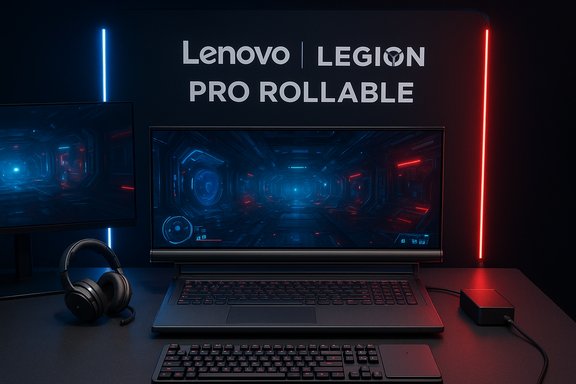
Lenovo’s Legion Pro Rollable — a horizontally expanding gaming laptop that reportedly transforms from a compact 16‑inch machine into a 21.5‑ or 24‑inch ultrawide OLED — has leaked ahead of an expected CES 2026 concept reveal, combining next‑generation silicon, a Blackwell‑era NVIDIA RTX 5090 laptop GPU, and a suite of on‑device AI features aimed at competitive gamers.
Lenovo’s experiment with rollable displays is not new: the company released the ThinkBook Plus Gen 6 Rollable as an early commercial example of motorized, flexible OLED panels, and has been iterating display mechanics and firmware since. The Legion Pro Rollable appears to take that engineering foundation into the Legion gaming family, using a horizontally extending OLED to create an ultrawide, portable gaming canvas. Multiple outlets have reported the leak originated from promotional material and insider briefings ahead of a CES concept announcement. This leak outlines three defining pillars for the concept device:
What is verifiable:
Key leaked features and implications:
Users should expect:
However, the concept raises practical questions that only hands‑on testing and official technical disclosures can answer: the long‑term durability of a motorized dual‑edge rollable under heavy travel and frequent expansion, the real effectiveness and fairness of on‑screen AI assistance in competitive contexts, thermal and battery tradeoffs for a 24‑inch‑class ultrawide inside a laptop, and the eventual price point and warranty coverage for mechanically novel components.
If Lenovo demonstrates a quiet, durable dual‑motor tension mechanism, a well‑tuned AI overlay suite that respects competitive boundaries, and acceptable thermals for a top‑end RTX 5090 SKU, the Legion Pro Rollable could be one of the more consequential experiments in gaming hardware design in recent years. Until then, it remains an exciting concept that highlights how far mobile gaming hardware can push the envelope — and a reminder that the road from concept to reliable, widespread production is paved with both engineering wins and real‑world tradeoffs.
Source: Windows Latest Exclusive: Lenovo Legion Pro Rollable uses a 16-to-24 inch rollable OLED, RTX 5090, Core Ultra, and AI gaming feature with Windows 11
 Background / Overview
Lenovo’s experiment with rollable displays is not new: the company released the ThinkBook Plus Gen 6 Rollable as an early commercial example of motorized, flexible OLED panels, and has been iterating display mechanics and firmware since. The Legion Pro Rollable appears to take that engineering foundation into the Legion gaming family, using a horizontally extending OLED to create an ultrawide, portable gaming canvas. Multiple outlets have reported the leak originated from promotional material and insider briefings ahead of a CES concept announcement. This leak outlines three defining pillars for the concept device:- A Lenovo PureSight OLED panel that starts at a 16‑inch footprint and can expand horizontally to either 21.5 inches (Tactical Mode) or 24 inches (Arena Mode) for ultrawide gaming.
- Top‑tier silicon: a maxed‑out Intel Core Ultra mobile H‑class CPU alongside an NVIDIA GeForce RTX 5090 laptop GPU.
- A collection of AI‑driven gaming features (AI Scene Detection, Cursor Tracking, AI Game Assistance, Adaptive AI Lighting) running on Lenovo’s AI stack (Lenovo AI Engine+ with LA Core elements).
Why a rollable OLED for gaming matters
The ultrawide gap for traveling pros
Esports athletes and pro streamers often prefer larger, ultrawide displays for peripheral awareness — something desktop setups can deliver but laptops traditionally cannot. Lenovo’s pitch, as captured in the leaks, positions the Legion Pro Rollable as a solution for those who need both a portable device and, at times, a 24‑inch competitive display without carrying external monitors. The concept targets the training workflows of traveling pros: a compact machine for transit that converts into an ultrawide battlestation in seconds.Ultrawide advantages and software friction
Ultrawide aspect ratios (21:9 and beyond) can improve situational awareness in MOBAs and simulators and provide richer cinematic presentation for single‑player titles. However, many games still assume 16:9 HUD layouts; Lenovo’s approach — pairing hardware with software utilities and AI overlays — is intended to bridge that gap by selectively scaling or enhancing important UI regions rather than forcing full HUD remapping. Expect per‑title tuning to be crucial.Confirmed technical claims and independent verification
Display: PureSight OLED, 16" -> 21.5" / 24" expansion
The original leak describes a Lenovo PureSight OLED panel that defaults to 16 inches and extends horizontally to 21.5 or 24 inches, with Windows handling automatic aspect changes and custom gaming modes (Focus, Tactical, Arena). Lenovo already uses the PureSight OLED brand on recent Legion and Legion‑adjacent products (for example, Legion Go Gen 2 and Legion Pro monitors), supporting the plausibility of the branding and high‑end OLED choices. Caveats and verification:- Multiple outlets repeat the 16‑to‑24 inch narrative, but the precise measured dimensions and native resolutions have not been independently confirmed as of these reports. The 16→21.5→24 sizing appears in the Windows Latest leak and has been echoed elsewhere, but public hands‑on evidence is not yet available. Treat sizes as reported but not yet lab‑verified.
GPU: NVIDIA GeForce RTX 5090 (Laptop)
NVIDIA’s RTX 50‑series ("Blackwell") arrived as a major platform update earlier in the year, and the RTX 5090 Laptop GPU is a documented mobile variant designed for high‑end gaming laptops. Lenovo and other OEMs are listed among partners shipping RTX 50‑series laptops. Public NVIDIA materials confirm RTX 5090 mobile availability and the series’ emphasis on AI‑driven features like DLSS 4 and frame generation — essential enablers for high‑refresh, high‑fidelity laptop gaming. The leaked Legion Rollable specifically mentions an RTX 5090 configuration, aligning it with top‑end mobile hardware trends.CPU: Intel Core Ultra (maxed‑out mobile SKU)
Lenovo’s Legion lineup has been migrating to Intel Core Ultra H/HX‑class silicon for maximum mobile throughput. The leak references a maxed‑out Intel Core Ultra CPU (exact SKU unconfirmed). Intel Core Ultra H variants are commonly used in 16‑inch Legion Pro 7i SKUs, which makes the claim credible for a concept targeted at esports pros. That said, the exact SKU (for example Core Ultra 9 275HX) and its sustained power envelope inside a rollable lid remain to be confirmed by Lenovo.AI stack: Lenovo AI Engine+, LA Core (LA1 + LA3)
Lenovo’s marketing and retailer pages for recent Legion machines already reference Lenovo AI Engine+ and LA Core modules (LA1 + LA3) for scenario detection, Smart FPS and dynamic tuning. These elements appear in product descriptions for Legion Pro devices, and the Rollable leak ties similar AI capabilities to the new form factor for visual assistance and training overlays. That consistency across Lenovo’s product messaging supports the claim that the rollable concept would leverage the same AI stack.Mechanical design: dual‑motor tension system and durability questions
The leak asserts the Rollable uses a dual‑motor, tension‑based mechanism that extends the OLED panel smoothly from both left and right edges while keeping the panel under controlled tension to avoid wrinkling or vibration. The report also mentions low‑friction internal paths and motors tuned for quiet operation.What is verifiable:
- Lenovo’s ThinkBook Rollable used a motorized spool plus tension/frame elements; the company has engineering experience in motorized rollables that makes the described engineering pathway plausible.
- The specific dual‑motor tension arrangement, noise levels, and long‑term durability under gaming conditions (rapid, repeated expansions during travel) are not independently validated in the leak. No third‑party teardown or hands‑on testing data for this Legion concept exists yet, so motor noise, creep over time, resistance to dust and humidity, and the risk of visible creasing are unknown variables. Treat detailed mechanical claims as plausible engineering descriptions rather than confirmed production‑grade specs until Lenovo offers official technical documentation or reviewers test a unit.
AI features: helpful augmentation or questionable gimmick?
The leaked feature set is focused on visual awareness rather than gameplay automation, which is an important distinction for competitive integrity and developer cooperation.Key leaked features and implications:
- AI Scene Detection: auto‑identifies game types and zooms/clarifies key UI regions (maps, cooldowns) into a dedicated overlay window. Useful in FPS/MOBA where micro‑UI details matter, but depends on per‑title accuracy and framing choices.
- Cursor Tracking: a small zoomed window follows the cursor, reducing head/eye movement across a wide canvas — practical for sniping, precision aiming, and UI interactions.
- AI Game Assistance: contextual tips or guidance for bosses or mission segments, surfaced alongside the game. This sounds useful for training but raises questions about what is considered allowable assistance in competitive play.
- Adaptive AI Lighting: lighting cues adapt in real time to in‑game events to add peripheral visual feedback (e.g., flash on damage). This augments immersion and awareness at the cost of potential distraction if poorly tuned.
- If implemented client‑side and transparent, these overlays can provide legitimate training benefits (reaction‑time drills, map awareness) without altering game state.
- On‑device AI (Lenovo AI Engine+, LA Core) reduces cloud latency and preserves privacy for real‑time overlays. Retail pages already show Lenovo pushing AI Engine+ in Legion hardware, which lends credibility to on‑board AI ambitions.
- Competitive fairness: tournament organizers may disallow AI overlays that provide non‑native information or automate decision‑making. For pro use, Lenovo will need clear modes that disable assistance for official competition.
- Accuracy and latency: real‑time scene detection and crisp zooms require robust models and low inference latency. The effectiveness will vary greatly by title and visual complexity.
- Developer cooperation: some overlays may rely on screen‑reading heuristics rather than clean integrations; without SDKs or developer support, overlays might misidentify HUD elements or obscure critical information.
Software, Windows 11, and aspect‑ratio handling
Windows 11 already supports dynamic scaling and display mode switching, but rapid on‑the‑fly aspect ratio changes (16:10/16:9 → 21:9/ultrawide) present user‑experience challenges:- UI scaling, window placement, and game HUDs can shift unexpectedly. Lenovo will need robust OS‑level integrations (profiles, app/game rules) to make mode switching predictable and comfortable.
- Leaked materials show mention of a Copilot key and integrated profile switching consistent with Lenovo’s recent Copilot+ PC messaging; that maps logically to a user experience where a single button toggles expansion + UI mode.
- Expect a combination of automatic detection (when a known game runs), a manual mode switch, and a profile editor for individual titles. The real test will be how many games behave gracefully without manual patching or community tweaks.
Thermals, power and portability trade‑offs
The Legion family’s existing 16‑inch Pro hardware shows the tradeoffs that come with packing desktop‑class power into a laptop chassis: strong performance, high TGPs, large power adapters (up to 400 W), and limited unplugged gaming time. A rollable lid adds mechanical complexity and weight to the lid assembly, and the additional mass could slightly shift thermals or center‑of‑gravity but likely won’t materially change system cooling, which is chassis‑bound (vapor chamber, heat pipes, fans).Users should expect:
- Shorter battery life under gaming load compared to thin ultrabooks; the device will be designed to be used plugged in for extended sessions.
- A heavier carry weight and likely large adapter with top SKUs; the rollable mechanism’s motors and supporting hardware add mass and cost.
- Possible surface temperature and fan noise tradeoffs when pushing RTX 5090 + Core Ultra at sustained TGPs. Independent Legion Pro 7i product pages and reviews illustrate similar tradeoffs in the non‑rollable lineup.
Durability, warranty and repairability
Lenovo’s first rollable (ThinkBook Plus Gen 6) set early expectations: motorized rollables are feasible but bring new wear vectors (rolling cycles, flexible substrate fatigue, seal degradation). The leaked Legion Pro Rollable claims low‑friction paths and quiet motors, but real‑world robustness depends on:- Effective sealing to prevent dust ingress in the path of the OLED.
- Reliable tensioning and surface support to prevent permanent creasing over tens of thousands of cycles.
- Repair or replacement pathways: whether the display module is serviceable and whether warranties cover mechanical failure from frequent expansion.
Market positioning, price and likely buyer
Lenovo appears to be positioning the Legion Pro Rollable as a concept/proof‑of‑concept device aimed at pro esports athletes who travel. That niche positioning mirrors the early adopter markets for other radical form factors (foldables, rollables, dual‑screen devices). Expect:- A premium price tag, potentially well into the multiple‑thousand‑dollar range, driven by the cost of flexible OLEDs, motors, and RTX 5090 mobile hardware. Historical pricing on the ThinkBook rollable plus high‑end Legion SKUs suggests this will not be a budget product.
- Initial availability likely limited to concept or limited‑run channels; Lenovo may use CES 2026 to showcase the engineering and gather feedback before committing to mass production.
- Streamers and creators who value a single portable ultrawide for capture and content work.
- Professional players and coaches who prioritize on‑the‑go training with ultrawide setups.
- Early adopters and tech collectors who appreciate distinctive, headline‑grabbing hardware.
What to watch for at CES and beyond
- Hands‑on reviews that test the mechanical repeatability: look for cycle counts and dust ingress results, noise measurements, and long‑term crease checks.
- Real gameplay demos showing the AI overlays in live matches — accuracy, latency, per‑title behavior, and how overlays integrate with anti‑cheat or tournament rules.
- Pricing and service details: whether Lenovo commits to a limited‑run concept or outlines a roadmap to retail SKUs.
- Firmware and Windows 11 integration: how profile switching, scaling, and Copilot key interactions work in daily use.
Conclusion — bold concept, practical questions
The Legion Pro Rollable leak represents a bold, logical next step for Lenovo’s rollable work: transplanting the motorized flexible display from business laptops into the gaming arena makes sense on engineering grounds and offers a genuinely novel value proposition for traveling esports pros and content creators. The design combines top‑tier mobile silicon (Core Ultra + RTX 5090), a high‑end PureSight OLED experience, and a set of on‑device AI features that could materially improve training workflows.However, the concept raises practical questions that only hands‑on testing and official technical disclosures can answer: the long‑term durability of a motorized dual‑edge rollable under heavy travel and frequent expansion, the real effectiveness and fairness of on‑screen AI assistance in competitive contexts, thermal and battery tradeoffs for a 24‑inch‑class ultrawide inside a laptop, and the eventual price point and warranty coverage for mechanically novel components.
If Lenovo demonstrates a quiet, durable dual‑motor tension mechanism, a well‑tuned AI overlay suite that respects competitive boundaries, and acceptable thermals for a top‑end RTX 5090 SKU, the Legion Pro Rollable could be one of the more consequential experiments in gaming hardware design in recent years. Until then, it remains an exciting concept that highlights how far mobile gaming hardware can push the envelope — and a reminder that the road from concept to reliable, widespread production is paved with both engineering wins and real‑world tradeoffs.
Source: Windows Latest Exclusive: Lenovo Legion Pro Rollable uses a 16-to-24 inch rollable OLED, RTX 5090, Core Ultra, and AI gaming feature with Windows 11
