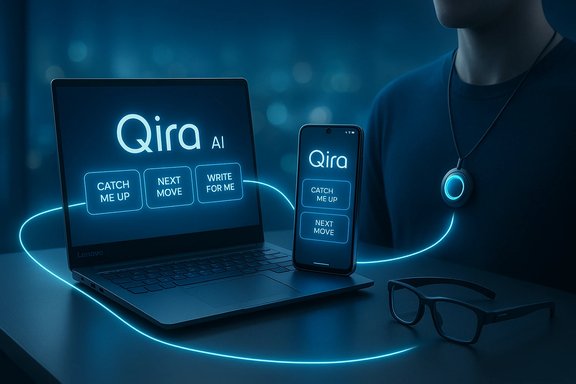
Lenovo and Motorola today unveiled Qira, a system-level, cross-device AI assistant that the companies say will begin rolling out on select Lenovo PCs in Q1 2026 and appear on Motorola phones and proof‑of‑concept wearables later in the year, positioning Qira as a “Personal Ambient Intelligence System” that lives across smartphones, PCs, tablets, and wearables.
Lenovo introduced Qira at its Tech World stage during CES 2026, framing the product as more than another chatbot or single‑app assistant. Instead, Qira is described as an always‑available intelligence layer embedded at the operating‑system level that maintains cross‑device continuity, builds a fused knowledge base of user‑approved content and interactions, and executes contextual actions across apps and devices with the user’s permission. This announcement arrives at a moment when OEMs and silicon vendors are racing to put meaningful inference on device and to embed generative features into operating systems. The direction is clear: on‑device capabilities plus a controlled cloud complement are being marketed as the path to low‑latency, privacy‑sensitive assistant features. Industry observers have been equally enthusiastic and cautious about this shift — noting the productivity promise while flagging new consent, governance, and attack‑surface issues that come with persistent, cross‑session memory.
Examples presented in demos include having the device listen to a keynote and then draft a short LinkedIn post, or tapping the device to ask a contextual question about what the camera sees. Publications that covered the demos emphasized that Project Maxwell is directional — exploring a new form factor rather than promising immediate retail availability — yet it signals Motorola’s roadmap for always‑present, multimodal companions tied into Qira.
Key privacy and security concerns to watch:
At the same time, the product raises legitimate questions about defaults, consent, and administrative control. The fused knowledge base concept is powerful but increases the need for transparent retention policies, audit trails, and strict controls over sensor usage. Implementation — not marketing — will determine whether Qira becomes a trusted assistant or another source of user anxiety and regulatory scrutiny. Independent reviews, security audits, and enterprise validation in the months following the Q1 2026 PC rollout will be the true barometer.
For Windows and Android users invested in Lenovo and Motorola hardware, Qira promises a glimpse of seamless cross‑device assistance that could change daily workflows. For privacy‑conscious users and IT teams, the pragmatic advice is to review the initial settings, insist on clear admin tools, and validate vendor claims against independent testing before enabling broad adoption.
Source: Technobezz Lenovo and Motorola announce Qira AI assistant for 2026 launch
 Background
Lenovo introduced Qira at its Tech World stage during CES 2026, framing the product as more than another chatbot or single‑app assistant. Instead, Qira is described as an always‑available intelligence layer embedded at the operating‑system level that maintains cross‑device continuity, builds a fused knowledge base of user‑approved content and interactions, and executes contextual actions across apps and devices with the user’s permission. This announcement arrives at a moment when OEMs and silicon vendors are racing to put meaningful inference on device and to embed generative features into operating systems. The direction is clear: on‑device capabilities plus a controlled cloud complement are being marketed as the path to low‑latency, privacy‑sensitive assistant features. Industry observers have been equally enthusiastic and cautious about this shift — noting the productivity promise while flagging new consent, governance, and attack‑surface issues that come with persistent, cross‑session memory.What Qira Is — A Personal Ambient Intelligence
System-level intelligence, not another app
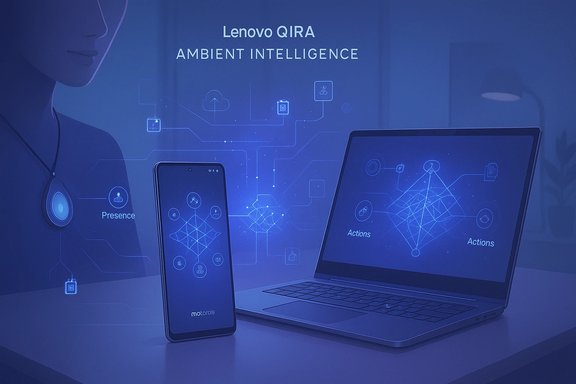
Qira is intended as a system‑level agent that lives across Lenovo and Motorola devices. Lenovo positions it as an ambient intelligence layer: it can proactively surface suggestions, perform actions on behalf of the user, and remain quietly present until engaged. Entry points include voice (“Hey Qira”), a dedicated hardware key on some devices, or a persistent UI pill on phones. That consistent invocation model is a deliberate attempt to reduce friction when moving between devices.Core design attributes
Lenovo describes Qira as built on three pillars:- Presence — continuous cross‑device availability and multiple natural entry points.
- Actions — the ability to act across apps and devices using local AI and device capabilities.
- Perception — a fused knowledge base combining user‑selected interactions, documents, and multimodal sensory data (when permitted) to understand context and continuity over time.
Core Experiences and UX: What Qira Can Do
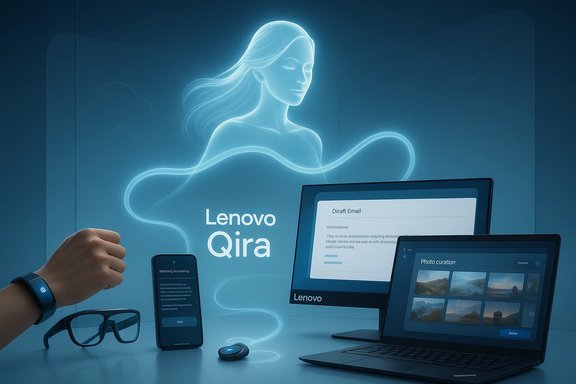
Lenovo laid out a set of headline experiences intended to show how this system approach delivers real‑world value. The features emphasize continuity, creative assistance, and meeting/communication support.- Next Move — proactive, context‑aware suggestions that propose the logical next steps based on what the user is doing right now.
- Write For Me — on‑canvas writing assistance for emails, documents, and messages that adapts to user tone and intent.
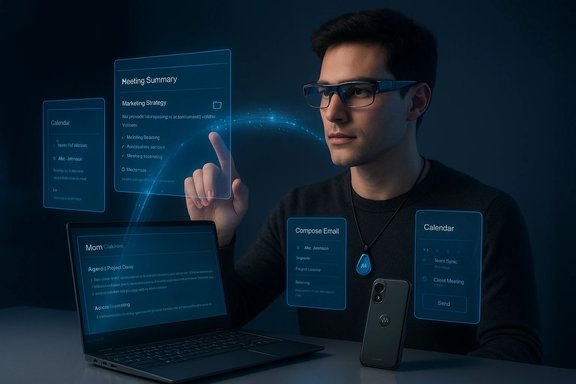
- Catch Me Up — activity summaries that let users re‑enter a project, meeting, or conversation after stepping away.
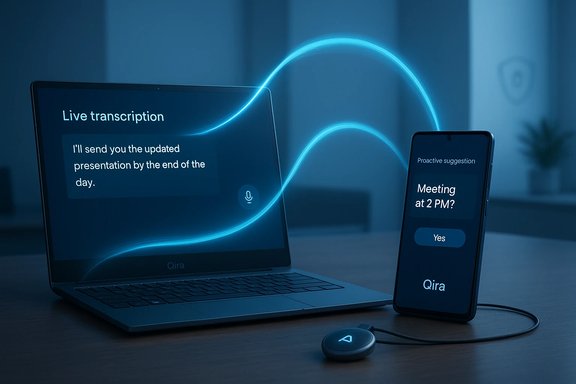
- Pay Attention — real‑time meeting transcription, translation, and key‑point capture for later reference.
- Live Interaction — multimodal, real‑time interactions during screen sharing and camera sessions for collaborative workflows.
- Creator Zone — a focused environment for visual creation and photo editing with on‑device generative tools (powered by partners like Stability AI on selected PCs).
Project Maxwell and Wearable Concepts
Motorola’s 312 Labs showed a proof‑of‑concept called Project Maxwell — an “AI Perceptive Companion” device that resembles an AI pin or pendant. Project Maxwell is not a commercial product (today it’s a concept), but it demonstrates how Qira could extend into hands‑free, camera/microphone‑enabled accessories that perceive the environment and perform tasks without direct phone interaction.Examples presented in demos include having the device listen to a keynote and then draft a short LinkedIn post, or tapping the device to ask a contextual question about what the camera sees. Publications that covered the demos emphasized that Project Maxwell is directional — exploring a new form factor rather than promising immediate retail availability — yet it signals Motorola’s roadmap for always‑present, multimodal companions tied into Qira.
Architecture: Hybrid, With an Emphasis on On‑Device Processing
Hybrid model: device-first, cloud‑when‑necessary
Lenovo says Qira uses a hybrid architecture that prioritizes on‑device processing for latency and privacy, while leveraging secure cloud services for heavier tasks or cross‑device synchronization when explicitly required. The company describes a “fused knowledge base” that combines locally kept memories, documents, and interactions and synchronizes only under user control. That hybrid approach mirrors the broader industry trend of pairing small, efficient on‑device models with larger cloud models for knowledge retrieval and heavy reasoning.Offline capability and NPU dependence
Because Lenovo positions Qira to run locally for many tasks, the feature set will map to device NPUs and platform capabilities. In practice, that means some devices (those with modern NPUs and sufficient RAM/storage) will offer richer local functionality, while older devices will rely more on cloud augmentation. This hardware dependency is consistent with recent moves in the PC and phone markets where Copilot+ and similar features require qualifying NPUs and platform integrations.Partnerships and Ecosystem
Qira is presented as an ecosystem play. Lenovo’s announcement lists a roster of partners intended to supply specialized capabilities and content integrations:- Microsoft — integration with Microsoft 365 and Azure tooling to enable secure local‑to‑cloud capabilities across Windows devices.
- Stability AI — powering private, on‑device image generation in Creator Zone on supported PCs.
- Notion — secure search and reasoning over a user’s Notion workspace to surface personal notes and plans.
- Perplexity — enabling deeper, chain‑of‑thought style explanations and sourced answers.
- Expedia/Vrbo — surfacing travel inventory based on user intent and providing booking handoffs.
Privacy, Security, and Governance — Promises and Open Questions
Lenovo’s privacy framing
Lenovo emphasizes privacy by design: data is processed locally where possible, user control is central, and cloud services are used only when necessary and secured. Those are meaningful design goals that track with user expectations for sensitive tasks like meeting transcription and personal memory. Lenovo’s materials explicitly call out local processing as a way to enable offline functionality and reduce exposure.Real risk vectors
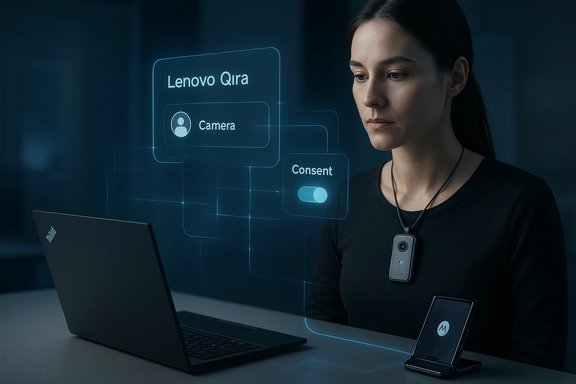
However, persistent cross‑device memories and multimodal sensing introduce complex consent and security questions that go beyond simple marketing claims. Independent analysis and industry conversation around the “AI PC era” have repeatedly warned that features which index local content — even when labeled “on‑device” — require robust consent models, audit logs, fine‑grained controls, and transparent retention policies. The history of product rollouts with persistent recall features shows that defaults and administrative controls matter deeply; vendors have previously adjusted defaults in response to scrutiny.Key privacy and security concerns to watch:
- How much of the fused knowledge base is stored persistently, and for how long?
- What controls do users and IT admins have to delete memories, restrict sensors, or opt out of cross‑device sync?
- How is data encrypted at rest and in transit, and which third parties (partners) are permitted to access derived signals?
- What governance, logging, and redress mechanisms exist for inadvertent or malicious agent actions?
Practical Implications for Consumers and IT
For consumers
Qira’s system approach is attractive for anyone who uses multiple Lenovo and Motorola devices and wants continuity without manual context switching. The appeal is immediate: fewer repeated prompts, coherent drafts across devices, and automatic re‑orientation after stepping away. On supported hardware, offline functionality could make assistants genuinely useful during travel or in low‑connectivity scenarios. However, early buyers should:- Confirm which devices and SKUs are eligible for full local Qira experiences.
- Check the privacy controls and default settings before enabling fused memory features.
- Evaluate the usefulness of privacy‑preserving on‑device generative tools vs cloud variants (which may offer broader knowledge but require network access).
For enterprise and IT
IT teams will need to treat Qira like a new platform service. Even if personal Qira memories are opt‑in, cross‑device agent actions could interact with corporate apps and data. Enterprises should expect:- New policy controls for data retention and device sync.
- Need for validation of encryption, key management, and audit trails.
- Potential certification or compliance guidance for deploying Qira in managed fleets.
Strengths and Opportunities
- Unified cross‑device continuity reduces context switching and can accelerate routine workflows.
- Device‑first capabilities improve latency and enable offline scenarios that cloud‑only assistants cannot match.
- Partner integrations (Microsoft, Stability AI, Notion, Perplexity) can add high‑value vertical features without breaking the single‑agent UX.
- Hardware + software co‑design makes emergent experiences (on‑device generation, real‑time transcription) more practical for mainstream users.
Risks, Limitations, and Where Vendors Must Prove Themselves
- Privacy defaults and consent — If fused memories and cross‑device perceptions are enabled by default, user trust will erode quickly. Robust opt‑in flows and granular controls are essential.
- Security and attack surface — Always‑on sensors and cross‑device agents expand the potential entry points for attackers; vendors must provide hardened firmware, secure enclaves for key material, and rapid patching.
- Hardware dependency and fragmentation — Full Qira capabilities will likely require modern NPUs and specific OS builds, producing a tiered experience that could confuse buyers and complicate OEM support.
- Transparency and auditability — Users and admins will want clear logs about what the agent did, what data it read, and what was transmitted to the cloud. Without those features, legal and compliance teams will be hesitant to greenlight enterprise rollouts.
- Commercial dependency on partners — Integrations with third parties (e.g., Perplexity, Notion, Stability AI) are powerful, but they also introduce contract and supply‑chain fragility if partners change terms or integrations break.
What to Watch Next
- Which Lenovo models get the initial Q1 2026 update, and whether hardware qualifications (specific NPUs, RAM, or storage) are explicitly listed for each feature.
- The exact privacy and admin controls that ship with the first builds: memory deletion, sync toggles, sensor granular permissions, and defaults.
- Motorola’s timeline for Qira on phones and whether Project Maxwell moves from concept to a developer kit or limited pilot.
- Independent security audits and privacy reviews that test on‑device claims and cloud‑sync behaviors.
- Developer and third‑party integration surfaces that allow apps to opt into or opt out of Qira orchestration.
Final Assessment
Qira is an ambitious attempt to reframe personal AI from siloed apps to an always‑present system intelligence that follows users across devices. The architecture and feature set map to current industry direction: push inference to the device, pair it with curated cloud services, and bake continuity into workflows. Early strengths include meaningful continuity, on‑device latency/privacy benefits, and a partner ecosystem that adds specialized capabilities.At the same time, the product raises legitimate questions about defaults, consent, and administrative control. The fused knowledge base concept is powerful but increases the need for transparent retention policies, audit trails, and strict controls over sensor usage. Implementation — not marketing — will determine whether Qira becomes a trusted assistant or another source of user anxiety and regulatory scrutiny. Independent reviews, security audits, and enterprise validation in the months following the Q1 2026 PC rollout will be the true barometer.
For Windows and Android users invested in Lenovo and Motorola hardware, Qira promises a glimpse of seamless cross‑device assistance that could change daily workflows. For privacy‑conscious users and IT teams, the pragmatic advice is to review the initial settings, insist on clear admin tools, and validate vendor claims against independent testing before enabling broad adoption.
Source: Technobezz Lenovo and Motorola announce Qira AI assistant for 2026 launch