

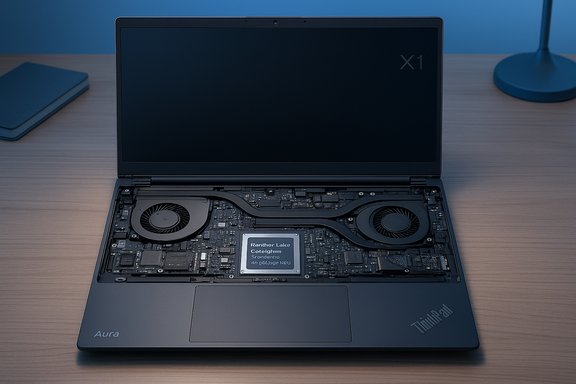
Lenovo’s next-generation ThinkPad X1 Carbon Gen 14 Aura Edition and the ThinkPad X1 2‑in‑1 Gen 11 Aura Edition have leaked in significant detail, promising a major internal redesign built around Intel’s upcoming Panther Lake (Core Ultra Series 3) platform, improved repairability, a new high‑resolution webcam, larger haptic controls, and a host of thermals‑focused engineering changes intended to deliver sustained performance for demanding workloads. The leak — circulated through Windows‑focused outlets and internal roadmap excerpts — paints these as Lenovo’s 2026 flagship business laptops, with an emphasis on on‑device AI capability, better cooling, and easier serviceability than many recent ultraportables.
Background / Overview
Lenovo’s “Aura” branding has been used across recent ThinkPad X1 Aura Edition refreshes to denote devices tuned for AI features, premium displays, and enhanced collaboration tools. The Gen 13 Aura Edition pushed Copilot+ readiness and higher‑end Intel Core Ultra Series silicon; the Gen 14 and Gen 11 Aura leaks appear to follow that trajectory while introducing a significant internal rethink of component layout and serviceability. This leaked roadmap sits directly on top of Intel’s Panther Lake platform messaging — a multi‑tile Core Ultra Series 3 family that expands integrated GPU core counts and integrates more capable NPUs, enabling device makers to bake local AI features into laptops. The leaked claims include:- Use of Intel Core Ultra X7 Series 3 silicon with integrated Arc‑derived GPUs scaling up to 12 Xe cores and on‑package NPUs delivering tens of TOPS.
- A new internal design that places components on both sides of the motherboard to free interior volume for cooling and repair access, reportedly increasing heat dissipation by ~20% and enabling ~30W of sustained load.
- A 10MP front camera with a wide 110° field of view and distortion correction, an unusually large haptic touchpad, and an improved pen docking mechanism for the 2‑in‑1 model.
- An alleged iFixit repairability score of 9/10, a notable departure from the more sealed designs common in ultra‑thin premium laptops. This particular claim is sourced from the leak and secondary reporting but remains unconfirmed on iFixit’s public site.
What the leak actually details
Design: dual‑sided motherboard, larger haptic touchpad, and repair focus
According to the leaked materials, Lenovo redesigned the internal floorplan so that major components are distributed on both sides of the mainboard. The stated motivation is twofold: reclaim internal volume to improve airflow and cooling channeling, and simplify disassembly paths for common repairs. The leak explicitly links that redesign to a larger haptic touchpad and cleaner internal routing that could reduce thermal bottlenecks.The leak also claims a strong repairability outcome: an iFixit assessment scoring the X1 Carbon Gen 14 and X1 2‑in‑1 Gen 11 9/10. If true, this would represent one of the best repairability scores for high‑end ultraportables in recent years, driven by accessible battery, modular I/O, and independently serviceable parts. That iFixit score should be treated as a leak‑sourced claim until it appears in iFixit’s public teardown report.
Processors, graphics and on‑device AI
Both X1 models are reported to be configured around Intel Core Ultra X7 Series 3 processors, the higher‑tier part of Intel’s Panther Lake family. The platform-level description in the leak asserts:- iGPU up to 12 Xe cores (Arc‑derived Xe3 family for Panther Lake),
- a significant on‑package NPU budget (leak materials reference NPUs in the tens of TOPS range for these X‑class parts),
- support for high‑rate LPDDR5x memory and modern I/O.
Thermals and sustained performance claims
The leak highlights a claimed ~20% improvement in heat dissipation and the ability to maintain ~30W of sustained load, which is a crucial practical metric absent in brief turbo‑boost figures. Maintaining sustained multi‑core clocks is often the differentiator between a laptop that spikes in short benchmarks and one that actually performs under prolonged compilation, rendering, or ML inference tasks. The dual‑side component distribution and larger internal dissipation channels are the engineering levers Lenovo reportedly used to reach this target.Camera, collaboration hardware and input changes
Both X1 models are said to include a 10MP front camera with a 110° field of view and software‑level distortion correction. This marks a notable leap over the common 720p or 1080p webcams still present in many business laptops and suggests a focus on higher‑quality video collaboration and document capture (scanning) workflows. The 2‑in‑1 Gen 11 reportedly adds a new magnetically docked pen with easy storage and replacement, while both models will feature an unusually large haptic touchpad.Ports, battery and other features
Leaked materials sketch modern port arrays (Thunderbolt, HDMI, USB‑A) and suggest battery sizes and chassis weights consistent with thin 14‑inch flagship notebooks. The roadmap excerpts also mention Linux availability on certain SKUs and an emphasis on enterprise features (ThinkShield, TPM, vPro options in some configurations). As with any roadmap leak, final SKUs, regional options, and battery capacities remain subject to change.Verifying the claims: cross‑checks with independent sources
When a leak connects to a major platform shift like Intel’s Panther Lake, the most important validation is cross‑referencing platform technical claims with established industry reporting and Intel’s own messaging.- Intel‑platform validation: Panther Lake / Core Ultra Series 3 materials circulated in trade reporting corroborate the move to a Xe3‑derived iGPU that can scale to 12 Xe cores in top SKUs, plus larger NPU budgets (platform TOPS). Those platform claims align with the leak’s choice of Core Ultra X7 silicon for a flagship X1 family. However, exact NPU TOPS for a given system depend on SKU selection and OEM power profiles.
- Chip and SKU reporting: Independent coverage from hardware outlets tracking Panther Lake leaks confirms the existence of X‑branded Core Ultra parts and the general NPU/GPU scaling — strengthening the technical plausibility of the leak’s CPU and iGPU claims. That reporting also documents SKU complexity and regional SKU variations that frequently change prior to launch.
- Secondary news outlets: Coverage repeating the Windows Latest / Windows Report leak picks up the same claims around dual‑side component placement, 10MP camera, and the iFixit figure. These secondary reports increase the leak’s visibility but do not independently confirm teardown or vendor statements. Treat them as corroborating leaks rather than independent proofs.
- OEM precedent and Lenovo disclosures: Lenovo’s recent Aura and Gen 13 launches show the company positioning X1 Aura Editions around Copilot+ readiness and higher‑end Intel silicon, which makes the continuation into Gen 14 logical. Past Lenovo press materials also confirm that the company is actively pursuing more capable on‑device AI experiences and premium collaboration hardware in X1‑class devices. That context makes the leak’s product positioning plausible.
Strengths implied by the leak
- Repairability and serviceability: A claimed 9/10 iFixit score would be a significant industry story. Enterprise customers and IT admins prize repairability for lower TCO and easier field service, and Lenovo adopting a more modular internal layout would be a welcome move for long‑term ownership.
- Sustained performance for real workloads: The focus on improving heat dissipation and maintaining sustained 30W loads — if realized — moves the X1 from short‑burst benchmark performance toward genuinely usable long‑duration throughput for compilation, virtualization, and on‑device inference workloads.
- Higher‑quality webcam and input changes: A 10MP, 110° camera with distortion correction is a practical upgrade for hybrid work, enabling better group shots, clearer document capture, and flexible framing without losing resolution. The larger haptic touchpad maintains the ThinkPad lineage of precision input while modernizing the tactile experience.
- Platform alignment with Panther Lake: Choosing Core Ultra X7 Series 3 silicon positions these models to benefit from higher iGPU core counts and larger NPUs, enabling local AI features and better integrated graphics performance without a discrete GPU — an important trend for thin business laptops.
Risks, caveats and what remains unverified
- iFixit score is unconfirmed: The 9/10 repairability rating comes from the leak and has been repeated by outlets relaying the leak; iFixit’s public teardown pages do not (as of the leak) show a published teardown confirming that score. Until a verified teardown is posted, treat this as an encouraging but unverified claim.
- Thermal claims depend on OEM tuning: A claimed 20% heat dissipation improvement and sustained 30W rating are useful engineering targets, but final consumer performance depends heavily on Lenovo’s firmware tuning (fan curves, power limits) and the chosen CPU SKU. Independent benchmark testing across multi‑hour workloads will be necessary to validate these claims.
- NPU and TOPS figures vary by configuration: On‑package NPU capability is a platform‑level metric; actual delivered TOPS in a given model may vary by package, power budget, and how much headroom the OEM leaves for CPU and GPU. Public Panther Lake marketing cites platform TOPS but vendors often present conservative NPU figures for shipping SKUs. Cross‑check actual device spec sheets and independent ML benchmark results when available.
- Battery life trade‑offs: Higher‑rate LPDDR5x memory, brighter displays, and larger NPUs increase power draw. If Lenovo aims for sustained performance and high display brightness, buyers should expect shorter runtimes in heavy workloads compared to lower‑power alternatives — a familiar trade‑off in thin, high‑performance Windows laptops. Historical Aura Edition reviews show good displays and premium design but often middling battery numbers in real tests.
- Driver and Linux readiness: The leak mentions Linux availability on some SKUs, but driver maturity for bleeding‑edge integrated GPUs and NPUs historically lags Windows support. Enterprise buyers choosing Linux should confirm vendor driver support and long‑term maintenance plans before procurement.
- Pricing and availability are fluid: Roadmap leaks commonly carry tentative pricing and launch windows; previous Aura‑branded X1 laptops carried premium price tags. Treat reported price and CES timing as provisional until Lenovo publishes official SKUs and regional MSRPs.
What to do if you’re considering one (IT buyers and prosumers)
- Wait for official Lenovo SKUs and spec sheets before final procurement decisions. Leaks reliably inform roadmap direction but not final parts, warranties, or enterprise support options.
- When review units are available, prioritize tests that measure:
- Sustained multi‑core CPU performance over several hours.
- Real‑world battery life under mixed productivity scenarios.
- Webcam quality (document capture, low light, distortion correction).
- Thermal / fan acoustics trade‑offs at sustained 30W loads.
- For Linux users or developers, request driver/firmware support timelines and test kernels with vendor drivers early in the evaluation cycle.
- For IT managers, factor in repairability: if iFixit or another teardown confirms modular parts and easy battery replacement, that can materially reduce TCO and downtime — but verify warranty terms (do modular parts void anything? and regional repair support.
How this matters for the wider PC landscape
Lenovo’s rumored internal redesign and the positioning of X1 Aura Editions around Panther Lake silicon reflect two broader industry shifts: first, vendor pushback on sealed, ultra‑thin designs in favor of repairable engineering; and second, OEMs designing around on‑device AI hardware to deliver Copilot+ and similar local experiences. If Lenovo can successfully combine a serviceable internal layout with meaningful sustained performance and practical local AI features, it will set a high bar for enterprise ultraportables — and increase buyer focus on repairability and long‑term management.From Intel’s perspective, Panther Lake’s scaling of integrated GPU and NPU resources aims to make high‑end thin‑and‑light machines more versatile without discrete GPUs. The reported mapping of X7/X9 silicon into ThinkPad, Yoga, and creator machines is consistent with Intel’s stated objectives for the platform. However, the real user experience will be shaped by OEM thermal engineering and software stacks that expose NPU features to enterprise workflows.
Final assessment and cautious optimism
The leak describing the ThinkPad X1 Carbon Gen 14 and X1 2‑in‑1 Gen 11 Aura Edition outlines a confident engineering shift: better serviceability, a renewed focus on sustained performance, and practical improvements in webcams and input surfaces. These are user‑facing upgrades that matter in everyday enterprise use more than flashy spec sheets. The alignment with Intel’s Panther Lake makes the CPU/GPU/NPU claims technically plausible, and secondary reporting has amplified the leak’s key points. That said, several critical claims remain to be independently validated: the iFixit repairability score, sustained thermal performance under real workloads, real delivered NPU TOPS for shipping SKUs, and price/availability. Until Lenovo publishes official specifications and independent reviewers perform extended hands‑on tests, treat the leak as a strong indicator of direction rather than a final purchase blueprint.For IT decision‑makers and power users, the leaked roadmap is promising: if repairability and sustained performance are delivered alongside Panther Lake’s AI capabilities, X1 Aura Edition’s next generation could genuinely change procurement calculus — favoring devices that are both AI‑capable and maintainable. Wait for official launch announcements and independent teardown/review coverage before making fleet‑level commitments.
Lenovo’s leaked approach — marrying on‑device AI silicon with a renewed focus on thermal headroom and repairability — captures the central engineering debates of the era: performance versus battery life, sealed thinness versus serviceability, and cloud‑centric AI versus local, private AI acceleration. The X1 Carbon Gen 14 and X1 2‑in‑1 Gen 11 Aura Edition leak signals Lenovo is betting heavily on the latter set of trade‑offs; the industry and buyers will watch closely as official specs and real‑world tests arrive.
Source: Windows Report Lenovo ThinkPad X1 Carbon Gen 14 and X1 2-in-1 Gen 11 Aura Edition Details Leak Online
