

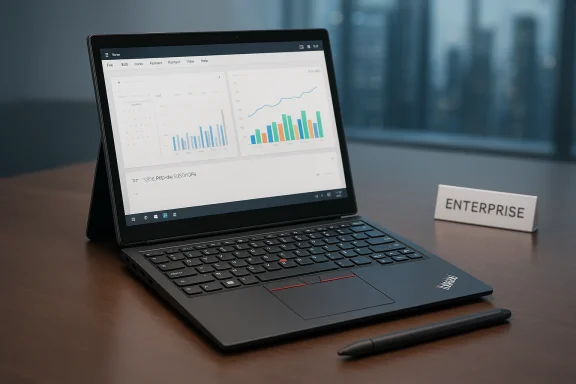
Lenovo’s new ThinkPad X13 Detachable revives a form factor many assumed was effectively retired: the high-end Windows 2‑in‑1 detachable tablet. Announced as a purpose‑built device for commercial customers and professionals, the X13 Detachable combines a 13‑inch 3:2 touchscreen, Intel’s latest Core Ultra 3 series processors, up to 64GB of LPDDR5x memory, a detachable backlit keyboard with the iconic TrackPoint, and a thin magnesium‑aluminum chassis that aims to match the Surface Pro’s portability while addressing several long‑standing enterprise needs. Lenovo positions this as a “no‑compromise detachable” designed for users who want tablet flexibility without giving up workstation‑class features — and it’s clearly aimed at businesses willing to pay a premium for security, manageability, and durability. The device will be available in the third quarter of 2026 with pricing starting at $1,999.
The detachable Windows tablet market has been quiet for several years. Microsoft’s Surface line remains the most visible example of the category, while most OEMs pivoted toward ultraportable clamshells and convertible laptops rather than detachable, kickstand‑style tablets. Lenovo’s ThinkPad X13 Detachable marks one of the more substantial re‑entries into this niche by a major PC maker, and it does so with a distinctly enterprise‑first design language.
Historically, detachable tablets lived and died on compromises: thinness and weight demanded limited batteries and thermals; detachable keyboards often felt like accessories sold separately; and enterprise buyers routinely pushed back against non‑standard repairability and legacy ports. Lenovo’s announcement attempts to confront many of those objections head‑on by delivering ThinkPad‑grade security and input features (including a detachable keyboard with a TrackPoint), modern internals such as Thunderbolt 4 ports and optional 5G, and Linux compatibility for organizations that standardize on non‑Windows stacks.
The detachable market has suffered partly because consumers and businesses alike favor predictable battery life, full keyboards, and better thermals — features that traditional laptops still do better. Lenovo’s success will depend on convincing buyers that the X13 Detachable’s unique mix of features (TrackPoint, vPro, Linux support, TB4) offers net gains over premium clamshells and existing Surface models.
That said, price and practical tradeoffs will limit how broadly this class of device can replace traditional laptops. A $1,999 starting point puts the X13 Detachable into consideration alongside powerful ultraportables and thin workstations that often offer better thermals and battery for the money. For buyers who truly need a detachable with high RAM, Linux support, TrackPoint ergonomics, and enterprise‑grade manageability, Lenovo’s entry is well‑targeted and thoughtfully executed. For everyone else, it will remain a niche — albeit a technically impressive one.
If Lenovo supports the X13 Detachable with consistent firmware updates, competitive accessory bundles, and a transparent enterprise support window, it could encourage other OEMs to revisit the detachable market. For now, Lenovo’s move is a welcome vote of confidence in Windows 2‑in‑1s — but whether it reignites a broader market depends on how well the company balances price, practical battery life, and the kind of polish that turns tech demos into everyday workhorses.
In short: the ThinkPad X13 Detachable is not for everyone, but for the people and organizations it targets, it may be the most convincing detachable yet.
Source: Windows Central Lenovo revives the Windows 2-in-1 scene with its own ThinkPad X13 2-in-1 PC
 Background
The detachable Windows tablet market has been quiet for several years. Microsoft’s Surface line remains the most visible example of the category, while most OEMs pivoted toward ultraportable clamshells and convertible laptops rather than detachable, kickstand‑style tablets. Lenovo’s ThinkPad X13 Detachable marks one of the more substantial re‑entries into this niche by a major PC maker, and it does so with a distinctly enterprise‑first design language.Historically, detachable tablets lived and died on compromises: thinness and weight demanded limited batteries and thermals; detachable keyboards often felt like accessories sold separately; and enterprise buyers routinely pushed back against non‑standard repairability and legacy ports. Lenovo’s announcement attempts to confront many of those objections head‑on by delivering ThinkPad‑grade security and input features (including a detachable keyboard with a TrackPoint), modern internals such as Thunderbolt 4 ports and optional 5G, and Linux compatibility for organizations that standardize on non‑Windows stacks.
What Lenovo shipped: core specs and hardware choices
Lenovo is leaning into a very specific set of hardware choices that tell you where it thinks demand will come from.Key hardware highlights
- Processor: Intel Core Ultra 3 series (U5 and U7 options, and vPro support). These chips combine performance and efficiency cores with integrated AI acceleration.
- Memory: Up to 64GB LPDDR5x (soldered), signaling this product is targeting heavy multitaskers and pro users who need large memory footprints.
- Storage: Up to 1TB M.2 PCIe 4.0 NVMe (2242 form factor).
- Display: 13‑inch, 3:2 IPS touchscreen at 2880×1920 with 120Hz variable refresh rate (and 60Hz fallback), 500 nits peak brightness and 100% sRGB coverage.
- Battery: 45Wh tablet battery; Lenovo claims “all‑day” life depending on configuration and usage.
- Connectivity: Two Thunderbolt 4 USB‑C ports, optional 5G, Wi‑Fi 7, Bluetooth 5.4, and optional NFC.
- Input & accessories: Detachable keyboard folio with 1.5mm key travel, LED backlight, a 3‑button trackpad, and for the first time in a detachable accessory, the ThinkPad TrackPoint. The included Lenovo Slim Pen charges in the folio via pogo pins.
- Cameras & audio: 5MP IR front camera with Windows Hello support and privacy shutter, an 8MP rear camera, and Dolby Atmos‑tuned stereo speakers.
- Security: Fingerprint reader on the folio, IR camera, physical camera shutter, and ThinkPad‑class ruggedness and BIOS options.
- Chassis & weight: Tablet measures 9.3mm thin and uses a magnesium and aluminum construction; accessory folio uses glass‑fiber reinforced polycarbonate.
Why this matters: the ThinkPad twist on a familiar form factor
The detachable tablet form factor is not new, but Lenovo’s ThinkPad family brings expectations — durability, enterprise features, and a specific ergonomics philosophy — that few competitors match. There are several concrete reasons the X13 Detachable could change conversations in IT procurement and among road warriors:- Enterprise readiness: ThinkPad devices have a long track record in business fleets. Lenovo’s inclusion of vPro capable CPUs, firmware options, and familiar manageability tools is a major plus for IT teams that value standardization. The presence of a Kensington lock and replaceable USB‑C ports further suggests Lenovo is thinking about fleet serviceability and asset protection.
- Input parity with laptops: The detachable folio’s TrackPoint and 1.5mm key travel aim to reduce the subjective penalty of using an attachable keyboard versus a full laptop keyboard. For users who type a lot, this might be decisive.
- Linux friendliness: Official support for Fedora Linux makes the X13 Detachable attractive to developers and organizations that run mixed OS environments. That’s a rare offering from mainstream Windows OEMs and taps into a niche of power users who otherwise purchase non‑business hardware or convert devices unofficially.
- Modern I/O and performance: Dual Thunderbolt 4, Wi‑Fi 7, and the Core Ultra platform mean the device isn’t hamstrung by dated connectivity. For docking, external GPU (where supported), or high‑speed storage needs, this is important.
- Aesthetic and functional parity with Surface Pro: At 9.3mm, the tablet matches the Surface Pro’s thinness, and the combination of pen support, kickstand, and detachable folio gives users a familiar and proven workflow.
Strengths: what Lenovo got right
Lenovo’s design decisions address many of the typical weak points in detachable tablets, and those choices will matter for buyers who need durability and manageability.- No‑compromise performance envelope: Offering up to 64GB LPDDR5x and a 1TB PCIe 4.0 SSD in a detachable is significant. That much RAM and high‑speed storage allow heavier multitasking and local workloads than most detachables historically offered.
- TrackPoint in a detachable: This is a thoughtful inclusion for long‑time ThinkPad users. It lowers the cognitive friction for users migrating from traditional ThinkPad laptops to a tablet form factor.
- Enterprise features and security: vPro, a physical shutter, fingerprint on the folio, and rugged construction address IT requirements that often keep organizations from deploying consumer tablets broadly.
- Modern connectivity stack: Dual Thunderbolt 4 ports give flexibility for external displays, docks, and fast data lanes. Wi‑Fi 7 and optional 5G reflect a forward‑looking connectivity strategy.
- Pen and folio integration: Including a pen that charges in the folio and offering a folio that charges the pen makes the accessory ecosystem feel more complete and less like a separate cost center.
- Linux support: Official Fedora support signals a rare level of openness from an OEM in this product category.
Risks and drawbacks: why adoption may be limited
Even with strong specs, Lenovo faces practical headwinds. Some are inherent to the detachable form factor; others are market realities.- Price is a major barrier: With a starting price of $1,999, this device sits firmly in premium territory. If the keyboard folio isn’t included in that price, the effective entry cost will be even higher. For many enterprises and individual buyers, that price competes directly with thin-and-light laptops that have better thermals, larger batteries, and traditional keyboards built in.
- Battery capacity vs. thinness trade‑off: A 45Wh battery is modest for a 13‑inch device with a high‑resolution 120Hz display. Lenovo’s “all‑day” claim will depend heavily on usage profile, refresh rate, and background AI workloads. Power users who rely on sustained heavy loads (compilation, VMs, video encoding) may find the battery and thermal envelope limiting compared with clamshells that can sustain higher wattage.
- Soldered memory: While 64GB max is impressive, the RAM is soldered. That eliminates upgrade paths and forces buyers to correctly spec memory at purchase time. For fleet managers, this can increase upfront costs or create inventory management complexity.
- Serviceability and repairability concerns: The tablet chassis is thin and compact; while Lenovo touts replaceable USB‑C ports and a rugged case, deep repairs (motherboard replacement, battery swaps) typically remain harder in detachables than in laptops. Enterprises with strict lifecycle and repair policies may consider that when comparing TCO.
- Niche market size: The detachable tablet is a niche within a niche. Many buyers prefer convertibles or ultraportables with integrated keyboards because they avoid accessory loss, misalignment, and separate charging. The X13 Detachable needs to convince a broad enough market segment that the tradeoffs are worthwhile.
- Price vs. Surface ecosystem: Microsoft still owns strong software and accessory integration with Surface products. Lenovo will need to ensure its drivers, firmware updates, and accessory interoperability meet high expectations — any stumbles in firmware or driver support could hurt perception.
Use cases where the X13 Detachable excels
The device is not a one‑size‑fits‑all proposition, but it is well‑suited to a number of professional scenarios.Field and frontline workers
For employees who need a portable, rugged device with cellular connectivity and secure manageability, the X13 Detachable fits well. The optional 5G, Kensington lock, and IP‑adjacent ruggedization are practical for sales teams, field engineers, and service technicians who value portability and enterprise controls.Presenters and creative professionals
The 3:2 13‑inch display with pen support and a 120Hz refresh rate makes the tablet attractive for designers, annotators, and presenters who need a responsive canvas and accurate aspect ratio for documents. The detachable folio improves on‑desk typing and the TrackPoint enables precise cursor control during edits or presentations.Hybrid developers and Linux users
Official Fedora support is a major differentiator. Developers who rely on Linux workflows, containers, or mixed OS stacks will appreciate a factory‑supported device. The high RAM ceiling enables heavier local development workloads, such as containerized microservice stacks or VM‑based testing.Executives and road warriors
For executives who prioritize a lightweight, premium look and need a device that doubles as a tablet for reading and a laptop for email and slides, the X13 Detachable checks many boxes. Thunderbolt docking for office setups and Wi‑Fi 7 for fast hotel and office connectivity are compelling.Enterprise procurement considerations
IT decision makers should weigh several practical factors before selecting the X13 Detachable for fleet rollouts.- Total cost of ownership (TCO): High upfront cost must be balanced against manageability, warranty, and expected lifecycle. Evaluate repair and replacement costs for detachable accessories.
- Security baseline: Confirm firmware update cadence and vendor support for BIOS, Intel AMT/vPro features, and secure boot workflows.
- Standardization and images: If Linux is part of your stack, having official support simplifies imaging and driver deployment. Confirm Lenovo’s enterprise tooling compatibility with your existing MDM and patching systems.
- Accessory management: Plan for keyboard folio and pen lifecycle, spare parts, and provisioning. If accessories are optional or sold separately, build those costs into procurement.
- User training and support: Users moving from clamshells to detachables may need guidance on workflows, especially regarding battery conservation and dock behavior.
Competition and market dynamics
Lenovo’s move into this space pits it against Microsoft’s Surface Pro family, as well as a handful of niche players that produce detachable tablets for enterprise markets. Microsoft’s advantage remains deep integration between Windows and Surface firmware, plus a long history of accessory support. Lenovo’s counterplay is a ThinkPad heritage, enterprise features, and a potentially more flexible channel for enterprise sales.The detachable market has suffered partly because consumers and businesses alike favor predictable battery life, full keyboards, and better thermals — features that traditional laptops still do better. Lenovo’s success will depend on convincing buyers that the X13 Detachable’s unique mix of features (TrackPoint, vPro, Linux support, TB4) offers net gains over premium clamshells and existing Surface models.
Practical advice for buyers
- If you can afford the premium and need the specific features (Linux support, TrackPoint on a detachable, optional 5G, very high RAM topped configurations), the X13 Detachable is a compelling candidate.
- If battery life and raw sustained performance under heavy loads are top priorities, compare clamshell laptops with similar CPUs; those will typically sustain higher wattage and therefore better performance in long workloads.
- For fleet purchases, insist on evaluating a loaner unit in real‑world scenarios: video conferencing all day, mixed Wi‑Fi/5G travel, and docking into enterprise docks. Look closely at driver stability across Windows Update cycles.
- For developers or Linux users, validate toolchain and driver availability for your specific Linux distribution and workflows.
Where Lenovo needs to prove itself post‑launch
Several areas require careful follow‑through from Lenovo to convert interest into adoption.- Firmware and driver polish: Surface products have benefited from years of tight firmware and OS integration. Lenovo must match that polish, especially around pen latency, power management, and dock behavior.
- Accessory pricing and availability: The economics of the folio, pen, and spare parts will influence many purchases. Bundled accessories at a reasonable price can offset the high base MSRP.
- Realistic battery expectations: Clear, measured benchmarks for typical enterprise tasks (video calls, document editing, remote VPN use) will help buyers set expectations and avoid disappointment.
- Long‑term support policies: Enterprise buyers want predictable lifecycle support. Lenovo should publish clear timelines for firmware updates, driver maintenance, and spare parts availability.
Final assessment: a reasoned bet on a specialized future
The ThinkPad X13 Detachable is an ambitious device that resurrects a form factor many had written off. Lenovo’s approach — loading the tablet with ThinkPad DNA, enterprise features, and modern connectivity — makes it much more than a Surface knockoff. It’s a strategic product aimed at IT departments and professionals who value security, manageability, and a premium input experience.That said, price and practical tradeoffs will limit how broadly this class of device can replace traditional laptops. A $1,999 starting point puts the X13 Detachable into consideration alongside powerful ultraportables and thin workstations that often offer better thermals and battery for the money. For buyers who truly need a detachable with high RAM, Linux support, TrackPoint ergonomics, and enterprise‑grade manageability, Lenovo’s entry is well‑targeted and thoughtfully executed. For everyone else, it will remain a niche — albeit a technically impressive one.
If Lenovo supports the X13 Detachable with consistent firmware updates, competitive accessory bundles, and a transparent enterprise support window, it could encourage other OEMs to revisit the detachable market. For now, Lenovo’s move is a welcome vote of confidence in Windows 2‑in‑1s — but whether it reignites a broader market depends on how well the company balances price, practical battery life, and the kind of polish that turns tech demos into everyday workhorses.
In short: the ThinkPad X13 Detachable is not for everyone, but for the people and organizations it targets, it may be the most convincing detachable yet.
Source: Windows Central Lenovo revives the Windows 2-in-1 scene with its own ThinkPad X13 2-in-1 PC
