

LG owners woke this week to a routine webOS firmware push that left Microsoft Copilot sitting on their home screens — and for many the new Copilot tile behaves like a system component that can be hidden but not removed, touching off a broad backlash about device ownership, privacy defaults, and how AI is being grafted onto devices after purchase.
What changed from expectation to outrage was the delivery method. Multiple owners reported that a firmware‑over‑the‑air (FOTA) update added a visible Copilot tile to the webOS home ribbon, and — crucially — the TV’s app‑management UI in many cases offered only hide or disable, not uninstall. Several users reported that performing a factory reset restored the Copilot tile, strongly suggesting the component was delivered as a privileged system package or baked into the firmware image rather than as an ordinary removable app. Those repeatable, on‑the‑ground reports form the core evidence behind the current consumer revolt.
Several outlets and forum aggregations have independently reproduced the basic behavioral claims (tile added by update; no uninstall affordance; reappearance after reset), which increases confidence the issue is widespread across certain firmware builds and models rather than an isolated unit‑level bug. Still, vendor confirmation — a model‑by‑model technical bulletin from LG — is the clearest path to resolving residual uncertainty.
For users: hide the tile, disable Live Plus and ad personalization, use an external streamer or network segmentation if you value strict privacy, and demand an explicit uninstall option from the vendor.
For vendors: publish technical details, offer meaningful opt‑outs and uninstall paths, make AI features opt‑in for in‑field devices, and default to privacy‑minimal settings. Failure to do so will likely result in reputational harm, consumer migration away from built‑in smart layers, and intensified regulatory scrutiny.
The incident is a timely reminder that in the race to put AI into every screen, convenience without consent is a fragile strategy. If manufacturers and platform partners want AI on TVs to be seen as a helper rather than a Trojan horse, the path is simple: design for user control, not distribution convenience.
Conclusion: the technology’s promise is real; the rollout choices were not. Restoring consumer trust will require clear technical transparency, durable opt‑outs, and an immediate fix that gives owners back the control they reasonably expected when they bought their TVs.
Source: DesignTAXI Community https://community.designtaxi.com/to...g-unremovable-microsoft-copilot-to-smart-tvs/
 Background
How we got here
Microsoft, LG and other major TV makers publicly signaled a strategy to bring Microsoft Copilot — the company’s conversational AI — to living‑room screens during the 2025 product cycle. The pitch was straightforward: put an LLM-powered assistant on a large, shared screen to improve discovery, accessibility and conversational search. LG showcased an “AI‑forward” webOS roadmap and an “AI Remote” concept that would surface Copilot, while Samsung published staged rollouts for selected 2025 models.What changed from expectation to outrage was the delivery method. Multiple owners reported that a firmware‑over‑the‑air (FOTA) update added a visible Copilot tile to the webOS home ribbon, and — crucially — the TV’s app‑management UI in many cases offered only hide or disable, not uninstall. Several users reported that performing a factory reset restored the Copilot tile, strongly suggesting the component was delivered as a privileged system package or baked into the firmware image rather than as an ordinary removable app. Those repeatable, on‑the‑ground reports form the core evidence behind the current consumer revolt.
What owners actually saw
The observable sequence
- The TV applied a routine webOS FOTA update through LG’s standard update channels.
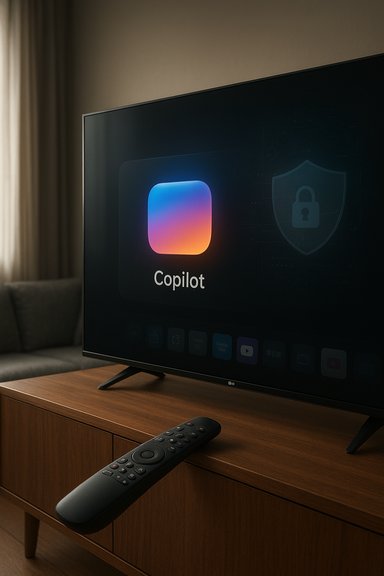
- After the update, a Copilot icon or tile appeared on the home screen — usually in the apps row or the new AI/assistant area.
- When users opened the Edit / App Manager screens, Copilot often lacked an uninstall/delete affordance; the UI showed only hide or disable.
- In multiple reports, a factory reset reintroduced the Copilot tile, indicating it may be embedded in the firmware image restored by reset.
Implementation variations reported
Accounts collected from forums and social threads indicate differences in how Copilot is surfaced on sets:- Some owners see a web shortcut that launches a Copilot web experience, accepting voice input via the remote’s mic.
- In other cases the tile appears to act as a tightly integrated system shortcut, more like a baked‑in feature than a removable app.
Technical explanation: why the tile can feel “unremovable”
Two well‑understood packaging models explain the observed behavior:- Privileged system package — an OEM installs a component outside the regular user app sandbox and marks it as a system app. User UIs typically allow only hiding or disabling such apps because uninstalling them could break platform features. This pattern is common for DRM modules and tightly integrated agents.
- Firmware‑baked component — the companion or shortcut is included in the firmware image that FOTA applies. A factory reset restores that image, so any baked‑in components reappear. Removing such an element usually requires a vendor rollback or low‑level reflashing tools users don’t have.
Why people are upset — the three overlapping sensitivities
- Loss of device autonomy
Consumers reasonably expect optional third‑party services installed on hardware they bought to be removable. A component that cannot be deleted feels like forced software and erodes the sense of ownership. Community threads make clear that this psychological breach — a visible, persistent UI element imposed post‑purchase — is central to the anger. - Privacy and telemetry expansion
Modern smart TVs already collect viewing and usage signals through features like Automatic Content Recognition (ACR), which LG brands as Live Plus. An assistant that benefits from on‑screen context (timestamps, scene metadata) and voice data logically increases the scope of telemetry that could be used for personalization or advertising. Without transparent defaults and persistent opt‑outs, users are right to worry such an assistant could broaden profiling. These fears are plausible given historic smart‑TV telemetry practices, though specific telemetry changes tied to Copilot remain unverified without vendor disclosure or forensic analysis. - Opaque update mechanics
Firmware updates are expected to supply security and stability fixes. A silent update that adds partner services — especially ones that appear non‑removable — looks like feature creep delivered over maintenance channels, undermining trust and triggering calls for clearer patch notes and consent flows.
Scale and reaction
The backlash is not limited to a single thread. Reports and screenshots circulated across Reddit, enthusiast forums, and mainstream tech outlets, collecting thousands of upvotes and heated commentary. Typical community mitigation advice includes hiding the tile, disabling ACR/Live Plus and ad personalization, keeping the TV offline, blocking network access at the router, or using an external streaming box to avoid the native smart layer entirely. Those are workable short‑term tactics but imperfect long‑term solutions.Several outlets and forum aggregations have independently reproduced the basic behavioral claims (tile added by update; no uninstall affordance; reappearance after reset), which increases confidence the issue is widespread across certain firmware builds and models rather than an isolated unit‑level bug. Still, vendor confirmation — a model‑by‑model technical bulletin from LG — is the clearest path to resolving residual uncertainty.
Privacy: plausible concerns and verifiable limits
- Plausible privacy concerns: an assistant that integrates with on‑screen context and voice input raises the potential scope of data collection — which services receive that data, how long it is retained, and whether it’s shared with ad platforms or third parties. Given LG’s existing ad and personalization business lines, those concerns are understandable.
- What is not proven yet: claims that Copilot is actively listening beyond existing webOS audio handling, or that specific new telemetry flows were added with this update, remain unverified. Those technical assertions require vendor disclosure or independent network/firmware captures and forensic analysis to prove. Treat such claims as reasonable privacy hypotheses, not established facts, until data confirms them.
- Practical user mitigations: users can reduce exposure by disabling Live Plus/ACR, turning off ad personalization, hiding the tile, or isolating the TV on a separate network segment. These steps reduce telemetry but do not change the presence of a system‑level component.
Practical steps for affected owners
The following are short, practical mitigations drawn from community reporting and vendor guidance — outcomes vary by model and firmware version:- Hide the Copilot tile in the Edit/App List if the UI offers that option. This removes the visual presence but not the underlying component.
- Disable Live Plus / ACR and ad personalization in webOS settings to limit contextual telemetry where menus provide that control. (Exact menu paths differ by model; consult your model’s support pages.
- Turn off Auto Update or set the TV to prompt before applying updates where possible, to avoid silent feature changes. Note: some updates may still be applied by the vendor even with Auto Update off.
- Keep the TV offline or place it on a segmented guest network to block upstream telemetry; this also prevents remote app updates but reduces smart features.
- Use an external streaming device (Roku, Fire TV stick, Apple TV, or an HDMI‑connected game console) and set the TV to display the external input by default. This effectively bypasses the smart UI for day‑to‑day viewing.
Critical analysis: strengths, missteps, and risks
The legitimate value proposition
- Copilot on TVs can be useful. A well‑implemented assistant could improve search, offer accessibility features, summarize content, and make discovery less fragmented across streaming services. When positioned correctly, conversational assistive features are a natural evolution for large‑screen interfaces.
The missteps
- Delivery model over people-first design. Shipping a persistent system tile onto already‑sold hardware without a clear consumer opt‑in or an obvious uninstall path betrays a product decision that prioritized distribution velocity over user consent. That is the crux of the backlash.
- Opaque update communications. Firmware is commonly used for security fixes; using that channel to insert partner services without prominent release notes violates reasonable expectations about what “maintenance” updates do.
The risks to LG and Microsoft
- Reputational damage. Consumer trust is a fragile asset. For many users, the living room is a privacy‑sensitive environment; losing trust here has outsized brand impact.
- Regulatory scrutiny. The practice of pushing system‑level third‑party services onto consumer devices post‑sale could attract attention from consumer protection and privacy regulators in jurisdictions that treat unilateral post‑purchase changes as unfair or misleading trade practices. The exact legal exposure depends on local law and whether disclosures were adequate.
- Security surface increase. System‑level services with network connections enlarge the attack surface if their implementation or update process is insecure. Privileged packages require extra scrutiny.
What vendors should do now — minimum expectations
If the goal is to repair trust quickly and reduce regulatory pressure, LG and Microsoft should consider the following actions:- Publish a clear technical bulletin explaining the packaging and update model used for the Copilot tile, including whether it’s baked into firmware or installed as a privileged system package. Transparency here reduces speculation.
- Offer a straightforward, model‑specific uninstall or rollback path for affected owners, or a permanent opt‑out toggle surfaced prominently in settings. Never rely only on “hide” as the option for removing partner services.
- Clarify privacy practices: what data Copilot collects on TV, where it is sent, retention periods, third‑party sharing, and how this interacts with existing LG telemetry like Live Plus. Provide a simple, persistent opt‑out and an accessible data‑deletion pathway.
- Improve update transparency: a consumer‑facing change log that differentiates security patches, stability updates, and optional feature additions — and a consent step for the latter when delivered to already‑sold units.
- Adopt privacy‑first defaults for on‑device assistants: minimal telemetry, local processing where feasible, and opt‑in personalization rather than opt‑out.
Broader industry implications
This episode is a microcosm of a larger tension in consumer tech: manufacturers see the homescreen as a monetizable real estate and a vector for value‑added services, while many consumers expect hardware to remain under their control once purchased. The push to “embed AI everywhere” collides with legitimate expectations about post‑purchase sovereignty and privacy. If vendors continue to roll partner services onto owned devices without clear consent mechanisms, expect:- Heightened consumer friction and migration to external streamers or “dumb” displays.
- Increased regulatory interest in forced preinstallation and update practices.
- A market premium for vendors that promise removability, privacy by design, and clear update policies.
Where claims remain unverifiable (and why that matters)
Several very specific technical or telemetry claims have circulated — for example, that Copilot added new ambient‑listening behaviors beyond existing remote‑mic flows, or that new telemetry channels share data with ad platforms. Those are plausible and deserve scrutiny, but they are not proven in the public record yet. Independent network captures, firmware analysis, or a vendor disclosure are needed to verify those claims. The absence of definitive proof does not eliminate the legitimacy of user concern; it simply means technical proofs must be gathered before definitive accusations are lodged. Treat privacy‑impact claims with appropriate caution and demand evidence.Final verdict and recommended next steps
The Copilot‑on‑LG episode is a clear example of a good idea executed in a way that erodes trust. The functionality — conversational assistance on a big screen — is not inherently problematic and can add real user value. The problem is the distribution model: adding what behaves like a privileged, non‑removable component to already‑sold hardware without a clear removal path, explicit consent and a transparent privacy lifecycle is a product and communications failure.For users: hide the tile, disable Live Plus and ad personalization, use an external streamer or network segmentation if you value strict privacy, and demand an explicit uninstall option from the vendor.
For vendors: publish technical details, offer meaningful opt‑outs and uninstall paths, make AI features opt‑in for in‑field devices, and default to privacy‑minimal settings. Failure to do so will likely result in reputational harm, consumer migration away from built‑in smart layers, and intensified regulatory scrutiny.
The incident is a timely reminder that in the race to put AI into every screen, convenience without consent is a fragile strategy. If manufacturers and platform partners want AI on TVs to be seen as a helper rather than a Trojan horse, the path is simple: design for user control, not distribution convenience.
Conclusion: the technology’s promise is real; the rollout choices were not. Restoring consumer trust will require clear technical transparency, durable opt‑outs, and an immediate fix that gives owners back the control they reasonably expected when they bought their TVs.
Source: DesignTAXI Community https://community.designtaxi.com/to...g-unremovable-microsoft-copilot-to-smart-tvs/
