

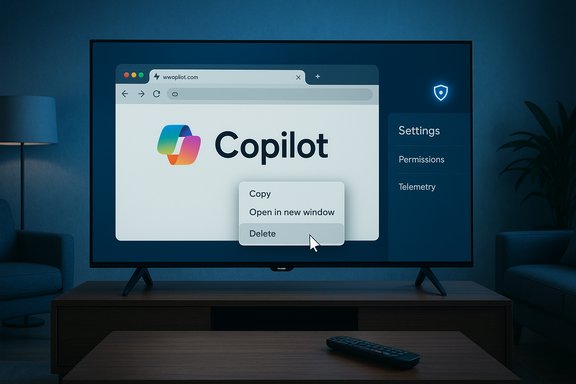
LG’s decision to let owners remove the Microsoft Copilot shortcut from affected webOS smart TVs is a swift, public-facing correction to a rollout that exposed longtime tensions between device ownership, firmware updates, and the push to bake generative AI into everyday appliances.
LG and Microsoft publicly signaled a collaboration to surface Copilot — Microsoft’s conversational AI assistant — on television platforms as part of an “AI TV” strategy showcased earlier in the year. The stated goal was to make discovery, search, and recommendations easier on large screens by giving users a direct entry point to conversational assistance. In mid‑December, a routine webOS firmware update placed a visible Copilot tile on many LG TVs’ home screens. Owners discovered that the tile could be hidden but not deleted through the TV’s normal app management UI; in some reported cases a factory reset restored the tile, indicating the component may have been deployed as a privileged or firmware‑baked asset rather than a removable content‑store app. This realization provoked widespread user backlash — most visibly on Reddit where a single r/mildlyinfuriating post rapidly amplified into thousands of upvotes and media coverage. LG subsequently clarified to the press that the Copilot entry functions as a browser shortcut that opens Microsoft’s Copilot web interface in the TV’s built‑in browser (not as a native, always‑listening system app), and that microphone input is activated only with explicit user permission. The company pledged to “take steps to allow users to delete the shortcut icon if they so desire,” though initial public statements did not include a detailed timeline.
Source: Technobezz LG will let TV owners remove Microsoft Copilot shortcuts after backlash
 Background
LG and Microsoft publicly signaled a collaboration to surface Copilot — Microsoft’s conversational AI assistant — on television platforms as part of an “AI TV” strategy showcased earlier in the year. The stated goal was to make discovery, search, and recommendations easier on large screens by giving users a direct entry point to conversational assistance. In mid‑December, a routine webOS firmware update placed a visible Copilot tile on many LG TVs’ home screens. Owners discovered that the tile could be hidden but not deleted through the TV’s normal app management UI; in some reported cases a factory reset restored the tile, indicating the component may have been deployed as a privileged or firmware‑baked asset rather than a removable content‑store app. This realization provoked widespread user backlash — most visibly on Reddit where a single r/mildlyinfuriating post rapidly amplified into thousands of upvotes and media coverage. LG subsequently clarified to the press that the Copilot entry functions as a browser shortcut that opens Microsoft’s Copilot web interface in the TV’s built‑in browser (not as a native, always‑listening system app), and that microphone input is activated only with explicit user permission. The company pledged to “take steps to allow users to delete the shortcut icon if they so desire,” though initial public statements did not include a detailed timeline. What actually shipped — technical anatomy
Browser shortcut vs. native app
LG’s official characterization is important: the Copilot tile appears to be a web shortcut that launches Copilot in the onboard browser rather than a fully integrated webOS application. That packaging choice explains two things: it’s technically lightweight and fast to roll out, and it does not, by itself, require low‑level OS hooks or persistent background services. However, because webOS treated the tile as a privileged home‑screen asset in the update, users lacked the usual uninstall affordance. Why that distinction matters:- Native apps are typically sandboxed, installed via the content store, and removable by users.
- System or firmware‑baked assets can be hidden but not removed from standard UI workflows and may reappear after factory resets.
- A browser shortcut that’s pinned as a system tile still occupies the same real estate as streaming apps and behaves like preinstalled software from a user’s perspective.
The rollout mechanics and user experience
Reports from multiple outlets and community investigations showed a consistent pattern: owners installed an over‑the‑air webOS update, rebooted, and found a Copilot tile pinned to the home ribbon. In many cases the TV’s Edit/App Manager offered only Hide or Disable, not Delete. Several owners who performed factory resets saw the tile return, a classic signal that the tile was included in the system image provisioned by the update. Those reproducible observations are the empirical core of the controversy.The public reaction and swift correction
Viral ignition
The story gained mainstream visibility because a single Reddit post showing a Copilot tile labeled “cannot be deleted” amassed huge attention and became a focal point for broader resentment about preinstalled bloat, advertising, and opaque telemetry in smart TVs. That viral pressure prompted accelerated coverage from outlets including The Verge, Ars Technica, Tom’s Hardware and PCWorld.LG’s response
Within days LG told reporters it “respects consumer choice” and would add a deletion option for the Copilot shortcut in a forthcoming webOS update, while reiterating that microphone features are only activated with explicit user consent. The statement reframed the issue from “a secret always‑on assistant baked into my TV” to “a pinned web shortcut that will become removable.” That public concession is the central outcome: LG publicly committed to restore a degree of agency that users felt had been removed.Why this mattered: privacy, control, and trust
Ownership vs. platform control
Smart TVs are durable goods purchased and used for many years, yet they now receive frequent firmware updates that can materially alter how the device looks and what data it collects. When a vendor uses those updates to pin third‑party services to the home screen without a durable deletion mechanism, it collides with a widespread user expectation: purchased hardware should not be turned into a persistent distribution channel for partner services without an easy opt‑out. The Copilot episode is a textbook example of that tension.Privacy and telemetry questions
Even if the Copilot tile only launches a web page, legitimate questions remain about data flows:- What telemetry is collected during Copilot sessions from the TV (device identifiers, ACR/context signals, viewing metadata)?
- Are Copilot sessions linked to a user account by default, and how long are transcripts or queries retained?
- Does the TV associate on‑device personalization signals (for example, Live Plus/ACR data) with Copilot usage for ad or recommendation monetization?
Industry context: why OEMs and platform partners do this
Manufacturers have clear incentives to maximize the visibility and adoption of partner services. Pinning shortcuts and default tiles:- Improves discoverability and short‑term adoption metrics for partners.
- Creates a visible “AI TV” differentiator in marketing materials.
- Potentially increases the value of personalization/advertising systems by surfacing additional interaction signals.
What LG should (and must) do next
The company’s pledge to add a delete option is necessary but not sufficient. A credible remediation should include all of the following:- Publish a clear technical note explaining exactly how the Copilot shortcut was provisioned (system package vs firmware image vs editable home‑screen tile). This should include a definitive model list and per‑region rollout details.
- Ship the deletion option promptly and document the rollout schedule and how it behaves after a factory reset. Owners need assurance it will be a persistent deletion, not a cosmetic hide.
- Publish a privacy and telemetry FAQ that details what data is collected during Copilot use, how long it’s retained, whether device identifiers are linked to Copilot sessions, and how microphone access is gated.
- Default to the most privacy‑protective settings for any shipped AI features (microphone off, no implicit account linkage, granular opt‑ins for personalization).
- Improve update notices and changelogs so customers receive clear, human‑readable information when FOTA changes alter UI assets or add partner services.
Practical advice for affected owners (step‑by‑step)
Until LG delivers the promised deletion update, owners have imperfect but practical mitigations:- Hide the Copilot tile from the launcher using Edit/App Manager options to remove it from daily view.
- In Settings → Privacy (or similar), disable ACR/Live Plus and ad personalization features to reduce on‑screen recognition telemetry.
- Avoid signing in to vendor accounts on the TV if not required, and do not sign in to Copilot from the TV browser if you want to limit account‑linked personalization.
- Use network segmentation: place the TV on a guest Wi‑Fi network or on a separate VLAN to reduce cross‑device linkage; consider router‑level DNS filtering to limit access to endpoints you don’t want the device reaching (be aware this may break features).
- When possible, use an external streaming device (Chromecast/Apple TV/Roku/Fire TV) as your primary interface, disabling the TV’s onboard smart features if vendor defaults are unacceptable.
Broader regulatory and competitive implications
Regulatory pressure is increasing
Regulators in multiple jurisdictions have already scrutinized smart‑TV telemetry, automatic content recognition (ACR), and disclosure practices. The Copilot tile incident raises two regulatory axes:- Consumer protection: adding system‑level features post‑sale without clear uninstall or opt‑out mechanisms can be framed as an unfair practice.
- Privacy: undisclosed telemetry aggregation or account linking could fall afoul of data protection rules depending on the jurisdiction.
Competition and user sentiment
If OEMs insist on pushing default tiles and hard‑to‑remove integrations, a product differentiation path will emerge:- Privacy‑first players (or third‑party external streamers) will emphasize user control and predictable behavior.
- OEMs that preserve choice will reduce churn and brand friction; those that don’t will face amplified negative sentiment on forums and social platforms, which can affect buying decisions in a thin‑margin, high‑volume market.
Strengths and risks of the Copilot‑on‑TV strategy
Strengths
- Rapid deployment: Pinning a web shortcut is quick to roll out and allows OEMs to market AI capabilities without deep platform integration.
- Discoverability: A home‑screen tile increases the probability of first‑time use, which is critical for feature adoption in consumer devices.
- Low engineering cost: A web wrapper reduces the need for long native development cycles and simplifies cross‑platform parity.
Risks
- Perception of bloatware: If a feature can’t be removed easily, users view it as intrusive preinstalled software, harming trust.
- Privacy concerns: Even web‑based experiences can collect telemetry and potentially be linked to device identifiers or vendor personalization engines.
- Regulatory exposure: Repeated nontransparent behavior raises the risk of regulatory inquiries or consumer‑protection complaints.
- Brand damage: The living room is intimate; forced features that feel coercive can create lasting negative associations with a brand.
Verification, remaining unknowns, and cautionary notes
Several important details remain either model‑specific or unconfirmed publicly:- Exact list of LG models and regions impacted by the initial webOS update and the percentage of owners who received the tile.
- The technical packaging in firmware images for each model (system package vs editable tile) across webOS versions.
- Precise telemetry endpoints and retention policies for Copilot sessions initiated from TVs.
The takeaways for manufacturers and platform designers
- Respect device ownership norms: post‑sale software additions that alter UI or privacy surfaces must include durable, discoverable uninstall/opt‑out flows.
- Publish transparency materials up front: telemetry FAQs, model lists, and clear permissions behavior should accompany any feature rollout that touches microphones, cameras, or ACR systems.
- Use opt‑in by default for sensitive features: the more intimate the device (a living room TV), the higher the bar for default privacy settings.
- Treat user interface real estate as valuable and contested: placing partner tiles on the home screen without consent will generate user backlash and negative word‑of‑mouth, which is costly in brand terms.
Conclusion
LG’s reversal to allow deletion of the Copilot shortcut shows how consumer feedback can rapidly influence product decisions when companies overreach with post‑sale feature rollouts. The technical fix — making a tile deletable — is straightforward, but the deeper issues revealed by the episode are systemic: firmware updates can change device behavior in ways that undermine user agency, and introducing ambient AI into personal spaces without thorough, transparent consent frameworks invites predictable backlash. The best path forward is clear: restore user agency, publish telemetry and packaging details, and default to privacy‑protective settings. Only then will “AI TV” earn the trust it needs to become a genuinely helpful addition to the living room ecosystem.Source: Technobezz LG will let TV owners remove Microsoft Copilot shortcuts after backlash
