

LG’s sudden push of Microsoft Copilot onto millions of webOS televisions — delivered as a system-level tile that many owners could not remove — has ignited a global backlash that reaches far beyond remote controls and home screens.
LG and Microsoft first signaled a broad Copilot-for-TV push during the 2025 product cycle, positioning conversational AI as a core part of the next-generation living‑room experience. The companies framed Copilot as a convenience for deep content discovery, natural-language search, and accessibility features for TV users. That roadmap was publicly discussed at trade events and in product literature, setting expectations that Copilot would be available on 2025 models and integrated into webOS’ expanding AI toolkit.
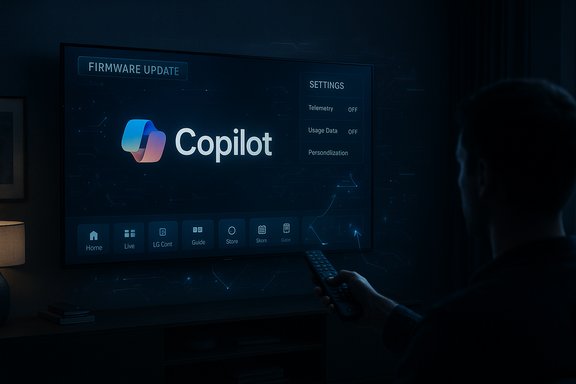
What changed in mid-December 2025 was not the feature but the delivery method. A routine webOS firmware update inserted a visible Copilot tile into many owners’ home ribbons; in numerous reported cases the tile behaved like a preinstalled system component — hideable but not uninstallable. Community reports show the tile often reappeared after factory resets, strongly suggesting privileged packaging or firmware-level inclusion rather than a removable Content Store app. Those observable behaviors are the root of consumer frustration.
Expect the following potential developments over the next 12–24 months:
If AI assistants are to become an accepted part of everyday appliances, their adoption path must be one of consent, performance parity for older hardware, and privacy‑preserving defaults. Otherwise, manufacturers risk pushing users toward “dumb” displays and third‑party streamers as privacy-first alternatives — or toward vendors that explicitly promise removable, auditable software stacks.
For manufacturers and platform partners, the lesson is stern and immediate: ship AI with user agency as the default. For consumers, the episode is a reminder to scrutinize update prompts, privacy toggles, and to consider network-level controls when device autonomy matters. The living room — a private, collective space — will decide whether AI assistants are welcome guests or unwelcome intruders.
Source: FinancialContent https://markets.financialcontent.co...y-microsoft-copilot-integration-on-smart-tvs/
 Background and overview
LG and Microsoft first signaled a broad Copilot-for-TV push during the 2025 product cycle, positioning conversational AI as a core part of the next-generation living‑room experience. The companies framed Copilot as a convenience for deep content discovery, natural-language search, and accessibility features for TV users. That roadmap was publicly discussed at trade events and in product literature, setting expectations that Copilot would be available on 2025 models and integrated into webOS’ expanding AI toolkit.What changed in mid-December 2025 was not the feature but the delivery method. A routine webOS firmware update inserted a visible Copilot tile into many owners’ home ribbons; in numerous reported cases the tile behaved like a preinstalled system component — hideable but not uninstallable. Community reports show the tile often reappeared after factory resets, strongly suggesting privileged packaging or firmware-level inclusion rather than a removable Content Store app. Those observable behaviors are the root of consumer frustration.
Technical anatomy: how Copilot landed on your TV
System tile vs. removable app
The most important technical distinction is how the Copilot entry was packaged. Reports and hands-on examinations by owners and community analysts indicate the Copilot icon often functions as a web shortcut that launches Microsoft’s Copilot web UI inside the TV’s browser shell rather than as a fully native, locally executed application. When that shortcut is provisioned as a system or firmware-baked component, the standard uninstall affordances are removed — leaving only hide or disable options exposed to consumers. Multiple field reports showing tile persistence after factory resets back this pattern.Firmware delivery and the “mandatory” update model
LG distributed the change through routine FOTA (firmware‑over‑the‑air) channels, part of its multi-year update program that extends OS updates to older hardware. While update programs generally offer security and longevity benefits, using the same channel to provision a partner’s system-level shortcut blurs the line between maintenance and feature delivery. Owners who explicitly expected only security patches or bug fixes were surprised to find a brand‑new AI assistant added without an obvious opt‑in. Community testing shows that disabling Auto Update does not always prevent vendor-supplied updates in every configuration, which complicates the end‑user’s ability to avoid the change.Resource and performance implications
On resource-constrained or older sets, running additional background processes or keeping a web-based assistant “hot” can introduce visible UI lag. Early user reports and community testing indicate that older 2022–2023 models sometimes experienced slower navigation and longer app-launch times after the update — a symptom expected when retrofitting resource-intensive cloud interactions onto legacy hardware. These reports are consistent with the engineering trade-offs of adding LLM-backed features to devices not originally designed for them, but they remain user-observed behavior pending formal benchmarking.Privacy, telemetry, and the ownership debate
Why this feels different from past “bloatware”
Preinstalled shortcuts and promotional tiles on smart TVs are not new. What elevates the Copilot episode into a privacy and ownership issue is threefold: the assistant’s potential access to audio input and on‑screen context, its deep placement in the OS where normal uninstall routes are absent, and the perception that the device’s software identity was changed after purchase. For many owners, a TV is not just an app platform; it’s a fixture in a private space. The notion of an unremovable third‑party service embedded into that fixture triggers a stronger reaction than past examples of bundled apps.Automatic Content Recognition (ACR), Live Plus, and telemetry concerns
Smart TVs commonly support Automatic Content Recognition (ACR) systems that index what’s playing on-screen to enable recommendations and targeted advertising. Community reports flagged that some telemetry and personalization toggles (examples include Live Plus–style features) surfaced or were toggled in the settings around the same time as the Copilot rollout. Security researchers and privacy advocates caution that coupling an assistant with ACR and ad‑personalization systems increases profiling surfaces — although definitive, vendor‑authenticated evidence tying Copilot to new telemetry endpoints is not yet publicly published. Until firmware images and network traffic are independently audited, those claims should be considered potential risks supported by user reports rather than established facts.The erosion of device ownership
The controversy illustrates a broader industry pivot: hardware increasingly arrives as a portal for services, and the software experience becomes a monetizable product separate from the original device sale. When manufacturers can alter a device’s interface years after purchase — adding non-removable software and enabling data flows by default — the line between ownership and licensed service becomes blurred. This episode marks a clear consumer-facing moment in that transition.Industry strategy and competition: why Microsoft and LG did this
Microsoft’s distribution win
From Microsoft’s perspective, embedding Copilot onto a major TV vendor’s home ribbon is a distribution victory. It creates a direct path into millions of living rooms and sidesteps the friction of app-store discovery. If Copilot becomes the primary assistant on a platform with significant install base, Microsoft gains influence over how users discover content across streaming services — a structural advantage in the emerging “AI SEO” era where LLM-driven recommendations shape visibility. Multiple trade analyses note that securing such prime placement effectively bypasses typical app-market competition.LG’s strategic gamble
For LG, the partnership with Microsoft is a bid to differentiate hardware in a commoditized TV market by offering an AI-forward UX. The gamble: AI features tied to a recognizable assistant could increase perceived product value and unlock future monetization paths. But the backlash suggests LG underestimated consumer expectations for post-purchase control and for privacy-friendly defaults. The strategic trade-off — platformization for recurring revenue versus preserving brand trust — is now being tested in real time.Competitive ripples
LG’s move will likely ripple across relationships with other ecosystem players, and might prompt competitors to prioritize their preferred assistants. The incident could accelerate vendor lock-in dynamics as OEMs align with particular cloud providers — or it could provoke a market segment that promotes privacy-first or minimalist displays as a counter-appeal. The architecture of content discovery and recommendation will become a battleground where platform-level assistants wield search and placement influence.What’s verified, what’s unverified — and what to treat with caution
- Verified by multiple independent community reports: the Copilot tile appeared on many LG TVs after a webOS update; it frequently lacked a normal uninstall option and could often only be hidden; factory resets in numerous reports restored the tile, implying privileged packaging.
- Vendor statements: LG publicly acknowledged the tile was a web shortcut in many deployments and has committed to providing a true deletion option in a future webOS patch. That commitment was communicated after the backlash but lacked a precise timeline at the time of community reporting.
- Reported but not yet independently verified: specific firmware version identifiers (for example, claims about webOS version 33.22.65 in some summaries) and assertions that telemetry features were automatically toggled to ON by default for all affected devices. These claims come from user reports and secondary articles but lack a formal, published firmware change log from LG confirming the exact version numbers and default toggles; treat them with caution until vendor technical bulletins or firmware image audits confirm them.
Immediate practical advice for affected owners
For owners who value control or privacy, pragmatic stopgaps reduce exposure while vendors issue fixes.- Disable Live Plus / ACR‑style features where present in Settings.
- Decline ad personalization and limit account sign-ins on the TV.
- If necessary, keep the TV offline or restrict it to a segmented network to prevent cloud‑bound telemetry.
- Consider using an external streaming device (a controlled stick or set‑top box) and set the TV to a “display only” mode when possible.
Regulatory and legal horizons
This incident arrives at a moment when regulators are intensifying scrutiny of data practices for consumer IoT and AI products. The convergence of always-available assistants, ACR telemetry, and opaque update mechanics creates a ripe policy target for privacy enforcement and consumer-rights rules.Expect the following potential developments over the next 12–24 months:
- Increased regulatory attention to default settings and opt‑in consent for AI and microphone-enabled features in consumer devices.
- Requests (or requirements) for clearer firmware change logs that disclose when new third‑party services are added and whether they are removable.
- Consumer-protection inquiries into whether firmware updates that materially change device functionality require affirmative consent or prominent notification.
Product design lessons: how not to ship AI into living rooms
The engineering and product lessons are straightforward and painful:- Make consent explicit and persistent. AI features that tap microphones, cameras, or on-screen context must require clear opt‑in, not be delivered silently through maintenance channels.
- Preserve uninstallability. If a third‑party service can be removed, do not bake it into the firmware image or mark it permanently as a privileged package unless absolutely necessary — and if you do, document why and give users an override.
- Fail gracefully on older hardware. When retrofitting AI experiences to legacy devices, provide a “lite” or cloud‑borne alternative that does not hamper UI performance, and clearly label any model‑specific limitations.
- Be transparent about data flows. Publish machine-readable, easily discoverable privacy disclosures that explain exactly which endpoints are contacted and what categories of telemetry are collected when a user interacts with the assistant.
The broader significance: a turning point for consumer AI
This episode is less a technical showcase than a distribution milestone with cultural consequences. The Copilot integration is impressive in capability but controversial in method. It shines a spotlight on a new industry fault line: manufacturers racing to turn devices into persistent platforms for cloud AI versus consumers who want devices that remain under their control.If AI assistants are to become an accepted part of everyday appliances, their adoption path must be one of consent, performance parity for older hardware, and privacy‑preserving defaults. Otherwise, manufacturers risk pushing users toward “dumb” displays and third‑party streamers as privacy-first alternatives — or toward vendors that explicitly promise removable, auditable software stacks.
What to watch next
- LG’s promised patch that allows true deletion of the Copilot tile: monitor official webOS update notes and staged OTA rollouts for explicit uninstall instructions.
- Independent technical audits: firmware image and network‑traffic analyses that can confirm whether new telemetry endpoints or microphone behaviors were introduced. Until such audits are public, telemetry claims remain user-reported risks.
- Competitor responses: whether rival OEMs will change their own AI rollouts to emphasize opt‑in flows or harden platform policies about post‑sale software changes.
Conclusion
The Copilot-on-LG controversy crystallizes a central paradox of the AI era: the technology’s potential to materially improve everyday devices is real, but the path to adoption is as important as the end feature. A quietly pushed, non-removable system tile may score short-term engagement wins, but it damages long-term brand trust and invites regulatory scrutiny.For manufacturers and platform partners, the lesson is stern and immediate: ship AI with user agency as the default. For consumers, the episode is a reminder to scrutinize update prompts, privacy toggles, and to consider network-level controls when device autonomy matters. The living room — a private, collective space — will decide whether AI assistants are welcome guests or unwelcome intruders.
Source: FinancialContent https://markets.financialcontent.co...y-microsoft-copilot-integration-on-smart-tvs/
