

LG’s new Micro RGB evo arrives as a deliberate challenge to the status quo in high-end TVs: an LCD-based flagship that borrows OLED control philosophies, packs RGB sub‑pixel illumination at microscopic scale, and layers advanced AI across image processing and the smart-TV interface. The company says the MRGB95 series — arriving in 75‑, 86‑ and 100‑inch sizes — brings the widest color reproduction yet for an LG LCD, backed by Intertek verification and a CES 2026 Innovation Award for the 100‑inch model.
LG’s release stresses that the Micro RGB evo uses the company’s smallest individual RGB LEDs and applies OLED‑grade driving and control logic to those LEDs — essentially bringing 13 years of OLED control experience to an RGB‑backlit LCD. That’s an important distinction: Micro RGB is still an LCD stack (polarizers, liquid crystal layer, colour filters) but with radically different backlight behavior. LG frames that as the path to higher color volume and more faithful color reproduction. Caveat: the precise LED pitch (microns), the number of RGB elements per inch, and the LED addressing architecture are not specified in LG’s public brief. Those are technical details that independent labs or hands‑on teardowns will need to confirm.
The Micro RGB evo will be on display at LG’s CES booth; the show will be the first public chance to judge whether LG’s combo of Micro RGB hardware and the α11 Gen 3 AI pipeline amounts to a practical step forward — or a compelling set of vendor claims awaiting validation.
Key technical claims and verification citations: LG press materials and multiple independent reports confirm the product launch, Intertek color certification, α11 Gen 3 processor claims, 1,000+ dimming zones and Copilot/Gemini Multi‑AI integration as reported in LG’s announcement and industry coverage.
Source: ChannelLife Australia https://channellife.com.au/story/lg-unveils-micro-rgb-evo-flagship-tv-with-ai-at-ces/
 Background
Why Micro RGB matters now
For the last decade the premium‑TV arms race split into two tracks: OLED for pixel‑level emissive blacks and LCD variants (MiniLED, QNED) pushing peak brightness and local dimming. Micro RGB shifts that balance by using ultra‑small individual red, green and blue LEDs in the backlight instead of a white/blue LED + quantum‑dot filter architecture. The theoretical advantage is straightforward: direct RGB backlighting can control color and brightness at a far finer granularity than a single‑color backlight with color filters, improving saturated color volume, peak highlights and the precision of local contrast when driven correctly. LG positions the Micro RGB evo as a successor-class LCD that applies OLED control techniques to these tiny RGB LEDs.What LG announced
LG’s official brief for the Micro RGB evo (model family MRGB95) lists the following headline claims:- Micro RGB backlight using LG’s smallest RGB LEDs and OLED‑style control.
- α (Alpha) 11 AI Processor Gen 3 with a Dual AI Engine and Dual Super Upscaling that runs two AI upscalers in parallel.
- RGB Primary Colour Ultra with Intertek certification for 100% coverage of BT.2020, DCI‑P3 and Adobe RGB.
- Micro Dimming Ultra controlling more than a thousand independent local dimming zones.
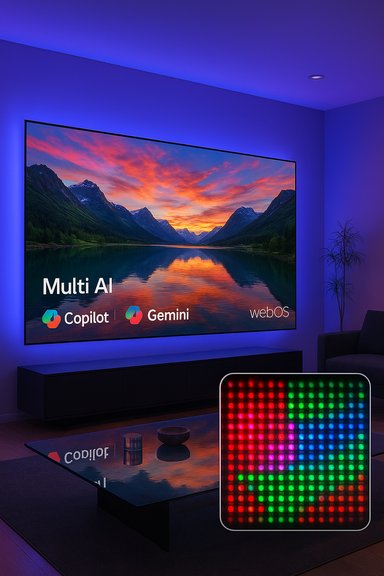
- Deep webOS integration of AI features described as a Multi‑AI environment — including Microsoft Copilot and Google Gemini — plus Voice ID, AI Picture/Sound Wizard, AI Concierge and other personalization layers.
- A 100‑inch MRGB95B winning a CES 2026 Innovation Award.
Technical deep dive: display architecture and picture pipeline
What “Micro RGB” means in practice
Micro RGB replaces the conventional single‑color (usually white or blue) LED backlight + color filter stack with arrays of microscopic red, green and blue LEDs. When those LEDs are sufficiently small and dense, they allow per‑subpixel or near‑subpixel level control of light and colour, rather than the coarser control of white backlights with hundreds or thousands of zonal dimming regions.LG’s release stresses that the Micro RGB evo uses the company’s smallest individual RGB LEDs and applies OLED‑grade driving and control logic to those LEDs — essentially bringing 13 years of OLED control experience to an RGB‑backlit LCD. That’s an important distinction: Micro RGB is still an LCD stack (polarizers, liquid crystal layer, colour filters) but with radically different backlight behavior. LG frames that as the path to higher color volume and more faithful color reproduction. Caveat: the precise LED pitch (microns), the number of RGB elements per inch, and the LED addressing architecture are not specified in LG’s public brief. Those are technical details that independent labs or hands‑on teardowns will need to confirm.
Color gamut and the Intertek certification
LG says the Micro RGB evo achieves 100% coverage of BT.2020, DCI‑P3 and Adobe RGB, and that Intertek has certified those results. Intertek certification is a meaningful independent verification step — it indicates testing against standardized measurement procedures rather than strictly vendor self‑testing. Multiple trade outlets and analysts picked up the Intertek note in LG’s announcement. Important context for readers: BT.2020 is an extremely wide color container rarely filled entirely by consumer displays. Full BT.2020 coverage is a headline‑grabbing metric, but the practical value depends on content encoded with that gamut and on accurate tone mapping. Most mainstream HDR content today targets DCI‑P3 or narrower profiles; BT.2020 is more of a forward‑looking reservoir for future workflows and next‑generation content. Treat the 100% figure as an indication of potential color volume rather than an immediate real‑world magic bullet. LG’s Intertek certification, however, does add credibility that the panel/backlight combination can produce a very wide reproducible color set.Local dimming and contrast: “Micro Dimming Ultra”
LG claims Micro Dimming Ultra manages more than a thousand independent dimming zones. That level of addressability, combined with RGB LEDs, should reduce classic MiniLED haloing and improve highlight control because the system can tune color and brightness more locally. Early reporting confirms the >1,000 zones phrasing in the PR coverage. Remaining questions for reviewers:- How effective is zone edge suppression (is there visible blooming around small bright objects on dark backgrounds)?
- How does the system handle mixed scenes with many simultaneous highlights (stadiums, cityscapes)?
- How tightly coupled are the per‑zone RGB intensity controls with the LCD panel’s subpixel filtering — i.e., is there any color fringing?
The α11 AI Processor Gen 3: Dual AI Engine and Dual Super Upscaling
LG is positioning the α11 (Alpha) 11 AI Processor Gen 3 as the computational heart of the Micro RGB evo. Key claims:- Dual AI Engine architecture.
- Dual Super Upscaling, which runs two types of AI upscalers simultaneously to improve sharpness while retaining natural appearance.
- Upscaling fidelity across low‑bitrate streaming, broadcast and upconverted SDR to HDR workflows.
- Temporal stability (are there hallucinations or motion artifacts when the AI switches filters?.
- How the AI pipeline interacts with HDR metadata (Dolby Vision, HDR10+) and scene‑by‑scene tone mapping.
Software and AI: Multi‑AI, webOS and the smart experience
Multi‑AI: Copilot, Gemini and webOS integration
LG describes a Multi‑AI environment that integrates Microsoft Copilot and Google Gemini alongside LG’s own AI services. The Micro RGB evo runs webOS and adds personalized features:- Voice ID for per‑user profiles
- AI Picture Wizard and AI Sound Wizard for automated optimization
- AI Concierge, AI Chatbot and AI Search to surface contextual content information
- A customizable My Page home screen
Practical benefits — and limits
- The integration of Copilot and Gemini could make on‑screen search and contextual information richer (actor lookups, scene metadata, recipe extraction from cooking shows).
- Voice ID and profile switching are useful for households, and AI Picture/Sound Wizards can reduce the friction of achieving a good default image and sound profile.
- AI upselling and features are only as good as the UI and latency; slow responses or poor UX will sunken perceived value.
- Model privacy, data routing and cloud vs. on‑device inference are key questions LG must answer in documentation and firmware behavior (e.g., is voice data sent to third‑party servers? Is Gemini used via cloud calls?. LG’s announcement is explicit about Multi‑AI inclusion but limited on data‑handling specifics. That’s a point where buyers and privacy‑minded users should seek detail.
Positioning and product roadmap
Sizes and place in LG’s lineup
LG will ship the Micro RGB evo MRGB95 in 75‑, 86‑ and 100‑inch sizes. The 100‑inch MRGB95B earned a CES 2026 Innovation Award, and LG frames the new range alongside its OLED and QNED (MiniLED/QNED) lines, giving customers a three‑way choice across emissive, MiniLED and Micro RGB LCD technologies.Target customer
LG is clearly aiming at two overlapping groups:- High‑end home cinema buyers and prosumers who value color fidelity and want a display that approaches professional monitor behavior while staying in a large‑screen, living‑room form factor.
- Tech‑forward consumers who prize AI features and a personalized TV experience (Copilot/Gemini, voice interactions, curated home screens).
Critical analysis: strengths, opportunities and potential risks
Notable strengths
- Broad independent verification of the color claim: Intertek certification for 100% coverage of BT.2020, DCI‑P3 and Adobe RGB is a strong signal that LG’s hardware can generate very wide gamut volumes. That’s rare for consumer LCDs and gives the Micro RGB evo a credible technical headline.
- Architecture convergence: Borrowing OLED control techniques and pairing them with micro‑scale RGB LEDs and a powerful AI processor is a sensible convergence that could deliver the best aspects of both LCD and OLED (peak brightness + color volume + improved local contrast).
- Processing horsepower: The α11 Gen 3’s Dual AI Engine and Dual Super Upscaling reflect an industry‑correct move to modular, specialized neural nets for different image tasks rather than monolithic heuristics. That should allow better per‑scene behavior when done well.
- Smart ecosystem flexibility: Multi‑AI with Copilot and Gemini — if implemented with clear UX and privacy controls — could make the TV a genuinely useful conversational surface and content companion beyond basic voice search.
Key risks and open questions
- Vendor claims vs. measured performance: Metrics like “100% BT.2020” and “more than a thousand dimming zones” are measurable, but the true user experience depends on tuning: halo artifacts, tone mapping, and color consistency across brightness levels are the decisive factors. Independent lab tests will be required. LG’s Intertek certification mitigates the color‑gamut skepticism but doesn’t eliminate the need for real‑scene HDR measurements.
- Practicality of BT.2020 today: Very little consumer content fully exploits BT.2020. For most viewers, the immediate benefit is richer DCI‑P3 reproduction and improved HDR highlights rather than dramatic day‑to‑day differences. The metric is future‑proofing more than instant payoff.
- AI privacy and data flows: Integrating multiple third‑party AI providers introduces complexity around where data is sent and how long it’s retained. LG needs to publish clear, accessible privacy controls and allow opt‑outs or local inference options. The PR mentions Multi‑AI but not data‑handling specifics.
- Cost, size and market reach: The Micro RGB evo line focuses on very large screen sizes (75–100 inches), which confines the audience and likely the price bracket. This will be a premium, niche segment initially; trickle‑down to smaller, more affordable sizes will dictate wider adoption.
- HDR standard fragmentation: As HDR formats continue to evolve (HDR10+, Dolby Vision 2, vendor proprietary tone mapping), how LG’s pipeline interacts with creative intent matters. Excessive AI tone mapping could stray from a filmmaker’s intent if not well‑controlled by user presets or Filmmaker Mode‑like options.
How to evaluate the Micro RGB evo at CES and after launch
What to test on the show floor
- Look for measured demonstrations showing reference color patches and HDR tone‑mapping behavior across real scenes.
- Test for blooming/halo artifacts around small bright highlights on dark backgrounds (e.g., star fields, specular highlights).
- Compare upscaling behavior on low‑bitrate streaming and broadcast content; watch for temporal artifacts.
- Ask about calibration modes and hardware controls: does the panel expose calibration targets for 3D LUTs, and can professional tools be used?
Post‑purchase checklist for buyers
- Confirm firmware features and privacy settings: can AI services be disabled? Where is voice data processed?
- Request an independent calibration report or hire a calibrator if you plan to use the TV as a semi‑professional monitor.
- Compare HDR behavior across platforms (Netflix, Prime Video, Ultra HD Blu‑ray) and check for consistent tone‑mapping.
- Monitor LG’s software support plan: ongoing AI features depend on software updates and model improvements.
Where this fits in the market and the near future
Micro RGB is not an incremental step — it’s a pivot in how high‑end LCDs are engineered and controlled. LG’s Micro RGB evo joins similar moves by other vendors who are racing to bring RGB backlighting down to sub‑100‑micron scales and pair it with advanced per‑zone driving. Early press indicates Samsung and other makers are pursuing likewise strategies for 2026 displays, suggesting the market will see a flurry of Micro RGB options and head‑to‑head demos at CES. If the Micro RGB evo fulfills its promise in objective lab measurements and real‑world viewing, it will close much of the gap between LCD brightness/color advantages and OLED’s contrast control — producing a third, hybrid flagship category that is neither traditional LCD nor pure OLED.Final assessment
LG’s Micro RGB evo is an ambitious product that deliberately targets the intersection of highest possible color fidelity and next‑generation smart TV intelligence. The Intertek verification of wide color coverage, the CES 2026 Innovation Award and corroborating industry coverage lend weight to LG’s claims. Yet the real story will be in independent measurements, firmware tuning and how LG handles privacy and AI orchestration in day‑to‑day use. For buyers who prioritize color accuracy, professional‑aware workflows, or want a living‑room display capable of future‑proof wide‑gamut playback, the Micro RGB evo deserves serious attention once lab reviews are available. For mainstream buyers, the technology is promising but currently positioned in a premium bracket — waiting for independent tests and smaller (more affordable) sizes could be the prudent path.The Micro RGB evo will be on display at LG’s CES booth; the show will be the first public chance to judge whether LG’s combo of Micro RGB hardware and the α11 Gen 3 AI pipeline amounts to a practical step forward — or a compelling set of vendor claims awaiting validation.
Key technical claims and verification citations: LG press materials and multiple independent reports confirm the product launch, Intertek color certification, α11 Gen 3 processor claims, 1,000+ dimming zones and Copilot/Gemini Multi‑AI integration as reported in LG’s announcement and industry coverage.
Source: ChannelLife Australia https://channellife.com.au/story/lg-unveils-micro-rgb-evo-flagship-tv-with-ai-at-ces/
