

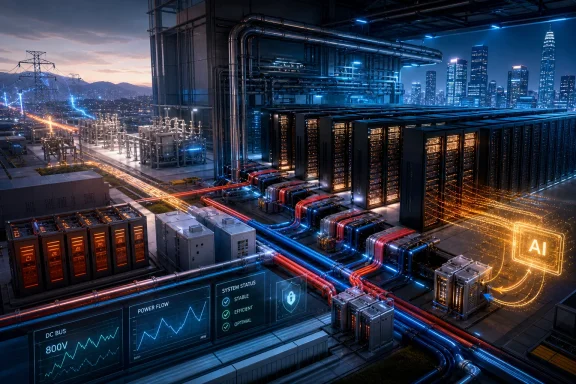
LG Uplus and LS Electric are joining forces to develop and validate a new generation of power infrastructure for artificial intelligence data centers, targeting the demanding electrical architecture behind NVIDIA’s Vera Rubin platform. The South Korean companies plan to test and standardize an 800-volt direct-current distribution system, combining LG Uplus’s operational data-center experience with LS Electric’s power-conversion, distribution, monitoring, and diagnostic technologies. The agreement matters far beyond one vendor partnership: it reflects a fundamental shift in which electricity, cooling, and facility control are becoming as decisive to AI performance as GPUs, networking, and software.
LG Uplus and LS Electric signed their memorandum of understanding on July 21, 2026, at the LS Yongsan Tower in Seoul. Senior executives from both companies attended, including LS Electric Chairman Koo Ja-kyun, LS Electric Chief Executive Chae Dae-seok, LG Uplus Chief Executive Hong Beom-sik, and LG Uplus enterprise division head Kwon Yong-hyun.
Under the agreement, the companies will jointly develop, demonstrate, and pursue standardization of 800V DC power infrastructure intended for next-generation AI data centers. LG Uplus will contribute real operational power data and provide a proof-of-concept environment, while LS Electric will develop the corresponding DC power systems and supply data-analysis and diagnostic capabilities.
That transition also changes the engineering challenge. Traditional colocation facilities were designed primarily around general-purpose servers, storage arrays, and network equipment with comparatively predictable rack densities. AI factories built around tightly integrated accelerator clusters impose much higher and more variable electrical loads.
The company’s ambition is to provide an integrated electrical stack spanning high-voltage grid connections, medium-voltage distribution, low-voltage equipment, DC delivery, operational analytics, and fault diagnosis. Such end-to-end integration could become particularly valuable as AI facilities move away from conventional, heavily segmented power chains.
A Vera Rubin NVL72 rack combines 72 Rubin GPUs and 36 Vera CPUs, connected through NVIDIA’s sixth-generation NVLink fabric. The broader platform also includes ConnectX-9 network adapters, BlueField-4 data-processing units, Spectrum-6 Ethernet, specialized storage infrastructure, and additional inference systems.
AI infrastructure reverses that model. The meaningful unit of compute is increasingly the entire rack, a group of racks, or even a complete data hall. If one portion of the electrical, thermal, or network architecture cannot keep up, expensive accelerators may sit idle despite being technically operational.
This is why NVIDIA describes the modern AI data center as an “AI factory.” Its output is not a physical product but trained models, generated tokens, completed inference requests, and automated decisions. The relevant efficiency metric is therefore no longer merely watts per server; it is useful AI work per megawatt.
They also create complex power profiles. Different phases may stress GPU arithmetic, high-bandwidth memory, CPUs, storage, or networking at different times. Rapid changes in utilization can produce short-lived peaks and valleys that complicate facility provisioning.
Each stage adds equipment, heat, space requirements, maintenance obligations, and some degree of conversion loss. The exact topology differs by facility, but the underlying problem remains: moving enormous amounts of power at relatively low voltage requires high current and substantial conductors.
That relationship matters because resistive losses rise with the square of the current. Lower current can therefore reduce heat in conductors, improve distribution efficiency, and permit more manageable cable or busway designs. An 800V DC architecture can move power closer to high-density racks without requiring the same current levels that a lower-voltage system would impose.
The potential advantages include:
Removing one conversion stage may simply move the conversion elsewhere. Likewise, an architecture optimized for full-capacity AI workloads may perform differently when utilization is low or highly variable. This is precisely why the LG Uplus proof-of-concept environment is important: laboratory specifications must be tested against actual operating conditions.
This division could shorten the distance between product development and deployment. Instead of developing components around theoretical rack behavior, LS Electric can evaluate how power demand changes across real workloads, maintenance events, thermal conditions, and redundancy scenarios.
The operator will also support a technical proof-of-concept environment for validating the next-generation DC solution. A useful trial will need to evaluate more than whether power reaches a rack. It should establish how the complete architecture behaves during both normal and abnormal conditions.
Key test scenarios are likely to include:
That software component deserves attention. As electrical systems become more dynamic, operators need visibility into conversion efficiency, bus conditions, component temperatures, fault currents, harmonic behavior, battery state, and rack-level demand. A technically efficient system can still be operationally weak if technicians cannot determine why it is behaving unexpectedly.
If a facility must provision every component for the theoretical coincidence of all peaks, it can strand a substantial portion of installed capacity. The building may have unused average power while being unable to add more accelerators because short-duration peaks could exceed electrical limits.
The concept resembles traffic shaping for a network. Rather than building every road for a momentary surge, the system buffers and regulates flow so that existing capacity carries more useful work.
NVIDIA says its Vera Rubin power supplies can reduce short-duration peaks and lower average consumption compared with earlier smoothing approaches. It also claims that broader power-management technology can allow operators to install significantly more GPUs within a fixed megawatt budget, depending on the chosen operating point and workload.
LS Electric’s opportunity is to connect rack behavior with switchgear, converters, batteries, protection systems, and grid-facing equipment. If the facility understands both IT schedules and electrical constraints, it can prevent avoidable peaks instead of merely reacting to them.
The most advanced implementation would link several control layers:
An 800V system also contains enough energy to demand strict equipment design, insulation, interlocking, personal protective procedures, and fault containment. The transition cannot succeed through efficiency gains alone; operators must be confident that technicians can install, inspect, isolate, and replace components safely.
This requires careful coordination among breakers, fuses, solid-state protection devices, converters, and control systems. Protection must be selective: the device nearest the fault should operate first, preserving service to unaffected sections.
AI data centers make selectivity especially important because a broad shutdown can interrupt thousands of interconnected accelerators. Losing one rack is costly, but an improperly coordinated trip that disconnects an entire pod may waste a long-running training job or disrupt customer-facing inference services.
A system that performs well in simulation but requires excessive downtime for routine maintenance will struggle commercially. Serviceability must therefore become a first-class design requirement, especially as AI facilities pursue continuous operation and tighter maintenance windows.
LG Uplus can provide valuable feedback here. Its technicians and operations teams can test whether the proposed architecture fits established workflows or requires entirely new training, staffing, and emergency-response procedures.
The AI data-center market is evolving so quickly that operators risk ending up with incompatible connectors, voltage ranges, communication protocols, telemetry formats, protection schemes, and service procedures. Fragmentation would raise costs and make customers more dependent on proprietary supply chains.
A useful 800V DC standard must account for that mixed environment. It should define interfaces clearly enough that power equipment, racks, monitoring systems, and protection devices from multiple suppliers can interoperate.
Areas requiring agreement include:
If LG Uplus and LS Electric can establish a repeatable design, they could pursue deployments beyond the domestic market. LS Electric has already emphasized ambitions in global and North American data-center power infrastructure, where grid access and equipment lead times have become major constraints on AI expansion.
However, international adoption would require compliance with local safety codes, certification regimes, utility requirements, and construction practices. A Korean proof of concept can establish technical credibility, but commercialization abroad will require extensive regional engineering.
Even so, the partnership could affect enterprise customers indirectly. LG Uplus may use the resulting infrastructure to deliver hosted GPU capacity, private AI platforms, managed inference, sovereign data services, and high-performance connectivity.
A more efficient facility can potentially support more accelerators within the same grid allocation. That may improve availability and reduce some infrastructure cost per unit of AI output, although GPU demand, financing, software licensing, and utilization will continue to influence pricing.
Businesses considering hosted AI infrastructure should evaluate:
Organizations may use Windows 11 workstations to develop applications that consume models hosted in an LG Uplus facility. They may also connect AI services to Microsoft 365, SQL Server, .NET applications, security information systems, and Windows-based line-of-business software.
The electrical architecture will remain invisible to most users, yet it can still shape application reliability and cost. If improved power delivery allows the provider to add more GPU capacity or avoid outages, Windows-based clients and business applications benefit without needing to understand the underlying DC system.
Developers may notice changes sooner. More efficient infrastructure can make long-context reasoning, coding agents, media generation, and tool-using services more practical at scale.
Providers may use efficiency gains to run larger models, support longer contexts, improve response speed, or increase margins. Strong demand can also keep prices elevated even when the cost per unit of computation falls.
The more likely near-term outcome is more capability at a similar price point, rather than a dramatic reduction in consumer AI subscription costs. Over time, competition among cloud and telecom providers could force more of the efficiency benefit through to customers.
Developers will need telemetry that connects application behavior to token consumption, latency, accelerator utilization, and potentially energy use. Facility-level efficiency is valuable, but poorly designed software can erase those gains by performing unnecessary reasoning steps or repeatedly invoking expensive models.
LS Electric, meanwhile, is competing in a market that includes major global electrical and industrial-automation suppliers. These companies are racing to provide reference designs, high-voltage equipment, liquid-cooling integration, energy storage, and software for AI facilities.
This changes the strategic balance. A provider with secured power and a validated deployment architecture may bring AI capacity online faster than a rival that has ordered more GPUs but lacks an energized building.
LG Uplus can potentially differentiate itself by demonstrating that it understands both telecom-grade availability and AI-specific electrical behavior. LS Electric can differentiate itself by proving that its equipment works under the rapid, high-density load patterns of modern accelerator clusters rather than only meeting static nameplate requirements.
Retrofitting may be technically possible but commercially unattractive if it requires extended downtime or sacrifices too much floor space. Purpose-built AI facilities can instead optimize the building around rack-scale computing from the beginning.
The LG Uplus-LS Electric project could therefore produce two classes of solution: a full 800V design for new construction and a transitional architecture for facilities that must support both legacy AC equipment and next-generation DC racks.
This rebound effect is already visible across the AI industry. Better accelerators reduce the energy required for a given operation, but expanding model sizes, longer reasoning chains, and larger user populations can increase total demand.
A facility can improve GPU efficiency while wasting energy through oversized cooling equipment or lightly utilized servers. Conversely, a slightly less efficient accelerator may produce better overall results if software keeps it consistently utilized.
The partnership’s access to real operational data should support a more realistic evaluation. Useful measurements would include:
Such flexibility could help utilities accommodate large AI loads, but only if operators expose meaningful control and commit to operating within agreed limits. Otherwise, ever-larger campuses may strain local generation and transmission capacity despite improvements inside the building.
Authentication, network segmentation, signed firmware, secure updates, tamper-resistant logs, and controlled administrative access must be built into the platform. A sophisticated power system should not create a new route through which attackers can disrupt an AI facility.
Observers should look for several concrete developments:
A reference design would allow customers to compare the proposed system with conventional AC alternatives. Without that detail, efficiency claims will remain difficult to evaluate.
Independent validation would strengthen confidence, particularly for safety and interoperability. Large customers will want evidence that the architecture can operate reliably for years, not merely survive a short demonstration.
The most valuable outcome would be an interface that supports multiple rack vendors, converters, protection systems, and management platforms. Open specifications would reduce customer risk and encourage suppliers to compete on quality rather than incompatibility.
It will also be important to see whether the companies target greenfield campuses or retrofits. Greenfield deployment is technically cleaner, while retrofit capability could address a much larger installed base.
For Windows-oriented enterprises consuming hosted AI services, this integration could ultimately matter more than the voltage itself. Better coordination between applications and infrastructure could improve service-level consistency, reduce failed workloads, and provide more transparent cost and energy reporting.
The LG Uplus and LS Electric partnership shows that the next phase of AI competition will be decided not only by who can obtain the newest accelerators, but by who can power, cool, protect, monitor, and operate them at scale. If the companies can turn 800V DC distribution from an engineering proposal into a safe, interoperable, and commercially repeatable platform, South Korea could gain an important position in the infrastructure layer beneath the global AI economy. The decisive evidence will come from the proof of concept: real workloads, real faults, real maintenance, and real measurements of how efficiently Vera Rubin can convert constrained megawatts into useful intelligence.
 Background
LG Uplus and LS Electric signed their memorandum of understanding on July 21, 2026, at the LS Yongsan Tower in Seoul. Senior executives from both companies attended, including LS Electric Chairman Koo Ja-kyun, LS Electric Chief Executive Chae Dae-seok, LG Uplus Chief Executive Hong Beom-sik, and LG Uplus enterprise division head Kwon Yong-hyun.Under the agreement, the companies will jointly develop, demonstrate, and pursue standardization of 800V DC power infrastructure intended for next-generation AI data centers. LG Uplus will contribute real operational power data and provide a proof-of-concept environment, while LS Electric will develop the corresponding DC power systems and supply data-analysis and diagnostic capabilities.
From telecom operator to AI infrastructure provider
LG Uplus is best known as one of South Korea’s major telecommunications operators, but telecom companies increasingly view data centers, cloud connectivity, managed infrastructure, and AI hosting as strategic enterprise businesses. Their networks, facilities, operations teams, and established corporate customer relationships provide a foundation from which to offer more specialized AI data-center services.That transition also changes the engineering challenge. Traditional colocation facilities were designed primarily around general-purpose servers, storage arrays, and network equipment with comparatively predictable rack densities. AI factories built around tightly integrated accelerator clusters impose much higher and more variable electrical loads.
LS Electric’s role in the partnership
LS Electric brings experience across switchgear, transformers, power management, automation, protection, and electrical distribution. Its contribution will therefore extend beyond supplying a single converter or cabinet.The company’s ambition is to provide an integrated electrical stack spanning high-voltage grid connections, medium-voltage distribution, low-voltage equipment, DC delivery, operational analytics, and fault diagnosis. Such end-to-end integration could become particularly valuable as AI facilities move away from conventional, heavily segmented power chains.
Why Vera Rubin Changes the Data-Center Equation
NVIDIA’s Vera Rubin platform is not simply a faster GPU generation. It represents the company’s continuing shift from selling individual accelerators toward delivering complete rack- and pod-scale computing systems in which processors, interconnects, storage, cooling, power controls, and management software operate as a coordinated platform.A Vera Rubin NVL72 rack combines 72 Rubin GPUs and 36 Vera CPUs, connected through NVIDIA’s sixth-generation NVLink fabric. The broader platform also includes ConnectX-9 network adapters, BlueField-4 data-processing units, Spectrum-6 Ethernet, specialized storage infrastructure, and additional inference systems.
The rack becomes the computer
In older enterprise environments, administrators could treat each server as a largely independent unit. Power entered the rack, operating systems managed individual hosts, and workloads moved through familiar virtualization or cluster-management layers.AI infrastructure reverses that model. The meaningful unit of compute is increasingly the entire rack, a group of racks, or even a complete data hall. If one portion of the electrical, thermal, or network architecture cannot keep up, expensive accelerators may sit idle despite being technically operational.
This is why NVIDIA describes the modern AI data center as an “AI factory.” Its output is not a physical product but trained models, generated tokens, completed inference requests, and automated decisions. The relevant efficiency metric is therefore no longer merely watts per server; it is useful AI work per megawatt.
Agentic AI intensifies the load
Vera Rubin is designed partly around agentic workloads that perform multistep reasoning, call tools, retrieve data, verify intermediate results, and repeatedly interact with external systems. These workloads can run for much longer than a conventional prompt-and-response exchange.They also create complex power profiles. Different phases may stress GPU arithmetic, high-bandwidth memory, CPUs, storage, or networking at different times. Rapid changes in utilization can produce short-lived peaks and valleys that complicate facility provisioning.
Understanding the Move to 800V DC
Most data centers receive alternating-current electricity from the grid and then convert it several times before the power reaches server components. A conventional path may involve transformers, switchgear, uninterruptible power supplies, power-distribution units, rack-level conversion equipment, and server power supplies.Each stage adds equipment, heat, space requirements, maintenance obligations, and some degree of conversion loss. The exact topology differs by facility, but the underlying problem remains: moving enormous amounts of power at relatively low voltage requires high current and substantial conductors.
Why higher voltage helps
Electrical power is the product of voltage and current. For the same amount of power, increasing voltage allows the system to reduce current.That relationship matters because resistive losses rise with the square of the current. Lower current can therefore reduce heat in conductors, improve distribution efficiency, and permit more manageable cable or busway designs. An 800V DC architecture can move power closer to high-density racks without requiring the same current levels that a lower-voltage system would impose.
The potential advantages include:
- Lower distribution losses can preserve more of the facility’s electrical capacity for useful computing.
- Reduced current can decrease the amount of copper required for some portions of the distribution system.
- A simplified conversion chain can remove equipment that consumes space and introduces failure points.
- Higher-voltage delivery can support denser racks without multiplying cable bundles to impractical levels.
- DC architectures may integrate more naturally with batteries, renewable generation, and other DC-native energy resources.
Why DC is not automatically more efficient
Direct current should not be treated as a universal efficiency shortcut. The result depends on the entire system design, including conversion stages, protection devices, redundancy, cable lengths, operating load, maintenance procedures, and the efficiency of downstream rack equipment.Removing one conversion stage may simply move the conversion elsewhere. Likewise, an architecture optimized for full-capacity AI workloads may perform differently when utilization is low or highly variable. This is precisely why the LG Uplus proof-of-concept environment is important: laboratory specifications must be tested against actual operating conditions.
The Division of Responsibilities
The partnership has a logical structure. LG Uplus will contribute the facility context and operational evidence, while LS Electric will apply that evidence to the design of electrical equipment and management systems.This division could shorten the distance between product development and deployment. Instead of developing components around theoretical rack behavior, LS Electric can evaluate how power demand changes across real workloads, maintenance events, thermal conditions, and redundancy scenarios.
LG Uplus provides the operational laboratory
LG Uplus plans to supply power data accumulated through data-center operations. That information can help reveal average consumption, transient peaks, utilization patterns, failure behavior, maintenance windows, and differences between nominal equipment ratings and real-world demand.The operator will also support a technical proof-of-concept environment for validating the next-generation DC solution. A useful trial will need to evaluate more than whether power reaches a rack. It should establish how the complete architecture behaves during both normal and abnormal conditions.
Key test scenarios are likely to include:
- The system must demonstrate stable operation under sustained high-density AI loads.
- It must tolerate rapid changes in demand without unacceptable voltage deviations.
- Protection systems must isolate faults quickly without unnecessarily interrupting healthy racks.
- Redundant paths must transfer or recover loads within the required availability window.
- Monitoring platforms must expose reliable telemetry to facility and IT operations teams.
- Maintenance procedures must protect technicians working around high-energy DC equipment.
- Efficiency must be measured across realistic load ranges rather than at one ideal operating point.
LS Electric develops the power stack
LS Electric intends to use the supplied data and trial environment to develop a DC power solution optimized for AI data centers. It will also provide analytical and diagnostic tools capable of interpreting electrical behavior and identifying emerging problems.That software component deserves attention. As electrical systems become more dynamic, operators need visibility into conversion efficiency, bus conditions, component temperatures, fault currents, harmonic behavior, battery state, and rack-level demand. A technically efficient system can still be operationally weak if technicians cannot determine why it is behaving unexpectedly.
Power Smoothing Becomes a Core AI Technology
AI accelerators do not necessarily draw power at a steady rate. Training and inference workloads move through compute-intensive, communication-intensive, and waiting phases, causing demand to fluctuate over very short intervals.If a facility must provision every component for the theoretical coincidence of all peaks, it can strand a substantial portion of installed capacity. The building may have unused average power while being unable to add more accelerators because short-duration peaks could exceed electrical limits.
Managing transient demand
NVIDIA has introduced rack- and facility-level power-smoothing mechanisms for Vera Rubin. These systems use energy storage and coordinated controls to absorb short peaks, fill valleys, and present a steadier demand profile to upstream infrastructure.The concept resembles traffic shaping for a network. Rather than building every road for a momentary surge, the system buffers and regulates flow so that existing capacity carries more useful work.
NVIDIA says its Vera Rubin power supplies can reduce short-duration peaks and lower average consumption compared with earlier smoothing approaches. It also claims that broader power-management technology can allow operators to install significantly more GPUs within a fixed megawatt budget, depending on the chosen operating point and workload.
Where LS Electric could add value
Rack-level smoothing does not eliminate the need for facility-level coordination. A large AI campus may contain hundreds or thousands of racks, each responding to synchronized jobs, software updates, checkpoint operations, or network events.LS Electric’s opportunity is to connect rack behavior with switchgear, converters, batteries, protection systems, and grid-facing equipment. If the facility understands both IT schedules and electrical constraints, it can prevent avoidable peaks instead of merely reacting to them.
The most advanced implementation would link several control layers:
- Workload orchestration could shift nonurgent jobs away from constrained periods.
- Rack controllers could cap or shape accelerator power without causing abrupt application failures.
- Local energy storage could absorb millisecond- and second-scale fluctuations.
- Facility controls could coordinate cooling and electrical demand.
- Grid interfaces could respond to electricity prices, demand-response signals, or supply constraints.
Safety and Protection at 800 Volts
Higher-voltage DC distribution offers compelling engineering benefits, but it introduces serious protection and serviceability challenges. Direct-current arcs do not pass through a natural zero-crossing point in the way alternating-current waveforms do, making some faults more difficult to interrupt.An 800V system also contains enough energy to demand strict equipment design, insulation, interlocking, personal protective procedures, and fault containment. The transition cannot succeed through efficiency gains alone; operators must be confident that technicians can install, inspect, isolate, and replace components safely.
DC fault behavior
A short circuit in a high-energy DC system can develop extremely quickly. Protection equipment must detect the event, determine its location, and interrupt current before damage propagates.This requires careful coordination among breakers, fuses, solid-state protection devices, converters, and control systems. Protection must be selective: the device nearest the fault should operate first, preserving service to unaffected sections.
AI data centers make selectivity especially important because a broad shutdown can interrupt thousands of interconnected accelerators. Losing one rack is costly, but an improperly coordinated trip that disconnects an entire pod may waste a long-running training job or disrupt customer-facing inference services.
Maintenance and human factors
Equipment designers must also consider the practical realities of field operations. Labels, connectors, isolation points, lockout procedures, remote-control functions, and diagnostic interfaces need to be understandable under pressure.A system that performs well in simulation but requires excessive downtime for routine maintenance will struggle commercially. Serviceability must therefore become a first-class design requirement, especially as AI facilities pursue continuous operation and tighter maintenance windows.
LG Uplus can provide valuable feedback here. Its technicians and operations teams can test whether the proposed architecture fits established workflows or requires entirely new training, staffing, and emergency-response procedures.
Standardization Could Be the Real Prize
The companies have explicitly identified standardization as part of their collaboration. That may prove more consequential than any individual proof of concept.The AI data-center market is evolving so quickly that operators risk ending up with incompatible connectors, voltage ranges, communication protocols, telemetry formats, protection schemes, and service procedures. Fragmentation would raise costs and make customers more dependent on proprietary supply chains.
Avoiding a vendor-specific electrical island
NVIDIA can define requirements around its own rack systems, but a functioning data center includes equipment from many other vendors. Operators may deploy different accelerator generations, CPU racks, storage systems, network switches, cooling equipment, and conventional enterprise servers in the same campus.A useful 800V DC standard must account for that mixed environment. It should define interfaces clearly enough that power equipment, racks, monitoring systems, and protection devices from multiple suppliers can interoperate.
Areas requiring agreement include:
- Nominal voltage and acceptable operating ranges must be clearly defined.
- Connectors and bus interfaces must prevent unsafe or incorrect attachment.
- Grounding and isolation approaches must work across international electrical regimes.
- Fault-detection and interruption behavior must be predictable.
- Telemetry should use documented data models and secure communication methods.
- Maintenance states and emergency shutdown functions should be consistent.
- Equipment must communicate capability and health without locking operators into one management platform.
Korea as an AI infrastructure test bed
South Korea has a dense digital economy, strong semiconductor and electrical-equipment industries, sophisticated telecommunications networks, and substantial enterprise demand. Those conditions make it a credible environment for validating advanced data-center infrastructure.If LG Uplus and LS Electric can establish a repeatable design, they could pursue deployments beyond the domestic market. LS Electric has already emphasized ambitions in global and North American data-center power infrastructure, where grid access and equipment lead times have become major constraints on AI expansion.
However, international adoption would require compliance with local safety codes, certification regimes, utility requirements, and construction practices. A Korean proof of concept can establish technical credibility, but commercialization abroad will require extensive regional engineering.
Enterprise Impact
Most enterprises will not install Vera Rubin NVL72 racks in their own server rooms. The electrical density, liquid cooling, capital requirements, and specialized staffing make that unrealistic for conventional corporate facilities.Even so, the partnership could affect enterprise customers indirectly. LG Uplus may use the resulting infrastructure to deliver hosted GPU capacity, private AI platforms, managed inference, sovereign data services, and high-performance connectivity.
AI capacity becomes a service
For enterprise customers, the practical question is not whether they own an 800V bus. It is whether they can obtain reliable, secure, and economically predictable access to AI computing.A more efficient facility can potentially support more accelerators within the same grid allocation. That may improve availability and reduce some infrastructure cost per unit of AI output, although GPU demand, financing, software licensing, and utilization will continue to influence pricing.
Businesses considering hosted AI infrastructure should evaluate:
- Whether capacity is dedicated, reserved, or shared with other tenants.
- How the provider isolates customer data and management traffic.
- Which availability commitments apply to long-running training jobs.
- How failed jobs, checkpoints, and storage recovery are handled.
- Whether energy and carbon data are available at the customer or workload level.
- How easily models and datasets can move to another provider.
Implications for Windows-centric organizations
Windows enterprises will encounter Vera Rubin mainly through cloud services, managed platforms, and hybrid infrastructure rather than through traditional Windows Server deployments on the GPU racks themselves. Linux remains dominant in large-scale AI training, but Windows clients, Microsoft development tools, Active Directory environments, and Azure-connected management systems will remain part of the surrounding enterprise workflow.Organizations may use Windows 11 workstations to develop applications that consume models hosted in an LG Uplus facility. They may also connect AI services to Microsoft 365, SQL Server, .NET applications, security information systems, and Windows-based line-of-business software.
The electrical architecture will remain invisible to most users, yet it can still shape application reliability and cost. If improved power delivery allows the provider to add more GPU capacity or avoid outages, Windows-based clients and business applications benefit without needing to understand the underlying DC system.
Consumer and Developer Implications
Consumers are unlikely to see a product labeled “powered by 800V data-center infrastructure.” The effect will instead appear through faster AI services, improved availability, more sophisticated assistants, and wider use of real-time multimodal models.Developers may notice changes sooner. More efficient infrastructure can make long-context reasoning, coding agents, media generation, and tool-using services more practical at scale.
Better infrastructure does not guarantee lower prices
NVIDIA presents Vera Rubin as a major improvement in performance per watt and cost per token. Those improvements could reduce the infrastructure cost of running a given model, but customers should not assume that every saving will appear as a lower subscription fee.Providers may use efficiency gains to run larger models, support longer contexts, improve response speed, or increase margins. Strong demand can also keep prices elevated even when the cost per unit of computation falls.
The more likely near-term outcome is more capability at a similar price point, rather than a dramatic reduction in consumer AI subscription costs. Over time, competition among cloud and telecom providers could force more of the efficiency benefit through to customers.
Developers will need better observability
Applications built around AI agents may initiate many model calls, database queries, tool executions, and retries for a single user request. This complicates both cost control and capacity planning.Developers will need telemetry that connects application behavior to token consumption, latency, accelerator utilization, and potentially energy use. Facility-level efficiency is valuable, but poorly designed software can erase those gains by performing unnecessary reasoning steps or repeatedly invoking expensive models.
Competitive Implications
The partnership positions LG Uplus against telecom operators, cloud providers, colocation companies, and specialized GPU-hosting firms. In the AI infrastructure market, access to accelerators is only one competitive factor; available electricity, cooling capacity, deployment speed, and operational reliability increasingly determine who can serve customers.LS Electric, meanwhile, is competing in a market that includes major global electrical and industrial-automation suppliers. These companies are racing to provide reference designs, high-voltage equipment, liquid-cooling integration, energy storage, and software for AI facilities.
Competition moves from chips to megawatts
The AI boom initially appeared to be a contest over GPU supply. It has now expanded into a race for transformers, switchgear, substations, generators, batteries, cooling equipment, land, permits, and utility interconnections.This changes the strategic balance. A provider with secured power and a validated deployment architecture may bring AI capacity online faster than a rival that has ordered more GPUs but lacks an energized building.
LG Uplus can potentially differentiate itself by demonstrating that it understands both telecom-grade availability and AI-specific electrical behavior. LS Electric can differentiate itself by proving that its equipment works under the rapid, high-density load patterns of modern accelerator clusters rather than only meeting static nameplate requirements.
Pressure on legacy facilities
Existing data centers face a difficult choice. They can retrofit halls for liquid cooling and higher-density power, reserve those sites for conventional workloads, or replace portions of the electrical architecture.Retrofitting may be technically possible but commercially unattractive if it requires extended downtime or sacrifices too much floor space. Purpose-built AI facilities can instead optimize the building around rack-scale computing from the beginning.
The LG Uplus-LS Electric project could therefore produce two classes of solution: a full 800V design for new construction and a transitional architecture for facilities that must support both legacy AC equipment and next-generation DC racks.
Sustainability and Grid Impact
Vera Rubin’s performance-per-watt improvements do not necessarily mean that total data-center electricity consumption will decline. When computation becomes more efficient and valuable, operators often deploy more of it.This rebound effect is already visible across the AI industry. Better accelerators reduce the energy required for a given operation, but expanding model sizes, longer reasoning chains, and larger user populations can increase total demand.
Efficiency must be measured at facility level
Chip-level efficiency is only one part of the equation. A full assessment should include power conversion, cooling, networking, storage, idle capacity, backup systems, and water use.A facility can improve GPU efficiency while wasting energy through oversized cooling equipment or lightly utilized servers. Conversely, a slightly less efficient accelerator may produce better overall results if software keeps it consistently utilized.
The partnership’s access to real operational data should support a more realistic evaluation. Useful measurements would include:
- Total facility energy per completed workload should be tracked, not merely GPU power.
- Conversion losses should be measured at multiple load levels and temperatures.
- Cooling energy and water consumption should be included in efficiency reporting.
- Failed and repeated jobs should count toward the true cost of output.
- Embodied impacts from additional electrical equipment should be considered in lifecycle analyses.
Potential grid benefits
A controllable DC infrastructure could eventually interact more intelligently with the electricity grid. Batteries, workload scheduling, and power caps may allow a data center to reduce demand during constrained periods or absorb renewable generation when it is abundant.Such flexibility could help utilities accommodate large AI loads, but only if operators expose meaningful control and commit to operating within agreed limits. Otherwise, ever-larger campuses may strain local generation and transmission capacity despite improvements inside the building.
Strengths and Opportunities
The LG Uplus-LS Electric agreement aligns a data-center operator with an electrical systems specialist at a moment when power architecture is becoming a primary constraint on AI growth. Its strongest opportunities arise from combining real-world evidence with product engineering.- The proof-of-concept approach can expose failure modes and efficiency losses before commercial deployment.
- Access to operational power data can make LS Electric’s designs more representative of real AI workloads.
- An 800V DC architecture may reduce current, cabling requirements, conversion losses, and occupied space.
- Integrated monitoring could help operators detect degradation before it causes an outage.
- Standardization work could create a broader ecosystem rather than a one-off proprietary installation.
- LG Uplus could turn validated infrastructure into managed AI services for enterprises that cannot build their own facilities.
- LS Electric could use the project as a reference for expansion into global AI data-center markets.
- Coordinated power smoothing may allow more useful compute within constrained grid allocations.
Risks and Concerns
A memorandum of understanding does not guarantee a deployable commercial product. The companies must still demonstrate technical performance, safety, standards compliance, maintainability, and favorable economics.- High-voltage DC protection is complex, particularly because sustained arcs can be difficult to interrupt.
- A proprietary design could increase lock-in even if it delivers strong efficiency.
- Standards may evolve after early equipment has already been installed.
- Real-world savings may fall short of projections if conversion stages merely move elsewhere in the system.
- Technician training and revised maintenance procedures could add operational cost.
- Mixed AC and DC environments may be more complicated than either architecture alone.
- NVIDIA platform changes could force redesigns before equipment reaches broad deployment.
- Rapid AI demand growth may overwhelm efficiency gains and increase total grid consumption.
- Cybersecurity weaknesses in power-management software could expose critical facility controls.
- An outage in a highly consolidated power architecture could affect more computing capacity at once.
Authentication, network segmentation, signed firmware, secure updates, tamper-resistant logs, and controlled administrative access must be built into the platform. A sophisticated power system should not create a new route through which attackers can disrupt an AI facility.
What to Watch Next
The next meaningful milestone will be a detailed description of the proof-of-concept installation. The companies have announced their objectives, but commercial relevance will depend on the scale, topology, workload, and measurement methodology used in testing.Observers should look for several concrete developments:
A defined reference architecture
LG Uplus and LS Electric need to explain how power travels from the utility connection to the Vera Rubin racks. That should include redundancy levels, conversion points, energy storage, protection equipment, cooling integration, and management interfaces.A reference design would allow customers to compare the proposed system with conventional AC alternatives. Without that detail, efficiency claims will remain difficult to evaluate.
Quantified performance results
The project should publish measurable outcomes such as conversion efficiency, distribution loss, transient response, rack availability, fault-isolation time, and maintenance requirements. Results across partial, average, and peak loads will matter more than a single best-case figure.Independent validation would strengthen confidence, particularly for safety and interoperability. Large customers will want evidence that the architecture can operate reliably for years, not merely survive a short demonstration.
Progress on standards
The companies should identify which Korean and international standards bodies they intend to engage. Compatibility with emerging 800V data-center ecosystems will influence whether the technology becomes exportable or remains tied to one operator.The most valuable outcome would be an interface that supports multiple rack vendors, converters, protection systems, and management platforms. Open specifications would reduce customer risk and encourage suppliers to compete on quality rather than incompatibility.
A commercial deployment timeline
A proof of concept becomes strategically important only when it leads to a production installation. The market will watch for a named LG Uplus facility, committed capacity, construction schedule, and customer service based on the new architecture.It will also be important to see whether the companies target greenfield campuses or retrofits. Greenfield deployment is technically cleaner, while retrofit capability could address a much larger installed base.
Integration with AI software operations
The most ambitious version of the project would connect power telemetry to workload orchestration. That could allow jobs to respond automatically to rack conditions, available megawatts, cooling limits, or energy prices.For Windows-oriented enterprises consuming hosted AI services, this integration could ultimately matter more than the voltage itself. Better coordination between applications and infrastructure could improve service-level consistency, reduce failed workloads, and provide more transparent cost and energy reporting.
The LG Uplus and LS Electric partnership shows that the next phase of AI competition will be decided not only by who can obtain the newest accelerators, but by who can power, cool, protect, monitor, and operate them at scale. If the companies can turn 800V DC distribution from an engineering proposal into a safe, interoperable, and commercially repeatable platform, South Korea could gain an important position in the infrastructure layer beneath the global AI economy. The decisive evidence will come from the proof of concept: real workloads, real faults, real maintenance, and real measurements of how efficiently Vera Rubin can convert constrained megawatts into useful intelligence.
References
- Primary source: Seoul Economic Daily
Published: 2026-07-22T01:00:13.897026
Loading…
en.sedaily.com - Related coverage: tomshardware.com
Loading…
www.tomshardware.com - Related coverage: blogs.nvidia.com
Loading…
blogs.nvidia.com - Related coverage: nvidianews.nvidia.com
NVIDIA Vera Rubin Opens Agentic AI Frontier | NVIDIA Newsroom
NVIDIA today announced the NVIDIA Vera Rubin platform is opening the next frontier of agentic AI, with seven new chips now in full production to scale the world’s largest AI factories.nvidianews.nvidia.com - Related coverage: developer.nvidia.com
NVIDIA Vera Rubin POD: Seven Chips, Five Rack-Scale Systems, One AI Supercomputer | NVIDIA Technical Blog
Artificial intelligence is token-driven. Every prompt, reasoning step, and agent interaction generates tokens. Over the past year, token consumption has grown…developer.nvidia.com
- Related coverage: s22.q4cdn.com