

Linus Torvalds has officially announced that the next major kernel after the recently released Linux 6.19 will be called Linux 7.0, a small-but-symbolic decision that underscores both the informal traditions of kernel versioning and the practical realities of maintaining a two‑decade‑old open source project.
Linux kernel version numbering has long been a mashup of practical bookkeeping, in‑jokes, and the project lead’s personal whims. The major‑number bump to 5.0 in early 2019 is a canonical example: Torvalds explained at the time that the jump from 4.21 to 5.0 was not feature‑driven but simply because he’d “run out of fingers and toes to count on.” That pragmatic, sometimes playful attitude toward numbering has continued as the kernel matured.
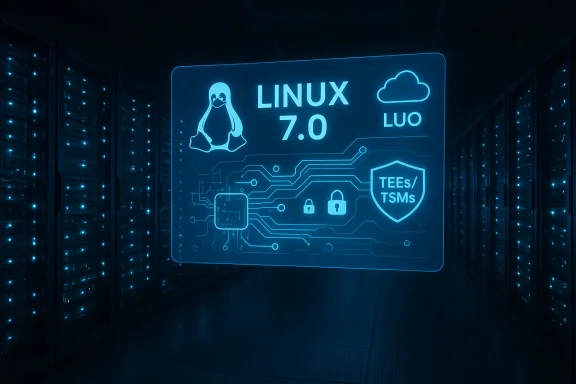
In his announcement for Linux 6.19, Torvalds again referenced the strain of tracking ever‑growing minor numbers and said the next kernel will be called 7.0 — a naming choice driven by convenience, not by any special feature set or ABI break. The 6.19 release itself is notable for a handful of high‑profile merges and infrastructure pieces that point to where kernel development is heading: live kernel updates for production datacenters, encrypted PCIe links and device authentication plumbing, broader silicon enablement, and increasingly polished support for emerging architectures such as RISC‑V.
Why LUO matters: LUO’s arrival reflects a continued push to reduce patch‑and‑reboot windows in cloud infrastructure. For operators that run large fleets of VMs, the ability to apply critical fixes to host kernels without an immediate VM downtime window is an operational lever that can measurably reduce risk and maintenance windows — assuming the orchestration and validation story matures.
This is a multi‑party effort — the kernel pieces include PCI core changes, cryptography support, and IOMMU/arch bits — and the acceptances noted in the merge threads show vendor contributions and interop coordination. The result is infrastructure that can eventually enable things like confidential device assignment in cloud contexts and protect against a class of hardware interception attacks.
Those are big, positive moves for the platform, but they come with real operational and supply‑chain questions. Organisations should treat 6.19/7.0 as a capability milestone to evaluate and test, not as an automatic upgrade path. Validate LUO under your hypervisor and driver mix, insist on vendor firmware provenance for any PCIe crypto use, and continue to rely on LTS designations and conservative distro policies for production stability. In short: the number on the kernel tarball might be new, but the best practices for adopting it are the same as they always have been — test thoroughly, understand the trust model, and upgrade deliberately.
Source: theregister.com Linus Torvalds confirms next Linux will be version 7.0
 Background
Linux kernel version numbering has long been a mashup of practical bookkeeping, in‑jokes, and the project lead’s personal whims. The major‑number bump to 5.0 in early 2019 is a canonical example: Torvalds explained at the time that the jump from 4.21 to 5.0 was not feature‑driven but simply because he’d “run out of fingers and toes to count on.” That pragmatic, sometimes playful attitude toward numbering has continued as the kernel matured. In his announcement for Linux 6.19, Torvalds again referenced the strain of tracking ever‑growing minor numbers and said the next kernel will be called 7.0 — a naming choice driven by convenience, not by any special feature set or ABI break. The 6.19 release itself is notable for a handful of high‑profile merges and infrastructure pieces that point to where kernel development is heading: live kernel updates for production datacenters, encrypted PCIe links and device authentication plumbing, broader silicon enablement, and increasingly polished support for emerging architectures such as RISC‑V.
What landed in Linux 6.19 — the practical context for “7.0”
Before unpacking the versioning story and what the move to 7.0 might mean, it’s worth summarizing the substantive engineering changes that arrived in the 6.19 cycle and created the backdrop to Torvalds’ message.Live Update Orchestrator (LUO)
One of the most consequential merges in 6.19 is the inclusion of the Live Update Orchestrator (LUO) — infrastructure that enables applying kernel updates with reduced disruption to running virtual machines. LUO builds on earlier kexec handover work and is explicitly intended to make live kernel updates safer and more practical in large virtualized deployments. Early public notes on this work show Google engineers and others driving it toward production readiness; the kernel repository already contains LUO documentation in the kernel Documentation tree.Why LUO matters: LUO’s arrival reflects a continued push to reduce patch‑and‑reboot windows in cloud infrastructure. For operators that run large fleets of VMs, the ability to apply critical fixes to host kernels without an immediate VM downtime window is an operational lever that can measurably reduce risk and maintenance windows — assuming the orchestration and validation story matures.
PCIe link encryption and device authentication
Linux 6.19 also merged the initial infrastructure for PCI Express link encryption and device authentication, with AMD’s SEV‑TIO support included as the first shipped implementation. The work establishes a foundation for authenticating devices and protecting PCIe traffic from interception or tampering, coordinated through a Trusted Execution Environment (TEE) or a platform TSM (Trusted Security Manager). That architecture is intended to enable confidential VMs to verify that assigned devices are trustworthy and that PCIe traffic is protected end‑to‑end.This is a multi‑party effort — the kernel pieces include PCI core changes, cryptography support, and IOMMU/arch bits — and the acceptances noted in the merge threads show vendor contributions and interop coordination. The result is infrastructure that can eventually enable things like confidential device assignment in cloud contexts and protect against a class of hardware interception attacks.
Additional hardware enablement and filesystem tweaks
6.19 is also a collection of incremental but important advances:- Broader support and polish for recent Intel and AMD silicon, including device enablement and driver updates.
- Initial or improved support for emerging RISC‑V platforms and other SoCs that have seen increased upstream attention.
- Filesystem fixes and tweaks across ext4, XFS, and others.
- Miscellaneous device driver additions such as ASUS Armoury support and updated platform quirks.
What Torvalds’ 7.0 naming actually means — and doesn’t mean
When Linus says the next kernel will be 7.0, he is doing what he’s always done with version numbers: choosing a human‑readable label that helps avoid unwieldy low‑level bookkeeping while signalling nothing special in terms of compatibility or feature weight. Historically:- The move to 4.0 in 2015 and to 5.0 in 2019 were not driven by a particular ABI shift, but by Torvalds’ preference about how to count the minor releases.
- The kernel project’s versioning is intentionally non‑semantic: releases are not marketed as “major” or “minor” in the way some commercial products are, and important semantics are instead expressed through Long‑Term Support (LTS) designation and distribution packaging choices.
Critical analysis — technical upside, practical obstacles, and risks
The technical merges in 6.19 (and the early hints of 7.0) bring both clear benefits and non‑trivial risks that operators and kernel watchers should weigh.Upside: better security posture and operational flexibility
- PCIe link encryption offers a structural improvement in hardware security, enabling encryption/authentication of a previously cleartext bus. This is potentially transformational for cloud providers, confidential computing, and environments that handle regulated data on shared hardware. The approach — coordinating key provisioning through TEEs/TSMs — gives a plausible cross‑architecture path for hardware vendors and firmware to interoperate.
- Live Update Orchestrator is a practical step toward reducing downtime for production hosts. If LUO matures, it could let teams apply kernel security fixes faster and with lower VM disruption risk, which translates directly into reduced exposure windows for zero‑day vulnerabilities.
- Continued RISC‑V and alternative‑SoC enablement diversifies the silicon ecosystem Linux supports, helping to future‑proof Linux for varied hardware suppliers and geopolitically‑sensitive procurement scenarios.
Obstacles and risks
- Trust model complexity for PCIe encryption. The proposed architecture relies on platform firmware or a TEE (TSM) to provision keys. That shifts trust from the host OS to firmware components and TEEs, which are often opaque, vendor‑specific, and difficult to audit at scale. While TSMs exist for good reasons, they introduce firmware supply‑chain considerations: a compromised TSM could undermine the security the system is meant to create. Operators will need clear firmware provenance, vendor attestations, and mechanisms for updates and revocation.
- Operational maturity of LUO. LUO is promising, but live kernel update mechanisms are notoriously subtle. Edge cases in device drivers, timing windows for state transfer, and interactions with diverse hypervisor stacks may produce latent reliability concerns. Before adopting LUO in production, operators should validate it across their full hardware and VM stacks and ensure robust rollback and observability. The kernel tree includes LUO documentation, but upstream inclusion is the first step — production readiness is a separate bar.
- Performance and regression risk. Large infrastructure merges sometimes bring unexpected regressions. The kernel community’s steady pace of weekly release candidates and active rc‑era testing helps, but the sheer breadth of drivers and architectures means regressions can be subtle and distribution lifecycles may need to lengthen testing horizons. Independent benchmarking and cautious rollout remain essential.
- Potential for vendor coordination headaches. PCIe link encryption and other HW features require firmware and hardware vendors to align with kernel expectations. That coordination takes time, and the practical security gains will depend on timely vendor firmware updates and device support, which historically varies by vendor and platform.
What this means for distributions, cloud providers, and end users
The arrival of 6.19 and the naming of 7.0 is not a single‑day event for the wider ecosystem. The practical impact will differ by stakeholder.For Linux distributions
- Stable distros (LTS releases) will continue to be conservative: they will pick a kernel base (or continue to carry a backported stack) and prioritize fixes, LTS maintenance, and ABI stability. A version label of 7.0 is not in itself a trigger to upgrade for stable‑release maintainers.
- Rolling and cutting‑edge distros will likely adopt 6.19 quickly for users who want new hardware support and the latest infrastructure. They will be the first place LUO and PCIe crypto see early mainstream testing outside vendor labs.
For cloud providers and operators
- Cloud operators will evaluate LUO and PCIe crypto based on operational benefit vs. risk. LUO’s promise to reduce VM disruption during kernel updates is directly attractive, but service‑level safety, driver support, and rollback mechanics must be verified. PCIe encryption benefits confidential computing use cases, but requires vendor BIOS/firmware cooperation. Early adopters will likely be hyperscalers and service providers building confidential computing platforms.
For enterprise and OEMs
- OEMs that ship hardware intending to support PCIe encryption must provide firmware/TSM support and clear documentation. Enterprises should ask hardware vendors about support roadmaps, and avoid assuming kernel inclusion equals immediate platform support.
Practical advice: how to prepare and evaluate 6.19 / 7.0
If you manage systems or make platform decisions, treat 6.19 and the coming 7.0 cycle as a testable milestone rather than a mandatory upgrade. Recommended steps:- Test 6.19 in a staging environment that mirrors production hardware and hypervisor stacks.
- Validate critical workloads with any new kernel features enabled or disabled to measure stability and performance.
- If considering LUO, run controlled upgrade drills: prepare rollback paths, automation to detect failures, and observability to verify device and VM state after handover.
- For PCIe encryption use cases, request vendor timelines for firmware/TSM support and evaluate vendor attestations for TEEs before trusting device encryption in production.
- Align upgrade windows with distribution and vendor guidance; do not conflate a major version number with a guaranteed LTS lifecycle — verify which kernel versions distributions designate as LTS for institutional support.
On versioning patterns and the “19 releases” observation
Some commentary has observed a pattern where certain kernel series produced roughly 19 or 20 minor releases before the major number advanced. That history is uneven and often driven by human choices in how Linus or maintainers choose to name the next tag. The kernel’s own release archive and long‑term maintenance policy are the authoritative sources for exact counts and LTS designations. Historical notes about 4.x → 5.0 and similar increments are well documented in the kernel mailing archives and public records of tags and announcements. Treat such numeric anecdotes as interesting color rather than a deterministic rule.Deeper implications: security, the supply chain, and future work
Two of the headline themes in 6.19 — encrypted PCIe links and LUO — point to a broader direction for kernel and platform security.- The kernel community is increasingly focused on end‑to‑end trust: not just CPU memory encryption or VM confidentiality, but the whole device path from PCIe link through to VM. That broader threat model is realistic: as hardware becomes more complex and supply chains more distributed, link‑level protections become attractive. But they also widen the attack surface if firmware or TEE components are not independently auditable. The industry will need strong firmware supply‑chain practices and revocation/attestation models.
- Operational tooling that reduces downtime (LUO) is essential in an era where cloud operators must balance constant patching with high availability. But the devil is in the details: stateful device drivers and exotic hardware corner cases remain the primary risk vectors for live updates. The kernel‑community process of rc testing and wide‑scale dogfooding in distributions helps, but will not replace careful operator validation.
Strengths and notable engineering calls in 6.19
- Vendor collaboration. PCIe link encryption work demonstrates multi‑vendor coordination in upstream kernel trees, which is an engineering strength. Cross‑company alignment on protocols and TSM semantics is essential for a secure and interoperable result.
- Operational focus. LUO indicates that production‑scale concerns are moving upstream rather than being left solely to vendor patches. That’s a positive shift that should reduce fragmentation in long‑term operator tooling.
- Breadth of support. The usual steady march of driver and architecture support ensures newer hardware gets upstreamed quickly, avoiding long vendor forks and improving the long‑term health of the kernel tree.
Weaknesses, unknowns, and open questions
- Firmware and TSM trust. The PCIe encryption model depends on platform components that are not under kernel control. The kernel can provide frameworks, but trust anchors in firmware and TSM implementation quality remain open questions. Will vendors provide sufficient attestation and update mechanisms? The answer is uncertain and critical.
- Maturity of LUO for heterogeneous hardware. LUO’s real‑world success depends on driver correctness across many architectures and device classes. Live kernel updates have historically been hard to get right across the entire driver ecosystem. Early adopters should proceed carefully.
- Performance regressions and testing coverage. With so many moving parts, regressions will surface. The kernel’s CI and rc review process help, but the onus remains on downstream integrators to run comprehensive real‑world tests.
How to watch this space
If you want to follow the rollout and technical debates around 6.19 and the upcoming 7.0 cycle, the most valuable signals will be:- Kernel mailing list announcements and Linus’ merge messages (where he publicly signaled the 7.0 naming).
- Upstream Git trees and documentation files in the kernel source (LUO docs landed in mainline 6.19).
- In‑depth technical coverage from Linux‑focused sites that parse the merge logs and vendor coordination (the Phoronix coverage of 6.19 is a good example).
Conclusion
Linus Torvalds’ decision to call the next kernel 7.0 is, in the end, an administrative convenience that reminds us the kernel’s version numbers are a human artifact rather than a strict semantic contract. What matters more are the engineering choices baked into the code: Live Update Orchestrator that could reshape patch windows for virtualized infrastructure, and PCIe link encryption plumbing that aims to close a class of hardware attack surfaces — both of which are now part of the upstream kernel conversation.Those are big, positive moves for the platform, but they come with real operational and supply‑chain questions. Organisations should treat 6.19/7.0 as a capability milestone to evaluate and test, not as an automatic upgrade path. Validate LUO under your hypervisor and driver mix, insist on vendor firmware provenance for any PCIe crypto use, and continue to rely on LTS designations and conservative distro policies for production stability. In short: the number on the kernel tarball might be new, but the best practices for adopting it are the same as they always have been — test thoroughly, understand the trust model, and upgrade deliberately.
Source: theregister.com Linus Torvalds confirms next Linux will be version 7.0
