

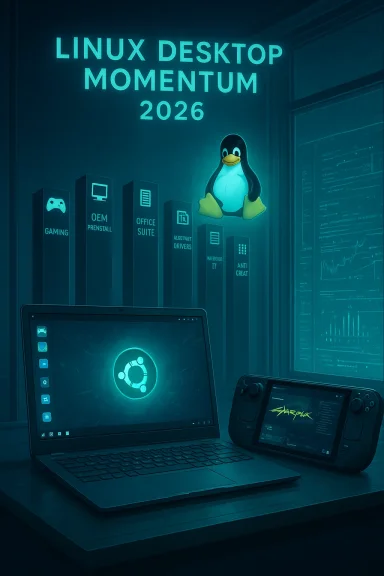
Linux’s desktop moment will not arrive because of a single press release or a viral distro launch — it demands a near-simultaneous collapse of friction across games, hardware, OEMs, enterprise applications, and vendor incentives, and while 2025–2026 has moved the needle, the moat around Windows remains deep and well defended.
Background / Overview
The idea that 2026 could be “the Year of the Linux Desktop” rests on seven interlocking changes many commentators have sketched: better native support from game developers, a dominant, user-friendly default desktop, a clear default distribution for mainstream users, native business‑grade productivity and creative apps, broad OEM preinstalls, significantly improved hardware support, and measurable enterprise desktop rollouts. That checklist captures the practical blockers to a mass switch: compatibility, discoverability, support, and economic incentives. The conversation around these points has accelerated because several measurable signals moved in 2024–2025 — Valve’s Steam/Proton push and Steam Deck success, OEM Linux certifications, and a burst of interest around polished distros timed with Windows 10’s end of life — but none of these changes alone guarantees a wholesale desktop turnover. The trends are real, and growing; they are cumulative, not instantaneous.1) Game developers would have to get serious about supporting Linux
Why games matter
Gaming is one of the strongest day‑to‑day anchors keeping mainstream consumers on Windows. High‑profile PC games — new triple‑A launches and long‑tail legacy titles — form a large part of why many people keep a Windows install around. Steam Deck and SteamOS exposed a substantial Linux‑facing audience, and Valve’s investments in Proton have materially reduced friction for many titles. But platform parity means native ports, anti‑cheat support, and developer QA for Linux — not just relying on compatibility layers.What's changed — Proton and SteamOS
Valve’s Proton compatibility layer (a Wine-based stack that maps DirectX to Vulkan and handles many Windows-to-Linux gaps) has matured quickly; Steam Play updates in 2025 moved Proton toward being enabled by default for titles without native Linux builds, shrinking the “why it won’t install” confusion for new Linux gamers. Proton 9/10 releases expanded the playable library and performance improvements have been continually upstreamed. Those are concrete, friction‑reducing moves that broaden Linux’s game coverage. Valve’s Steam Deck remains the most visible consumer proof point that a large audience will buy a Linux‑centric gaming device: the device’s lifecycle (including refurbished programs and later OLED revisions) and its reported multi‑million unit engagement underscore that there is a sizeable player base that expects Linux to be viable for mainstream gaming. But the Deck’s success is necessary, not sufficient: developers must ship native Linux/SteamOS builds or at least test and support Proton combinations.What must happen next
- Major publishers must ship at least a few headline titles with native Linux support or commit to prioritized Linux ports, rather than relying solely on Proton.
- Anti‑cheat vendors (kernel‑level systems like Ricochet, Javelin, etc. must provide Linux support or publishers must collaborate with Valve on alternative protection models that work across OSes.
- Game launchers and DRM systems must be tested and certified on popular distros and SteamOS builds.
- Tools for developers to cross‑test Windows builds against Proton must be integrated into CI pipelines to catch regressions early.
Risks and realities
Proton reduces user‑facing friction, but anti‑cheat and DRM remain serious hurdles for many multiplayer titles. Even with Proton covering a large library, the perception of better support — official ports, store badges, and publisher QA — is the psychological trigger that moves casual gamers. Expect gaming to remain a wedge where Linux wins in niche and enthusiast segments (and on devices like Steam Deck), but for a wholesale desktop coup the major publishers and anti‑cheat vendors must meaningfully change their roadmaps.2) Distro makers would have to settle on a desktop
The fragmentation paradox
Linux’s diversity is its cultural strength and its mainstream weakness. For power users, choice (GNOME, KDE Plasma, Cinnamon, Xfce, tiling WMs) is a feature; for mass users, it’s a confusing first question: “Which distro and desktop should I pick?” Windows’ single UI and predictable first‑run experience removes that choice barrier.What the market needs
Mainstream adoption favors an opinionated default that “just works” out of the box: consistent installer, predictable update UX, polished settings, first‑run privacy defaults, and a predictable app store. Distros like Ubuntu (GNOME‑based), KDE Neon (KDE‑based), Zorin, and Pop!_OS already attempt to be that polished default. But a single dominant, consumer‑facing desktop and a small number of well‑branded mainstream distros would lower the cognitive load for ordinary users.Evidence of consolidation pressure
Market signals in 2025 showed polished releases timed around Windows 10’s EOL — for instance, Zorin OS 18’s launch and downloads spiking after Windows 10 support ended — indicating that an opinionated “Windows‑like” entry distro can capture interest. Community debate about universal packaging and store standards also shows the ecosystem acknowledging the need for smoother desktop transitions.Risks and cultural friction
Consolidation is anathema to some in the community: any dominant vendor‑led standardization risks alienating the “old guard” and sparking forks or anti‑centrism. The tradeoff is classic: mainstream adoption benefits from a narrow set of defaults; open‑source ethos values choice and decentralization.3) Users would need a clear choice of distro
From decision paralysis to discoverability
Beyond settling on a desktop environment, the ecosystem needs discoverable defaults. A mainstream Linux desktop needs clear branding, a user‑friendly upgrade path from Windows, OEM certification, and an app store with well‑curated commercial and free software.How the choice would be determined in practice
- Where merchants and OEMs place a distro in the buy flow matters. If Steam/Valve, Microsoft‑adjacent hardware vendors, or major ISVs implicitly pressure a distro into prominence (e.g., “Steam Verified on Ubuntu 24.04”), user choice narrows.
- Enterprises will likely dictate a distro for corporate fleets — Canonical/Ubuntu, Red Hat, or SUSE can collectively drive enterprise‑grade desktop adoption through paid support contracts and MDM integration.
Evidence and cross‑signals
OEM certification programs (Dell + Canonical, Lenovo’s Fedora/Ubuntu efforts, System76 selling hardware with Pop!_OS) show how vendor‑supported Linux SKUs can remove friction. When the “Which distro?” question can be answered at purchase by the OEM, adoption becomes far more plausible.4) Business app support (office, productivity, creative apps)
The Microsoft Office inertia problem
Microsoft Office — especially Excel — is not just a productivity suite; in many organizations it’s a de facto platform for workflows, macros, automation, and financial models. Replacing those spreadsheets requires near‑feature parity and strong file fidelity. Microsoft’s commercial footprint (Microsoft 365 revenue and Copilot rollouts) shows how baked in the Office ecosystem remains across enterprises.What would break the lock‑in
- Fully compatible, enterprise‑grade replacements for Excel (formulas, macros/VBA compatibility, pivot behavior, add‑ins) or a broad corporate willingness to migrate to cloud‑first, cross‑platform SaaS alternatives.
- Native versions of major creative tools (Adobe Photoshop, Premiere) or polished cross‑platform alternatives with vendor endorsements. Adobe’s Creative Cloud remains a major anchor for creative professionals.
- Enterprise management tooling parity: directory integration, patching, device management, and vendor support contracts for desktop Linux must exist at scale.
Practical pathways
- Document‑level compatibility programs and a vendor commitment to match Excel macro behavior where businesses depend on it.
- Hybrid models: keep critical Windows applications inside centrally managed Windows VMs while shifting bulk knowledge‑worker devices to Linux.
- ISV incentives: subsidies or support programs for ISVs to ship Linux builds.
Risks
Expect conservative organizations to prefer a hybrid approach for several years. The complexity and risk in converting workflows dependent on macros, ActiveX, and vendor‑specific Excel add‑ins mean that productivity app support is a decisive gating factor for mass adoption.5) PC makers would have to offer more Linux preinstalls
Why preinstalls matter
Most consumer PCs come with Windows preinstalled, and inertia is powerful. The easiest path to mainstream desktop Linux is through OEMs offering Linux as a first‑class purchase option at retail and online checkouts, with clear marketing and post‑sales support.Current progress and limits
Several OEMs already ship Linux SKUs: Dell’s XPS Developer Editions with Ubuntu, Lenovo’s certified Fedora/Ubuntu SKUs, and boutique vendors like System76 ship with Pop!_OS out of the box. These show OEMs can and will do it — but the mainstream channels still prioritize Windows as the default consumer option.What must change
- Mainstream OEMs must surface Linux as a visible option in the purchase flow, not buried under “developer” or “business” menus.
- Retail marketing and support materials must reassure consumers: “Linux option includes 1‑year support / drivers / recovery.”
- Channel partners and retailers must be trained and incentivized to offer Linux as a choice.
Risks and commercial friction
OEMs navigate complex revenue streams tied to Windows licensing and preinstalled software bundles. Microsoft remains an important partner for OEMs. Widespread Linux preinstalls will require explicit OEM business cases: cost savings, differentiation for developer markets, or public‑sector tenders demanding open stacks.6) Better hardware support
The perennial barrier
Driver availability (GPU, Wi‑Fi, power management, fingerprint readers, webcams) is the most frequent reason Linux users report a poor first‑boot experience. Many of these drivers rely either on upstream kernel support or vendor‑supplied blobs; historically, vendors like Broadcom, Realtek, and sometimes GPU vendors have lagged or offered only proprietary blobs, forcing reverse engineering.Positive trends
- GPU vendors have made notable moves: NVIDIA released open kernel modules in stages and improved Linux support, while AMD and Intel have generally worked upstream with open driver stacks. The situation is better than a decade ago: NVIDIA’s kernel modules (R515+ timeline) and AMD/Intel upstream collaboration reduce the number of quantum‑large compatibility gaps — but userspace and firmware blobs can still complicate seamless installs.
- Major OEMs are increasingly testing Linux on shipping SKUs and contributing firmware updates to LVFS/fwupd, which reduces the day‑one pain for Linux buyers.
What must happen next
- Vendors must ship firmware and maintain kernel compatibility paths (signed LVFS updates, regular upstream patches).
- OEMs should prioritize Linux validation during hardware qualification cycles and publish clear compatibility matrices.
- Anti‑cheat and DRM providers must re‑architect or port components to non‑Windows kernels to make multiplayer titles reliably playable without Windows.
Risks
Hardware regressions still crop up across kernel releases, and vendor‑provided closed drivers can break with kernel changes. While vendor collaboration has improved, the ecosystem still depends on more consistent vendor engagement, especially for low‑cost Wi‑Fi chips and niche peripherals.7) We would need more business desktop deployments
Why enterprise matters
Enterprises buy devices in volume, control software life cycles, and set workplace standards. If medium and large businesses (and public sector fleets) adopt Linux at scale, the market share math changes fast: training and support flows normalize, ISVs will prioritize Linux, and OEMs will increase stock keeping units that ship Linux.What a migration program requires
- Enterprise‑grade management tooling: patching, directory/identity integration (Samba AD/SSSD), endpoint security solutions, and MDM support on par with Windows tooling.
- Paid support contracts and ISV certifications for line‑of‑business applications.
- Pilot case studies that demonstrate TCO advantages: license cost savings, deferred hardware refreshes, and extended device lifecycles.
Real examples and signals
Municipal pilots and public sector procurement show practical gains: a number of European municipalities have executed limited desktop migrations (Échirolles is a documented municipal example that migrated a subset of workstations to Zorin OS and LibreOffice as part of a broader open‑source transition). Distros timed to Windows 10’s end of life saw immediate interest spikes, providing operational case studies that demonstrate feasibility in constrained contexts. Those pilots are necessary proof points for larger enterprises to take the plunge.Risks and transition paths
Large enterprises will rarely do “big bang” migrations. Expect staged pilots, hybrid fleets (Linux for developers, Windows VMs for legacy apps), and multiyear rollouts. The real inflection point will be when ISVs sign support contracts for Linux and management tooling matures to reduce migration effort below the enterprise risk tolerance.Putting the pieces together: a realistic timeline and probability
If these seven things were to align in 2026, the process would look like this:- Valve and major publishers lock down Proton and anti‑cheat workarounds; several triple‑A titles ship with verified SteamOS builds.
- OEMs surface Linux checkout options broadly (Dell, Lenovo, HP, plus boutique vendors), with clear driver support and one‑click recovery images.
- Enterprise pilots convert non‑critical fleets, LibreOffice/ODF usage grows in public sector procurement, and vendors offer paid Linux desktop support contracts.
- Market share moves from single‑digits in niche segments toward low double digits in selective regional or vertical markets over multiple quarters as retention replaces mere download spikes.
Strengths, weaknesses, and the real tipping point
Strengths
- Momentum in gaming: Proton and Steam Deck lowered the barrier for gamers and created a visible, mainstream device that runs Linux out of the box.
- OEM and vendor engagement: Dell, Lenovo, and boutique vendors like System76 are actively shipping Linux SKUs and working with upstream maintainers — reducing day‑one friction for buyers.
- Public sector pilots: Cost and sovereignty concerns are real incentives for governments to trial desktop Linux, and municipal examples provide proof points for cautious enterprises.
Weaknesses / Risks
- Application lock‑in: Microsoft Office, particularly Excel and custom macros, remains entrenched. Replacing these workflows is a heavy lift that requires either near‑identical compatibility or broad SaaS replacements and retraining.
- Hardware edge cases: Wi‑Fi, power management, and niche peripherals still trigger first‑boot failures more frequently on Linux than Windows; while improving, these regressions kill mainstream adoption.
- Cultural fragmentation: The Linux community’s value on choice can slow standardization; without a small set of opinionated defaults, mainstream users face confusing choice paralysis.
The true tipping point
The effective pivot point is not a single technical milestone; it is when the combined cost (training + migration + occasional Windows fallback) of moving a device fleet to Linux is lower than continuing to pay for Windows upgrades, hardware refreshes, and Microsoft licensing for a given organization. That calculation hinges on enterprise procurement decisions, ISV support, and whether hardware vendors treat Linux as a first‑class SKU.Practical advice for IT leaders and enthusiasts in 2026
- For IT leaders: run measured pilots (30–90 days) on non‑critical endpoints with explicit KPIs (support tickets, app compatibility, user satisfaction). Keep a rollback plan and a Windows VM fallback for legacy apps.
- For gamers: consult ProtonDB and Steam’s verified lists; keep a Windows fallback for the titles that rely on unsolved anti‑cheat.
- For hobbyists or prospective switchers: test with live USBs, validate hardware (Wi‑Fi, GPU, webcam), and prefer OEMs that ship Linux by default to avoid day‑one driver surprises.
Conclusion
2026 is less likely to be a single “Year of the Linux Desktop” headline event and more likely to be a year of accelerating, multi‑vector momentum: gaming stacks that make mainstream titles playable, OEMs that surface Linux as a legitimate retail option, and targeted public‑sector migrations that provide operational proof. Those forces together increase Linux’s practical viability on the desktop and are already producing measurable market shifts in pockets and verticals. But replacing Windows on a mass, business‑critical scale requires Microsoft‑level ISV engagement (especially for Office/Excel workflows), broad anti‑cheat support for games, and consistent, vendor‑backed hardware compatibility. Each of the seven items on the checklist can be achieved, but they must converge — ecosystem by ecosystem — before Linux can claim the mainstream desktop crown. The movement is real, but in 2026 it looks like pragmatic momentum, not inevitability.Source: How-To Geek 7 things that must happen for Linux to overtake Windows in 2026
