

Linux gaming on Steam has quietly crossed an important threshold — the platform’s Linux user share has passed the 3% mark and the momentum behind that gain is unmistakably tied to Valve’s Steam Deck hardware and AMD’s growing role in the Linux graphics and driver ecosystem.
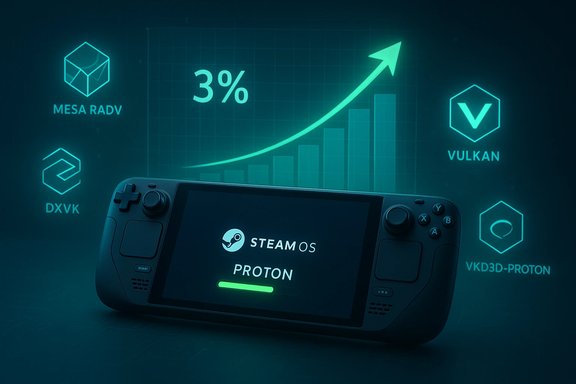
Linux has long been a niche platform for PC gaming, but that niche has been steadily expanding for several years. Valve’s Steam Hardware & Software Survey — the most visible public pulse of Steam’s installed base — shows Linux climbing from roughly 2% a year ago to just over 3% in recent survey snapshots, a gain driven by Valve’s handheld ecosystem and the compatibility work wrapped into Steam Play (Proton). Two complementary trends explain the rise. First, hardware built around AMD APUs — most visibly the Steam Deck family — has introduced large numbers of players to a Linux-first gaming experience, because Steam Deck units run SteamOS by default. Second, the translation layers and runtime improvements (Proton, DXVK, vkd3d-proton and the underlying Mesa/RADV graphics stack) have made many Windows games workable on Linux with little or no manual tweaking. These two forces have combined to make SteamOS, and Linux gaming more broadly, less of a niche hobby and more of a practical option for mainstream players.
That means developers, publishers, and hardware vendors should treat Linux — particularly the Steam Deck ecosystem and AMD-powered Linux devices — as a legitimate growth channel. For gamers, the upshot is better compatibility and a broader set of choices. For the industry, the lesson is that open collaboration between hardware vendors, platform holders and open-source communities can accelerate platform viability in ways that purely proprietary strategies struggle to match.
Source: Neowin https://www.neowin.net/amp/amd-and-steam-deck-continue-to-drive-linux-gaming-adoption-on-steam/
 Background
Linux has long been a niche platform for PC gaming, but that niche has been steadily expanding for several years. Valve’s Steam Hardware & Software Survey — the most visible public pulse of Steam’s installed base — shows Linux climbing from roughly 2% a year ago to just over 3% in recent survey snapshots, a gain driven by Valve’s handheld ecosystem and the compatibility work wrapped into Steam Play (Proton). Two complementary trends explain the rise. First, hardware built around AMD APUs — most visibly the Steam Deck family — has introduced large numbers of players to a Linux-first gaming experience, because Steam Deck units run SteamOS by default. Second, the translation layers and runtime improvements (Proton, DXVK, vkd3d-proton and the underlying Mesa/RADV graphics stack) have made many Windows games workable on Linux with little or no manual tweaking. These two forces have combined to make SteamOS, and Linux gaming more broadly, less of a niche hobby and more of a practical option for mainstream players. The numbers: what the Steam survey really tells us
The Steam Hardware & Software Survey is optional and imperfect, but it is consistent enough to reveal trends. In the October 2025 snapshot Linux registered about 3.05% of participating users; follow-up months remained in the same neighborhood with small month-to-month variation. SteamOS Holo — Valve’s Linux distribution for handhelds — accounts for a sizeable share of the Linux total, indicating the Steam Deck family is a major contributor to the Linux user base. Other survey highlights that matter for the Linux story:- Steam Deck presence is visible in the hardware strings reported on Linux (the Deck’s custom GPU and APU IDs have measurable representation in the Linux subset).
- AMD hardware is strongly represented on Linux — Phoronix’s analysis of recent surveys shows AMD CPUs make up a much higher share among Linux Steam users than on Windows, reflecting the Deck’s AMD APU and the popularity of AMD-powered handhelds and small-form-factor PCs.
Why AMD matters: hardware, open-source drivers and Steam Deck economics
AMD silicon in the driver’s seat
AMD’s presence in Linux gaming is several-fold. The Steam Deck’s custom AMD APU put a performant, power-efficient AMD solution into millions of portable devices that boot to SteamOS by default. Public statements from Valve and independent analyses have repeatedly tied the Deck’s popularity to the Linux uptick. Estimates for Steam Deck shipments vary (Valve uses the non-specific phrase “multiple millions”), but independent market research and press analyses consistently show that the Deck moved millions of units and remains the dominant handheld PC in its category. That installed base alone changes the calculus for Linux support. Phoronix’s reporting indicates AMD’s CPU share among Linux Steam users is much higher than on Windows, reinforcing that Steam Deck and AMD-powered hardware are central to Linux growth on Steam. This skew also helps explain why AMD- and Valve-centric driver work (Mesa/RADV improvements, shader compiler work, and targeted Proton tuning) has outsize leverage on Linux gaming quality.Open-source drivers and the Mesa ecosystem
AMD’s active upstreaming and the community-driven Mesa project have made the Linux experience smoother for Radeon users. The Radeon Vulkan driver used widely on Linux — RADV, implemented inside Mesa — is the product of contributions from Valve, AMD, Red Hat and many independent developers. Over the past two years Mesa’s release cadence and feature set have improved rapidly, adding performance optimizations, better shader handling, and explicit support for features needed by modern translation layers (including cooperative matrix and float8 extensions that enable advanced upscalers like FSR4). The result: the open-source stack is no longer an academic curiosity — it’s the practical graphics layer for most Linux gamers today.Why that matters in practice
- AMD’s open-source strategy reduces friction for Proton and vkd3d-proton to expose advanced GPU features on Linux.
- Valve’s collaboration with the Mesa community (and Valve’s own contributions) mean optimizations benefit the entire Linux ecosystem, not just one vendor or binary driver distribution.
- For the Deck and AMD-powered handhelds, these upstream improvements translate into better battery life, smoother frame pacing and faster shader compilation — all visible wins for handheld play.
Proton, vkd3d-proton and the compatibility leap
The translation stack that makes Windows games run on Linux has matured quickly. Proton — Valve’s officially shipped Windows-compatibility layer built on Wine and many downstream components — plus the Direct3D-to-Vulkan work in DXVK and VKD3D-Proton, are the technical engines for this compatibility. Recent feature releases have been notably consequential:- VKD3D-Proton 3.0 introduced a rewritten DXBC shader backend, improved DX12 compatibility and explicit support for AMD FSR4 via Vulkan cooperative-matrix and shader-float8 extensions. Those changes fixed cases where D3D12 titles previously failed and opened the door for modern upscalers on Linux.
- Community metrics compiled from ProtonDB and Boiling Steam show the share of Windows titles that at least launch on Linux has climbed dramatically; analysts and press outlets consolidated that data into headlines such as “nearly 90% of Windows games now launch on Linux,” while noting this includes a range of playability bands from “Platinum” (runs out of the box) to “Borked” (doesn’t run). Those community-sourced measures matter because they represent real user experience rather than binary port/no-port status.
Strengths: the practical advantages Linux now offers gamers and developers
- Lower friction for handheld gamers: Steam Deck owners get a unified, curated experience where Valve certifies and optimizes games for the hardware and runtime. That reduces the "tweaking" barrier that deterred earlier Linux adopters.
- Open-source driver momentum: Mesa, RADV and the amdgpu kernel driver are improving rapidly — performance gaps that once favored Windows are often much smaller or gone for many titles, especially rasterized workloads. This gives AMD-equipped Linux users truly competitive performance in many scenarios.
- Compatibility reach via Proton: The translation stack has removed a massive software barrier. For many players the dominant friction point is now anti-cheat and DRM, not rendering or input compatibility.
- Ecosystem synergies: Valve’s Steam Deck, Proton, and the upstream open-source stacks form a virtuous loop: more Decks create incentive to fix Linux bugs; upstream fixes benefit desktop Linux and other handhelds; better compatibility attracts more developers to test on Linux.
Risks and unresolved problems
While progress is real, several structural issues could slow or complicate Linux’s continued growth on Steam.1. Anti-cheat and multiplayer compatibility
Games that depend on kernel-level anti-cheat solutions remain the biggest practical barrier. Many popular online titles rely on anti-cheat systems designed for Windows and either block or break on Linux. Until anti-cheat vendors embrace cross-platform designs or Valve/others broker wider support, many multiplayer hits will remain impractical for Linux gamers. This is a market-structural problem, not a purely technical one.2. Fragmentation and support expectations
Linux is not one OS — distributions, runtimes (Flatpak vs native), compositor stacks (X11 vs Wayland), and driver versions vary. That makes a single developer testing matrix more complex than a single Windows SKU. Valve’s approach with Deck Verified helps mitigate this for Deck owners, but outside of Valve’s ecosystem fragmentation still complicates broad “desktop Linux” support.3. Driver edge cases — ray tracing and some RT features
RADV and upstream Mesa routinely close the gap on rasterization performance, but some advanced GPU features (ray tracing performance parity, vendor-specific extensions) still show gaps depending on driver choices. For titles that depend on the absolute bleeding edge of vendor-specific implementations, Windows can retain an advantage. This is improving quickly, but the gaps are non-zero.4. Hardware supply and business signals
Valve’s decision to describe Steam Deck sales only as “multiple millions” leaves the exact installed base uncertain; independent market research points to millions of units shipped but estimates vary. That uncertainty matters for third-party publishers who decide where to invest QA time and marketing dollars. Valve’s leadership can shift developer mindshare, but precise sales transparency would further reduce the risk calculus.What this means for developers, publishers and Windows-first studios
Developers should update their mental models. The economics of supporting Linux are changing:- If a game targets handheld or low-power modes, Valve’s Deck audience and Proton compatibility can unlock meaningful additional sales without a native port.
- If a game uses kernel-level anti-cheat, developers will face a strategic decision: tolerate the smaller Linux addressable market or invest in cross-platform anti-cheat solutions and extra QA for Proton support.
- Developers shipping DirectX 12 titles should test with VKD3D-Proton and track upstream Mesa changes; recent releases like VKD3D-Proton 3.0 fix many earlier DX12 compatibility problems and support modern features like FSR4 on AMD hardware.
Practical tips for gamers and system builders
- For players who want the simplest experience: buy a Deck-family device or a preconfigured SteamOS/Steam Deck-like distribution. That minimizes troubleshooting and ensures better Deck-verified compatibility.
- For desktop Linux users: track Mesa and kernel updates, and use ProtonDB and community guides to check whether a specific title is practical for your hardware and distribution. Ryzen/AMD users on modern Mesa releases generally enjoy the best out-of-the-box experience right now.
- If you need to play competitive multiplayer titles that use strict anti-cheat: check official developer statements and the Steam Deck Verified database before switching to Linux — many of those titles still require Windows.
The competitive landscape: where Windows still leads and why Linux growth matters
Windows remains the dominant platform for a reason: ubiquity, a single vendor-supported driver stack, and historical developer focus. Linux’s gains do not presage a sudden overthrow of Windows on PC, but they do change the dynamics in a few concrete ways:- Choice and resilience for consumers: a viable Linux alternative reduces lock-in risk and gives consumers leverage when OS policies or hardware requirements become unpopular.
- Ecosystem diversification: a multiplicity of well-supported platforms tends to spur innovation (handheld consoles, alternative stores, independent QA tooling).
- Strategic leverage for Valve and AMD: the Deck + Proton + Mesa stack demonstrates how a vertical alignment (hardware + OS + runtime + upstream contributions) can shift market behavior without toppling existing platforms.
Conclusion: steady momentum, not a sudden revolution
The headline — Linux passing the 3% mark on Steam — is important because it quantifies a change that has been visible in practice for some time. That change is not an overnight revolution; it is the result of hardware adoption (Steam Deck and AMD APUs), intensive open-source driver work, and compatibility-layer engineering (Proton, VKD3D-Proton, DXVK). Together these elements have made Linux a practical gaming platform for a far wider audience than before. The most immediate and tangible victory is for handheld and single-player gaming, where the Deck experience — powered by AMD silicon and a maturing Linux stack — offers a polished, portable alternative. For multiplayer-heavy, anti-cheat-dependent titles and for studios that need guaranteed parity with Windows, Windows will remain the primary platform for the foreseeable future. But the balance is shifting: the problems that once made Linux an impractical choice for most gamers are being solved one layer at a time.That means developers, publishers, and hardware vendors should treat Linux — particularly the Steam Deck ecosystem and AMD-powered Linux devices — as a legitimate growth channel. For gamers, the upshot is better compatibility and a broader set of choices. For the industry, the lesson is that open collaboration between hardware vendors, platform holders and open-source communities can accelerate platform viability in ways that purely proprietary strategies struggle to match.
Source: Neowin https://www.neowin.net/amp/amd-and-steam-deck-continue-to-drive-linux-gaming-adoption-on-steam/
