

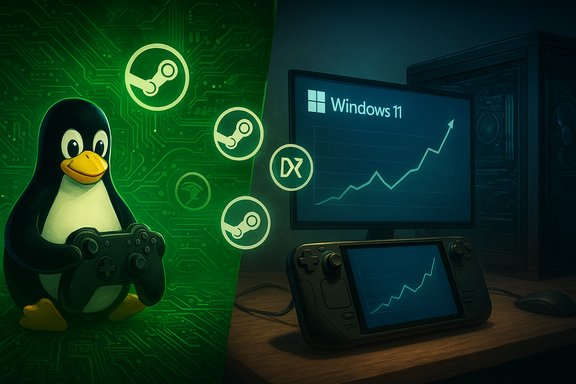
Linux gaming’s momentum is not a rumor anymore — it’s measurable, built on real engineering (Proton, SteamOS) and hardware (Steam Deck and a growing class of handhelds), and it’s exposing strategic fractures in how Microsoft positions Windows for PC gamers.
The debate that used to live in forums and subreddit threads has moved into the mainstream press because two things changed at once: Valve committed serious engineering and product weight to a Linux-first gaming stack, and a tectonic product event — the Steam Deck and SteamOS — created real, widespread Linux gaming usage that shows up in telemetry. Valve’s compatibility layer, Proton, plus the curated SteamOS experience have steadily reduced friction for running Windows games on Linux. Community compatibility tracking and audits now report that a large majority of Windows games are launchable on Linux via Proton and related tools, and Steam’s own telemetry shows Linux making measurable gains among active gamers. At the same time, Microsoft’s Windows line — particularly the transition from Windows 10 to Windows 11 with its stricter hardware rules and an increasingly noisy consumer UI — has generated a lot of dissatisfaction among PC gamers. For many enthusiasts the question is no longer whether Linux can run games; it’s whether Microsoft is still the obvious steward of the “PC gaming experience.” That tension is what the Outerhaven column summarized: Linux climbing, Windows stumbling, and gamers watching to see which platform pushes the industry forward.
For gamers, the sensible approach is pragmatic: test Linux for your library, keep Windows for required titles, and don’t treat this moment as an either/or ultimatum. For Microsoft and publishers, the coming 12–24 months are a test: respond to the signals (developer telemetry, community momentum, handheld hardware) or watch a modest but meaningful shift in who defines the “best place to play” on PC. The rise of Linux gaming is real, measurable, and accelerating; whether it becomes a decisive force depends as much on corporate choices as on continued engineering progress.
Source: The Outerhaven Linux PC Gaming Is On The Rise While Windows Trips Over Itself | The Outerhaven
 Background / Overview
The debate that used to live in forums and subreddit threads has moved into the mainstream press because two things changed at once: Valve committed serious engineering and product weight to a Linux-first gaming stack, and a tectonic product event — the Steam Deck and SteamOS — created real, widespread Linux gaming usage that shows up in telemetry. Valve’s compatibility layer, Proton, plus the curated SteamOS experience have steadily reduced friction for running Windows games on Linux. Community compatibility tracking and audits now report that a large majority of Windows games are launchable on Linux via Proton and related tools, and Steam’s own telemetry shows Linux making measurable gains among active gamers. At the same time, Microsoft’s Windows line — particularly the transition from Windows 10 to Windows 11 with its stricter hardware rules and an increasingly noisy consumer UI — has generated a lot of dissatisfaction among PC gamers. For many enthusiasts the question is no longer whether Linux can run games; it’s whether Microsoft is still the obvious steward of the “PC gaming experience.” That tension is what the Outerhaven column summarized: Linux climbing, Windows stumbling, and gamers watching to see which platform pushes the industry forward.What the Outerhaven piece argued — clear summary
- Linux gaming has come a long way thanks to Valve’s work on Proton and SteamOS, and the experience for many games feels near‑seamless. The article emphasizes that compatibility and performance improvements are real, especially for indie titles, older libraries, and single‑player games.
- The author argues that Microsoft has lost direction for PC gaming — citing Windows 11’s UI choices, background clutter, and what readers perceive as a lack of a dedicated, gaming‑focused Windows SKU.
- The piece admits Windows remains the default for most AAA games (DirectX pipelines, anti‑cheat, launchers) but warns Microsoft’s choices have created an opening for Linux to gain mindshare and market momentum.
- Ultimately, the writer’s main point is pragmatic: use what works, but don’t ignore the structural shifts that make Linux a viable, growing alternative.
The facts you can verify right now
Steam telemetry: Linux’s share and Windows 11’s majority
Valve’s official Steam Hardware & Software Survey for October 2025 lists Windows 11 (64‑bit) at 63.57% of participating Steam clients and Linux at roughly the low single digits (the October snapshot shows Linux above historic lows and moving upward). Those Steam numbers are important because they reflect the active gaming population publishers watch for developer priorities.Windows 10 support deadline and migration pressure
Microsoft’s Windows 10 end‑of‑support date (October 14, 2025) created a hard decision point for many users. That calendar drove a mix of outcomes — migrations to Windows 11 on new or compatible machines, purchases of new hardware, enrollment into short‑term Extended Security Updates (ESU), and increased interest in alternatives such as Linux on older machines. This is a major structural reason why Linux adoption spikes looked larger than before: users who couldn’t or wouldn’t upgrade to Windows 11 started to evaluate other options.Proton and compatibility — how much works?
Community‑driven compatibility trackers (ProtonDB, Deck Verified, Boiling Steam analyses) and independent coverage now report that a very large share of Windows games can be launched on Linux via Proton and the broader translation stack (Wine + DXVK + vkd3d‑proton). Multiple industry write‑ups place launchable titles near the ~80–90% mark for “can start and be played to some degree,” with the caveat that “works” ranges from perfect out‑of‑box to requiring tweaks. Treat percentage numbers as directional: the precise fraction depends on definition (launchable vs. native‑grade playability) and the dataset used.Anti‑cheat: the remaining hard boundary
The clearest and most persistent blocker for full Linux parity is anti‑cheat and kernel‑level protection. Epic’s Easy Anti‑Cheat and BattlEye have made important engineering moves to support Linux/Proton in recent years, and vendors now offer opt‑in paths for Proton support — but many publishers haven’t enabled those paths, and some anti‑cheat implementations are tied to Windows‑specific, kernel‑level techniques that remain incompatible without explicit vendor work. That’s why large multiplayer and esports titles still tilt toward Windows as a practical requirement.Steam Deck and handhelds matter
The Steam Deck is more than a single product: it’s Valve’s distribution vehicle for SteamOS and Proton, and every Deck owner becomes a Linux gaming telemetry point. Estimates from market researchers and aggregated press reporting indicate multiple millions of Steam Deck units in the installed base — numbers vary by firm and methodology — but the device’s existence and volume sales materially accelerate Linux exposure among mainstream gamers. Use sales figures as an estimate, not an exact canonical count.Why the momentum is real — engineering, product, and community vectors
- Valve’s engineering investment is not small. Proton is continuously updated and receives targeted fixes for major titles. The core translation layers (Wine / DXVK / vkd3d‑proton) have matured to the point that modern DirectX titles render correctly on many Linux systems.
- Curated OS distribution matters. SteamOS and gaming‑focused distributions (and downstream community distros like Bazzite) bundle runtimes, driver kernels, and convenience features that drastically lower the barrier to entry for non‑technical users.
- Community tooling shrinks friction. ProtonDB, Deck Verified, Decky Loader, Lutris, Heroic, and community guides make problem‑solving communal, cutting the solo‑tinkerer overhead that historically scared mainstream users away.
- Handheld hardware provides a visible, tactile value proposition. A Steam Deck user experiences Linux gaming every day — the device normalizes the stack and brings new users into the Linux ecosystem without a conscious migration decision.
Where Windows still leads — and why it matters
- DirectX and developer pipelines: Many studios design for DirectX-based toolchains and test on Windows as the primary platform. That still yields the fastest path to parity for features like ray tracing, platform‑integrated overlays, and driver day‑one optimizations.
- Anti‑cheat and multiplayer ecosystems: Competitive multiplayer remains Windows‑centric because anti‑cheat ecosystems and competitive infrastructure (ranked servers, tournament platforms) are tuned for Windows.
- Publisher business decisions: Where the money and the largest install base are, publishers prioritize testing and certification. Windows remains the largest single target for revenue among PC gamers.
Critical analysis: strengths, blind spots, and risks
Strengths of the Linux push
- Rapid technical progress: The translation stack reached a maturity level few predicted this quickly. That reduces the incremental cost for hobbyists and many mainstream gamers to try Linux.
- Productized experience: SteamOS + Decks + curated distros create a user experience, not a puzzle. That’s what consumers asked for: a clean, gaming‑focused environment.
- Lower barrier for hardware refresh avoidance: For users with otherwise capable hardware blocked from Windows 11 by TPM/CPU checks, Linux is a pragmatic way to keep devices safe and useful without forcing a purchase.
Windows’ own strategic damage
- Perceived consumer fatigue: Many gamers report frustration with UI clutter, in‑OS advertising, and background services — visible symptoms that feed a narrative of “Windows losing focus.” Whether those are design choices or necessary telemetry/monetization decisions, the perception matters.
- Failure to productize a true gaming‑first Windows SKU: Gamers wanted a lean, opt‑in gaming edition of Windows — an Xbox OS for PC argument — and Microsoft’s public efforts have felt incremental rather than transformational. The Outerhaven piece captures that sentiment. That gap in product messaging and experience is an opportunity Valve exploits by shipping a gaming‑centric OS.
Real risks and limitations for Linux
- Anti‑cheat dependence: Even if Proton can launch 90% of Windows games in a lab sense, the most visible titles for many gamers (competitive shooters, MMOs) are the ones that still block or complicate Linux play. Unless anti‑cheat vendors and publishers broadly adopt Linux‑friendly runtimes, those titles will keep Windows privileged.
- Publisher inertia: First‑party porting and certification remain costly. Many publishers will place Windows at the head of their QA pipelines because that maintains the lowest friction for the largest market.
- Fragmentation and UX expectations: While curated distros make progress, the broader Linux ecosystem’s variety is still an on‑ramp hurdle for nontechnical users who want everything to “just work.”
Unverifiable or fluid claims — flagged
- Claims about absolute Proton compatibility percentages and exact Steam Deck shipment totals vary by dataset and definition. The community estimates that “roughly nine in ten” Windows games are now launchable via Proton are directionally accurate, but the exact figure depends on how “launchable” is measured and which repositories are counted. Treat headline percentages and unit counts as estimates rather than immutable fact.
Practical guidance for PC gamers (short checklist)
- Inventory critical games: Check the compatibility status of titles you care about on ProtonDB and Steam’s Deck Verified notes.
- Test before you commit: Boot a live USB of a gaming‑focused distro or run SteamOS in a VM to validate hardware basics (Wi‑Fi, GPU driver behavior, controller mapping).
- Keep a fallback: Maintain a small Windows partition or a Windows VM for titles that require native anti‑cheat or launcher support.
- Prioritize backups: Use Steam Cloud or manual backups for saves and mods before performing any OS migration.
- Benefits of trying Linux now:
- Reuse older hardware that Windows 11 rejects.
- Avoid immediate hardware spend while staying secure.
- Try a gaming‑focused environment with low subscription pressure.
- Downsides to plan for:
- Possible incompatibility with competitive multiplayer.
- Occasional driver regressions or need for community troubleshooting.
- Some peripherals and launchers may be more Windows‑centric.
The Microsoft question: can (or should) Microsoft “fix” this?
The Outerhaven piece asks a provocative question: why not bring the Xbox Series X|S system approach to PC? Technically, Microsoft already uses shared core components between Windows and Xbox system software — Xbox system software itself has historically been a heavily modified Windows NT derivative and shares some platform plumbing with Windows — but a console OS is designed to be a closed, tightly controlled environment with very different priorities. Shipping an “Xbox‑style” experience for general‑purpose PCs would be a dramatic product decision and not a trivial port. The technical realities and business tradeoffs are complex: consoles can strip background services, telemetry, and application layers because they control the entire stack; Windows must support a wide array of hardware and enterprise scenarios. The political and commercial choice to make a tightly controlled “gaming first” Windows would therefore be both feasible and costly for Microsoft. Microsoft could try several moves: better gaming‑focused SKUs, clearer toggleable privacy/performance modes, deeper cooperation with anti‑cheat vendors, or an official small-footprint “Full‑Screen gaming OS” mode. Any of those would require bold product leadership and a willingness to accept tradeoffs that the company historically tries to avoid. The consequence of not acting, however, is clear: other ecosystems will keep eating away at pain points Windows will need to fix.What publishers and vendors should watch
- Publishers: Track Steam telemetry and the growth of SteamOS installs in your user base. If Linux share and handheld usage continue to climb, it becomes economically sensible to test Proton compatibility and enable anti‑cheat runtime opt‑ins sooner.
- Anti‑cheat vendors: Broadening support to Proton and Linux runtimes without compromising integrity is a technical and commercial priority. Steps already underway with EAC and others show it’s possible — vendor work and publisher enablement are the next steps.
- Hardware vendors: If OEMs lean into Linux‑friendly driver support and documentation, the onramp smooths further — especially for AMD/Intel where open driver stacks are already strong.
Conclusion — a nuanced prediction
The PC gaming market is entering an era of pluralism, not instant replacement. Windows remains the practical default for competitive multiplayer and many AAA launch targets, but Linux — powered by Proton, SteamOS, and the Steam Deck’s installed base — is now a viable, growing alternative for a broad swath of PC gaming use cases. That change was avoidable; Microsoft’s product choices (Windows 11 hardware gates, UI direction, and perceived lack of a dedicated gaming SKU) opened a window Valve and the broader open‑source community have walked through.For gamers, the sensible approach is pragmatic: test Linux for your library, keep Windows for required titles, and don’t treat this moment as an either/or ultimatum. For Microsoft and publishers, the coming 12–24 months are a test: respond to the signals (developer telemetry, community momentum, handheld hardware) or watch a modest but meaningful shift in who defines the “best place to play” on PC. The rise of Linux gaming is real, measurable, and accelerating; whether it becomes a decisive force depends as much on corporate choices as on continued engineering progress.
Source: The Outerhaven Linux PC Gaming Is On The Rise While Windows Trips Over Itself | The Outerhaven
