

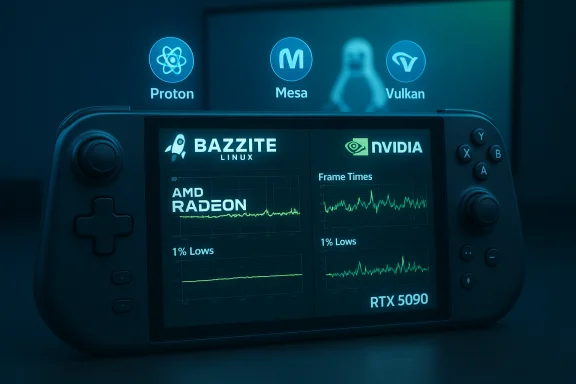
Gamers Nexus’ recent deep dive into GPU performance on Bazzite — a gaming‑focused, SteamOS‑style Linux distribution — delivers a striking, sometimes contradictory picture: Linux gaming has matured to the point where top‑end frame rates are demonstrably achievable, but hardware vendor choices and driver maturity still shape who actually benefits. The channel’s benchmarks, summarized by NotebookCheck and amplified across enthusiast communities, show AMD GPUs delivering steadier, more predictable results under Bazzite while some Nvidia cards produced inconsistent scores and odd frame‑pacing problems — a technical story that matters to anyone weighing a Linux switch for gaming.
Bazzite is an immutable, handheld‑focused Linux distribution built to give Steam/Proton games a console‑like experience with tuned Mesa stacks, curated kernel builds, and a lightweight compositor. It arrives in the same ecosystem that made the Steam Deck popular and is increasingly used by enthusiasts as a Windows alternative for dedicated gaming machines. The distribution bundles Proton, tuned Mesa/Vulkan drivers, utilities for TDP/fan control, and a launcher‑first UX designed to reduce background noise and deliver steadier frame times.
Gamers Nexus’ recent round of tests sought to answer a targeted question: how do modern discrete GPUs perform on Bazzite when running triple‑A titles through native Linux ports or Proton/compatibility layers? The tests intentionally focused on Linux behavior rather than a direct Linux vs Windows head‑to‑head, acknowledging the measurement challenges and incompatibilities inherent in cross‑OS benchmarking. That methodological caution is essential: measuring the two ecosystems with identical toolchains is rarely possible, so the emphasis was on Linux‑side comparatives across GPUs.
However, the platform transition will be incremental: vendor driver openness (or lack thereof), studio decisions about anti‑cheat, and the pace of compatibility tooling will determine whether Linux becomes a mainstream replacement for Windows gaming or remains a viable alternative for a significant niche of users. AMD’s open contributions to Mesa and driver stacks are a huge tactical advantage for Linux adoption in the near term; Nvidia’s position will improve only if driver distribution and testing on modern kernels become more consistent.
The realistic path forward looks like this:
The takeaway for PC gamers and buyers is pragmatic: treat these results as evidence of opportunity, not a general switch instruction. If the idea is to optimize for perceptual smoothness and you’re prepared to dual‑boot or tinker, Bazzite offers a real improvement in many scenarios. If your library and social gaming life live in ecosystems that demand kernel‑level anti‑cheat or tight Windows integration, staying put — for now — is the more practical route. Either way, the continuing improvements in Mesa, Proton, and distro packaging make this an exciting time for Linux gaming; Nvidia’s quirks remind us that the software stack is as important as the silicon underneath.
Source: Notebookcheck Linux GPU benchmarks impress in Windows gaming alternative Bazzite, but Nvidia is inconsistent
 Background / Overview
Bazzite is an immutable, handheld‑focused Linux distribution built to give Steam/Proton games a console‑like experience with tuned Mesa stacks, curated kernel builds, and a lightweight compositor. It arrives in the same ecosystem that made the Steam Deck popular and is increasingly used by enthusiasts as a Windows alternative for dedicated gaming machines. The distribution bundles Proton, tuned Mesa/Vulkan drivers, utilities for TDP/fan control, and a launcher‑first UX designed to reduce background noise and deliver steadier frame times.Gamers Nexus’ recent round of tests sought to answer a targeted question: how do modern discrete GPUs perform on Bazzite when running triple‑A titles through native Linux ports or Proton/compatibility layers? The tests intentionally focused on Linux behavior rather than a direct Linux vs Windows head‑to‑head, acknowledging the measurement challenges and incompatibilities inherent in cross‑OS benchmarking. That methodological caution is essential: measuring the two ecosystems with identical toolchains is rarely possible, so the emphasis was on Linux‑side comparatives across GPUs.
What Gamers Nexus did (and why it matters)
Gamers Nexus selected an array of modern GPUs — including flagship and midrange models — and ran a suite of games on Bazzite. Notable GPU models included the Nvidia RTX 5090 and midrange RTX 5060, AMD Radeon RX 9070 XT and RX 9060 XT, and a handful of Intel Arc offerings. The test slate mixed demanding modern titles (Starfield, Baldur’s Gate 3, Black Myth: Wukong) with other engines to stress driver and runtime behavior under Linux. Key procedural notes from Gamers Nexus’ run:- They froze updates in Bazzite to maintain a stable test baseline — a conservative choice that prevents mid‑test driver or runtime changes but can also miss performance fixes pushed later.
- The channel avoided direct Windows comparisons using the same capture tools because the measurement stacks differed; instead, they focused on relative GPU behavior within the Linux environment.
- Acknowledging reproducibility limits, they warned viewers that kernel, Mesa, Proton, and driver versions materially affect results.
Key findings: performance headlines and surprises
AMD’s consistency vs Nvidia’s variability
- AMD GPUs generally delivered steadier, more consistent frame pacing across the tested games under Bazzite. The Radeon RX 9070 XT repeatedly scored competitively and offered smoother frame‑time graphs in titles where Nvidia’s flagship hardware misbehaved.
- Nvidia’s results were uneven. In several titles the RTX 5090 produced high peak averages but displayed frame‑pacing anomalies and unexplained regressions in Linux builds, sometimes yielding worse perceived gameplay than cheaper AMD alternatives. Gamers Nexus highlighted twitchy frame times and occasional odd marks in games like Baldur’s Gate 3 and Starfield.
Specific numbers that defined the narrative
- In Black Myth: Wukong at 1080p, Gamers Nexus measured the RTX 5090 at roughly 114.8 fps average but noted severe frame‑pacing and microstutter. The RX 9070 XT sat at ~105.2 fps with considerably steadier frame‑times — an outcome where the cheaper card offered the better subjective experience. Reported averages came from the channel’s Linux runs and were summarized in recent coverage. These figures should be read as Bazzite‑specific and contingent on the exact Mesa/Proton/driver stack used during testing.
- In Starfield, even at 4K, the RX 9070 XT topped the charts in some runs, with the RTX 5090 barely ahead in average numbers but far worse in pacing. That result underlines how driver maturity and API/renderer differences can flip expectations that normally favor Nvidia on Windows.
When Windows builds run through compatibility layers, results can change
Gamers Nexus also observed that running Windows versions of some titles through Proton or compatibility layers altered performance — in some cases improving Nvidia outcomes relative to their native Linux builds. That underscores two things: first, the game build (native Linux vs Windows binary) matters enormously; second, compatibility layers are now sophisticated enough to sometimes bridge gaps but can’t fix kernel‑level anti‑cheat or driver issues.Technical deep dive: why do results diverge?
1) Driver model differences and packaging
- AMD and Intel maintain more open, upstream‑friendly Linux driver stacks (Mesa, RADV, RadeonSI, Intel’s Gallium drivers). That openness enables rapid fixes and tight integration with kernel updates, which is especially valuable for Vulkan performance and shader handling.
- Nvidia’s historically proprietary driver model means binary blobs, special packaging, and occasional regressions when kernel or Mesa versions change. While Nvidia has made strides with Linux support, edge cases remain and sometimes manifest as inconsistent performance or frame‑pacing anomalies on newer titles. Gamers Nexus’ tests reflect these legacy constraints in real gameplay.
2) Shader compilation, caching, and runtime behavior
Modern engines compile or JIT many shader permutations at runtime. The timing and blocking behavior of those compilations can create visible hitches. Linux stacks using Proton + Mesa often use different caching strategies or patched precompile behaviors that can reduce blocking stalls; conversely, a given vendor driver’s shader pipeline might increase spikes under certain workloads. The upshot is that average FPS alone isn’t the whole story — 1% and 0.1% lows and frame‑time variance drive perceived smoothness.3) Power governors, thermal profiles, and compositor overhead
Bazzite’s tuned kernel and userland utilities expose direct TDP sliders, governors, and fan curves, which can help maintain steadier sustained clocks and prevent “burst then throttle” cycles that distort averages. Windows builds — especially OEM images with background utilities — can produce scheduling noise that exacerbates frame‑time variance on thermally constrained hardware. Gamers Nexus’ handheld‑focused notes emphasize these systemic differences.Compatibility and anti‑cheat: the practical blocker
One of the largest non‑performance constraints for switching to Linux gaming is anti‑cheat compatibility. Many modern multiplayer titles rely on kernel‑level anti‑cheat systems (examples from the industry include EA’s Javelin and various proprietary solutions) that either require platform‑specific kernel hooks or strict Secure Boot behavior — implementations that currently prevent reliable play on many Linux distributions. Reporting from Tom’s Hardware and Windows Central explains that Battlefield 6’s Javelin requirement and other vendor choices effectively block SteamOS/Bazzite users from playing those titles unless the developer invests in Linux support or grants compatibility.- Some anti‑cheat solutions, like BattlEye, have Linux support options (and can be supported on Proton if the developer opts in), but many studios choose not to support Linux because of additional engineering or perceived security vector concerns. The result: even if raw performance is comparable, an entire class of multiplayer titles remains inaccessible on many Linux gaming stacks.
Cross‑checks and corroboration: what independent sources show
- NotebookCheck summarized Gamers Nexus’ Linux tests and highlighted the same major trends: AMD’s steadiness vs Nvidia’s inconsistent Linux performance, and the difficulty of doing direct Windows/Linux comparisons because of tooling differences.
- Gamers Nexus’ own coverage and GPU reviews (including recent RX 9070 and RTX family tests) provide primary measurement context showing that AMD’s latest cards are competitive in raster workloads and that Linux behavior can vary by driver and game. These primary GN outputs back the channel’s conclusions and provide technical logs that corroborate the NotebookCheck summary.
- Community reaction — visible in Reddit and enthusiast forums — reinforces the pattern: many Bazzite users report excellent AMD experiences and occasional Nvidia headaches, with practical troubleshooting threads recommending driver rollbacks or specific Bazzite releases to stabilize Nvidia cards. That community data is noisy but useful as a real‑world validation of the measured inconsistencies.
Practical guidance: should you switch to Bazzite for gaming?
The answer depends on use case, tolerance for tinkering, and game library:- If you primarily play single‑player, shader‑heavy AAA games and want a lean, console‑like gaming OS where perceptual smoothness matters, Bazzite can deliver visible benefits — especially with AMD GPUs, which tend to be the safer choice on Linux right now.
- If you rely on Game Pass, frequent multiplayer with modern anti‑cheat systems, or vendor OEM utilities (Armoury Crate features, Windows‑only updaters), keep Windows — or at least dual‑boot. Bazzite and Proton simply cannot run many protected multiplayer titles today.
- If you own Nvidia hardware and prefer a hands‑off experience, be prepared for more troubleshooting today than with AMD. Community tips include:
- Trying specific driver versions (some users report greater stability on older 565/566 branches in certain Bazzite snapshots).
- Rebasing Bazzite to an earlier release if a new driver stack introduces regressions.
- Testing individual game builds in Proton Experimental vs native Linux ports to see which path yields the best pacing.
- Back up Windows and keep recovery media; never overwrite a primary gaming drive without a fallback.
- Try Bazzite via a live image or an external SSD first to validate hardware and driver behavior.
- Dual‑boot for a transitional period — keep Windows for multiplayer and daily tasks, use Bazzite for focused single‑player sessions.
- If you commit to Linux, favor AMD GPUs for fewer surprises; check ProtonDB and community threads for title‑specific guidance.
Risks, unresolved issues, and red flags
- Anti‑cheat and multiplayer lockouts remain the single biggest blocker for a full migration. Until major studios either adopt Linux‑friendly anti‑cheat or Proton/Valve develop robust compatibility layers that respect security constraints, many online experiences will remain Windows‑exclusive. This is not a performance problem but a platform policy and engineering gap.
- Driver regressions and version sensitivity: Nvidia’s closed driver model can mean sudden regressions when kernels or Mesa change. Users may need to chase driver versions or rely on community fixes. That fragility can be a significant productivity and playtime cost for casual users.
- Measurement variance: Because Gamers Nexus froze updates to stabilize their Linux baseline, their results are a snapshot; vendor patches after that freeze could materially change outcomes. Any decision based on these numbers should factor in the possibility that a later driver or Mesa update will alter the landscape.
- Edge cases for HDR/VRR and display features: Some users reported color/HDR and VRR quirks when swapping GPU vendors and OS stacks. These are solvable but often require hands‑on configuration — another reason the switch is better suited to tinkerers and enthusiasts.
Where the ecosystem is headed (analysis and outlook)
Linux gaming stacks have improved rapidly: Proton has matured, Mesa receives frequent upstream work, and Valve’s investments via the Deck and compatibility tooling have created a rich, practical environment for many titles. That progress explains how Bazzite can now host benchmark‑quality runs and deliver smoother experiences in shader‑heavy single‑player games.However, the platform transition will be incremental: vendor driver openness (or lack thereof), studio decisions about anti‑cheat, and the pace of compatibility tooling will determine whether Linux becomes a mainstream replacement for Windows gaming or remains a viable alternative for a significant niche of users. AMD’s open contributions to Mesa and driver stacks are a huge tactical advantage for Linux adoption in the near term; Nvidia’s position will improve only if driver distribution and testing on modern kernels become more consistent.
The realistic path forward looks like this:
- Short term: Linux (Bazzite/SteamOS) excels for single‑player and many Proton‑friendly titles; AMD is the safer GPU buy for Linux.
- Medium term: Valve, driver vendors, and some studios will plug gaps; Proton and broader compatibility will expand the playable library but anti‑cheat remains a blocker for large multiplayer titles.
- Long term: If anti‑cheat vendors (or game studios) commit to cross‑platform solutions and vendor drivers stabilize, Linux could become a mainstream secondary platform for many gamers — not because it outperforms Windows in every case, but because it reduces background overhead and improves perceived smoothness in targeted scenarios.
Conclusion
Gamers Nexus’ Bazzite benchmarks are a milestone moment: they demonstrate that Linux gaming can deliver top‑end, real‑world performance, and that driver maturity — not raw silicon alone — decides the quality of the experience. For players who prioritize single‑player immersion and are comfortable tinkering, Bazzite is an increasingly compelling option, especially when paired with AMD GPUs. For mainstream gamers who depend on Game Pass, anti‑cheat multiplayer, or a completely hands‑off experience, Windows remains the safer choice.The takeaway for PC gamers and buyers is pragmatic: treat these results as evidence of opportunity, not a general switch instruction. If the idea is to optimize for perceptual smoothness and you’re prepared to dual‑boot or tinker, Bazzite offers a real improvement in many scenarios. If your library and social gaming life live in ecosystems that demand kernel‑level anti‑cheat or tight Windows integration, staying put — for now — is the more practical route. Either way, the continuing improvements in Mesa, Proton, and distro packaging make this an exciting time for Linux gaming; Nvidia’s quirks remind us that the software stack is as important as the silicon underneath.
Source: Notebookcheck Linux GPU benchmarks impress in Windows gaming alternative Bazzite, but Nvidia is inconsistent
