

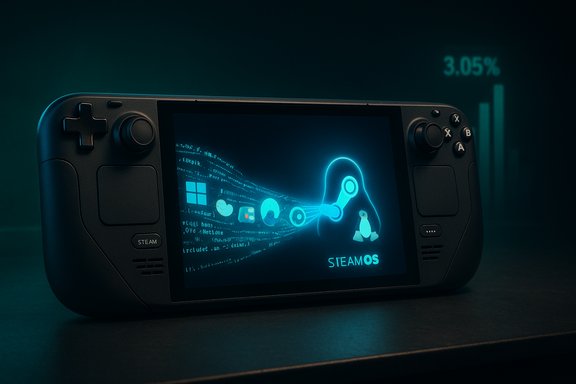
Linux gaming has quietly hit a milestone: Valve’s October Steam Hardware & Software Survey shows Linux at 3.05% of active Steam users for the first time, a symbolic but meaningful jump that reflects the combined effects of the Steam Deck/SteamOS ecosystem, better compatibility tooling (Proton), and growing dissatisfaction with Windows upgrade paths.
Steam’s Hardware & Software Survey is a voluntary monthly snapshot that developers and the industry use as a bellwether for what gamers actually run on their machines. In the October 2025 snapshot, Steam reports Windows at 94.84%, macOS at 2.11%, and Linux at 3.05% — the first time the Linux slice has cleared the 3% mark in the survey’s modern history. That same data shows SteamOS Holo (Valve’s SteamOS variant) accounting for roughly 27% of Linux installs on Steam, an indicator that handheld devices running SteamOS — primarily the Steam Deck — are a major contributor to the uptick. This isn’t a tectonic shift in desktop market share — Windows remains overwhelmingly dominant — but it is a practical inflection inside the gaming ecosystem. A higher Linux share on Steam affects developer testing priorities, anti‑cheat and DRM conversations, and the economics of supporting multiple OSes for new titles. The community reaction and coverage across multiple outlets have been consistent: the numbers matter because the Steam audience is the most active gaming segment and therefore the one publishers watch most closely.
What has changed is the operational landscape: publishers and platform owners must plan for a more pluralized environment where handheld first experiences, compatibility layers, and community telemetry influence product roadmaps. For users and IT managers, the practical advice is straightforward — test the titles that matter, verify anti‑cheat requirements, and treat Linux as a growing, viable option for many gaming scenarios, but not yet as a turnkey replacement for Windows when competitive multiplayer or vendor‑specific features are core to the experience.
Source: Windows Central Linux gaming just hit a major milestone — is Windows in trouble?
 Background / Overview
Steam’s Hardware & Software Survey is a voluntary monthly snapshot that developers and the industry use as a bellwether for what gamers actually run on their machines. In the October 2025 snapshot, Steam reports Windows at 94.84%, macOS at 2.11%, and Linux at 3.05% — the first time the Linux slice has cleared the 3% mark in the survey’s modern history. That same data shows SteamOS Holo (Valve’s SteamOS variant) accounting for roughly 27% of Linux installs on Steam, an indicator that handheld devices running SteamOS — primarily the Steam Deck — are a major contributor to the uptick. This isn’t a tectonic shift in desktop market share — Windows remains overwhelmingly dominant — but it is a practical inflection inside the gaming ecosystem. A higher Linux share on Steam affects developer testing priorities, anti‑cheat and DRM conversations, and the economics of supporting multiple OSes for new titles. The community reaction and coverage across multiple outlets have been consistent: the numbers matter because the Steam audience is the most active gaming segment and therefore the one publishers watch most closely. What the numbers actually mean
Steam’s snapshot — a gamer-centric sample
Steam’s survey is not a global OS census; it reflects the subset of Steam users who opt into the telemetry. That makes it especially valuable for publishers and developers, because these are the people buying and playing PC games. A move from roughly 2% to 3.05% in 12 months is small in absolute terms, but inside the Steam ecosystem it represents millions more sessions, installs, and playtime hours that weren’t on Linux a year ago.SteamOS concentration and handheld influence
Within that Linux cohort, SteamOS’s roughly 27% share means Valve’s handheld presence is shifting the composition of Linux gaming. Each Steam Deck counts as a Linux client in the survey even if the owner never thought of themselves as a Linux user before buying the device. That “silent migration” explains a lot of the numerical momentum: Steam Decks bring people to Linux by default.The difference between “can launch” and “works perfectly”
Community-driven compatibility metrics (ProtonDB, Deck Verified, and aggregated analyses such as Boiling Steam’s) show that most Windows games now launch under Proton/Wine on Linux. Industry commentary places the portion of Windows titles that at least start on Linux at roughly ~90%, but this is an aggregate of crowd-sourced reports and categories (Platinum/Gold/Silver/Bronze/Borked). Launchability is not the same as perfect, competitive, multi‑player ready performance — the nuance matters.Why Linux is gaining ground — the drivers of momentum
1) Steam Deck and SteamOS: hardware that changes behavior
The Steam Deck’s market effect is more than device sales; it’s behavioral. A user who buys a Deck interacts with a Linux-first gaming experience every day. Valve’s “Deck Verified” program plus continued firmware and OS improvements have reduced friction for ordinary gamers, and those Deck installs are showing up in Steam’s Linux numbers. Industry estimates and research groups describe the Deck as selling in the multiple‑millions range (estimates vary across firms), but Valve’s public positioning is intentionally conservative; the most reliable statement is that Deck sales are material and that they materially influence Linux install counts on Steam. Treat raw unit figures as market‑research estimates rather than precise public-company disclosures.2) Proton and the compatibility stack
Valve’s Proton (a gaming-focused downstream of Wine) combined with DXVK/VKD3D and modern Vulkan drivers has made it far easier for Windows‑only games to run on Linux. Community databases like ProtonDB and editorial analyses compiled by sites such as Boiling Steam show the proportion of games that no longer “bork” has fallen substantially. These improvements turn Linux from a hobbyist tinkering platform into an honest option for single‑player and many indie/AA titles. Multiple outlets report that almost nine in ten Windows games are now launchable on Linux to some degree. Again, the data source is community-driven and evolving.3) Windows transitions and user dissatisfaction
A non‑technical catalyst is Microsoft’s own product timeline: the end of free Windows 10 support and stricter Windows 11 requirements (hardware checks, TPM enforcement) pushed users into decision points. For machines that won’t meet Windows 11 requirements, Linux has become practical again as a supported, secure, and modern OS — and for many gamers the Steam Deck or a Linux trial offers a cheaper, lower‑friction alternative to buying a new PC or paying for extended security support. This calendar-driven pressure is real and measurable in survey and download spikes.The technical reality: compatibility, performance, and the anti‑cheat problem
Proton’s achievements and limits
- Proton has matured to the point where many modern DirectX titles render correctly on Linux thanks to DXVK (D3D9/10/11 → Vulkan) and VKD3D‑Proton for D3D12 translations.
- GPU driver improvements (Mesa for AMD/Intel and updated proprietary drivers from NVIDIA) reduce regressions and close performance gaps in many scenarios.
- However, not every title works perfectly. Frame pacing, shader compilation behavior, and platform‑specific integrations still require optimization per title and per hardware.
Anti‑cheat and multiplayer: the sticking point
The most persistent blocker for Linux’s mainstream gaming credibility is competitive multiplayer that relies on kernel‑level anti‑cheat systems. Solutions such as certain implementations of Easy Anti‑Cheat, BattlEye, and vendor-specific kernel components are often incompatible with Proton or require explicit publisher opt‑ins and vendor updates to support Linux. That leaves big multiplayer franchises and esports staples out of reach for many Linux players, because even if the game launches, the multiplayer component may refuse to connect or will be blocked by security checks. Until anti‑cheat vendors broadly adopt Linux‑friendly models, the majority of online competitive gaming will remain Windows‑centric.What this means for Windows — immediate implications and longer trends
Short term: Windows is not in crisis
Windows still controls nearly 95% of Steam’s active user base; that dominance ensures first‑class support for Windows in development roadmaps, day‑one driver optimizations, and anti‑cheat compatibility. A 3% Linux share on Steam is noticeable but not existential. Developers and publishers will continue to prioritize Windows for testing and certification because that’s where the money and the largest player base still are.Medium term: pressure points Microsoft must watch
- Handheld momentum and improved compatibility lower the barrier for some gamers to move off Windows.
- Developer toolchains, middleware, and publisher choices will respond to where engagement grows; multiple viable gaming platforms complicate binary decision‑making.
- Microsoft’s own moves — for example partnering in hardware-driven handheld efforts and introducing handheld-optimized Windows experiences — indicate it sees the strategic risk and is adapting (see announcements around the ROG Xbox Ally handhelds and their Windows-focused “handheld compatibility” programs as evidence of industry response).
Long term: pluralism, not replacement
A more likely outcome is a pluralized PC gaming ecosystem: Windows will remain the default for competitive multiplayer and complex AAA productions that rely on anti‑cheat and console‑level certification. Linux (through SteamOS and Proton) will carve out strong niches — handhelds, single‑player and indie-first catalogs, and cost-sensitive users who repurpose older hardware. For publishers, that reduces the risk of “single‑stack” dependency but does not erase the strategic advantage Windows holds today.Developer and publisher practical checklist
- Inventory platforms and prioritize testing: Windows first, then Windows handheld profiles, then experimental Linux/Proton test passes for high‑value titles.
- Reassess anti‑cheat dependencies: evaluate whether anti‑cheat vendors offer Linux/Proton-compatible runtimes or opt‑in support, and plan multiplayer launches accordingly.
- Consider “handheld readiness” as a certification target: measure input schemes, UI scaling, and performance budgets for handheld devices such as Steam Deck and ROG Xbox Ally.
- Monitor community compatibility data: ProtonDB, Deck Verified, and aggregated reports like Boiling Steam are fast indicators of real‑world playability.
- Document fallback strategies: maintain Windows‑only features behind feature flags where necessary and communicate platform limitations transparently to players.
Business and market signals: what to watch next
- Month‑over‑month Steam survey trends: sustained gains (rather than one‑off spikes) in Linux share will be the clearest signal of structural change. A single month passing 3% is meaningful; multiple consecutive increases would become operationally significant.
- Anti‑cheat vendor roadmaps: public commitments from the major anti‑cheat providers to support SteamOS/Proton or to offer opt‑in runtimes for Proton would materially change publishers’ risk calculus.
- Handheld installed base estimates: Valve and independent analysts give different unit numbers for the Steam Deck; treat these as estimates. If the Deck (and other handhelds like the ROG Xbox Ally) continue to sell in the multiple‑millions range, the population of habitual Linux gamers on Steam will grow accordingly.
- Developer announcements of native Linux ports: high‑profile native Linux releases (or publisher commitments to Proton-certified builds) will accelerate commercial confidence in the platform.
Strengths, risks and strategic takeaways
Strengths now visible for Linux gaming
- Compatibility tooling has matured: Proton, DXVK, VKD3D and modern drivers make a surprising number of Windows titles usable on Linux.
- Steam Deck acts as a distribution vector: SteamOS on handhelds introduces mainstream players to Linux by default.
- Cost and lifecycle advantages: For older hardware that fails Windows 11 checks, Linux provides an extensible, secure alternative without per‑device license costs.
Key risks and unresolved gaps
- Anti‑cheat and multiplayer incompatibility: Kernel‑level anti‑cheat remains the single largest technical hurdle that prevents Linux from being a one‑to‑one replacement for Windows in competitive gaming.
- Crowd‑sourced data limitations: ProtonDB and similar tools are invaluable but crowdsourced; headline percentages (like “~90% playable”) represent the state of reports, not an absolute engineering audit. Interpret them with caution.
- Hardware and driver variability: while AMD/Intel open drivers and Mesa have improved, proprietary NVIDIA drivers and platform-specific configurations still cause regressions that can affect the out‑of‑box experience.
Strategic takeaways for stakeholders
- For developers: test, measure, and communicate. Prioritize Windows but build a plan to certify or monitor Linux playability if your title is likely to attract Deck or handheld players.
- For publishers: engage anti‑cheat vendors proactively and weigh the benefits of enabling Linux‑friendly runtimes where feasible.
- For Microsoft: adaptation beats denial. Microsoft’s partnership-led handheld initiatives show a recognition that the gaming ecosystem is changing; the company’s long-term strength will depend on adapting Windows to be the best gaming host — especially for handheld and hybrid experiences.
Caveats and unverifiable claims
- Steam Deck unit sales are widely reported as “multiple millions” but exact figures vary by analyst and vendor; Valve’s public statements have been intentionally non‑specific. Use IDC/industry estimates as directional rather than authoritative.
- The “~90% of Windows games playable on Linux” headline comes from aggregated, community‑sourced ProtonDB/Boiling Steam analyses and should be read as launchability coverage rather than a guarantee of flawless gameplay or competitive online access for every title. This is an important distinction when planning platform support or communicating with customers.
Conclusion
Linux crossing the 3.05% threshold on Steam is more than a symbolic news item — it is a measurable outcome of device-driven adoption (Steam Deck/SteamOS), significant engineering progress in Proton and the graphics translation stack, and a calendar of Windows transitions that nudged users to explore alternatives. That said, Windows is not in immediate peril: the platform still dominates Steam and will remain the priority for most studios because of sheer scale and anti‑cheat realities.What has changed is the operational landscape: publishers and platform owners must plan for a more pluralized environment where handheld first experiences, compatibility layers, and community telemetry influence product roadmaps. For users and IT managers, the practical advice is straightforward — test the titles that matter, verify anti‑cheat requirements, and treat Linux as a growing, viable option for many gaming scenarios, but not yet as a turnkey replacement for Windows when competitive multiplayer or vendor‑specific features are core to the experience.
Source: Windows Central Linux gaming just hit a major milestone — is Windows in trouble?
