

The quiet exodus away from Windows that accelerated through 2025 is no longer a fringe narrative: a combination of lifecycle deadlines, hardware gating, improved Linux usability, and geopolitical concerns has pushed everyday users — not only hobbyists — to seriously consider Linux as a practical alternative. What began as a trickle of curious ISO downloads has become measurable momentum: mainstream distributions timed to the Windows‑10 end‑of‑support window reported unprecedented trial activity, commercial scans of millions of endpoints show Linux share rising into the low single digits and beyond, and enterprise readiness reports confirm large swaths of devices either won’t or can’t move to Windows 11 without replacement. The result is a rare market inflection where Linux is no longer only a tinkerer’s playground but a pragmatic, sometimes necessary, option for people who want control, privacy, and longer device lifetimes.
Microsoft’s lifecycle decision to end mainstream support for Windows 10 created an unavoidable deadline for hundreds of millions of PCs and their owners. That calendar event forced a simple operational question: upgrade to Windows 11 where possible, buy into limited Extended Security Updates (ESU), replace the device, or move to another supported operating system. The combination of Windows 11’s stricter hardware requirements (TPM, Secure Boot and curated CPU lists), the costs of hardware refreshes, and rising concerns about telemetry and AI‑centric features in Windows 11 left many people searching for alternatives.
Two kinds of evidence best describe the shift: hard telemetry (web analytics and asset scans) and product‑level signals (distro download spikes and forum activity). Each has limitations — download counts are not installs, and web analytics samples depend on the sites measured — but together they point to a meaningful increase in user interest and practical migration attempts.
Other practical headwinds remain:
If you care about device longevity, privacy, or avoiding forced hardware churn, today’s Linux distributions are worth testing. If you manage enterprise fleets, include Linux and ChromeOS Flex in your migration playbooks where application and peripheral compatibility allow. For gamers and creators, the Proton story has made Linux a viable platform for many titles — but validation per title and per anti‑cheat requirement remains essential.
Conclusion: The migration wave is not a one‑time headline; it is a multi‑year trend accelerated by hard deadlines, product design choices and shifting public sentiment. For many users — especially those on older hardware, privacy‑conscious citizens in jurisdictions prioritizing digital sovereignty, and gamers whose titles work on Proton — Linux has transitioned from “an experiment” to a practical alternative. The next chapters will be written not by headlines alone, but by retention data, vendor commitments, and how well the broader ecosystem fixes the remaining friction points.
Source: ZDNET Why people keep flocking to Linux in 2025 (and it's not just to escape Windows)
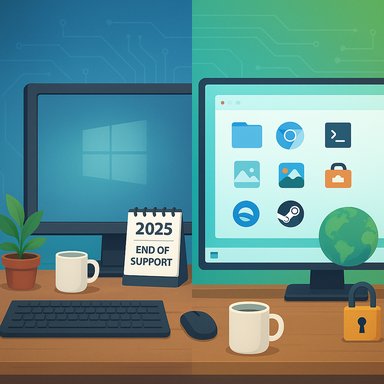 Background / Overview
Microsoft’s lifecycle decision to end mainstream support for Windows 10 created an unavoidable deadline for hundreds of millions of PCs and their owners. That calendar event forced a simple operational question: upgrade to Windows 11 where possible, buy into limited Extended Security Updates (ESU), replace the device, or move to another supported operating system. The combination of Windows 11’s stricter hardware requirements (TPM, Secure Boot and curated CPU lists), the costs of hardware refreshes, and rising concerns about telemetry and AI‑centric features in Windows 11 left many people searching for alternatives.Two kinds of evidence best describe the shift: hard telemetry (web analytics and asset scans) and product‑level signals (distro download spikes and forum activity). Each has limitations — download counts are not installs, and web analytics samples depend on the sites measured — but together they point to a meaningful increase in user interest and practical migration attempts.
The data that matters right now
The desktop numbers: StatCounter and others
Public web‑analytics trackers have recorded clear growth for desktop Linux. StatCounter’s public dashboard and related reporting show Linux desktop share climbing into the mid single digits in the U.S. in 2025 — a milestone that has been covered widely by the trade press. These measurements vary by methodology and region, but they converge on the same trend: desktop Linux is growing from a very small base and its growth is now visible in mainstream metrics. Why this matters: even a few percentage points in a large market translate to millions of users, and for the desktop ecosystem that creates real downstream effects — more community momentum, more support from hardware vendors and ISVs, and more attention from mainstream press and retailers.Government traffic and the “real world” sample
The U.S. federal Digital Analytics Program (DAP), which aggregates billions of sessions across government websites, shows a higher Linux footprint than many public trackers report; DAP’s dataset reflects actual visitor sessions to hundreds of government domains and is less susceptible to sampling quirks than some market trackers. Analysts using DAP data reported Linux desktop share rising into the mid‑single digits, and when ChromeOS and Android are grouped with Linux’s kernel lineage, the user‑facing footprint becomes a very large slice of daily online activity. Treat these figures as a specific sample (web visitors to government sites), not a full census, but they corroborate the upward trend seen elsewhere.Asset scans: Lansweeper and enterprise readiness
Independent scans and vendor reports provide another lens. A large‑scale inventory analysis from Lansweeper covering more than 15 million consumer desktop operating systems found Linux desktops at just over 6% of identified systems — a figure that aligns with both web metrics and distribution‑level signals. Meanwhile, ControlUp’s Windows‑11 readiness studies show many endpoints in enterprises remain on Windows 10 and that a significant minority of consumer and business machines will need replacement to reach Windows 11 — a dynamic that naturally favors alternative OS adoption where replacement is impractical or undesired.The “Zorin phenomenon”: a case study in timing and product fit
Zorin OS 18 — a distribution intentionally pitched at Windows switchers — passed the one‑million‑downloads mark in just over a month after launch, and the Zorin Group reported roughly 78% of those downloads originated from Windows devices. That single headline captures the moment: many users are not merely curious; they are actively testing alternatives because the Windows upgrade path is blocked, expensive, or unappealing. Multiple mainstream outlets and the Zorin team itself published and corroborated these numbers. Still, downloads are a leading indicator — trials, not guaranteed conversions — but the scale and the composition of those trials are notable.Why Linux is suddenly a practical option — five converging drivers
- Hard hardware gating for Windows 11. TPM 2.0, Secure Boot, and curated CPU support produce a categorical division: many perfectly functional machines are not vendor‑supported for Windows 11. For users on limited budgets, forcing a new‑hardware purchase is untenable. ControlUp and industry scans quantify how many endpoints are either “ready but unupgraded” or “incompatible and require replacement,” and the cost calculus pushes some users toward Linux.
- Windows‑10 end of support created a behavioral deadline. A vendor stop to free security patches is a practical threat vector: the risk profile of continuing on an unsupported platform changes immediately. ESU is a possible bridge but it’s time‑boxed and, for many, awkward or costly. The October 14, 2025 cutoff was the inflection point that turned latent curiosity into active migration tests.
- Ease of use has improved dramatically. Distributions such as Zorin, Linux Mint, and Ubuntu prioritize a familiar desktop metaphor, polished GUIs, and guided migration tooling. Today’s mainstream distros include streamlined installers, live‑USB testing, automatic hardware detection, and curated app stores — reducing the friction that once kept casual users away. Zorin’s product positioning explicitly targets Windows migrants and shows how design choices lower the cognitive cost of switching.
- Gaming compatibility is no longer the Achilles’ heel it used to be. Valve’s investment in Proton and the steady improvements to the Direct3D→Vulkan translation stack have made thousands of Windows titles playable on Linux — not perfectly in every case, but well enough for many gamers. Proton updates in 2024–2025 materially expanded compatibility and solved specific multi‑GPU/driver issues, narrowing a key gap between Linux and Windows for entertainment‑focused users.
- Digital‑sovereignty and privacy concerns — especially in Europe. Some governments and enterprises treat vendor cloud promises with skepticism and prioritize software and platforms that allow them to keep control over data and infrastructure. Open‑source distros, locally managed update channels, and the ability to host services on domestic infrastructure make Linux a policy fit for jurisdictions worried about foreign control of data. Those policy choices have real procurement implications.
What’s changed in the ecosystem — practical signals
- Distros timed to the Windows‑10 EOL released migration aids and OneDrive/Office continuities, which reduced friction for business and home users.
- OEM and refurbisher conversations about pre‑installed Linux options gained traction in budget and sustainability channels.
- Migration tooling from community and third‑party projects — automated data movers, app‑mapping toolkits, and imaging solutions — matured and lowered manual steps.
- Anti‑cheat and vendor driver gaps remain, but vendor‑level fixes and workarounds are appearing more frequently, often driven by the sizable Steam Deck and Proton userbase.
Risks, limits, and what the data does not prove
It’s important to distinguish curiosity from durable migration. Headlines citing a million downloads are impressive, but they do not equate to one million long‑term, daily‑use Linux desktops. Download telemetry measures intent to test or to stage an install — some downloads are mirrored, some are repeated, and many are for VM/live‑USB use. Independent analysts and the Zorin team themselves caution that downloads are a leading signal; follow‑up metrics (active installs, retention, enterprise adoption contracts) are the ultimate measures of success. Treat the download milestone as evidence of scale of interest, not guaranteed conversion.Other practical headwinds remain:
- Proprietary vertical apps and device drivers: specialised accounting software, vendor‑locked scanners, and some peripherals present real compatibility blockers for businesses and certain prosumer workflows.
- Anti‑cheat and multiplayer gaming: while Proton has closed the gap for many titles, some competitive games still rely on kernel‑level anti‑cheat that blocks Linux play.
- Support and training for non‑technical users: community support is strong, but organizations requiring formal SLAs and vendor warranties will weigh migration costs (training, support contracts) against refresh or ESU options.
- Fragmentation and testing complexity: the Linux ecosystem’s diversity can increase testing complexity for ISVs and enterprise deployment teams.
The geopolitical angle: digital sovereignty and public‑sector moves
Public procurement in many European countries and some other jurisdictions increasingly factors sovereignty, local control, and auditability into IT strategy. When a vendor’s cloud or telemetry model conflicts with a government’s data‑residency and audit requirements, open‑source solutions and on‑prem alternatives gain an edge. Proof‑of‑concept national desktops and local Fedora/KDE‑based images have cropped up as experiments in providing sovereign alternatives to vendor‑managed ecosystems. For agencies and institutions where policy trumps convenience, Linux is now a credible procurement choice rather than an academic exercise.Practical migration playbook (for households, IT teams and small orgs)
- Backup first. Always. Local + cloud copies for critical data.
- Try before you commit. Create a live USB and run the distro on your hardware to test Wi‑Fi, GPU acceleration, and peripherals.
- Inventory critical apps and vendors. Identify anything that is Windows‑only; investigate ProtonDB, Wine, native Linux ports, or virtualization/cloud fallback options.
- Pilot and measure. Start with non‑critical machines or shared lab devices. Instrument the pilot: patch success rates, driver issues, support incidents and time‑to‑onboard.
- Keep fallbacks. Dual‑boot, a small Windows VM, or a retained Windows device for legacy apps is an appropriate short‑term strategy.
- Invest in user training and documentation. A few hours of onboarding materials or drop‑in workshops will significantly reduce support churn in the first three months.
- For enterprises: run a TCO comparison that includes training, support contracts, and lifecycle costs — don’t compare OS license cost alone.
- Test: Live‑USB day — test printers, network storage mounts, video playback, and Steam/Proton for gamers.
- Pilot: 10–50 devices — measure support calls over 30 days.
- Rollout: phased 20–30% per quarter, with a single‑click rollback image for easy recovery.
What Microsoft and the ecosystem may do next
Microsoft has the resources to respond by reducing upgrade friction for borderline hardware, improving messaging about device lifecycle, or offering more flexible transitional options to retain customers. The company also continues to integrate Linux into developer tooling (WSL, Azure integrations) — a strategy that both acknowledges Linux’s developer relevance and reduces the urgency for some users to abandon Windows entirely. That said, the structural tradeoffs between platform evolution (security, AI integration) and preserving a broad installed base remain real. If Microsoft makes the upgrade path less painful, the migration tide could slow; if not, the combination of cost pressure, privacy concerns, and improved Linux experiences will sustain the momentum.The newsroom verdict: pragmatic momentum, not inevitability
The pattern we’re seeing in 2025 is not a sudden overthrow of Windows. Instead, it’s a multi‑vector movement where practical forces — end‑of‑support deadlines, hardware gating, cost pressures, privacy policy and improved compatibility — converge to make Linux a real and usable alternative for millions of people. The Zorin OS download surge is the clearest single signal of that shift: it reflects a mass of Windows users actively testing an alternative because other paths were blocked or unappealing. But downloads alone are not a market crown; long‑term conversion will depend on retention, vendor support, and the resolution of vertical and peripheral edge cases.If you care about device longevity, privacy, or avoiding forced hardware churn, today’s Linux distributions are worth testing. If you manage enterprise fleets, include Linux and ChromeOS Flex in your migration playbooks where application and peripheral compatibility allow. For gamers and creators, the Proton story has made Linux a viable platform for many titles — but validation per title and per anti‑cheat requirement remains essential.
Bottom line
Linux in 2025 is no longer only an ideological alternative; it is a pragmatic choice for significant cohorts of users. The trend is driven by structural market forces and validated by multiple independent datasets: public web trackers, government analytics, large asset inventories, and focused product metrics from distribution projects. The headline numbers — a million downloads for a homeowner‑focused distro and low‑single‑digit desktop shares turning into mid‑single digits in targeted samples — are meaningful because they reflect real people testing a different path in reaction to tangible cost and policy pressures. The evolution will be gradual, uneven, and sector‑specific, but the question is no longer whether Linux can be a credible choice — it demonstrably is. The more important question now is how vendors, governments, and enterprises respond as that choice becomes a sustained option for everyday computing.Conclusion: The migration wave is not a one‑time headline; it is a multi‑year trend accelerated by hard deadlines, product design choices and shifting public sentiment. For many users — especially those on older hardware, privacy‑conscious citizens in jurisdictions prioritizing digital sovereignty, and gamers whose titles work on Proton — Linux has transitioned from “an experiment” to a practical alternative. The next chapters will be written not by headlines alone, but by retention data, vendor commitments, and how well the broader ecosystem fixes the remaining friction points.
Source: ZDNET Why people keep flocking to Linux in 2025 (and it's not just to escape Windows)
