

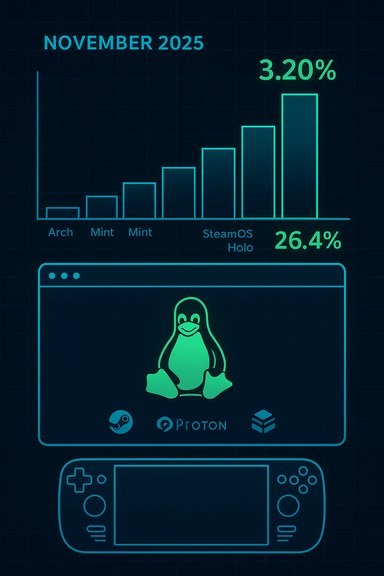
Linux’s share of active Steam clients climbed again in November 2025, hitting 3.20 percent of the platform’s reported user base — a new all‑time high and the second consecutive monthly gain after October’s breakthrough — driven largely by SteamOS installs, growth in gaming‑focused distributions such as Bazzite, and continuing improvements to Valve’s Proton compatibility layer.
Steam’s monthly Hardware & Software Survey is a voluntary, anonymous snapshot of the software and hardware Steam clients report when they opt into Steam’s telemetry. While it is not a global PC‑market census, it’s the single most important dataset that game developers and publishers use to gauge where active PC gamers actually play, which makes even small percentage shifts operationally significant. Valve’s November 2025 snapshot lists Windows at roughly 94.79 percent, macOS at 2.02 percent, and Linux at 3.20 percent, representing a measured but meaningful move in the platform mix. Within the Linux slice, Valve’s own SteamOS Holo — the OS used by the Steam Deck and other SteamOS installs — remains the dominant entry, accounting for about 26.4 percent of Linux Steam clients in November’s breakdown. Behind SteamOS you’ll find a growing set of distributions: Arch, Linux Mint, CachyOS, Bazzite, Ubuntu, and an identifiable Flatpak/Freedesktop SDK runtime presence, each contributing small but rising shares. This movement did not appear in isolation. Microsoft’s formal end‑of‑support for Windows 10 on October 14, 2025 created a calendar pressure point that, for many users, made alternatives worth testing. Microsoft documents the end‑of‑support date and the recommended upgrade and ESU (Extended Security Updates) options, which left a cohort of users with the realistic choice: upgrade hardware, pay for temporary support, or try another OS. That decision point amplified interest in Linux, and some of that interest is now visible inside Steam’s survey.
What to monitor in 2026:
The numbers themselves are modest, but the trajectory and the underlying engineering and product signals are what matter. If the November uptick becomes part of a sustained trend, developers, anti‑cheat vendors and OEMs will have to treat Linux not as an edge case but as an operational reality. For now, cautious optimism is the correct posture: test carefully, plan explicitly, and treat Linux as a growing alternative that’s increasingly capable — but still bounded by clear technical and commercial limits.
Source: The Verge Linux usage on Steam hits a record high for the second month in a row
 Background
Steam’s monthly Hardware & Software Survey is a voluntary, anonymous snapshot of the software and hardware Steam clients report when they opt into Steam’s telemetry. While it is not a global PC‑market census, it’s the single most important dataset that game developers and publishers use to gauge where active PC gamers actually play, which makes even small percentage shifts operationally significant. Valve’s November 2025 snapshot lists Windows at roughly 94.79 percent, macOS at 2.02 percent, and Linux at 3.20 percent, representing a measured but meaningful move in the platform mix. Within the Linux slice, Valve’s own SteamOS Holo — the OS used by the Steam Deck and other SteamOS installs — remains the dominant entry, accounting for about 26.4 percent of Linux Steam clients in November’s breakdown. Behind SteamOS you’ll find a growing set of distributions: Arch, Linux Mint, CachyOS, Bazzite, Ubuntu, and an identifiable Flatpak/Freedesktop SDK runtime presence, each contributing small but rising shares. This movement did not appear in isolation. Microsoft’s formal end‑of‑support for Windows 10 on October 14, 2025 created a calendar pressure point that, for many users, made alternatives worth testing. Microsoft documents the end‑of‑support date and the recommended upgrade and ESU (Extended Security Updates) options, which left a cohort of users with the realistic choice: upgrade hardware, pay for temporary support, or try another OS. That decision point amplified interest in Linux, and some of that interest is now visible inside Steam’s survey. What the November numbers actually say
Key figures at a glance
- Linux overall on Steam: 3.20% (November 2025), up from October.
- SteamOS Holo share among Linux clients: ~26.4%.
- Windows combined on Steam: ~94.79% (Windows 11: 65.59%, Windows 10: 29.06%).
Distribution breakdown (highlights)
Gaming‑centric distros and packaging formats that ease installation and runtime consistency are the most notable contributors to November’s movement:- SteamOS Holo (64‑bit): ~26.42% of Linux installs.
- Arch Linux, Linux Mint, CachyOS, Bazzite, Ubuntu all appear with low‑single digit shares, with month‑over‑month growth visible for Bazzite and CachyOS in particular.
- Freedesktop SDK / Flatpak runtime entries show a material presence and the largest month‑over‑month uptick among non‑OS entries, indicating many Steam users now run the Flatpak runtime variant of Steam.
Why this is happening: drivers and catalysts
1) The Steam Deck and SteamOS momentum
The Steam Deck’s simple but powerful product proposition — a portable, Linux‑based device that runs mainstream PC games with built‑in Proton compatibility and a clear “Deck Verified” compatibility program — created a large downstream effect. Each Deck counts as a Linux client in Steam’s survey, and the Deck’s popularity materially increased the number of active Linux sessions Steam measures. Valve’s broader SteamOS work, including updates that support a wider ecosystem of handhelds, further extends that footprint beyond Valve’s own hardware.2) Proton and the translation stack
Valve’s compatibility stack — Proton, DXVK, and VKD3D‑Proton — has continued to advance through 2025. The translation layers now handle many modern DirectX features more robustly, and recent releases added support for newer upscaling and performance features (VKD3D‑Proton 3.0 brought notable improvements, including FSR4 support and a major shader backend rewrite), which increases the playable surface area for Windows titles on Linux. Those technical gains make conversions less risky for typical single‑player and many indie titles.3) Packaging, runtimes and gaming‑focused distros
The appearance of Flatpak (Freedesktop SDK) as a visible entry in Steam’s survey and the month‑over‑month gains in gaming‑oriented distributions such as Bazzite and CachyOS reflect two linked trends: better packaging reduces install friction, and distros that ship kernels, driver stacks, and gaming tools out of the box make the Linux experience more turnkey. Some distros explicitly position themselves as SteamOS alternatives for users who want a Deck‑like experience on a standard PC; that positioning appears to be paying off.4) A calendar pressure: Windows 10 end‑of‑support
Microsoft’s documented end‑of‑support for Windows 10 on October 14, 2025 created an external, time‑bounded nudge for users. For many people with older hardware that does not meet Windows 11’s requirements (TPM, CPU generation), the decision paths were pragmatic: pay for extended support, buy new hardware, or test an alternative OS. That natural decision window aligns with observed increases in Linux exploration and downloads of user‑friendly distros.What this means for gamers, developers and vendors
Gamers
- Single‑player and indie gamers now have a much stronger argument to try Linux. Proton covers a large portion of the catalog well enough for everyday play, and the Steam Deck experience showed many players they can comfortably game on Linux.
- Competitive and anti‑cheat‑dependent players will still find Windows the safer choice. Major anti‑cheat systems have added Proton‑support paths, but adoption is opt‑in and uneven; many top multiplayer titles remain effectively Windows‑only because publishers don’t enable those runtime paths. This is the single largest functional barrier to broad Linux parity.
Developers and publishers
- A measurable Linux base inside Steam increases the commercial incentive to at least validate Proton compatibility. For many studios the cost of adding a Proton testing lane is now a rational investment — especially for single‑player titles and those likely to be played on handheld devices.
- Anti‑cheat, certification, and platform‑specific hardware features remain the gating concerns. Publishers must explicitly evaluate whether their multiplayer stack and third‑party anti‑cheat vendors support Proton/SteamOS paths and budget acceptance testing accordingly.
Hardware and OS vendors
- Valve has proven that a hardware‑plus‑software strategy (Deck + SteamOS + Proton) can shift user behavior. OEMs and component vendors should treat the Linux/gaming corridor as a non‑zero segment that can influence driver packaging decisions and desktop compatibility offerings.
Strengths, risks and technical caveats
Strengths
- Compatibility tooling has materially improved. Proton, DXVK, and VKD3D‑Proton updates have reduced launch failures across a broad set of titles, and community databases plus Valve’s Deck Verified program make it easier to estimate playability.
- Steam Deck created scale. A consistent, reproducible hardware baseline (the Deck) reduces one of Linux’s historical UX problems — the explosion of variable drivers and OEM configurations. That alone accelerated fixes and provided a concentrated set of telemetry.
- Packaging and distro specialization ease migration. Distros aimed at gamers and runtime containers (Flatpak) lower the entry cost for users who are not kernel hackers; that’s visible in the Flatpak and Bazzite gains.
Risks and remaining barriers
- Anti‑cheat and multiplayer support are uneven. The technical work to support kernel‑level anti‑cheat on Linux exists, and vendors have created Proton paths — but publisher adoption is inconsistent. Until major multiplayer franchises reliably support those paths, competitive multiplayer will favor Windows.
- Fragmentation increases QA surface. Multiple distributions, different packaging systems, and compositor/driver variability create complexity for developers trying to define a “supported” Linux environment. Flatpaks help, but they do not eliminate all differences.
- NVIDIA driver parity and ARM/other hardware permutations. While Mesa and AMD drivers have improved, proprietary drivers and platform‑specific quirks still produce occasional regressions. Testing matrices must account for NVIDIA’s behavior and the broad hardware ecosystem.
Tactical checklist: If you’re a gamer considering the jump
- Inventory critical titles and check ProtonDB and Deck Verified for each game you rely on. Prioritize anti‑cheat and multiplayer titles for testing.
- Try the easiest path first: boot a LiveUSB, run the Flatpak/Steam installer, or test on a Steam Deck (if available). This exposes hardware and driver issues without committing to a full install.
- Keep a small Windows partition or a VM for games that don’t work under Proton. Dual‑boot remains a pragmatic compromise for now.
- Back up game saves and important config files before migrating. Use Steam Cloud where available.
- Track Proton releases and VKD3D‑Proton changelogs — updates can flip a previously borked title to playable.
Publisher implications and what to watch next
Publishers should treat the November 2025 Steam snapshot as a signal rather than a mandate: Linux now represents a visible, growing cohort of engaged gamers on a platform that game makers track month to month. That should change testing priorities for titles likely to be played on handhelds or by single‑player audiences, and it should prompt a straightforward conversation with anti‑cheat vendors about Proton/SteamOS support if multiplayer is a target.What to monitor in 2026:
- Sustained month‑over‑month Linux growth on Steam (not just isolated spikes). Two months of gains are meaningful; a multi‑quarter trend would be operationally significant.
- Broader anti‑cheat vendor adoption and publisher enablement of Proton paths. Public commitments and SDK releases would materially reduce the multiplayer barrier.
- OEM and driver vendor behavior, particularly NVIDIA’s desktop driver stability and whether vendors adjust packaging to favor Linux gaming variants.
- Developer announcements of native Linux ports or Proton‑certified builds for high‑profile releases; these are both signals and accelerants.
Critical analysis: how consequential is this rise?
The move from ~3.05% in October to 3.20% in November is small in absolute terms — Windows remains the dominant environment for PC gaming by a very wide margin. However, the specifics matter: Valve’s Steam Deck and SteamOS create a canonical Linux gaming experience; Proton improvements narrow the technical gap for a large portion of the catalog; and packaging/runtime advances and gaming‑focused distros lower the adoption friction for non‑technical users. Taken together, these factors convert possibility into practicality for a specific segment of players. At the same time, the most important structural obstacles remain social and commercial as much as technical: publishers must choose to support Linux pathways for multiplayer, anti‑cheat vendors must maintain reliable Proton support, and hardware vendors must keep driver quality consistent across distributions. Until those commercial and policy choices become routine rather than exceptional, Linux will rise as a parallel niche — significant and growing, but not yet a replacement for Windows in the broadest sense.Final thoughts and pragmatic verdict
November’s Steam Hardware & Software Survey underlines a clear trend: Linux gaming is no longer a tinkerer’s sideline. It is an ecosystem — driven by Valve’s hardware, Proton’s maturation, and packaging/distribution changes — that now warrants explicit planning by developers and careful evaluation by gamers. For single‑player and indie audiences, and for users upgrading older hardware or choosing not to buy new Windows‑11‑only machines, Linux is a viable and improving option. For competitive multiplayer and titles dependent on proprietary anti‑cheat stacks, Windows remains the pragmatic default.The numbers themselves are modest, but the trajectory and the underlying engineering and product signals are what matter. If the November uptick becomes part of a sustained trend, developers, anti‑cheat vendors and OEMs will have to treat Linux not as an edge case but as an operational reality. For now, cautious optimism is the correct posture: test carefully, plan explicitly, and treat Linux as a growing alternative that’s increasingly capable — but still bounded by clear technical and commercial limits.
Source: The Verge Linux usage on Steam hits a record high for the second month in a row
