

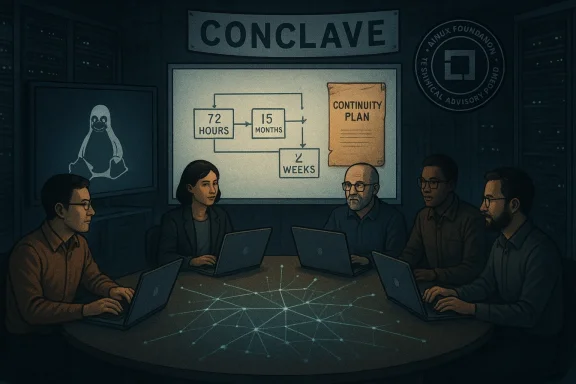
For more than three decades the Linux kernel community has operated with a quiet, powerful assumption: Linus Torvalds will be there to press the final merge button. That assumption — comfortable, pragmatic and effective — has now been replaced by a short, surgical protocol that tells maintainers what to do if the leader who has shepherded the mainline since 1991 is suddenly unable or unwilling to continue. The result is a formally documented continuity plan, filed in the kernel documentation as a new process item and meant to be invoked only when a graceful, planned handover is impossible.
Background
The Linux kernel’s development model is famously distributed: hundreds of subsystem maintainers across companies and countries shepherd changes in their own trees and send them upstream through a hierarchical patch flow. Yet the last gate — pulling everything into the canonical mainline repository — has long been centralized in one person: Linus Torvalds. That centralization worked because Torvalds has been a visible, constant presence for decades, but it also created a clear organizational vulnerability: the project’s bus factor — the number of people who need to be hit by a bus before the project is in deep trouble — was effectively zero for the canonical repository.The new document, added to the kernel’s Documentation/process collection in late January 2026 and colloquially known inside the community as the “Conclave” plan, does not upend the development model. Instead, it establishes a procedural fallback designed to remove ambiguity in the first, chaotic hours after a sudden leadership gap. The rules are spare, intentionally procedural and focused on speed and trusted relationships rather than public campaigning or personality-driven appointments.
What the continuity plan says — the mechanics
At its heart the plan defines a short, structured playbook that can be summarized in a few bullets. The key terms and timings are explicit:- The contingency is triggered if the maintainers responsible for the canonical repository become unwilling or unable to perform those duties or to facilitate a transition.
- An Organizer must be identified within a short window; that Organizer is normally the most recent Maintainers Summit organizer, with the Chair of the Linux Foundation Technical Advisory Board (TAB) acting as the backup.
- Within 72 hours, the Organizer opens discussions with the invitees to the most recent Maintainers Summit and sets a meeting that includes the TAB.
- If no Maintainers Summit has occurred in the previous 15 months, the TAB determines the invitees.
- The invitees may bring in additional maintainers as needed.
- The meeting, chaired by the Organizer, will consider options for ongoing management of the top-level kernel repository with the aim of maximizing long-term project health.
- Within two weeks, the group will communicate next steps publicly via the established kernel summit mailing list.
Why the kernel needed this now
There are three complementary reasons this formalization matters.- The project is aging and institutionalized. Many of the people who founded and shaped Linux have been doing this work for decades. Conversations at recent Maintainers Summits have acknowledged that the community is “getting grey and old,” and the kernel’s leadership contracts and organizational realities prompted a recognition that formal fallback procedures are appropriate.
- The canonical repository remains a centralized chokepoint. Despite the distributed workflow, the final act of integrating subsystem trees into the mainline has been concentrated. Past short absences (for instance, when Linus briefly stepped back during release cycles) were handled informally and successfully, but informal improvisation during a real crisis could produce confusion or conflict.
- Practical governance hygiene. Open-source projects of the kernel’s scale are effectively critical infrastructure. Documented procedures reduce the risk of ad-hoc decision-making under stress and give corporate stakeholders, maintainers and downstream consumers a clearer expectation of what will happen if the canonical flow is interrupted.
Where this departs from previous practice
Until now, the kernel’s fallback mechanisms were social and cultural more than codified. When Torvalds took a short, well-telegraphed break in the past, trusted lieutenants stepped in and the project continued. But those were stop-gap, ad-hoc arrangements: people knew who to call because they had relationships and precedent. This new plan does something different:- It names a process and a narrow set of decision-makers rather than leaving everything to informal networks.
- It formalizes the Maintainers Summit as an institutional anchor: the people invited to that summit are recognized as the trusted core for emergency decisions.
- It gives the Linux Foundation — through its Technical Advisory Board — an explicit backup role to ensure the community has an outside, administratively capable participant if summit invitees are stale or insufficient.
The "Organizer" concept: pragmatic and minimalist
The Organizer is a lightweight role meant to impose order quickly. This person is not a long-term appointment or a new permanent manager; rather, the Organizer's job is to convene, set the meeting and chair the discussions until the invited group reaches a decision. Choosing the last Maintainers Summit organizer as the default Organizer is a pragmatic choice: that person is already familiar with summit logistics and connected to the community. The TAB Chair as a fallback provides organizational continuity if the summit mechanism is stale.This approach avoids naming a preordained successor and resists personality-driven succession fights. It assumes decision-making will rest with the people who already hold subsystem responsibility and therefore understand the technical and human trade-offs.
Strengths of the new approach
There are several notable virtues to this minimal, procedure-first plan.- Speed and clarity. The defined time windows prevent paralysis and provide a clear expectation of how quickly the community must act in the event of a crisis.
- Trust-based decision-making. By defaulting to summit invitees — maintainers who already have technical jurisdiction — the plan keeps decisions in the hands of people with practical knowledge and established reputations.
- Avoids top-down imposition. The plan resists a single organization or corporate sponsor imposing a candidate, because decisions are to be made by a cross-section of trusted maintainers and the TAB only acts in well-defined circumstances.
- Operational realism. It acknowledges the reality that some maintainers will still handle merges and release duties, while ensuring administrative support from the Linux Foundation if needed.
- Documented fallback reduces chaos. Even if the plan is rarely used, having it reduces the chance that an unexpected event will trigger improvised, conflicting claims of authority.
Risks and limitations — what the plan does not solve
The Continuity Document is a useful improvement, but it is not a cure-all. Several risks and gaps remain, and they deserve attention.- No named successor or preselection mechanism. The plan explicitly avoids identifying a successor in advance. That means the decision will still be made under stress and may be subject to political dynamics at precisely the moment when clarity is most needed.
- Consensus problems. The invited group is small by design and may disagree. The document does not prescribe a clear voting mechanism, quorum rules, or tie-breakers; in a polarized scenario, two weeks may not be enough to build consensus.
- Narrow invitee pool. Reliance on the Maintainers Summit invitees is a trust-based heuristic, but it risks excluding emerging, capable maintainers who didn’t attend the last summit or maintainers in under-represented regions or companies.
- Secrecy vs. transparency. The plan envisions a meeting followed by a public announcement, but it leaves open how deliberations will be recorded, how dissenting views will be handled publicly, and whether the broader community will accept the outcome absent an explicit chartered vote.
- Potential corporate pressure and capture. In any transition event, large corporate employers with many contributors could exert influence through coordination. The plan does not include explicit anti-capture safeguards or conflict-of-interest processes.
- Still centralized in practice. Even with a robust process to pick a new organizer or managers in a crisis, the canonical model of having a small set of people who can commit to the mainline remains. The project remains vulnerable to key-people failure modes unless that structural model is itself addressed.
- Legal and operational clarity. The plan references the Linux Foundation supporting implementation, but it does not detail contractual issues such as signing keys, access controls, or emergency technical infrastructure (for example, cryptographic measures if a repository becomes inaccessible).
Historical precedents and what they teach us
Linux has faced similar stresses before. The community handled temporary absences of the mainline integrator and other crises by relying on trusted deputies. When Linus was less available for the 4.19 release, trusted maintainers stepped in to manage merges, showing the community can mobilize resiliently. Those events proved that ad-hoc leadership works in measured circumstances. The difference now is explicit codification: the project recognizes that ad-hoc is not the same as repeatable under crisis.The Maintainers Summit itself has become a meaningful institution: it acts as a periodic rehearsal of trust, bringing a cross-section of technical leads together and creating a group whose membership can reasonably be relied upon in emergencies. Documenting that reliance is sensible, but it also formalizes the summit’s authority in a way that raises questions about inclusiveness and turnover.
Scenarios and likely outcomes
What happens in practice will depend on context. Here are three plausible scenarios and how the documented process might play out.- Sudden incapacity or death of the maintainer of the canonical repo
- The Organizer is identified within 72 hours, convenes the summit invitees and TAB, and the group chooses a short list of people to operate the mainline temporarily (single committer or small team). Infrastructure access is coordinated through the Linux Foundation. The community receives a public announcement within two weeks.
- Torvalds steps aside without naming successors and refuses to help with transition
- The process is activated; because the maintainer’s withdrawal is intentional and possibly contested, the decision-making body will face political pressure. If consensus is slow, the TAB’s administrative levers (e.g., infrastructure control) become consequential. The plan’s lack of formal voting rules could make this messy — but the documented steps at least provide a neutral convening structure.
- The canonical repo becomes inaccessible due to key compromise or technical failure
- The contingency plan’s reference to repository accessibility matters; the Organizer convenes the maintainers and TAB, and the Linux Foundation can use its infrastructure and legal authority to reestablish canonical flow or bring an alternate repository online. Technical and cryptographic preparedness will determine how smooth this is.
Practical recommendations and next steps the community should consider
The document is a strong first step. To make it resilient in real-world, adversarial or complex situations, the community should consider these follow-ups:- Codify decision methods
- Define voting thresholds, quorum rules, and tie-break mechanisms for the summit invitee group so outcomes are defensible and repeatable.
- Broaden participation pathways
- Allow the summit invitee list to be supplemented through transparent, documented criteria that make room for capable but geographically or economically underrepresented maintainers.
- Harden infrastructure
- Ensure there are clear, auditable technical procedures for handing over repository access, rotating keys and recovering from compromise with cryptographic safeguards and multi-person approvals.
- Publish red-team scenarios and rehearsal schedules
- Regularly practice the process in tabletop exercises or rehearsals to iron out logistical issues — a crisis is not the time to discover that key contacts are unreachable.
- Conflict of interest and transparency rules
- Establish disclosure rules for participants and guidelines to reduce corporate capture risks during an emergency decision.
- Consider distributed merge authority models
- Longer term, explore technical models that reduce single-point-of-control risk (e.g., formal multi-committer models, delegated merge teams with rotating membership, or more sophisticated distributed signing workflows).
What this means for enterprises, distributions and end users
For companies that depend on Linux as infrastructure, the new plan reduces one kind of uncertainty: the project now has a documented, community-accepted mechanism to address a leadership vacuum. That matters for risk models, vendor contracts and kernel supply chain planning.However, enterprises should be realistic. The plan does not guarantee a painless transfer of leadership or the absence of disruption during a contentious transition. Organizations with critical dependencies should:
- Maintain up-to-date, security-conscious patching policies.
- Diversify kernel contacts among multiple maintainers and vendors.
- Participate in upstream testing and contribute to hardening infrastructure resilience.
Community reaction and politics
Public commentary from journalists and community observers has emphasized both the plan’s symbolic importance and its modesty. Many commentators framed the effort as long overdue: a pragmatic admission that no one is irreplaceable and that systems succeed when they document how to handle failure. Some maintainers have made light of the plan’s papal metaphors (the “Conclave” naming), but that levity masks a sober realization: the kernel is global infrastructure and needs institutional memory.Skeptics point out that a written plan won’t eliminate the social and political forces that can shape leadership transitions. The real tests will be whether the community accepts a decision reached under time pressure, and whether the plan’s participants adhere to norms of good faith and transparency.
A sober assessment
The Linux kernel continuity document is a notable, responsible piece of governance: short, conservative and rooted in existing community structures. It is not an ambitious reform of how control of the mainline is exercised, but it didn’t need to be. By codifying the immediate playbook for an emergency, the kernel community has reduced the chance of improvised, conflicting claims of authority — a real improvement.At the same time, the document leaves significant work undone. It does not address how to make the mainline less dependent on a central gatekeeper; it does not prescribe detailed voting or conflict resolution mechanisms; and it does not fully close the door on corporate influence or factionalism during a transition. That leaves the door open for future enhancements: clearer governance rules, improved infrastructure resilience and more inclusive decision processes.
Leadership transitions are social problems as much as technical ones. The kernel’s approach here reflects a conservative social engineering judgment: rely on existing, trusted relationships, move quickly and involve the Linux Foundation as a stabilizing, administrative partner when needed. That is sensible. But success will depend on discipline, transparency and the community’s willingness to iterate on the plan after it is tested — ideally in rehearsal rather than under emergency pressure.
The document marks a pragmatic, overdue recognition of a systemic risk. It converts a widely understood convention into a short, actionable protocol that should reduce confusion and delay during a shock to the project’s top-level stewardship. For a project that underpins huge swathes of global computing infrastructure, that is precisely the kind of small, concrete governance improvement the world needs: visible, constrained and focused on minimizing operational disruption. The next step is turning that document into practice through rehearsals, clarifications and incremental reforms that address the deeper centralization the plan acknowledges but does not itself resolve.
Source: TechRadar After 34 years the Linux kernel finalizes a backup plan for leadership
