

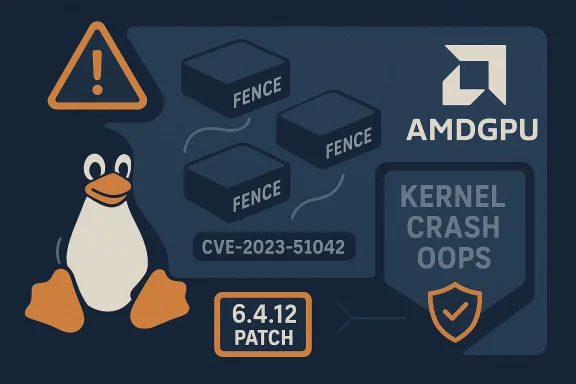
A recently disclosed Linux-kernel vulnerability, tracked as CVE-2023-51042, exposes a fence-related use‑after‑free in the AMD GPU driver (amdgpu) that was fixed upstream in the 6.4.12 stable release; the bug can crash affected kernels or otherwise deny availability to systems that accept untrusted local input via the GPU driver.
The defect lives in the amdgpu subsystem of the Linux kernel — specifically in the function amdgpu_cs_wait_all_fences in drivers/gpu/drm/amd/amdgpu/amdgpu_cs.c. The kernel maintainers recorded the fix as part of the stable fixes around the 6.4.12 release, and distribution vendors subsequently issued backports and advisories for their supported kernels.
At a high level, the bug is a classic memory‑safety error: code can access a fence object after it has been freed (use‑after‑free, CWE‑416), most likely triggered by a timing/race condition between threads that manage fence lifecycle and threads that wait for fences. The symptom in production is a kernel oops or panic — a hard crash for the kernel — which translates into a clear availability impact for affected machines.
Multiple public vulnerability databases have assigned the issue a high impact profile (CVSS 3.x values reported in public trackers indicate High severity), and distributors (Debian, Ubuntu, Red Hat, SUSE, and others) list the kernel fix and provide package-level mitigations. Operators should treat the vulnerability as a local attack vector: an attacker requires the ability to run code or make ioctl calls on the host (local, or remote only if the attacker already has the ability to run code there).
(Flag: any claim that an exploit exists in the wild would require new, verifiable evidence — until that appears, listing active exploitation would be speculative.)
Primary action — patch:
Source: MSRC Security Update Guide - Microsoft Security Response Center
 Background / Overview
The defect lives in the amdgpu subsystem of the Linux kernel — specifically in the function amdgpu_cs_wait_all_fences in drivers/gpu/drm/amd/amdgpu/amdgpu_cs.c. The kernel maintainers recorded the fix as part of the stable fixes around the 6.4.12 release, and distribution vendors subsequently issued backports and advisories for their supported kernels.At a high level, the bug is a classic memory‑safety error: code can access a fence object after it has been freed (use‑after‑free, CWE‑416), most likely triggered by a timing/race condition between threads that manage fence lifecycle and threads that wait for fences. The symptom in production is a kernel oops or panic — a hard crash for the kernel — which translates into a clear availability impact for affected machines.
Multiple public vulnerability databases have assigned the issue a high impact profile (CVSS 3.x values reported in public trackers indicate High severity), and distributors (Debian, Ubuntu, Red Hat, SUSE, and others) list the kernel fix and provide package-level mitigations. Operators should treat the vulnerability as a local attack vector: an attacker requires the ability to run code or make ioctl calls on the host (local, or remote only if the attacker already has the ability to run code there).
What the code-level problem looks like
The fence abstraction and why it matters
Fences are synchronization primitives the DRM (Direct Rendering Manager) subsystem uses to track GPU work completion across command submission and CPU/GPU boundaries. They are central to correct scheduling and resource lifecycle management for GPU jobs. If the kernel frees a fence while some other path still references it, the waiting path can dereference freed memory — a use‑after‑free — which can yield undefined behavior, kernel oopses, or in extreme cases memory corruption that could be leveraged for privilege escalation.How amdgpu_cs_wait_all_fences fits in
The vulnerable function, amdgpu_cs_wait_all_fences, is responsible for waiting on a set of fences for command-submission jobs. The bug arises where the function can hold or refer to a fence pointer that another code path frees concurrently. The upstream patch reorders checks and/or adds guards around the fence lifetime so that fences cannot be accessed after the underlying object may have been freed. That fix is included in the upstream 6.4.12 change set.Race conditions and UAFs: practical reality
Use‑after‑free bugs in kernel drivers often require specific conditions — concurrent operations, particular GPU command sequences, or edge-case job failures — to reliably trigger. That pattern explains why kernel developers classify many of these fixes as robustness improvements: they close rare but practical crash primitives that fuzzers (like syzbot) and developers discover under load. For defenders, the important point is the result: a deterministic or repeatable kernel crash is a remotely or locally exploitable denial-of-service vector for the host.Confirmed scope and vendor responses
- Upstream fix: the kernel stable trees include the patch as part of the 6.4.12 fixes and associated stable backports. The changelog and upstream commits explicitly reference the amdgpu fence fix.
- Distributions: Debian, Ubuntu, SUSE, and Red Hat listed the CVE and shipped fixes or kernel backports in their security advisories and kernel updates. Debian’s tracker lists fixed package versions for multiple suites; Ubuntu and SUSE show similar advisories and status updates for their kernels. If you run a distribution kernel, consult your vendor's kernel advisory and apply the vendor-supplied update or backport.
- Severity scoring: public trackers show a high‑impact vector (CVSS 3.x values reported as high, sometimes with slightly different numeric breakdowns among vendors), reflecting the potential confidentiality, integrity, and availability impacts if an attacker can coerce the kernel into memory corruption. Note, however, that the attack vector is local (an attacker must be able to invoke the relevant GPU IO paths).
Practical impact: who should worry most
This is primarily an operational‑availability and local‑attack risk. Consider the following high‑risk scenarios:- Shared multi‑user hosts (lab machines, multi‑seat desktops with untrusted users), where a local untrusted user might be able to issue DRM ioctls or otherwise interact with /dev/dri devices.
- Virtualized or containerized workloads where guests have GPU access (PCIe passthrough, mediated device drivers, or host‑exposed GPU devices). An unprivileged container or VM with GPU access dramatically increases the threat surface because the attacker already has a call path into privileged kernel code for the GPU stack.
- Cloud GPU instances or managed GPU servers that accept workloads from untrusted tenants. These environments must assume multi-tenant risk and prioritize patching or restrictive access controls.
Evidence of exploitability and real-world abuse
To date there are no widely-circulated public exploit packages or proof‑of‑concepts specifically tied to CVE‑2023‑51042 in mainstream exploit repositories. Public indicators and databases show the bug’s existence, its upstream fix, and vendor advisories, but public exploitation reports remain sparse and the Exploit Prediction Scoring System (EPSS) scores for this CVE were low at the time of publication — indicating limited observed exploitation activity. That does not mean the risk is zero: local DoS crash primitives are valuable to attackers targeting high‑availability hosts or aiming to chain faults into more privileged failures. Treat the absence of public exploits as a temporary observation, not a guarantee of safety.(Flag: any claim that an exploit exists in the wild would require new, verifiable evidence — until that appears, listing active exploitation would be speculative.)
Recommended mitigations and operational guidance
The single best mitigation is to apply a kernel update that includes the upstream fix or vendor backport. If you cannot immediately install a patched kernel, consider these intermediate steps to reduce risk.Primary action — patch:
- Inventory systems that run kernels older than 6.4.12 or vendor kernels that predate the backport. Check with uname -r and your distribution’s kernel package.
- Apply vendor security updates (kernel packages) or upgrade to a kernel that includes the 6.4.12 fix or the vendor’s equivalent backport. Reboot to use the updated kernel.
- Restrict access to GPU device nodes: remove group/device permissions from untrusted accounts so they cannot open /dev/dri/* or perform ioctls. This is often the least invasive short-term control and reduces threat from unprivileged users.
- Blacklist or unload the amdgpu module on hosts that do not need AMD GPUs:
- To temporarily prevent amdgpu from loading, add a blacklist line (for example, echo "blacklist amdgpu" > /etc/modprobe.d/blacklist-amdgpu.conf) and rebuild initramfs if required, then reboot. Note: this will disable AMD GPU hardware and likely degrade or eliminate graphical acceleration.
- Unloading amdgpu from a live system (modprobe -r amdgpu) may fail if the driver is in use (X/Wayland, display manager, or KMS users). Plan for scheduled reboots where necessary.
- For display-hosted desktops, consider booting with kernel parameters (e.g., nomodeset) as a stopgap, understanding this will reduce graphics functionality and possibly change boot behavior.
- For GPU‑exposed VMs or containers, remove direct GPU access for untrusted workloads until a patched kernel is applied. Reconfigure GPU passthrough or mediated device policies to reduce exposure.
- Watch kernel logs (dmesg, journald) for amdgpu-related oopses, WARN_ON messages, or stack traces referencing amdgpu_cs_wait_all_fences or fence handling. Recurrent amdgpu kernel warnings are a strong indicator of attempts to exercise driver paths.
- On multi‑tenant hosts, correlate user sessions or container activity with kernel oopses to identify potential abuse or misuse.
Patching checklist and operational playbook
- Identify affected hosts:
- Command: uname -r
- Check distribution advisories for fixed kernel package versions (Debian/Ubuntu/SUSE/Red Hat trackers list backport versions).
- Test updates:
- Stage the vendor kernel update in a non-production environment where possible. Confirm that AMD GPU workloads (display, compute, passthrough) behave as expected under the updated kernel.
- Schedule production patching:
- Plan for reboots and for possible driver/graphics stack behavior changes. Notify stakeholders.
- If immediate patching is impossible:
- Implement device-node permission lockdown, or temporarily remove/passthrough GPUs away from untrusted workloads.
- After patching:
- Monitor kernel logs and system stability for regression. Re-enable GPU features carefully and review performance-critical workloads.
- Document and rotate incident response:
- If you observed kernel oopses or crashes prior to patching, collect memory and logs (where permitted), and apply post‑incident analysis to determine possible exploitation.
Risk analysis — strengths of the fix and residual concerns
What’s good:- The upstream kernel team produced a targeted, low‑risk fix and integrated it into the stable release stream (6.4.12 and backports). That means distributors can produce backported packages without reworking large parts of the driver.
- Major distributions have acknowledged the CVE and issued advisories or backports; vendors of enterprise kernels (RHEL, SUSE, Debian/Ubuntu) generally provide predictable update mechanisms for quickly deploying these fixes.
- Kernel driver UAFs are inherently dangerous: in some contexts an attacker can turn them into code‑execution or privilege escalation primitives, not just crashes. While CVE‑2023‑51042 is documented as a local use‑after‑free with crash/DoS potential, the boundary between DoS and exploit is subtle — a sophisticated attacker working from a privileged user context or with specific device access could try to weaponize memory corruption. Public trackers score the impact as high, which is appropriate for a kernel-level UAF.
- Operational cost: patching kernels across mixed fleets is nontrivial. Kernel updates require reboots and driver/stack testing, particularly on machines used for graphics‑intensive workloads, virtualization with GPU passthrough, or compute jobs dependent on specific driver versions.
- Visibility: many cloud or managed environments do not expose low-level kernel logs to tenants, so detection of attempted abuse may be limited. This amplifies the importance of vendor-supplied patching in those environments.
Forensics, detection tips, and post‑patch verification
- If you experienced unexplained reboots or kernel oopses, look for stack traces that mention amdgpu, fences, or drm_job submission paths. Collect dmesg output, kernel-core dumps (kdump), and journal logs prior to patching.
- Post‑patch validation: after installing a fixed kernel, confirm:
- No amdgpu-related oopses appear in kernel logs under normal and stressed workloads.
- GPU workloads (rendering, compute jobs, passthrough VMs) run to completion.
- If you blacklisted amdgpu as a temporary mitigation, ensure the module remains absent from lsmod and validate system behavior.
- If you lack patch windows for certain hosts, consider moving sensitive workloads to patched nodes or cloud instances known to have fixed kernels until your fleet is remediated.
Final assessment and recommended urgency
CVE‑2023‑51042 represents a concrete memory-safety defect in a critical kernel driver. The exploit vector is local, which reduces immediate remote‑exposure risk, but the severity is non‑trivial: kernel-level use‑after‑free conditions can lead to complete host loss-of-availability and — under certain circumstances — privilege escalation. Public tracking and vendor advisories confirm the upstream fix and vendor backports; operators should treat the vulnerability as a high‑priority patch for multi‑user systems, GPU‑exposed virtualization hosts, and any multi‑tenant or cloud GPU deployment. Patch or apply compensating controls as soon as practical, verify the patch in staging, and monitor for any signs of attempted exploitation.Quick reference — what to do now
- Run uname -r on each host to identify kernel versions and compare against vendor advisories; prioritize kernels older than 6.4.12 or vendor packages that predate their backports.
- Apply vendor kernel updates or upgrade to a kernel that includes the 6.4.12 upstream fix; reboot where required.
- If you cannot patch immediately, restrict access to /dev/dri devices, or temporarily blacklist amdgpu and plan a staged reboot.
- Monitor kernel logs for amdgpu-related errors and collect diagnostics for any prior crashes.
- For cloud or multi‑tenant environments with GPU exposure, treat this as urgent: remove GPU passthrough or restrict tenant access until patched.
Source: MSRC Security Update Guide - Microsoft Security Response Center
