

A new Linux-kernel vulnerability tracked as CVE-2023-54082 has been recorded and fixed upstream: a null-pointer / use-after-free race in the AF_UNIX send path rooted in unix_stream_sendpage. The flaw can be triggered by a carefully orchestrated sequence of local socket/file-descriptor passing that leaves the peer’s receive queue in an inconsistent state; the result is a kernel oops or crash and, in some environments, the practical ability to cause denial-of-service or to support more complex local escalation chains. The fix — a small but critical locking correction that prevents lockless access to a peer’s recv queue — has been merged into stable trees and backported by vendors; operators should treat this as a patch-first issue for any Linux hosts that run kernels lacking the upstream correction.
Operators should prioritize:
Source: MSRC Security Update Guide - Microsoft Security Response Center
 Background
What the bug is, in plain language
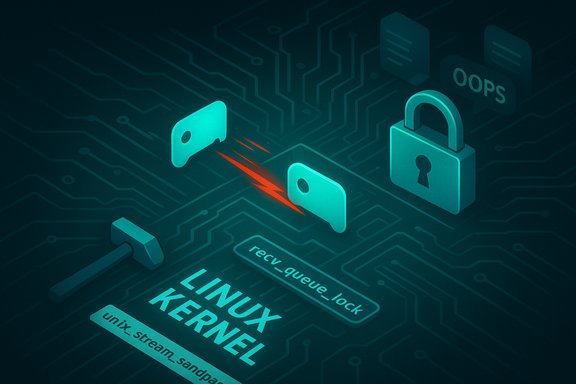
At its core, CVE-2023-54082 is a race condition in the AF_UNIX (Unix domain socket) send path. A function named unix_stream_sendpage attempted to append data to the last socket buffer (skb) in the peer’s receive queue without taking the peer’s receive-queue lock. Under a particular FD-passing loop (where file descriptors are shuttled between sockets creating a circular reference), both sockets can be closed without the recipient ever pulling the passed FD. Kernel garbage-collection code later walks and cleans such sockets while holding the receive-queue lock and unlinks skbs that hold FDs. The race window allows unix_stream_sendpage to access (and potentially dereference or use) an skb that is concurrently being unlinked and freed — a classic use-after-free / null-dereference scenario that leads to a kernel fault or oops.Reporter and upstream action
The issue was reported with a reproducible test-case and analysis; the research and report attributed to Bing-Jhong Billy Jheng led to an upstream patch (with contributions and messaging from kernel maintainers including Linus Torvalds) that simply ensures the peer’s recv queue is locked before the problematic access. The change is deliberately small and defensive — the goal is to remove the race window without large behavioral changes. Upstream commit notes and stable backport listings show the fix was added to stable branches (e.g., 5.10-stable and other trees) and maintainers called out that the issue is not present in newer series (6.5+) where sendpage was refactored.Technical analysis
Deep dive: how unix_stream_sendpage could fault
unix_stream_sendpage is part of the AF_UNIX stream sendpath that moves data from a page into a peer’s receive queue. In the vulnerable code path:- The sender looks at the last skb in the peer’s recv queue and attempts to append page-backed data into it.
- That access occurs without taking the peer’s recv-queue lock.
- Meanwhile, a separate cleanup path (garbage collection that handles sockets closed with pending FD-carrying skbs) iterates and removes skbs while holding that recv-queue lock.
- If the FD-fanning scenario described above occurs and both sockets are closed without the FD being received, the GC path may free or unlink the skb while unix_stream_sendpage is concurrently accessing it, producing a use-after-free or null-pointer deref in the kernel.
Severity, exploitability and attack surface
- Attack vector: local. An attacker needs the ability to create or operate on AF_UNIX sockets and to pass FDs between sockets — a capability available to local processes, containers, or tenants on multi-tenant systems. This is not a remotely exploitable network wormhole by itself.
- Primary impact: availability (kernel oops/panic, service outage). In practice the most immediate effect is host instability and denial-of-service. Vendors classify the issue as a local crash/DoS risk; some vendor feeds mark it as “important” given local exploitability on shared hosts.
- Privilege prerequisites: low-level local privileges are sufficient — an unprivileged user who can create sockets can trigger the condition. That makes multi-tenant hosts, development CI runners, and container hosts especially relevant to prioritize.
- Potential for chaining: while the public record shows DoS as the realistic outcome, kernel use-after-free defects can sometimes be escalated into arbitrary code execution or privilege escalation when combined with other vulnerabilities or favorable allocator behavior. Treat the possibility as non-zero for targeted threat actors; do not assume crash-only behavior is the final state.
Affected kernels and vendor status
Kernel series
Public upstream notes explicitly state the problem existed in stable branches in the 5.x and 6.1 families and was fixed by small backports; maintainers also note the issue does not exist in the 6.5+ series due to a refactor of sendpage logic. That means:- Kernels built from upstream trees prior to 6.5 that did not include the locking backport are in-scope.
- Many distribution kernels (which may be based on older stable branches) required vendor backports; common enterprise kernels were patched in place via normal security updates.
Vendor advisories and mapping
Distributors and enterprise vendors have ingested the upstream change and published fixes for their kernel packages. Operators should consult their distribution security advisories (Ubuntu, Debian, Red Hat/SUSE/Oracle, Amazon Linux, etc. for exact package versions that contain the backport. In cloud contexts, Microsoft published an attestation for the Azure Linux artifact confirming their inventory mapping for the affected upstream component; however, Microsoft’s product-scoped attestation does not automatically prove other Microsoft artifacts are unaffected — absence of an attestation is “not yet verified,” not evidence of absence. For practical triage, map the vendor-provided fixed package names to your installed kernel package and apply the update.How to detect if you are vulnerable
- 1. Identify kernel build and configuration:
- Run uname -r to get the current kernel version.
- If possible, check the kernel build config for AF_UNIX or socket options; if the AF_UNIX code is compiled in (typical for general-purpose kernels), proceed with inventory.
- 2. Inspect kernel logs for oops signatures:
- Look for kernel OOPS or KASAN traces mentioning unix_stream_sendpage, AF_UNIX, or a call trace that includes net/unix paths.
- Example commands: dmesg | grep -i 'unix_stream_sendpage' or journalctl -k | grep -i 'unix_stream' (note: exact string matches vary by distribution and kernel messages). If you see repeated OOPS/panic events tied to AF_UNIX code, treat the host as high priority.
- 3. Examine whether FD-passing patterns exist on the host:
- Audit applications and services that pass file descriptors between processes through unix domain sockets (e.g., system daemons, socket-activation frameworks, fancy IPC patterns used in container runtimes or orchestration). Systems that never pass FDs via AF_UNIX have lower risk but still should be patched as a general best practice.
- 4. Code or artifact inspection:
- For custom kernels or embedded images, inspect the kernel source tree (or uncompressed vmlinux) to see if the upstream commit(s) that implement the fix are present. If you maintain your own kernel builds, apply the patch or upgrade the tree and rebuild.
Immediate mitigations and remediation steps
Priority remediation (recommended)
- Apply vendor-supplied kernel updates that explicitly mention the CVE or list the upstream stable commit IDs as backported. Reboot into the patched kernel as soon as operational windows permit. Kernel fixes require a reboot to take effect.
Short-term compensating controls (when patching is delayed)
- Limit untrusted local access:
- Restrict who can create or manipulate AF_UNIX sockets. Harden container runtimes so unprivileged containers cannot create arbitrary AF_UNIX sockets without control.
- Apply filesystem permissions, AppArmor/SELinux policies, or container security profiles to limit which processes can interact with IPC endpoints.
- For managed fleets: do rolling node replacements with patched images in cloud environments (replace VM/node with patched image, drain workloads, terminate old nodes) rather than in-place kernel upgrades when that is operationally simpler.
- For device vendors/embedded products: backport the fix into the vendor kernel tree, rebuild firmware/kernel images and push updates via the normal firmware update pipeline. The patch is small and intentionally easy to backport but must be validated for the specific device build.
Detection, logging, and post-patch validation
- After applying patches, validate that the fix is present:
- Reboot into the patched kernel.
- Confirm no new OOPS or panic traces are observed for a representative workload.
- If possible, run vendor or upstream test-cases (reproducer) in an isolated test environment to verify the crash path no longer triggers.
- Preserve crash dumps and logs:
- If you observed an oops, collect vmcore/kdump and dmesg logs for forensic analysis before and after patching. Crash telemetry helps validate both whether the bug was present and whether remediation succeeded.
- Monitoring / SIEM rules:
- Add detection rules that alert on kernel OOPS signatures tied to net/unix or explicit unix_stream_sendpage traces. These are high-value signals for triage.
Risk assessment and operational guidance
Strengths of the fix
- The upstream correction is small, localized, and low risk: it introduces or reorders lock acquisition to close a race window rather than rearchitecting large subsystems. That makes the patch straightforward to backport and safe for distribution kernels.
Residual risks and caveats
- Backport lag: embedded devices, bespoke vendor kernels, and long-tail appliances may remain unpatched for significant time due to release cycles — these are primary risk populations. Inventory such devices and prioritize updates.
- Chained exploitation: Although public data emphasizes DoS as the realistic immediate effect, kernel UAFs are a class of bugs that can be escalated into more severe outcomes with favorable conditions; do not dismiss the issue as purely crash-only in high-threat contexts.
- Operational cost of kernel updates: rolling out kernel updates at scale requires test windows and reboots, and there is inherent operational risk; plan patching windows accordingly and test patches in staging.
Practical checklist (what to do now — prioritized)
- Inventory:
- Collect uname -r and kernel package versions across hosts.
- Identify images and appliances that embed Linux kernels (VM images, WSL/WSL2 kernel binaries, container base images used in production).
- Map to vendor advisories:
- Consult your distro/vendor security tracker for package names and versions that contain the backport. Plan staged rollouts.
- Patch and reboot:
- Apply vendor-supplied kernel updates and perform controlled reboots. Verify system health and absence of OOPS traces after the change.
- Hardening where patching is delayed:
- Restrict unprivileged creation of AF_UNIX sockets where feasible; tighten access control to IPC endpoints. Consider container runtime hardening.
- Post-patch validation:
- Confirm the kernel contains the fix in your test environment and monitor crash telemetry for at least one full maintenance cycle. Preserve vmcore/ dmesg logs for any observed OOPS.
Why this matters for mixed Windows/Linux estates
Linux kernels appear in many places inside predominantly Windows infrastructure: VMs running in Azure, container nodes, edge appliances, WSL/WSL2 kernels on developer laptops, and virtual appliances attached to Windows management. A kernel oops on any of those Linux elements can interrupt services, automation, or monitoring chains that are Windows-hosted. Microsoft’s machine-readable product-attestations name Azure Linux as a product that carries the implicated upstream component (a helpful operational signal), but absence of attestation in other Microsoft SKUs should not be taken as proof of absence — each image or kernel artifact must be inventoried and validated. Treat the Microsoft attestation as authoritative for the named product, but perform independent artifact inspection for other Microsoft-provided images you run.Final assessment and closing guidance
CVE-2023-54082 is a textbook kernel race condition: it’s small in code, but consequential in effect. The fix upstream is surgical and safe to backport, and distributors have already mapped and shipped updates for many mainstream kernel packages. Because the flaw is local and requires FD-passing activity, the risk profile is highest for multi-tenant build hosts, CI runners, container platforms, and embedded appliances that accept or pass file descriptors across AF_UNIX sockets.Operators should prioritize:
- Inventorying kernel artifacts across the environment
- Applying vendor kernel updates and rebooting into patched kernels
- Restricting local IPC usage and hardening access to AF_UNIX endpoints where remediation is delayed
- Monitoring kernel logs for OOPS signatures and preserving crash dumps for forensic confirmation
Source: MSRC Security Update Guide - Microsoft Security Response Center
