

A small, surgical change to the Linux kernel’s iBFT iSCSI sysfs exporter has been recorded as CVE-2025-21993: a fix that prevents a UBSAN (Undefined Behavior Sanitizer) shift-out-of-bounds warning in the function that exposes iBFT NIC attributes to userspace. While the patch is tiny — a single conditional that treats IPv6 prefix lengths differently — the issue touches a broad set of operational concerns for administrators who rely on iSCSI boot (iBFT) in IPv6-only or mixed environments, and it is a revealing example of how sanitizer tooling continues to surface correctness issues that can have real availability consequences.
iBFT (iSCSI Boot Firmware Table) is a firmware-provided structure used by systems that boot over iSCSI. It supplies network and target parameters to early userspace (initramfs/initrd) so that the kernel and boot scripts can bring up networking and attach root volumes before the full OS is loaded. Historically, many iBFT consumers and helper scripts were implemented with IPv4-first assumptions — including the idea of a 32-bit subnet mask — and while upstream work has improved IPv6 handling, edge cases remain.
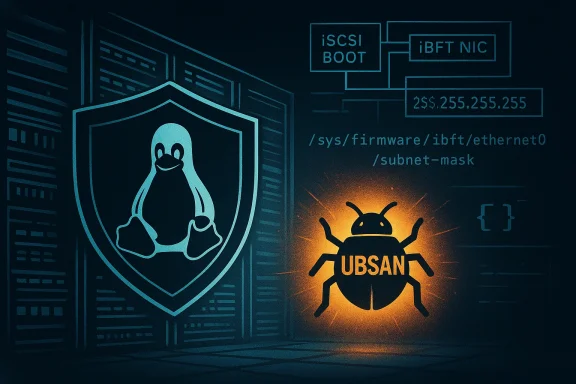
The bug tracked as CVE-2025-21993 arises during the sysfs attribute formatting code for iBFT NICs. When userspace tools (for example, iscsistart) read the Linux sysfs node that reports the subnet mask for a given iBFT NIC, the kernel code computed a 32-bit subnet mask using a left-shift expression that assumes the prefix length is no greater than 32. If iBFT contains an IPv6 prefix length (64 is common for IPv6 subnets), the exponent in the shift expression becomes negative, which is undefined in C and triggers a UBSAN shift-out-of-bounds warning during builds or run-time checks that enable sanitizer behavior. Upstream maintainers fixed the problem by detecting prefix lengths greater than 32 and returning a sentinel value (~0) for the subnet-mask sysfs attribute in that case.
This is primarily a correctness/sanitizer fix rather than an exploit chain: the change prevents undefined behavior diagnostics and protects against the unstable outcomes they can signal. Still, the risk classification and operational impact deserve a careful look because the symptom space — kernel warnings, sanitizer trips, potential panics, or sysfs misreports — can cascade into availability problems in real deployments.
Upstream maintainers added a guard:
Why this exact sentinel? For code that always emits a dotted-decimal IPv4 field (because the sysfs attribute interface is IPv4-oriented), setting the bits to all-ones yields the textual form 255.255.255.255 when printed, which acts as a non-meaningful but safe value that avoids negative arithmetic and keeps the sysfs contract intact for existing consumers.
More broadly, this CVE reinforces the practical value of sanitizers in the kernel development lifecycle and the necessity for operations teams to treat sanitizer-led fixes as more than developer housekeeping: they are part of the reliability and safety surface that keeps early-boot paths predictable and recoverable.
Source: MSRC Security Update Guide - Microsoft Security Response Center
 Background
iBFT (iSCSI Boot Firmware Table) is a firmware-provided structure used by systems that boot over iSCSI. It supplies network and target parameters to early userspace (initramfs/initrd) so that the kernel and boot scripts can bring up networking and attach root volumes before the full OS is loaded. Historically, many iBFT consumers and helper scripts were implemented with IPv4-first assumptions — including the idea of a 32-bit subnet mask — and while upstream work has improved IPv6 handling, edge cases remain.The bug tracked as CVE-2025-21993 arises during the sysfs attribute formatting code for iBFT NICs. When userspace tools (for example, iscsistart) read the Linux sysfs node that reports the subnet mask for a given iBFT NIC, the kernel code computed a 32-bit subnet mask using a left-shift expression that assumes the prefix length is no greater than 32. If iBFT contains an IPv6 prefix length (64 is common for IPv6 subnets), the exponent in the shift expression becomes negative, which is undefined in C and triggers a UBSAN shift-out-of-bounds warning during builds or run-time checks that enable sanitizer behavior. Upstream maintainers fixed the problem by detecting prefix lengths greater than 32 and returning a sentinel value (~0) for the subnet-mask sysfs attribute in that case.
This is primarily a correctness/sanitizer fix rather than an exploit chain: the change prevents undefined behavior diagnostics and protects against the unstable outcomes they can signal. Still, the risk classification and operational impact deserve a careful look because the symptom space — kernel warnings, sanitizer trips, potential panics, or sysfs misreports — can cascade into availability problems in real deployments.
What changed (technical summary)
The upstream change is small and localized inside drivers/firmware/iscsi_ibft.c, in the function that formats and exposes NIC attributes via sysfs. The original code attempted to compute a 32-bit subnet mask from a prefix length using an expression involving (1 << (32 - prefix)), which is valid only when the exponent is non-negative and less than the width of the type. When the iBFT contained an IPv6 prefix length (commonly 64), that arithmetic produced a negative shift count and triggered UBSAN.Upstream maintainers added a guard:
- If the stored prefix length is greater than 32, the code now sets the subnet-mask value to all-ones (bitwise ~0) for the 32-bit IPv4 mask field.
- Otherwise, it computes the mask using the original formula.
Why this exact sentinel? For code that always emits a dotted-decimal IPv4 field (because the sysfs attribute interface is IPv4-oriented), setting the bits to all-ones yields the textual form 255.255.255.255 when printed, which acts as a non-meaningful but safe value that avoids negative arithmetic and keeps the sysfs contract intact for existing consumers.
Why the UBSAN warning matters operationally
At first glance this is a classic correctness fix with minimal security implications: UBSAN warnings typically indicate undefined behavior but do not always correspond to an exploitable vulnerability. However, there are three operational realities that make this type of fix important:- Sanitizer signals are early indicators of potential memory-safety or correctness problems. When a sanitizer detects undefined behavior in kernel code, that behavior may be benign in most runs but can also be the root cause of more serious faults under different inputs, compilers, or optimization levels. Production kernels rarely enable UBSAN, but the underlying undefined behavior can still cause instability under certain compiler/architecture combinations.
- For systems that rely on iSCSI boot — especially cloud images, hyperconverged nodes, or diskless servers — any failure or unexpected behavior in the early-boot networking stack can lead to a complete inability to boot into the installed OS. That is a direct availability impact: if iscsistart or initramfs networking scripts encounter unexpected sysfs values or kernel warnings, automated recovery is limited at the pre-OS stage. The security advisory narrative explicitly calls out availability as the primary impact class for this CVE.
- Out-of-band detection and remediation are harder for early-boot failures. When a machine cannot mount its root filesystem because of a networking or boot-table issue, remediation often requires manual intervention (rescue media, console access), which increases mean time to repair and operational burden.
Scope and affected systems
- The bug lives in the Linux kernel's iBFT firmware driver (drivers/firmware/iscsi_ibft.c). Any Linux kernel build containing that driver and used on systems that rely on iBFT for iSCSI boot is in scope. This includes physical servers and virtual/cloud images that rely on firmware-provided boot tables.
- Distributions that ship kernels built with the affected code path have publisheded packages. Debian, Ubuntu, Oracle Linux, AlmaLinux and others have tracked the fix and pushed kernel updates. Operators should consult their distribution’s errata for the exact package names and CVE mapping.
- The configuration matrix matters: systems that never use iBFT or never boot from iSCSI are not affected in practice. Systems that use iBFT but always provide IPv4-only iBFT entries will not see the code path that triggers the unusual prefix length. The most important subset are IPv6-enabled environments where iBFT includes IPv6 prefix data.
- The vulnerability is recorded as an availability-impacting issue in several vendor advisories because the practical consequence is that early-boot networking can fail or produce warnings that affect automated boot. Microsoft’s public tracking of Linux kernel CVEs for Azure and related products has similarly emphasized availability concerns when Linux-based components are included in their stacks; operators running cloud images or Azure Linux should verify distribution updates included in their images.
Attack surface and exploitability
This CVE is not a traditional remote code-execution or privilege-escalation flaw. The underlying problem is undefined-shift arithmetic that can trigger sanitizer warnings and, under some conditions, might produce incorrect sysfs output or destabilize kernel behavior. Consider the following risk profile:- Remote exploitation: unlikely. Thred by the presence of an IPv6 prefix length in firmware-supplied iBFT data. An attacker would need control of the machine’s firmware-provided iBFT entries or to be able to manipulate early-boot firmware behavior. That is not a typical remote network attack surface.
- Local or supply-chain vectors: possible in specialized environments where the attacker can modify firmware (e.g., compromised provisioning images, maliciously prepared VM images, or firmware tampering). In such scenarios the attacker could craft iBFT entries that exercise the code path repetitively or with boundary values; repeated triggering of undefined behavior has in other cases caused denial-of-service outcomes.
- Availability consequences: the practical impact captured in vendor advisories is denial of availability — either persistent (the machine refuses to boot reliably) or sustained (while the attacker applies a malformed iBFT repeatedly). For operators, that translates to nodes that fail to join clusters or boot into the installed OS without manual rescue. The MSRC-style summary the user provided aligns with this classification: total loss of availability or iterative denial of availability are real-world outcomes for early-boot failures.
Vendor and distribution responses
Mainline kernel maintainers merged the patch; the change appears in stable kernel updates and has been picked up by distribution security teams. Several distributions published updates mapping the CVE to their kernel packages and advised operators to upgrade.- Ubuntu: the kernel-team mailing lists and Launchpad bugs documented the issue and the fix. The upstream commit was referenced in Ubuntu SRU discussions for jammy and later releases.
- Debian/Oracle/AlmaLinux/Rocky/Red Hat families: security trackers and errata pages list CVE-2025-21993 and link to kernel updates; administrators should use their normal patch-management processes to install the updated kernel packages appropriate to their release and architecture.
- Upstream: the kernel commit is short, clearly documented, and carries standard sign-offs; it is an example of an upstream correct-by-construction change intended to eliminate a UBSAN warning while preserving behavior for existing userspace consumers.
Detection and forensic guidance
Detecting attempts to exploit or unintentionally trigger this condition requires attention to early-boot logs and sanitizer output. If your environment captures kernel logs from initramfs or has console logging enabled for boot services, watch for:- UBSAN or kernel warnings mentioning "shift-out-of-bounds" or arithmetic shift errors during early boot.
- iscsistart or initramfs scripts reporting failures to configure NICs or “Invalid or missing ipaddr in fw entry” messages when iBFT is present. These messages were noted in user-space bug reports tied to IPv6 iBFT handling and help identify the scenario where the kernel emitted unexpected values.
- Repeated boot failures on nodes that otherwise successfully boot when booted with rescue media or when iBFT is not used — this differential points to firmware-supplied configuration as the trigger.
- If possible, capture serial console logs or enable persistent journaling of initramfs output during boot. Console captures will show early-boot warnings that are not present in later-stage system logs.
- If you manage fleets in a cloud environment, instrument images to record iBFT contents (for forensic analysis on a failed node) or use secure provisioning practices to verify firmware images and boot parameters during provisioning.
Mitigation and remediation steps
Immediate mitigations depend on your environment and risk tolerance. Recommended steps for operators:- Identify affected hosts:
- Query whether hosts in your fleet use iSCSI boot via iBFT (firmware/UEFI settings, provisioning scripts).
- Prioritize nodes that boot from iSCSI and run IPv6 in their iBFT entries.
- Patch promptly:
- Install vendor-supplied kernel updates that include the iscsi_ibft fix. Distributors have packaged the upstream change; apply those kernel updates via your standard maintenance windows. Upstream commit references are present in distribution errata.
- Temporary workarounds:
- If patching is not immediately possible, consider provisioning or booting with a kernel that does not read iBFT subnet-mask for IPv6 (for example, a temporary initramfs change that ignores the subnet-mask sysfs read) or disable iBFT-based automated network configuration in environments where IPv6-only iBFT occurs.
- As a longer-term measure, prefer provisioning workflows that provide explicit static IPv4/IPv6 configuration in initramfs or that use network daemons which are robust to mixed iBFT entries (some initramfs scripts have been updated to be more IPv6-aware).
- Validate after patch:
- Reboot a test node with the patched kernel and confirm that sysfs reports for /sys/firmware/ibft/ethernetX/{ipaddr,prefix-len,subnet-mask} behave as expected in both IPv4 and IPv6 iBFT cases.
- Check that iscsistart and initramfs networking scripts do not emit UBSAN or kernel warnings during early boot.
- Consider supply-chain defenses:
- Harden provisioning and firmware update processes to prevent untrusted modification of iBFT contents in environments where physical or firmware-level access is a concern.
Broader lessons: sanitizers and the kernel
This CVE is an instructive data point in an ongoing story: sanitizer tooling (UBSAN, KASAN, KMSAN, etc.) and fuzzers increasingly uncover correctness edges in mature codebases. Those edges are not merely academic — undefined behavior can be the precursor to real instability or, in certain contexts, exploitable conditions.- Sanitizers flag not only crashes but arithmetic and undefined-logic errors that are otherwise invisible. Addressing these improves cross-compiler portability and reduces the risk of subtle runtime failures on architectures and optimization levels you may not test frequently.
- Small, defensive guards (as in this fix) are often the right remediation: they keep existing interfaces stable for userspace while preventing undefined calculations from depending on input ranges that the code does not legitimately expect. The “set to ~0 when not applicable” pattern is a pragmatic a interfaces consistent while avoiding undefined shifts.
- For operations teams, the take-away is simple: sanitizer-driven fixes are not "purely developer hygiene" — they have operational consequences and should be part of the same prioritization as any other stability-focused kernel patch.
Checklist for administrators (concise)
- Inventory: Identify systems that boot from iSCSI and use iBFT-supplied network parameters.
- Patch: Apply distribution kernel updates that include the iscsi_ibft sysfs fix as soon as feasible.
- Test: Validate boot behavior for IPv6-only, IPv4-only, and mixed iBFT entries in a staging environment before rolling to production.
- Logging: Enable and collect early-boot console or initramfs logs to detect UBSAN or network-configuration warnings.
- Supply-chain: Ensure firmware and image provisioning controls prevent untrusted modification of iBFT, especially in multi-tenant or physical access-exposed environments.
Conclusion
CVE-2025-21993 is a compact but meaningful reminder that correctness issues discovered by sanitizer tooling can have pragmatic availability impacts. The underlying fix is uncontroversial and conservative: treat IPv6 prefix lengths specially when populating an IPv4-oriented subnet-mask sysfs field to avoid undefined shift arithmetic. Distribution security advisories already document the patch and operators should prioritize the kernel update for systems that rely on iBFT/iSCSI boots in IPv6 scenarios.More broadly, this CVE reinforces the practical value of sanitizers in the kernel development lifecycle and the necessity for operations teams to treat sanitizer-led fixes as more than developer housekeeping: they are part of the reliability and safety surface that keeps early-boot paths predictable and recoverable.
Source: MSRC Security Update Guide - Microsoft Security Response Center
