

The Linux kernel received a small but important defensive patch that closes CVE-2026-23237 — a NULL-pointer robustness bug in the Classmate laptop (cmpc) platform driver — by adding defensive checks to several sysfs and input paths, preventing a kernel oops that could otherwise be triggered if userspace accessed driver attributes before the driver had finished wiring up its internal pointers. (app.opencve.io) (spinics.net)
The Classmate‑laptop driver (drivers/platform/x86/classmate‑laptop.c) provides support for sensors and extra keys found in Intel Classmate Education devices (often deployed in education programs). It exposes device attributes via sysfs and registers an input device for the on‑board accelerometer and its configuration. During driver initialization the code must both (a) create sysfs attributes and (b) store the driver’s private pointers with dev_set_drvdata so other callbacks can find them later.
A subtle ordering window existed in this driver: sysfs attributes for the accelerometer were registered before the driver stored the accelerometer object pointer into the device’s driver data. If userspace read those sysfs attributes in that brief window, the attribute “show” or “store” handlers could call dev_get_drvdata and receive NULL, then proceed to dereference that NULL pointer — a classic kernel NULL‑pointer dereference that results in an oops (kernel crash) and loss of availability. The vulnerability has been recorded as CVE‑2026‑23237. (app.opencve.io) (spinics.net)
Why those particular checks? In this driver the sysfs attribute object cmpc_accel_sensitivity_attr_v4 is registered in cmpc_accel_add_v4() before the driver calls dev_set_drvdata on the inputdev->dev. If a read occurs between the attribute registration and the dev_set_drvdata assignment, the show/store code previously called dev_get_drvdata(&acpi->dev) and then dev_get_drvdata(&inputdev->dev) without verifying the results. The patch simply stops that unsafe dereference by returning -ENXIO when the expected pointer is NULL. (spinics.net)
This class of robustness bugs is common in device driver code and routinely fixed by adding defensive NULL checks or by reordering initialisation so that dev_set_drvdata (or equivalent) runs before sysfs or input attribute registration. The kernel project has repeatedly committed likewise tiny, surgical fixes across multiple drivers to remove deterministic NULL dereferences; those fixes are small in code but important operationally. Examples of that broader pattern have been catalogued in recent kernel CVE writeups and discussion threads where maintainers trimmed a handful of lines to replace crashes with safe error returns.
There is no public indication at the time of the patch that an exploit exists for this issue. Because the flaw is a NULL pointer dereference (not a crafted out‑of‑bounds memory write or use‑after‑free), the most realistic impact is a local or user‑triggered crash, not code execution. Nevertheless, any kernel crash in production is disruptive and should be fixed promptly; treat the absence of public exploit code as a positive, but do not defer patching in mission‑critical environments. (If you need absolute assurance, monitor your vendor advisories and test the patched kernel in a controlled environment before wide rollout.) (app.opencve.io)
Source: MSRC Security Update Guide - Microsoft Security Response Center
 Background
The Classmate‑laptop driver (drivers/platform/x86/classmate‑laptop.c) provides support for sensors and extra keys found in Intel Classmate Education devices (often deployed in education programs). It exposes device attributes via sysfs and registers an input device for the on‑board accelerometer and its configuration. During driver initialization the code must both (a) create sysfs attributes and (b) store the driver’s private pointers with dev_set_drvdata so other callbacks can find them later.A subtle ordering window existed in this driver: sysfs attributes for the accelerometer were registered before the driver stored the accelerometer object pointer into the device’s driver data. If userspace read those sysfs attributes in that brief window, the attribute “show” or “store” handlers could call dev_get_drvdata and receive NULL, then proceed to dereference that NULL pointer — a classic kernel NULL‑pointer dereference that results in an oops (kernel crash) and loss of availability. The vulnerability has been recorded as CVE‑2026‑23237. (app.opencve.io) (spinics.net)
What the patch changed (technical dive)
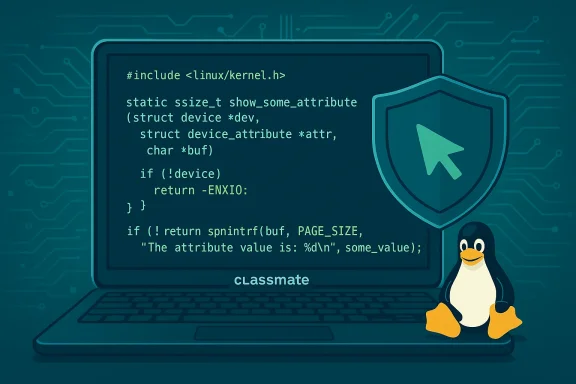
The upstream patch is surgical: it inserts simple NULL checks in a handful of accessors and entry points so they immediately return an error if a required pointer is not yet present. The commit adds checks such as:- if (!inputdev) return -ENXIO;
- if (!accel) return -ENXIO;
Why those particular checks? In this driver the sysfs attribute object cmpc_accel_sensitivity_attr_v4 is registered in cmpc_accel_add_v4() before the driver calls dev_set_drvdata on the inputdev->dev. If a read occurs between the attribute registration and the dev_set_drvdata assignment, the show/store code previously called dev_get_drvdata(&acpi->dev) and then dev_get_drvdata(&inputdev->dev) without verifying the results. The patch simply stops that unsafe dereference by returning -ENXIO when the expected pointer is NULL. (spinics.net)
Impact and scope
- Scope: single driver file (drivers/platform/x86/classmate‑laptop.c). The change is intentionally narrow in scope and contains no behavioral or feature changes beyond adding checks. (spinics.net)
- Primary impact: Availability. The flaw is a robustness issue: a NULL pointer dereference in kernel space which can produce an oops and crash the system (local denial‑of‑service). There is no indication in the upstream description that this bug enables remote code execution or privilege escalation; the risk profile is therefore limited compared with memory‑corruption or privilege escalation bugs. (app.opencve.io)
- Affected systems: Linux kernels that include the vulnerable classmate‑laptop code path and that run on hardware which binds that driver — i.e., Classmate laptop models that use the CMPC ACPI driver. If a distribution ships a kernel that includes the pre‑patch classmate driver, that kernel build is potentially affected, but the vulnerability only matters for hosts with the specific hardware and for workloads that exercise the sysfs attributes or input device paths. (spinics.net)
Why this pattern keeps showing up in kernel drivers
The Linux kernel contains many tiny drivers with lifecycle semantics that mix sysfs attribute creation, device registration, and device‑private pointer assignments. When attribute registration (or other callbacks) happens before device private pointers are stored, there is an initialization‑ordering race: userspace can attempt to access attributes in a window where the corresponding driver data is still unset.This class of robustness bugs is common in device driver code and routinely fixed by adding defensive NULL checks or by reordering initialisation so that dev_set_drvdata (or equivalent) runs before sysfs or input attribute registration. The kernel project has repeatedly committed likewise tiny, surgical fixes across multiple drivers to remove deterministic NULL dereferences; those fixes are small in code but important operationally. Examples of that broader pattern have been catalogued in recent kernel CVE writeups and discussion threads where maintainers trimmed a handful of lines to replace crashes with safe error returns.
Practical detection and triage for administrators
If you maintain systems that use Classmate hardware or are otherwise concerned, here’s how to triage and detect whether you are exposed and whether an oops could be related to this driver.- Identify whether the driver is present:
- Check your kernel build for drivers/platform/x86/classmate‑laptop.c or grep for “classmate” in the kernel config and modules list. If the driver is compiled into the kernel or available as a module, it’s a candidate for exposure. The source location and function names are present in the driver file.
- Kernel logs:
- Look in dmesg and journalctl for OOPS lines containing function names referenced in the patch (for example, cmpc_accel_sensitivity_show_v4, cmpc_accel_g_select_store_v4, cmpc_accel_open_v4). NULL pointer dereference oops entries will include call traces and the function names that led to the crash; match those names against the list changed in the patch. (spinics.net)
- Sysfs timing checks:
- On affected hardware you can inspect whether the accelerometer sysfs attributes appear under the device tree before the input device is completely initialized. If you repeatedly trigger reads at boot or immediately after driver bind and you observe intermittent kernel panics, that is consistent with an ordering/race exposure.
- Kernel version / distribution patch status:
- Check whether your distribution’s kernel package includes the upstream commit that adds the NULL checks. The upstream commit was posted on the platform‑driver‑x86 mailing list as part of an autosel patch set; downstream distributions typically cherry‑pick or backport such fixes into stable kernel updates. If your kernel package predates the patch you should treat the host as unpatched. (spinics.net)
Mitigation and remediation
For administrators and engineers the practical remediation path is simple and familiar:- Short term: Avoid exposing the vulnerable code path. If you can, remove or blacklist the classmate‑laptop module on systems that do not need it, or boot with a kernel configuration that avoids binding the driver on non‑Classmate hardware until you can patch. Kernel module blacklisting or rebuilding a kernel without the module are immediate mitigations.
- Recommended: Apply vendor or distribution kernel updates that include the upstream patch. Upstream committed the change quickly and it is a safe candidate for stable backport because it only adds early returns; distribution maintainers should backport it into the stable kernels they ship. (spinics.net)
- For embedded deployments or OEM images: rebuild device images to include the fixed driver and redeploy to the devices; because affected hosts are in the field as education machines, OEM firmware and image updates are the right way to ensure broad protection.
- Locate the upstream commit in your kernel of choice and cherry‑pick it into the stable branch you maintain.
- Run smoke tests on affected hardware to ensure the new -ENXIO returns are acceptable to userspace (they are; the checks only stop the crash path).
- Ship the updated kernel package and advise operators to reboot into the patched kernel.
For driver authors and reviewers: lessons and recommended fixes
This incident is textbook and instructive for driver maintainers:- Initialization ordering matters. Prefer assigning driver private data (dev_set_drvdata or equivalent) before registering sysfs attributes or registering callbacks that userspace can trigger.
- If you must register attributes early, ensure the accessor functions defensively verify dev_get_drvdata results before dereferencing them.
- Use devm APIs to reduce lifecycle surprises, but beware that devm memory management does not eliminate races between attribute registration and dev_set_drvdata ordering.
- Add minimal unit or integration tests that attempt to read sysfs attributes during probe/unbind windows; such tests can surface these timing windows early.
- Fuzzers and kernel testing tools (syzbot / syzkaller) find similar classes of bugs; integrate results from such tools into your CI and treat NULL dereferences flagged by these tools as high‑priority stability fixes.
Broader risk picture and responsible disclosure status
CVE‑2026‑23237 was published through the Linux CNA entry and recorded in public vulnerability databases; the upstream commit was visible on the platform‑driver‑x86 patchlist prior to the CNA publication. The patch arrived as a carefully reviewed kernel change and maintainers labelled the risk “very low” because the fix only replaces crashing behavior with safe error returns. (app.opencve.io) (spinics.net)There is no public indication at the time of the patch that an exploit exists for this issue. Because the flaw is a NULL pointer dereference (not a crafted out‑of‑bounds memory write or use‑after‑free), the most realistic impact is a local or user‑triggered crash, not code execution. Nevertheless, any kernel crash in production is disruptive and should be fixed promptly; treat the absence of public exploit code as a positive, but do not defer patching in mission‑critical environments. (If you need absolute assurance, monitor your vendor advisories and test the patched kernel in a controlled environment before wide rollout.) (app.opencve.io)
Detection, forensic notes, and indicators of compromise (IoC)
Because this vulnerability manifests as an oops there are clear forensic indicators:- Kernel oops messages in dmesg that include NULL pointer dereference text and mention the affected function names (cmpc_accel_sensitivity_show_v4, cmpc_accel_g_select_store_v4, cmpc_accel_open_v4). The stack trace will include the exact function names that the patch updates. (spinics.net)
- Reproducible crashes triggered by rapid, repeated sysfs reads of the accelerometer attributes immediately after device probe — if you can reproduce the crash deterministically on a device with the vulnerable driver, you have strong evidence of the issue.
- On devices without the physical hardware bound, the driver will not be instantiated and the relevant sysfs attributes will not exist; presence of the attributes combined with kernel oopses is the most telling combination.
Why the fix is appropriate (and why it’s safe)
There are two common approaches to this class of bug:- Reorder initialization so that driver private pointers are set before sysfs attr registration (avoid the window entirely).
- Add defensive NULL checks in accessors so an early access returns a controlled error rather than crashing.
Recommendations — checklist for operators and maintainers
- Operators (sysadmins, OEM support teams):
- Determine whether your fleet includes Classmate devices or otherwise uses this driver.
- Check for absence/presence of the commit in your distribution kernel packages; if missing, plan a staged rollout of the updated kernel or a patched package.
- If immediate patching is impossible, consider blacklisting or unloading the classmate‑laptop module on devices that do not require it.
- Distribution packagers and OEMs:
- Cherry‑pick the upstream commit into relevant stable kernel branches and package updates for affected releases.
- Include a short advisory describing that the change reduces kernel crashes and carries very low regression risk.
- Run basic input and sysfs tests on representative hardware before distribution.
- Driver authors:
- Audit other drivers for sysfs/driver‑data ordering assumptions; add unit/integration tests that attempt early user access during probe.
- Use CI tools and kernel fuzzers to catch time‑of‑initialization races before release.
Conclusion
CVE‑2026‑23237 is a straightforward example of a common kernel robustness problem: a NULL‑pointer dereference created by an initialization ordering window in a device driver. The upstream fix is tiny, conservative, and safe — it replaces an immediate crash with a controlled -ENXIO return — and the change is already present in the upstream patchset. Operators should treat this as a routine but actionable stability update: if you run kernels that include the vulnerable classmate‑laptop code on affected hardware, apply the patched kernel from your distributor or OEM as part of normal maintenance. The fix reduces availability risk and is low risk to deploy, which makes it a clear win for kernel reliability. (app.opencve.io) (spinics.net)Source: MSRC Security Update Guide - Microsoft Security Response Center
