

The Linux kernel patch for CVE-2024-26836 corrects a subtle but important ordering bug in the platform/x86 think-lmi driver that could allow firmware attribute changes on Lenovo workstations to bypass intended Admin-password checks unless the driver runs the password opcode first — a fix that was merged into the stable trees in 2024 and has since been folded into distribution updates. (osv.dev)
The think-lmi driver is Linux’s platform/x86 interface for Lenovo firmware settings on supported ThinkPad and ThinkStation models. It speaks the vendor-specific opcodes that the firmware expects when the kernel reads or writes BIOS/UEFI attributes, and it must follow the exact opcode sequencing the firmware enforces — including running password verification opcodes before applying protected attribute changes when the firmware’s Admin password feature is enabled. When that sequence is incorrect, firmware-level protections can be undermined by the OS. (osv.dev)
This particular defect was disclosed to the community and catalogued as CVE-2024-26836 on 17 April 2024; the Linux stable trees received a commit titled “platform/x86: think-lmi: Fix password opcode ordering for workstations,” and distribution maintainers started rolling the fix into stable kernel packages and advisories shortly afterwards. (osv.dev)
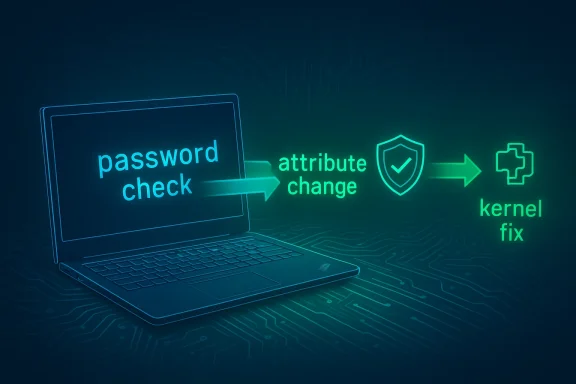
If the kernel driver applies attribute changes before the password verification is processed by firmware, the protection can be bypassed or the driver can present the wrong sequence to the firmware causing unintended outcomes. The fix committed for CVE-2024-26836 restores the correct ordering so that the password opcode executes before attribute updates on affected Lenovo workstations. (osv.dev)
Source: MSRC Security Update Guide - Microsoft Security Response Center
 Background
The think-lmi driver is Linux’s platform/x86 interface for Lenovo firmware settings on supported ThinkPad and ThinkStation models. It speaks the vendor-specific opcodes that the firmware expects when the kernel reads or writes BIOS/UEFI attributes, and it must follow the exact opcode sequencing the firmware enforces — including running password verification opcodes before applying protected attribute changes when the firmware’s Admin password feature is enabled. When that sequence is incorrect, firmware-level protections can be undermined by the OS. (osv.dev)This particular defect was disclosed to the community and catalogued as CVE-2024-26836 on 17 April 2024; the Linux stable trees received a commit titled “platform/x86: think-lmi: Fix password opcode ordering for workstations,” and distribution maintainers started rolling the fix into stable kernel packages and advisories shortly afterwards. (osv.dev)
Why this matters: firmware protections and opcode ordering
At a high level, modern firmware (UEFI/BIOS) exposes configuration settings that are often protected by an administrative password. On many vendor platforms — Lenovo included — the firmware requires the kernel or management agent to perform an explicit password opcode (a password check operation) before it allows changes to sensitive attributes (for example, toggling Secure Boot options, unlocking boot order changes, enabling/disabling virtualization features, or changing password-protection state).If the kernel driver applies attribute changes before the password verification is processed by firmware, the protection can be bypassed or the driver can present the wrong sequence to the firmware causing unintended outcomes. The fix committed for CVE-2024-26836 restores the correct ordering so that the password opcode executes before attribute updates on affected Lenovo workstations. (osv.dev)
Technical analysis: what went wrong, precisely
The implementation flaw
- The think-lmi driver introduced support for opcode-based attribute handling but arranged operations in an order that, on certain Lenovo workstation firmware, would change an attribute value before the firmware saw the password opcode that should have verified privileges.
- The firmware’s expectations are strict: when Admin password protection is enabled, the firmware will only commit attribute changes after receiving and validating the password opcode. If the kernel sends the change out-of-order, the firmware may accept the change (or the kernel may change a cached or shadowed value) without the intended authentication step.
The patch
- The kernel patch reorders the driver’s handling path so that the password opcode is executed prior to attribute modification. The authoritative kernel commit message and stable-tree cherry-picks document the fix. The change was tested on several ThinkPad models to ensure the re-ordered opcode sequence behaves correctly with Lenovo firmware. (osv.dev)
Severity and attack surface
- The vulnerability is local-only (attack vector: local). An attacker needs local access to the system — either a logged-in low-privileged account or the ability to run local code — to exercise the flaw. Multiple vulnerability trackers assign a high-impact rating (CVSS v3.1 base 7.8) because a successful exploit could compromise confidentiality, integrity, and availability of protected firmware attributes. However, the capability to reach firmware-level modifications depends on factors such as available local privilege, system configuration, and whether Admin password protection is enabled. (osv.dev)
Affected systems and kernel versions
Accurate inventory is essential. The vulnerability is in the Linux kernel driver (think-lmi) and therefore affects distributions and systems that:- Run the affected kernel versions that contain the buggy think-lmi implementation (introduced in the opcode-support work and present across multiple 5.x and 6.x kernel series), and
- Are installed on Lenovo workstation hardware where the firmware enforces Admin-password-controlled attribute changes (ThinkPad and ThinkStation variants tested during patching). (osv.dev)
- Example (representative, not comprehensive): vulnerability trackers list series and point releases affected across 5.17 up to early 6.7 and some 6.8 release candidates, with fixes backported to stable branches; consult your distro advisory for the exact package version that resolves CVE-2024-26836.
Attack scenarios and practical impact
Realistic attacker capabilities
- Local code execution: an unprivileged user or malware running locally may attempt to invoke the think-lmi interface or exploit an application that uses it to request firmware attribute changes.
- Privilege escalation pathway: if local code can perform attribute writes (for instance, through a setuid or misconfigured management tool), the ordering bug can enable attribute changes without prior password verification.
- Insider threat: a user with physical presence or an account on the host could attempt to modify firmware-protected settings to persist access or weaken host defenses.
Potential outcomes if successfully exploited
- Unauthorized modification of BIOS/UEFI attributes that are meant to be protected by an Admin password.
- Disabling or weakening of security controls (for example, disabling Secure Boot, relaxing boot protections, adjusting password policies).
- Persistent compromise vector: changes to firmware settings could facilitate boot-time persistence or create conditions enabling easier kernel-level tampering.
- Indirect availability impact if firmware changes lead to misconfiguration, causing system instability or rendering the device unbootable in worst cases.
What vendors and maintainers did (and when)
- The kernel maintainers received the patch and merged it into the stable kernel trees; the patch was authored and signed-off by contributors working with Lenovo-affiliated maintainers and reviewers, and later backported/cherry-picked into stable branches. The merge and stable-tree commits are recorded in the kernel Git and the public mailing list discussion.
- Distribution security teams (Debian, Ubuntu, SUSE, etc.) tracked the CVE and issued or scheduled fixes in their kernel packages; administrators should consult their distribution advisories for the exact package versions that include the fix. (osv.dev)
- Third‑party vulnerability databases and scanners (e.g., Snyk, Tenable, Wiz) cataloged the CVE, provided risk context, and added detection plugins where applicable. These sources also show variance in vendor severity scoring (some vendors or platforms may mark the issue as Medium depending on attack vector and distro packaging). Administrators should rely on their platform vendor’s advisory for remediation priority.
Patching and mitigation guidance (practical steps)
If you manage Lenovo workstations running Linux, treat this CVE as a device- and kernel-level patching priority for endpoints that rely on firmware/password protection.- Inventory (immediately)
- Identify Lenovo workstation models in your estate (ThinkPad, ThinkStation, and workstation-class hardware).
- Identify kernel versions and package release numbers currently deployed on each machine.
- Confirm exposure (short-term)
- Check whether the system firmware has Admin password protection enabled. If not enabled, the specific attack path may be moot; however, firmware settings can change and attackers may still attempt to exploit other vectors.
- Verify if your distribution has published a security advisory and which kernel package version contains the fix. Consult your distro’s security pages (Ubuntu, Debian, SUSE, etc.) and your vendor kernel advisory. (osv.dev)
- Apply updates (recommended)
- Install the vendor-supplied kernel update that includes the think-lmi fix. Use your distribution’s package manager and install the kernel packages that vendor advisories list as fixing CVE-2024-26836.
- For environments where kernel updates are tightly controlled, schedule a maintenance window and apply the patched kernel builds or rebuild the kernel with the commit cherry-picked.
- Validate
- After updating, reboot targeted hosts to the updated kernel and verify kernel version. Check dmesg or kernel logs for think-lmi initialization messages; regression tests for firmware changes (if you maintain automated firmware-management suites) should be executed.
- Compensating controls (if immediate patching is impossible)
- Disable remote or unnecessary user accounts on affected endpoints.
- Restrict who can run local configuration utilities or management tools that might access think-lmi interfaces; reinforce least privilege.
- Use host hardening policies and endpoint protection to reduce the likelihood of local code execution by untrusted software.
- Identify affected hosts and whether Admin-password-protected firmware exists.
- Confirm distributikage version.
- Patch kernels or schedule updates for affected machines.
- Reboot to patched kernels and validate fixes.
- Harden local account and process controls to reduce local exploitation surface.
Detection and hunting: what to look for
Because exploitation requires local access and attempts to invoke firmware attribute changes, defenders should focus on:- Unusual invocations of firmware-management utilities or calls to kernel ioctl paths related to think-lmi or vendor-specific firmware interfaces.
- Unexpected changes to BIOS/UEFI attributes (boot order changes, Secure Boot toggles, password-protection state changes) occurring without authorized change records.
- Privileged operations performed by non-administrative accounts or background processes that ordinarily wouldn’t alter firmware state.
- Endpoint telemetry showing new or unrecognized processes attempting to access platform-related sysfs paths or vendor-specific ACPI/WMI interfaces.
Risk assessment: strengths, limitations, and residual risks
Strengths (what the fix achieves)
- The patch addresses the root cause: an opcode-ordering logic error in the driver — not a superficial mitigation — restoring correct sequencing that firmware expects for Admin password checks.
- The fix has been merged into stable kernel trees, enabling distributions to backport and package corrected kernels for wide consumption.
Limitations and caveats
- Local access requirement: an attacker still needs local access or the ability to run local code; this is a meaningful barrier in many enterprise settings but not one you should rely on as a primary defense.
- Distribution lag: many organizations run vendor-supplied kernels or long-term support trees that might be slower to receive the fix; systems remain at risk er patched packages. Track your distro advisory for the specific fixed package string.
- Hardware nuance: the bug manifests against firmware that enforces password opcode ordering; not every Lenovo model or firmware revision may behave identically. The kernel patch author tested ThinkPad models, but hardware variance means full verification on your exact models is advised. (osv.dev)
Residual risk
- Systems that cannot be patched quickly (legacy LTS kernels, constrained update paths, or sensitive appliances) will retain residual risk. For these, combine the compensating controls outlined earlier (restrict local execution, audit management tools, and check firmware settings) until the patch can be applied.
Broader takeaways for firmware security and vendor driver code
This CVE is a reminder of three key realities for endpoint and firmware security:- Vendor-specific interfaces (like think-lmi) are delicate: they must precisely implement vendor expectations. Slight ordering or timing mismatches in driver code can nullify firmware protections.
- Firmware-level controls matter: Admin passwords and Secure Boot are only effective when firmware and OS interfaces observe the same semantics. Visibility into firmware interactions should be part of regular endpoint security posture.
- Patch management matters at the kernel level: kernel d to subtle logic bugs; maintaining an update pipeline for kernel and firmware updates is essential in workstations used in sensitive roles.
Final recommendations (executive summary)
- Treat CVE-2024-26836 as a high-priority kernel patch for affected Lenovo workstation fleets where firmware Admin password protection is used.
- Immediately inventory affected systems and map kernel package versions against distribution advisories.
- Apply vendor or distribution kernel updates that include the think-lmi fix; reboot systems into patched kernels and validate.
- If immediate patching isn’t possible, implement stricter local privilege controls and monitor firmware-change activity closely.
- Because this is a firmware-interaction bug, validate fixes on representative hardware models before mass deployment if you run custom kernels or manage specialized fleet images.
Conclusion
CVE-2024-26836 is a narrowly scoped but impactful vulnerability: it exposes how sequence matters when software talks to firmware. The Linux kernel community addressed the issue at the driver level by restoring the correct password-opcode-first ordering for Lenovo workstations; distributions and maintainers are responsible for packaging and delivering fixes. Organizations should prioritize deploying those kernel updates on affected devices, harden local execution controls where necessary, and add firmware-change monitoring to their endpoint detection playbooks. The issue underlines a practical lesson: firmware protections are only as strong as the code that interfaces with them. (osv.dev)Source: MSRC Security Update Guide - Microsoft Security Response Center
