

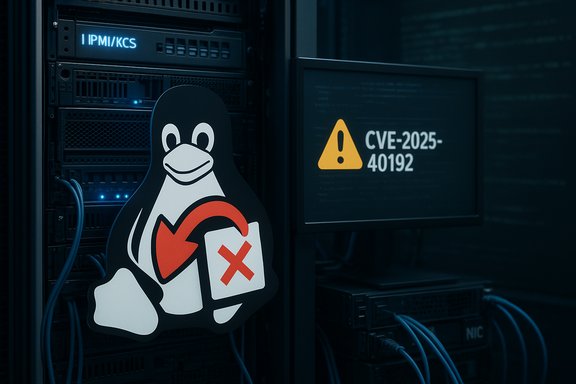
A short, surgical but consequential change in the Linux kernel has been rolled back after it introduced an unexpected stability regression: maintainers reverted a patch titled "ipmi: fix msg stack when IPMI is disconnected" because the change could cause the IPMI driver to enter an infinite loop when certain Baseboard Management Controllers (BMCs) misbehave. The reversion is tracked as CVE-2025-40192 and has been published across mainstream vulnerability trackers; distributors and vendors are advising administrators to verify that their kernels include the upstream revert or an equivalent vendor backport to avoid availability issues on servers that interact with BMCs.
Immediate steps if patching is not yet possible:
Source: MSRC Security Update Guide - Microsoft Security Response Center
 Background
What is IPMI and why the Linux driver matters
IPMI (Intelligent Platform Management Interface) and the broader family of BMC-based management tools provide out-of-band hardware control for servers: remote power, sensor collection, firmware access, and serial-over-LAN (SOL) consoles. These capabilities are essential for data-center management, remote troubleshooting, and automated provisioning, and they typically interface with the host OS via kernel drivers such as the KCS (Keyboard Controller Style) IPMI transport. Because IPMI paths bridge the management plane and the host kernel, defects in IPMI drivers primarily threaten availability (kernel oopses, hangs, or reboots) rather than confidentiality or privilege escalation in most cases.What the reverted patch attempted to fix
An upstream commit (identified by hash c608966f3f9c... aimed to adjust how the IPMI driver handles its message stack when the IPMI connection to the BMC becomes disconnected. The motivation was legitimate: previous code paths could leave message bookkeeping or KCS state in an inconsistent condition when the BMC abruptly reset or behaved outside expected protocols. The revert shows the change was locally invasive to the state-management code in drivers/char/ipmi/ipmi_kcs_sm.c, but — crucially — the new logic introduced a subtle bug that could place the driver into an infinite loop if certain BMCs responded or failed in particular ways. The kernel stable trees therefore accepted a revert to remove the regression.The vulnerability in plain language
- The issue is not a remote code execution or privilege-escalation vulnerability in the usual sense; rather, it's a logic/regression bug introduced by a prior patch that, under uncommon BMC behaviors, can cause the IPMI driver to loop indefinitely.
- An IPMI driver infinite loop typically consumes CPU, may flood kernel logs, and in many setups will starve other kernel work — ultimately raising the risk of host instability or a watchdog-triggered reset.
- The practical attack surface is therefore tied to access to the management/control plane (BMC) and to the presence of a vulnerable kernel. In many data centers and co-location environments, management networks are logically isolated, but shared NIC or NCSI configurations may increase exposure when BMCs are reachable from host networks.
What upstream changed — the reversion and its provenance
Kernel maintainers merged a revert commit (5d09ee1bec87... that explicitly undid commit c608966f3f9c.... The revert was circulated and applied into the stable branches (6.6, 6.12, 6.17, and others) as part of standard stable maintenance because the introduced regression produced real reports from operators. The revert patch alters the ipmi_kcs_sm.c logic by restoring previous state initialization semantics and by modifying the conditions under which the KCS state machine is considered valid, removing the path that could lead to an endless SI_SM_HOSED/loop scenario. The change is intentionally small and surgical — a conservative upstream rollback to preserve runtime stability while maintainers analyze a safer, corrected fix.Affected systems and distribution response
Kernel versions and distribution mapping
Multiple distribution trackers and advisory pages have mapped CVE-2025-40192 to the upstream revert and to vendor kernel packages. Debian, SUSE, Amazon Linux, and other distributors have already enumerated which release kernels include the revert or which remain vulnerable until they ship the backport. The public tracker entries show that some releases (for example, Debian stable/backports and certain stable kernel packages) are already marked fixed, while others remain vulnerable until their maintainers update packages and push updates to users. Administrators should consult their vendor or distribution security tracker to identify exact package versions for remediation.Severity and likelihood of exploitation
Trackers classify the issue as moderate in severity with a primary impact on availability. Some distributors provide CVSS metrics (for example, SUSE lists CVSS v3 = 5.5 and CVSS v4 ≈ 6.8 in their assessment), reflecting a low complexity local attack that can nonetheless cause high availability impact if triggered. Exploit-prediction scoring and telemetry (EPSS) at publication time indicate a low probability of immediate exploitation in the wild, but the real-world risk is the operational disruption that can arise when a widely distributed kernel exhibits a deterministic hang under specific BMC behavior.Why this matters to Windows and mixed environments
Many Windows-centric administrators manage hybrid racks and virtualization hosts where Linux-based tooling or BMC firmware interacts with Windows guests and hosts. BMCs (iLO, iDRAC, IMM, or vendor IPMI implementations) are agnostic to the guest OS and can produce management-plane traffic that the host kernel must process. A kernel-level infinite loop on the host can:- interrupt hypervisor services and guest availability,
- break remote management sessions (KVM-over-IP, SOL),
- hinder automated orchestration and remote remediation flows that rely on the host to remain responsive.
Detection: how to spot the problem in your environment
Look for indicators that are strongly associated with the IPMI KCS state machine entering a pathological state:- Repeated kernel warnings or oopses referencing ipmi_kcs_sm or KCS state transitions in dmesg or journal logs.
- High, sustained CPU usage in kernel context on a server with active BMC interactions.
- Repeated resets or watchdog-triggered reboots of hosts that correlate with management-plane activity (for instance, SOL sessions or large sensor polling bursts).
- Logs showing the KCS driver repeatedly emitting warnings like "KCS in invalid state X" or similar messages that match the upstream patch diffs and revert rationale.
Mitigation and remediation guidance
The safe, recommended approach is to install vendor-supplied kernel updates that include the upstream revert or a corrected backport. Because kernel changes require reboots (except when a trusted livepatch is available and verified), plan these updates through standard maintenance windows.Immediate steps if patching is not yet possible:
- Inventory affected hosts:
- Identify systems that use IPMI/KCS drivers or share NICs with BMCs (NCSI, OS2BMC, vendor bridging).
- Prioritize hosts that provide critical services or that are reachable from untrusted management networks.
- Short-term mitigations:
- If the ipmi/KCS functionality is modular, temporarily unload the module with modprobe -r ipmi_si ipmi_devintf ipmi_msghandler (note: unloading may be prevented if interfaces are in use and can disrupt legitimate management workflows).
- If the distribution builds IPMI into the kernel (non-modular), consider disabling BMC-host sharing in firmware/BIOS, or isolating the management network to trusted VLANs until kernels can be updated.
- Vendor coordination:
- Apply vendor-provided kernel packages rather than hand-patching or cherry-picked commits; vendor kernels often include other backports and must be tested in your environment before widespread deployment.
- Validation and post-patch checks:
- After installing updated kernels and rebooting, verify uname -r reflects the patched kernel and scan for historical dmesg patterns to ensure the previously observed KCS warnings no longer appear.
- Run soak tests that exercise management-plane operations (SOL, sensor polling, power cycles) to confirm the host remains stable under typical BMC traffic.
Critical analysis — strengths, limitations, and vendor risk
Strengths of the upstream response
- The revert is small and conservative: upstream maintainers chose to roll back the problematic change rather than push a hurried fix, minimizing the risk of further regressions.
- The change shows responsible triage — the kernel stable trees accepted the revert rapidly after operator reports surfaced, demonstrating a mature maintenance process for safety-first fixes.
Limitations and long-tail risks
- The biggest operational risk is the long tail of vendor and distributor backports: embedded systems, OEM kernels, and appliances often lag upstream fixes or may never receive them. In those environments, administrators may have no easy path to remediation other than firmware configuration changes or hardware replacement. This remains the predominant problem with kernel-level defects that are availability-critical.
- Detection can be noisy: kernel logs vary across vendors and kernel config flags; pattern-matching must be tuned to a variety of message formats and localized environments.
- Livepatches and quick hotfix channels vary by vendor: some providers offer verified livepatches for specific stable branches, while others require full kernel replacement and reboot — increasing the operational cost of remediation.
What operators should be wary of
- Avoid manual backports unless you have a fully-featured kernel QA pipeline: cherry-picking a commit without the distribution's integration testing can introduce ABI/API mismatches or silently break vendor-specific kernel modules.
- Do not assume that lack of public exploit code equals low risk; an availability bug that can be triggered by misbehaving management hardware or accidental operator action is still a practical threat to critical infrastructure.
Recommendations — an actionable checklist for administrators
- Inventory and prioritize:
- Identify all hosts with IPMI/BMC connectivity and tag them by business criticality.
- Patch:
- Apply vendor/distribution kernel updates that include the upstream revert or an equivalent, verified backport.
- Mitigate if necessary:
- Unload ipmi-related modules or disable BMC-host sharing in firmware if immediate patching is impossible — evaluate the operational cost first.
- Monitor:
- Add SIEM/telemetry rules for kernel oops messages and KCS-state warnings; retain expanded kernel logs during remediation windows.
- Test:
- After patching, conduct management-plane stress tests (SOL, sensor sweeps, power cycles) to validate stability.
- Vendor coordination:
- For appliances or vendor kernels, obtain explicit vendor advisories confirming the fix and the exact package/kernel build that resolves CVE-2025-40192.
Final assessment and closing thoughts
CVE-2025-40192 is a textbook example of how a small, well-intentioned grooming change can have outsized operational consequences when it interacts with imperfect real-world hardware. The upstream decision to revert the change rather than attempt a hasty replacement is the right engineering tradeoff for preserving host stability while maintainers develop a robust, regression-free fix. Administrators should treat this as an availability emergency for affected infrastructure: inventory BMC-enabled hosts, prioritize vendor kernel updates, and apply cautious temporary mitigations where immediate patching is not possible. The risk of widespread service disruption, not remote exploitation for code execution, is the bottom line — and for data centers and mixed OS environments that rely on out-of-band management, that is more than sufficient reason to act quickly. Caveat: information about exploit activity, vendor timelines, and distribution-specific package numbers changes quickly. Administrators must consult their vendor security advisories and distribution trackers for the exact package names and versions to install; where public trackers show a package as fixed, verify the changelog or advisory explicitly lists the upstream revert commit IDs before rolling changes into production.Source: MSRC Security Update Guide - Microsoft Security Response Center
