

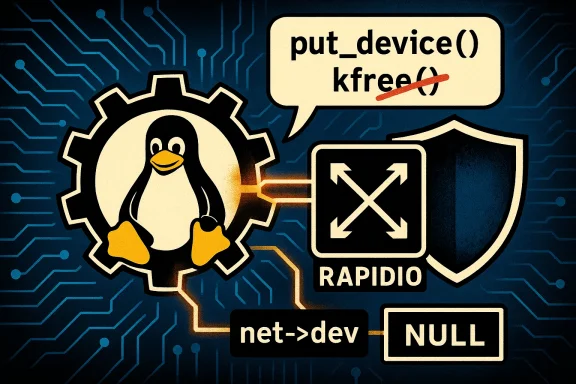
The RapidIO networking patch recorded as CVE-2025-21934 fixes a small but consequential memory-management mistake in the Linux kernel that, under certain failure conditions, could leave a RapidIO port structure pointing at freed memory — a classic use-after-free that translates into a high-severity availability and memory-corruption risk for affected systems. The upstream change replaces an incorrect kfree() with the proper put_device() call and explicitly nulls the mport->net pointer, closing a gap that could otherwise let failures of device_register() cascade into persistent instability.
RapidIO is a high-performance packet-switched interconnect used primarily in embedded systems, telecom equipment, and certain types of networking appliances. Its in-kernel drivers present RapidIO ports and devices to the kernel and, when present, expose a networking stack integration that allows RapidIO-connected endpoints to participate in network operations. Because RapidIO is commonly embedded in specialized hardware, the kernel code paths involved are less visible in general-purpose desktops, but they are critical in industries and appliances that rely on these interconnects.
The bug fixed in CVE-2025-21934 appears in the user-visible rapidio device registration path: rio_add_net() calls device_register() to attach a network device to the kernel. When device_register() fails, the older code used kfree() to release the memory for the network device structure; the correct behavior is to call put_device() to drop the device reference and let device lifetime management run its course. The patch also makes mport->net explicitly NULL after the cleanup to prevent later code from dereferencing a freed pointer. This change embodies a standard kernel-correctness principle: use the complementary lifecycle API rather than manually freeing structures that the device core owns.
Patch excerpt (conceptual representation):
Key operational facts:
Immediate actions (0–48 hours)
The CVE demonstrates a common truth in systems programming: correctness errors are often tiny in code size but fundamental in impact. A single wrong free or missing NULL assignment can convert a transient error into a persistent integrity or availability problem. The upstream patch respects the device core's reference-counting model and prevents a dangling pointer by nulling the mport->net handle — a defensive step to reduce the chance of later accidental access to freed memory.
From a forensic and maintenance perspective, this is the kind of "paper-cut" bug that is easy to miss in review but costly in production — making lifecycle API discipline crucial for kernel maintainers and module authors.
(Operational note: vendor attestations and distribution advisories are an essential complement to upstream commits when deciding remediation windows because your kernel may be a vendor-customized build where upstream tree mapping matters. Treat vendor advisories as authoritative for patch availability and scheduling.)
For most desktop environments the practical risk is limited because RapidIO is not commonly present. For embedded systems, telecom equipment, and other RapidIO-bearing appliances, this is a high-priority fix: apply vendor or distribution kernel updates promptly, or apply mitigations such as unloading the RapidIO driver until a patch can be installed. The upstream patch is the right one: it restores the device-core contract, makes the error path safe, and removes the dangling-pointer hazard that triggered the CVE classification.
Source: MSRC Security Update Guide - Microsoft Security Response Center
 Background
RapidIO is a high-performance packet-switched interconnect used primarily in embedded systems, telecom equipment, and certain types of networking appliances. Its in-kernel drivers present RapidIO ports and devices to the kernel and, when present, expose a networking stack integration that allows RapidIO-connected endpoints to participate in network operations. Because RapidIO is commonly embedded in specialized hardware, the kernel code paths involved are less visible in general-purpose desktops, but they are critical in industries and appliances that rely on these interconnects.The bug fixed in CVE-2025-21934 appears in the user-visible rapidio device registration path: rio_add_net() calls device_register() to attach a network device to the kernel. When device_register() fails, the older code used kfree() to release the memory for the network device structure; the correct behavior is to call put_device() to drop the device reference and let device lifetime management run its course. The patch also makes mport->net explicitly NULL after the cleanup to prevent later code from dereferencing a freed pointer. This change embodies a standard kernel-correctness principle: use the complementary lifecycle API rather than manually freeing structures that the device core owns.
What went wrong: a concise technical explanation
- rio_add_net() creates and initializes a network device structure and then calls device_register() on it. device_register() sets up kernel-level bookkeeping (struct device lifecycle links, reference counts) and may return an error code if registration fails.
- The buggy path assumed a straight memory free was acceptable when device_register() returned an error and invoked kfree(net). But because device_register() may have altered device reference counts and internal pointers, simply calling kfree() can leave other kernel code holding stale pointers or dangling references that expect the normal device release path to run.
- The correct corrective call is put_device(&net->dev) which decrements the device's reference count and triggers the device core's release callback when the count reaches zero — ensuring proper teardown and avoiding use-after-free races.
- Finally, mport->net was left pointing at the freed net object; the patch sets mport->net = NULL to ensure later code does not access the dangling pointer.
The official fixes and commit details
Upstream maintainers applied a surgical patch to drivers/rapidio/devices/rio_mport_cdev.c that replaces the kfree(net) call with put_device(&net->dev) and inserts mport->net = NULL in the error path. The commit message explicitly calls out that rio_add_net() calls device_register() and therefore requires the complementary put_device() call on failure. The patch was included in the Linux stable backports for multiple maintained series and appears in distribution updates that incorporate the stable trees.Patch excerpt (conceptual representation):
- Before: on device_register() failure -> kfree(net); goto cleanup;
- After: on device_register() failure -> put_device(&net->dev); mport->net = NULL; goto cleanup;
Affected code, versions, and distributions
Multiple vulnerability databases and distribution security trackers cataloged the issue as affecting in-tree Linux kernels and listed backported fixes in relevant stable trees. The vulnerability record (NVD and distribution trackers) indicates the problem is present in kernels before the fixed stable releases and that numerous distributions rolled fixes into their kernel publish pipelines.Key operational facts:
- The patch was merged into stable kernel trees and picked up by distributors that rebuild and ship patched kernel packages.
- Distributions with long-term support or with backport policies (Debian, Ubuntu, Red Hat, SUSE variants) published advisories or incorporated the fix in point releases or errata. Scanners and enterprise patch-management tools added detections and Nessus-style plugins to flag unpatched kernels.
Severity and impact: what this CVE means in practice
Vulnerability catalogs categorized CVE-2025-21934 as a high-severity, use-after-free class bug with a CVSS base score in the high range (commonly reported as 7.8 under CVSS v3.1). The core impacts to operators are:- Memory corruption / use-after-free: code later accessing mport->net could dereference freed memory, causing kernel crashes or unpredictable behavior.
- Availability loss: a triggered kernel panic or recurring instability can fully deny services provided by the affected host until it is rebooted and patched.
- Potential escalation paths: memory corruption in kernel context can sometimes be chained to execute arbitrary kernel code or escalate privileges, though successful exploitation for code execution generally requires more complex conditions than a straightforward crash. Nevertheless, kernel-level memory-safety defects are intrinsically severe because of their potential to affect confidentiality, integrity, and availability.
- The vector requires local or privileged actions that cause rio_add_net() to execute and trigger the device_register() failure path. Many databases list the attack vector as LOCAL (AV:L), meaning an attacker needs local access or the ability to interact with system device registration APIs or to present crafted device behavior via hardware.
- The exploitability depends on whether an attacker can force device_register() to fail in a controlled way while the code path is live. On systems without RapidIO hardware or where that driver is not loaded, the risk is theoretical and not practical.
Who should care: affected populations and use cases
- Telecom carriers and network-equipment vendors: RapidIO is common in high-speed switching fabrics and embedded dataplane devices used by carriers and certain enterprise appliances.
- OEMs that build specialized hardware: systems that ship with RapidIO interfaces must ensure their kernel builds include the fix and that customers receive patched firmware or kernel updates.
- Cloud/hosting providers that run custom appliances: if any host in the critical path exposes RapidIO devices, cluster reliability can be impacted.
- Embedded Linux operators and integrators: because embedded systems often run long-lived, rarely-updated kernels, unpatched devices can remain vulnerable for long periods.
Exploitation complexity and threat model
Understanding the difference between “vulnerable” and “practically exploitable” is key when triaging kernel fixes:- Access requirements: exploitation requires local access or the ability to influence kernel device registration flows. Remote network-based exploitation paths are not typical for this class of RapidIO device-driver bug.
- Hardware dependency: the flaw is reachable only if the RapidIO mport codepath is instantiated. Many kernels compile the RapidIO drivers as modules, so systems without the hardware will usually not load the module and are effectively not exposed.
- Failure control: to exploit the bug, an attacker must provoke device_register() into failing while leaving earlier allocations in place — this may be possible via crafted hardware or via misconfiguration, but it’s not trivially provable from a distance.
- Chaining potential: a determined attacker with local privileges and access to device surfaces could combine this bug with other kernel bugs to increase impact. However, proof-of-concept public exploits for CVE-2025-21934 have not been broadly reported at disclosure time; most public coverage focused on the stability and correctness implications rather than an active exploit campaign.
Detection, mitigation, and recommended actions
Practical steps for defenders and administrators can be grouped into immediate mitigations, medium-term operational actions, and long-term hardening.Immediate actions (0–48 hours)
- Inventory: identify hosts that load the RapidIO driver or instantiate RapidIO mports at runtime. Check lsmod, dmesg, and boot-time logs for drivers/rapidio and rio_mport entries.
- Patch priority: if a host runs RapidIO code, prioritize updating the kernel to a vendor-provided patch that contains the upstream fix. Distributors captured the change in their stable backports and advisories — apply those updates promptly.
- Reboot windows: kernel updates require reboots; schedule them in maintenance windows if patching production devices.
- Unload the RapidIO module or blacklist it where hardware is not used; this prevents the driver from executing the vulnerable path.
- Restrict local user access and appliance maintenance interfaces to trusted operators to limit the ability of unprivileged local actors to trigger device-registration paths.
- Use process- and endpoint-level monitoring to detect repeated kernel OOPS or panics that could indicate attempts to trigger the bug.
- Validate vendor kernels: obtain patched kernel builds or vendor-signed updates for appliances with embedded RapidIO hardware.
- Test patches in staging: confirm functionality of RapidIO device stacks after update to avoid regressions in specialized environments.
- Adopt robust device-release patterns in kernel development workflows; this bug underscores the danger of mixing raw frees with lifecycle-managed objects.
- Maintain an up-to-date CVE inventory tied to SBOMs and kernel configuration manifests so you can quickly identify affected artifacts.
- Ensure embedded systems and appliances have an update/rollback pathway; long-lived embedded kernels are a frequent source of persistent exposure.
Why the fix is correct (and why small fixes matter)
Kernel object lifetimes are managed across multiple subsystems; device_register() and put_device() are complementary operations. Using the right API ensures that any internal reference changes, release callbacks, and driver-specific teardown routines run in a predictable, safe order.The CVE demonstrates a common truth in systems programming: correctness errors are often tiny in code size but fundamental in impact. A single wrong free or missing NULL assignment can convert a transient error into a persistent integrity or availability problem. The upstream patch respects the device core's reference-counting model and prevents a dangling pointer by nulling the mport->net handle — a defensive step to reduce the chance of later accidental access to freed memory.
From a forensic and maintenance perspective, this is the kind of "paper-cut" bug that is easy to miss in review but costly in production — making lifecycle API discipline crucial for kernel maintainers and module authors.
Verification and cross-referencing: where this information comes from
The technical description and patch are recorded in the kernel-stable patch commits and messaging on Linux kernel lists; the relevant commit message and diff show the exact change: kfdevice(), and mport->net explicitly set to NULL on error. Distribution and enterprise advisories (Debian, Ubuntu, Red Hat, and others) followed by incorporating the stable fix into their kernel packages. Public vulnerability trackers (NVD, Debian security tracker) list the vulnerability and capture CVSS and impact notes. Enterprise scanning feeds and vulnerability databases cross-referenced the same set of facts and emphasized the high-severity rating for systems that do use RapidIO.(Operational note: vendor attestations and distribution advisories are an essential complement to upstream commits when deciding remediation windows because your kernel may be a vendor-customized build where upstream tree mapping matters. Treat vendor advisories as authoritative for patch availability and scheduling.)
Risk analysis: strengths, limitations, and residual concerns
Strengths of the response- The upstream fix is minimal, targeted, and conceptually correct: it applies the right lifecycle API and prevents dangling pointers.
- Distributions and vendors rapidly propagated the fix into stable trees and OS packages, making practical remediation straightforward for affected deployments.
- The vulnerability has a constrained attack surface: it requires local access and RapidIO usage, which narrows the exposed population.
- Embedded systems and appliances often run custom, long-lived kernels that are not always updated promptly; unpatched devices may remain exposed for months or years.
- Detection is non-trivial: simply scanning for CVE presence in package metadata may miss kernels that include the vulnerable commit but are otherwise custom-built and not tracked by package managers.
- While the primary impact is availability (DoS via crash), kernel memory corruption sometimes lends itself to creative chaining; operators should not assume “only DoS” without evaluating stack-specific attack feasibility.
- For some high-availability appliances, performing a kernel upgrade and reboot may be non-trivial; operators must weigh the immediate risk of crash against the disruption of patching. In most cases where RapidIO is actually used, the correct choice is to patch during the next maintenance window unless compensating controls can be proven effective.
Practical checklist for administrators
- Identify affected hosts:
- Run lsmod, dmesg, and kernel config queries to detect RapidIO drivers and mport devices.
- Cross-check kernel package versions against distribution advisories that list the fixed stable builds.
- Prioritize updates:
- Patch kernel packages from trusted vendor channels.
- Reboot in scheduled maintenance windows.
- Validate RapidIO device functionality and run regression tests where applicable.
- If you cannot patch immediately:
- Unload the rapidio modules or blacklist them when hardware is not required.
- Restrict local access to maintenance interfaces and use strict role-based access controls.
- Enable kernel crash-dump collection and monitoring to detect and triage any OOPS or panic events.
- Post-patch verification:
- Re-scan assets with your vulnerability scanner and confirm that CVE-2025-21934 is no longer flagged.
- Monitor for repeat OOPS, warning messages, or net device anomalies that might indicate incomplete remediation.
Conclusion
CVE-2025-21934 is a compact, high-value reminder that kernel correctness rests on proper use of lifecycle APIs. The vulnerability’s fix is small in code but significant in consequence — replacing a raw free with the correct put_device() pair and nulling a pointer eliminates a predictable use-after-free window that could otherwise lead to service crashes and unpredictable kernel behavior.For most desktop environments the practical risk is limited because RapidIO is not commonly present. For embedded systems, telecom equipment, and other RapidIO-bearing appliances, this is a high-priority fix: apply vendor or distribution kernel updates promptly, or apply mitigations such as unloading the RapidIO driver until a patch can be installed. The upstream patch is the right one: it restores the device-core contract, makes the error path safe, and removes the dangling-pointer hazard that triggered the CVE classification.
Source: MSRC Security Update Guide - Microsoft Security Response Center
