

Litmus has taken a familiar industrial-data pain point and turned it into a productized shortcut. With the launch of the Litmus Edge Bridge for Microsoft Azure IoT Operations, the company is betting that manufacturers no longer want another one-off integration project; they want a repeatable bridge from shop-floor devices to cloud analytics. The pitch is straightforward but powerful: automate device discovery, onboarding, and schema modeling so industrial data arrives in Azure in a structured, usable form rather than as a pile of raw telemetry.
The timing matters. Microsoft has been building Azure IoT Operations as a modern edge stack for connected industrial environments, and Litmus is now extending its own edge-data platform directly into that architecture. Together, the two vendors are targeting one of the hardest problems in industrial digital transformation: turning OT data into something that can reliably feed AI, analytics, and operational workflows across many sites.
For manufacturers, the attraction is less about novelty than relief. Anyone who has been through PLC mapping, device onboarding, or schema cleanup across multiple plants knows that the real cost is not in moving data once; it is in doing it repeatedly and consistently. This announcement is an argument that industrial integration can finally become more like software deployment and less like custom wiring.
Industrial data integration has always been a compromise between what machines can produce and what enterprise systems can consume. Sensors, PLCs, controllers, and vision systems generate a flood of signals, but those signals are often fragmented across vendors, protocols, and plant-specific conventions. That means the first challenge is not analytics; it is normalization.
Microsoft’s Azure IoT Operations is positioned as a unified data plane for the edge, built on Azure Arc-enabled Kubernetes and designed to capture, process, and normalize operational data before sending it to cloud services. Microsoft says the platform supports open standards, edge-native MQTT, and integration with services such as Microsoft Fabric, while also enabling cloud-based management of edge resources through Arc.
Litmus, meanwhile, has spent years building an industrial edge data platform around the idea that OT data must be contextualized before it becomes useful. The company’s earlier Microsoft partnership, announced in March 2025, already framed the relationship as an edge-to-cloud industrial AI play, with the Akri Litmus Connector simplifying real-time data collection and processing at the edge.
The new Edge Bridge is best understood as an evolution of that strategy. Instead of positioning itself merely as a connector vendor, Litmus is leaning into the role of an orchestration layer for industrial data models. That is a subtle but important shift, because industrial buyers increasingly want consistent deployment patterns rather than bespoke integration scripts.
The problem is that scale exposes inconsistency. A one-plant proof of concept can tolerate hand tuning; a 50-site rollout cannot. That is where automated discovery and schema-aware device onboarding become strategically valuable.
That matters because AI models are only as good as the operational semantics behind them. The more consistent the asset model, the easier it becomes to compare plant performance, retrain models, and automate response logic.
That may sound like a small improvement, but in industrial environments it is often the difference between a prototype and a repeatable architecture. The bridge is not just pushing data; it is helping create structured, Azure-native industrial data models that are easier to govern and reuse. The enterprise value comes from reducing variance across deployments.
Litmus is effectively turning that built-in capability into a more fully packaged industrial workflow. The vendor’s value proposition is not merely discovery, but discovery paired with contextualization and schema modeling. That combination is what helps make onboarding repeatable across multiple plants.
Litmus appears to be strengthening that model by automating how schemas are discovered, modeled, and delivered into Azure. That reduces the friction between plant-floor reality and cloud-side analytics tools.
This is where the product feels more like a data operations layer than a simple protocol bridge. It helps move the conversation from “Can we connect the machine?” to “Can we make the data durable, reusable, and trustworthy?”
That architecture is important because it signals Microsoft’s preferred pattern for industrial customers: standardized edge management, cloud governance, and modular services that can be deployed across many locations. In other words, Microsoft is not trying to replicate every legacy industrial stack; it is trying to make the edge behave more like a cloud-managed platform.
That is a big deal for industrial buyers, because consistency is often harder to achieve than connectivity. Arc provides the operational umbrella, and Litmus is plugging into that umbrella with industrial data orchestration.
For Microsoft, this is the kind of integration that reinforces its cloud platform story. For customers, it reduces the number of custom handoffs between plant systems and analytics layers.
That combination is likely to appeal most to enterprises already standardizing on Microsoft tooling. It may be less compelling for organizations seeking a vendor-neutral or multi-cloud-first industrial stack.
Microsoft’s documentation says Akri services in Azure IoT Operations let users connect, discover, and monitor assets, and that Akri connectors can establish southbound connections, ingest telemetry, and support command and control scenarios.
By using Akri, Litmus can plug into a native Microsoft mechanism rather than bolting on a separate discovery system. That should help with consistency, supportability, and long-term integration maintenance.
The practical result is that configuration becomes portable. Instead of reinventing the setup at each site, teams can standardize deployment behavior and use templates as reusable operational patterns.
The implication is clear: Microsoft wants Azure IoT Operations to be a platform, not just a product. Litmus benefits from that, but it also becomes part of a larger ecosystem where other vendors can eventually provide similar extensions.
That diagnosis is credible. Industrial data integration is one of the few enterprise domains where technical debt is still heavily physical. Every plant has its own equipment, its own conventions, and often its own local workaround culture.
Litmus’s CEO, Vatsal Shah, framed this issue directly by saying the difficulty is not merely data access, but making data consistent and repeatable across sites. That is exactly the right framing for industrial IT, because repeatability is what allows a plant model to scale beyond a pilot.
That kind of convergence is still uneven in many enterprises. OT teams care about uptime, deterministic behavior, and safety; IT teams care about standards, identity, automation, and governance. A platform that reduces the translation burden between the two has real value.
That is a classic edge computing advantage, but in industrial environments it also affects cost, latency, and compliance. Moving intelligence closer to the machine is often the only practical way to scale.
Litmus is already recognized by Gartner as a Challenger in the 2025 Magic Quadrant for Global Industrial IoT Platforms, which gives the company added credibility in enterprise discussions.
That raises the bar for competitors. They must now prove they can automate device discovery, preserve semantic models, and integrate cleanly into cloud-native operational stacks. A basic protocol gateway is not enough.
That does not mean competitors are out of the game. It does mean the battleground is moving upward from device connectivity into governance, model management, and operational consistency.
The key question is whether Litmus can keep its neutral posture while becoming more tightly embedded in Azure IoT Operations. That will shape how buyers evaluate the product over time.
It also matters for governance. Enterprises do not just want data; they want auditability, standardization, and a manageable lifecycle. Azure Arc and Azure IoT Operations are clearly designed to support that model.
That is one of the quiet truths of industrial software: the biggest consumer benefits often come from invisible backend improvements. Better integration at the edge can translate into fewer defects, less waste, and lower downtime.
The bridge also gives Litmus a chance to deepen its role in enterprise architecture discussions. Instead of just being the tool that connects machines, it can become the layer that normalizes and governs industrial data at scale.
Another concern is ecosystem concentration. The tighter the integration becomes with Azure services, the more attractive it looks to Microsoft-centric enterprises—and the more limiting it may feel to organizations that want to remain cloud-neutral. That is a strategic tradeoff, not a technical flaw, but it will matter in procurement conversations.
There is also the issue of maturity. Azure IoT Operations is still an evolving platform, and Akri-based services are part of that moving target. Enterprises will want proof that the architecture is stable, supportable, and production-ready across real-world plant conditions.
Another area to watch is whether Microsoft and Litmus publish more detail about deployment patterns, supported device classes, and governance controls. Industrial buyers will want to know how the bridge handles versioning, multi-site rollouts, schema evolution, and security boundaries. Those details are often what separate a compelling announcement from a durable product strategy.
Litmus’s new Edge Bridge for Azure IoT Operations is not a flashy announcement, but it is a strategically smart one. It targets the part of industrial transformation that costs the most time and creates the most frustration: turning machines into structured, governable, reusable data assets. If Litmus and Microsoft can prove that the bridge makes industrial deployments faster, cleaner, and more repeatable, they will have done more than launch a connector—they will have helped define what modern industrial data integration should look like.
Source: ACCESS Newswire Litmus Launches Edge Bridge for Microsoft Azure IoT Operations to Simplify Industrial Data Integration
The timing matters. Microsoft has been building Azure IoT Operations as a modern edge stack for connected industrial environments, and Litmus is now extending its own edge-data platform directly into that architecture. Together, the two vendors are targeting one of the hardest problems in industrial digital transformation: turning OT data into something that can reliably feed AI, analytics, and operational workflows across many sites.
For manufacturers, the attraction is less about novelty than relief. Anyone who has been through PLC mapping, device onboarding, or schema cleanup across multiple plants knows that the real cost is not in moving data once; it is in doing it repeatedly and consistently. This announcement is an argument that industrial integration can finally become more like software deployment and less like custom wiring.
 Background
Industrial data integration has always been a compromise between what machines can produce and what enterprise systems can consume. Sensors, PLCs, controllers, and vision systems generate a flood of signals, but those signals are often fragmented across vendors, protocols, and plant-specific conventions. That means the first challenge is not analytics; it is normalization.Microsoft’s Azure IoT Operations is positioned as a unified data plane for the edge, built on Azure Arc-enabled Kubernetes and designed to capture, process, and normalize operational data before sending it to cloud services. Microsoft says the platform supports open standards, edge-native MQTT, and integration with services such as Microsoft Fabric, while also enabling cloud-based management of edge resources through Arc.
Litmus, meanwhile, has spent years building an industrial edge data platform around the idea that OT data must be contextualized before it becomes useful. The company’s earlier Microsoft partnership, announced in March 2025, already framed the relationship as an edge-to-cloud industrial AI play, with the Akri Litmus Connector simplifying real-time data collection and processing at the edge.
The new Edge Bridge is best understood as an evolution of that strategy. Instead of positioning itself merely as a connector vendor, Litmus is leaning into the role of an orchestration layer for industrial data models. That is a subtle but important shift, because industrial buyers increasingly want consistent deployment patterns rather than bespoke integration scripts.
Why this matters now
The industrial AI conversation has moved beyond pilots. Companies want to operationalize predictive maintenance, energy management, quality analytics, and OEE at scale, and they need a data foundation that can survive site-to-site differences. Microsoft’s documentation explicitly highlights these use cases for Azure IoT Operations, including predictive maintenance, factory automation, asset health, sustainable operations, and real-time analytics.The problem is that scale exposes inconsistency. A one-plant proof of concept can tolerate hand tuning; a 50-site rollout cannot. That is where automated discovery and schema-aware device onboarding become strategically valuable.
- Repeated manual mapping slows deployments.
- Inconsistent data models complicate enterprise analytics.
- Custom scripts make support and governance harder.
- Edge-to-cloud projects often fail on operational complexity, not on connectivity.
The industrial AI backdrop
Industrial AI depends on context, not just collection. A pressure reading is useful only if the platform knows what asset it belongs to, what unit of measure applies, and how it relates to surrounding equipment and production state. Azure IoT Operations is designed to process and normalize data at the edge, and Litmus is now adding a layer that helps structure the device and schema side of that workflow.That matters because AI models are only as good as the operational semantics behind them. The more consistent the asset model, the easier it becomes to compare plant performance, retrain models, and automate response logic.
What the New Bridge Actually Does
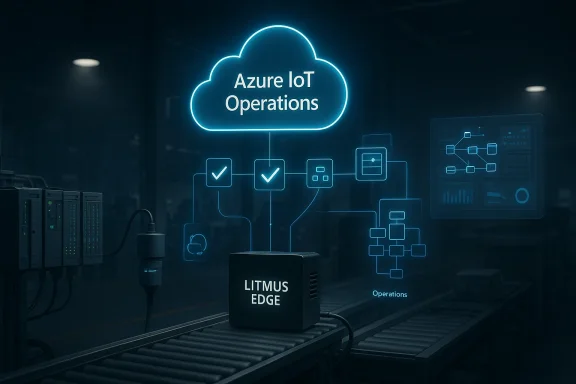
At the center of the announcement is a bridge between Litmus Edge and Azure IoT Operations that automates discovery and onboarding. According to the release, when Litmus Edge identifies a new PLC, sensor, or controller, that device becomes visible within Azure IoT Operations and can be onboarded in a single click. The result is a reduced need for manual scripting, repeated configuration, and custom mapping work.That may sound like a small improvement, but in industrial environments it is often the difference between a prototype and a repeatable architecture. The bridge is not just pushing data; it is helping create structured, Azure-native industrial data models that are easier to govern and reuse. The enterprise value comes from reducing variance across deployments.
Device discovery as an operational accelerator
Microsoft’s Azure IoT Operations already includes Akri services for automatic discovery of devices and assets, and its documentation describes Akri connectors as a way to simplify communication with servers and leaf devices. Microsoft also states that Akri services can discover devices automatically to reduce configuration overhead for OT users.Litmus is effectively turning that built-in capability into a more fully packaged industrial workflow. The vendor’s value proposition is not merely discovery, but discovery paired with contextualization and schema modeling. That combination is what helps make onboarding repeatable across multiple plants.
- Automatic discovery reduces plant-level setup work.
- Single-click onboarding shortens deployment cycles.
- Schema awareness improves data usability downstream.
- Fewer hand-built scripts lowers long-term support overhead.
Schema modeling is the real differentiator
The announcement places a lot of weight on schema modeling, and for good reason. Industrial telemetry without schema is often just serial data with context missing. Azure Device Registry and the schema registry in Azure IoT Operations provide a place to organize assets and use schemas for serialization and deserialization, which makes the pipeline more than a raw ingestion path.Litmus appears to be strengthening that model by automating how schemas are discovered, modeled, and delivered into Azure. That reduces the friction between plant-floor reality and cloud-side analytics tools.
Why this is more than a connector
The release emphasizes that the bridge can filter, enrich, transform, and route data before it reaches analytics platforms such as Microsoft Fabric. That matters because industrial systems rarely need “all data all the time.” They need the right data in the right shape.This is where the product feels more like a data operations layer than a simple protocol bridge. It helps move the conversation from “Can we connect the machine?” to “Can we make the data durable, reusable, and trustworthy?”
Microsoft’s Azure IoT Operations Strategy
Microsoft has been steadily assembling a modern industrial stack around Azure IoT Operations, Azure Arc, and cloud analytics services. The Azure product page describes Azure IoT Operations as scalable edge services built on industry standards, designed to capture data, process it at the edge, and send operational insights to the cloud, with repeatable deployment and edge redundancy enabled through Arc and Kubernetes.That architecture is important because it signals Microsoft’s preferred pattern for industrial customers: standardized edge management, cloud governance, and modular services that can be deployed across many locations. In other words, Microsoft is not trying to replicate every legacy industrial stack; it is trying to make the edge behave more like a cloud-managed platform.
Azure Arc as the control plane
Azure Arc gives Microsoft a way to extend governance and lifecycle management across distributed environments. Microsoft’s documentation describes Azure IoT Operations as running on Azure Arc-enabled Kubernetes clusters and using Arc to manage edge services from the cloud.That is a big deal for industrial buyers, because consistency is often harder to achieve than connectivity. Arc provides the operational umbrella, and Litmus is plugging into that umbrella with industrial data orchestration.
- Cloud governance across edge sites.
- Repeatable deployment of industrial workloads.
- Better lifecycle management for distributed plants.
- A more unified operational model for IT and OT teams.
Microsoft Fabric and cloud analytics
Microsoft also says Azure IoT Operations natively integrates with Microsoft Fabric, Azure Event Hubs, and the MQTT broker in Azure Event Grid. That makes the new bridge strategically relevant because industrial data no longer stops at the edge; it can move directly into Microsoft’s broader analytics ecosystem.For Microsoft, this is the kind of integration that reinforces its cloud platform story. For customers, it reduces the number of custom handoffs between plant systems and analytics layers.
A broader platform play
The deeper story is that Microsoft is assembling an industrial data fabric where edge services, identity, governance, and analytics all sit inside one architectural frame. Litmus helps fill in the OT side of that frame by making machine data more structured and deployable.That combination is likely to appeal most to enterprises already standardizing on Microsoft tooling. It may be less compelling for organizations seeking a vendor-neutral or multi-cloud-first industrial stack.
The Role of Akri in the Architecture
The announcement specifically says the connector leverages the Akri framework to enable real-time device and asset discovery. That is not accidental. Akri is one of the key architectural underpinnings that allows Azure IoT Operations to discover and manage devices in a Kubernetes-native way.Microsoft’s documentation says Akri services in Azure IoT Operations let users connect, discover, and monitor assets, and that Akri connectors can establish southbound connections, ingest telemetry, and support command and control scenarios.
Why Akri matters for industrial environments
Akri is important because industrial networks are messy. Devices may be old, proprietary, or difficult to manage centrally. A discovery framework that works in layered networks and supports connector templates can reduce the operational burden for IT and OT teams.By using Akri, Litmus can plug into a native Microsoft mechanism rather than bolting on a separate discovery system. That should help with consistency, supportability, and long-term integration maintenance.
Templates, deployment, and repeatability
Microsoft says connector templates can be created in the Azure portal, synced to the edge, and used by the Akri operator to deploy matching connector instances. That workflow is highly relevant to industrial buyers because it turns device onboarding into a more declarative process.The practical result is that configuration becomes portable. Instead of reinventing the setup at each site, teams can standardize deployment behavior and use templates as reusable operational patterns.
- Declarative templates reduce drift.
- Edge sync supports distributed deployment.
- Operator-driven configuration improves consistency.
- OT teams can work with a more predictable process.
Custom connectors and extension potential
Microsoft also notes that Akri SDKs let developers build custom connectors and focus on southbound logic while the SDKs manage interactions with Azure IoT Operations services. That makes the platform extensible and suggests that the Litmus integration may be only one example of a broader ecosystem pattern.The implication is clear: Microsoft wants Azure IoT Operations to be a platform, not just a product. Litmus benefits from that, but it also becomes part of a larger ecosystem where other vendors can eventually provide similar extensions.
Industrial Data Integration Has Been the Bottleneck
A lot of industrial transformation projects do not fail because the business case is weak. They fail because the data path is brittle, repetitive, and difficult to scale. The announcement directly calls out the time-consuming nature of manual onboarding, custom configuration, and repeated data mapping across sites, especially when customers are trying to enable predictive maintenance, energy optimization, and OEE analytics.That diagnosis is credible. Industrial data integration is one of the few enterprise domains where technical debt is still heavily physical. Every plant has its own equipment, its own conventions, and often its own local workaround culture.
The cost of one-off implementations
The problem with one-off integration projects is not just labor cost. It is also the operational risk of inconsistency. If each plant defines assets differently or exposes telemetry differently, centralized analytics becomes fragile and cross-site comparison becomes difficult.Litmus’s CEO, Vatsal Shah, framed this issue directly by saying the difficulty is not merely data access, but making data consistent and repeatable across sites. That is exactly the right framing for industrial IT, because repeatability is what allows a plant model to scale beyond a pilot.
OT and IT are still learning to work together
The bridge also reflects the ongoing convergence of OT and IT. Microsoft’s documentation describes Azure IoT Operations as helping remove barriers between operational technology and IT systems and supporting secure management of devices in layered networks.That kind of convergence is still uneven in many enterprises. OT teams care about uptime, deterministic behavior, and safety; IT teams care about standards, identity, automation, and governance. A platform that reduces the translation burden between the two has real value.
Why inline processing matters
The new bridge’s ability to filter, enrich, transform, and route data before cloud delivery could make the biggest difference for large plants. Raw telemetry streams can overwhelm downstream systems, while edge-side processing lets organizations send only the most relevant signals to Microsoft Fabric and other endpoints.That is a classic edge computing advantage, but in industrial environments it also affects cost, latency, and compliance. Moving intelligence closer to the machine is often the only practical way to scale.
Competitive Positioning and Market Implications
This announcement is also a competitive move. Litmus is reinforcing its position as the industrial data layer that can sit in front of major cloud platforms, while Microsoft is strengthening Azure IoT Operations with a more specialized industrial partner. That combination is designed to compete with a wide range of industrial edge and IIoT vendors offering similar “connect, contextualize, and scale” messages.Litmus is already recognized by Gartner as a Challenger in the 2025 Magic Quadrant for Global Industrial IoT Platforms, which gives the company added credibility in enterprise discussions.
What rivals will have to answer
Other industrial IoT and edge vendors will likely face a familiar challenge: customers do not want just connectivity anymore. They want a platform that makes industrial data usable across plants, clouds, and analytics tools.That raises the bar for competitors. They must now prove they can automate device discovery, preserve semantic models, and integrate cleanly into cloud-native operational stacks. A basic protocol gateway is not enough.
- Industrial data platforms must be schema-aware.
- Edge onboarding needs to be repeatable.
- Cloud integration must be operationally simple.
- OT and IT workflows need a shared model.
Microsoft’s ecosystem advantage
For Microsoft, the partnership leverages a powerful advantage: existing enterprise relationships. Industrial customers already using Azure, Fabric, or Arc will find this kind of integration easier to adopt than a completely new stack. The bridge helps convert Azure from “one of several options” into a more complete industrial platform story.That does not mean competitors are out of the game. It does mean the battleground is moving upward from device connectivity into governance, model management, and operational consistency.
The multi-cloud question
Litmus lists partnerships with Microsoft, Google Cloud, AWS, Databricks, Oracle Cloud, and Dell Technologies. That breadth suggests the company is still presenting itself as a cross-platform industrial data layer, even as this announcement highlights a deeper Microsoft alignment. The strategic tension here is obvious: customers like portability, but platform vendors want lock-in.The key question is whether Litmus can keep its neutral posture while becoming more tightly embedded in Azure IoT Operations. That will shape how buyers evaluate the product over time.
Enterprise Versus Consumer Impact
This is almost entirely an enterprise story, but it still has broader implications for how industrial systems evolve. The direct beneficiaries are manufacturers, operators, and industrial data teams that need reliable machine connectivity and structured information models. The consumer impact is indirect and comes later, through better product quality, more efficient factories, and more resilient supply chains.Enterprise impact: immediate and practical
For enterprise buyers, the most valuable outcome is lower friction. Faster onboarding, fewer scripts, and more consistent schemas can reduce deployment time and support costs. That matters when the return on investment depends on quickly scaling from a single line to a full fleet of plants.It also matters for governance. Enterprises do not just want data; they want auditability, standardization, and a manageable lifecycle. Azure Arc and Azure IoT Operations are clearly designed to support that model.
Consumer impact: indirect but real
Consumers will not notice the bridge itself, but they may feel its downstream effects. If manufacturers can optimize maintenance, energy use, and quality control more effectively, products can become more consistent and supply chains more reliable.That is one of the quiet truths of industrial software: the biggest consumer benefits often come from invisible backend improvements. Better integration at the edge can translate into fewer defects, less waste, and lower downtime.
Organizational change: the hidden layer
The bigger enterprise story may be cultural rather than technical. When edge data becomes easier to onboard, IT and OT teams can spend less time on plumbing and more time on process improvement. That can accelerate Industrial AI adoption, which is exactly the ambition both vendors are signaling.Strengths and Opportunities
The biggest strength of this announcement is that it attacks a genuine bottleneck in industrial digital transformation. The bridge is not trying to reinvent industrial automation; it is reducing the friction between devices, schemas, and cloud analytics. That is a practical, high-value problem with obvious enterprise demand.- Automated discovery reduces the manual work of finding and onboarding devices.
- Schema-aware data modeling improves downstream analytics quality.
- Azure Arc integration supports repeatable deployment across distributed sites.
- Edge-side filtering and enrichment can lower cloud noise and cost.
- Microsoft Fabric compatibility makes the bridge useful inside a broader analytics stack.
- Repeatability across plants is more valuable than a one-time demo.
- OT/IT collaboration becomes easier when the data model is standardized.
A better path to Industrial AI
The strongest opportunity is that Litmus and Microsoft are positioning industrial AI as a workflow, not a science project. If the data foundation is easier to maintain, then use cases like predictive maintenance and OEE can move faster from pilot to production. That is where buyers see ROI, and it is where vendors earn recurring trust.The bridge also gives Litmus a chance to deepen its role in enterprise architecture discussions. Instead of just being the tool that connects machines, it can become the layer that normalizes and governs industrial data at scale.
Risks and Concerns
The main risk is that industrial buyers may hear the promise of simplification and still run into integration complexity once they try to operationalize it. Even with a better bridge, plant environments remain heterogeneous, and the hardest problems are often hidden in edge cases, legacy equipment, and site-specific workflows. No platform removes that reality completely.Another concern is ecosystem concentration. The tighter the integration becomes with Azure services, the more attractive it looks to Microsoft-centric enterprises—and the more limiting it may feel to organizations that want to remain cloud-neutral. That is a strategic tradeoff, not a technical flaw, but it will matter in procurement conversations.
- Legacy device diversity can still complicate onboarding.
- Platform lock-in concerns may arise in multi-cloud environments.
- Operational maturity is still required to maintain data quality.
- Security and governance become more complex as automation increases.
- Template sprawl could create new management burdens if not controlled.
- Vendor expectations may exceed what early deployments can deliver.
- Edge reliability remains critical, especially in disconnected sites.
Adoption friction remains possible
Even a “single-click” onboarding flow can disappoint if the surrounding process is not well governed. If teams do not standardize naming, ownership, and lifecycle policies, automation can create faster chaos rather than faster clarity. The bridge is only as good as the operational discipline around it.There is also the issue of maturity. Azure IoT Operations is still an evolving platform, and Akri-based services are part of that moving target. Enterprises will want proof that the architecture is stable, supportable, and production-ready across real-world plant conditions.
What to Watch Next
The most important next test is whether the Litmus Edge Bridge becomes a reference architecture for industrial customers or remains a niche integration aid. If the demo at Hannover Messe translates into production adoption, it could become a model for how OT data platforms should plug into Azure. If not, it will join the long list of promising industrial announcements that were easier to showcase than to scale.Another area to watch is whether Microsoft and Litmus publish more detail about deployment patterns, supported device classes, and governance controls. Industrial buyers will want to know how the bridge handles versioning, multi-site rollouts, schema evolution, and security boundaries. Those details are often what separate a compelling announcement from a durable product strategy.
Signals worth monitoring
- Production reference customers using the new bridge.
- Deeper documentation around schema governance and lifecycle management.
- Expansion of connector templates and supported device types.
- Evidence of multi-site deployment at scale.
- Further integration with Microsoft Fabric and cloud analytics workflows.
Litmus’s new Edge Bridge for Azure IoT Operations is not a flashy announcement, but it is a strategically smart one. It targets the part of industrial transformation that costs the most time and creates the most frustration: turning machines into structured, governable, reusable data assets. If Litmus and Microsoft can prove that the bridge makes industrial deployments faster, cleaner, and more repeatable, they will have done more than launch a connector—they will have helped define what modern industrial data integration should look like.
Source: ACCESS Newswire Litmus Launches Edge Bridge for Microsoft Azure IoT Operations to Simplify Industrial Data Integration
