Lloyds Banking Group has signed a multi-year agreement to deploy Microsoft 365 E7, Microsoft’s AI-focused “Frontier Suite,” across the bank after already rolling out 40,000 Microsoft 365 Copilot licences and extending GitHub Copilot to more than 10,000 engineers. The deal is more than another enterprise software renewal dressed up in AI language. It is a bet that the next stage of office automation will not be a smarter chatbot in the sidebar, but a managed layer of agents operating inside the bank’s productivity, security, identity, and developer systems. For Microsoft, Lloyds is the kind of marquee customer that turns an AI bundle into a procurement pattern; for Lloyds, it is a high-stakes attempt to industrialise agentic AI without losing control of the institution it is meant to streamline.
The most important word in the Lloyds announcement is not Copilot. It is foundation. Microsoft 365 E7 combines Microsoft 365 E5, Microsoft 365 Copilot, Agent 365, Microsoft Entra Suite, and advanced Defender, Intune, and Purview capabilities into a single enterprise package. That bundling matters because it shifts AI from a workplace productivity add-on into a managed corporate control plane.
Banks do not buy collaboration software the way smaller companies buy SaaS. A UK high-street lender must account for identity, auditability, records retention, insider risk, data loss prevention, regulated communications, customer confidentiality, operational resilience, and a long chain of third-party dependencies. A general-purpose AI assistant that can summarize documents is useful; an AI layer that can be governed, monitored, restricted, audited, and revoked is the thing a bank can actually scale.
That is why Lloyds’ move is best understood as a transition from experimentation to standardisation. The bank has already deployed Microsoft 365 Copilot widely enough to move beyond the pilot theatre that surrounds many corporate AI announcements. Forty thousand licences are not a lab trial. Extending GitHub Copilot to more than 10,000 engineers suggests the same logic is being applied to software delivery as well as office work.
The arrival of Microsoft 365 E7 gives Lloyds a way to pull those strands into one procurement, governance, and security story. Microsoft would prefer customers to see E7 as the natural next step after E5 plus Copilot. Lloyds appears to be doing exactly that, but in a sector where “natural next step” still has to survive scrutiny from risk committees, regulators, auditors, and employees who will be asked to change how they work.
The package is built around the idea that Copilot and agents need a common understanding of workplace context. Microsoft calls that layer Work IQ: a system meant to connect people, content, meetings, files, relationships, and workflows so AI tools can act with more relevance than a generic model would. In plain English, it is Microsoft’s attempt to make enterprise AI useful because it knows how work actually happens inside Microsoft 365.
That framing is powerful, but it also exposes the strategic bargain customers are making. The more useful the assistant becomes, the more it depends on the richness of the Microsoft tenant. The email graph, Teams history, documents, SharePoint sites, meetings, identity records, permissions, compliance labels, and security telemetry all become part of the gravitational field. Once agents begin acting across that field, Microsoft 365 is no longer merely the office suite; it becomes the workplace runtime.
For Lloyds, that may be acceptable because the alternative is fragmentation. A large bank could stitch together separate AI assistants, agent frameworks, identity governance tools, endpoint controls, and compliance platforms, then hope the seams hold. Microsoft’s pitch is that the seams are the risk. E7 says: buy the bundle, keep the context close, manage the agents where you already manage the users.
That argument will resonate with IT departments exhausted by AI sprawl. It will also sharpen concerns about lock-in. If the next generation of internal workflows is built around Microsoft’s agent layer, leaving the Microsoft stack becomes harder not because documents are stored in a proprietary format, but because business processes themselves begin to depend on Microsoft-managed intelligence.
A summarisation mistake is irritating. A mistaken action taken across a workflow can be operationally significant. An AI agent that retrieves a policy, drafts a response, opens a ticket, updates a case, routes a request, or triggers a back-office process sits closer to the machinery of the bank than a chatbot that merely explains something. The value is higher because the agent can reduce friction; the risk is higher because the agent can move things.
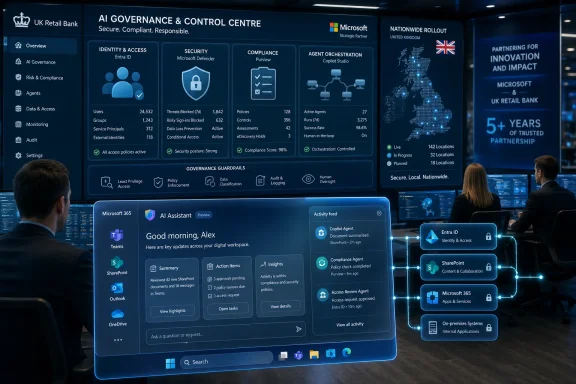
Lloyds says the deployment will include an AI-based staff assistant: a single self-service agent across the bank, helping employees access systems, information, and answers in one place. That is the kind of internal use case where agentic AI can make sense. In a large institution, finding the right HR policy, technology request path, customer-process document, or risk procedure can consume enormous amounts of staff time. A well-governed assistant that gives employees a single front door to institutional knowledge could plausibly save money and reduce frustration.
But a bank-wide assistant is also a permission boundary test. It must know what an employee can see, what they should not see, what information is current, what information is regulated, and what actions require human approval. If it becomes a polished wrapper around inconsistent content and messy permissions, it can scale confusion as efficiently as it scales productivity.
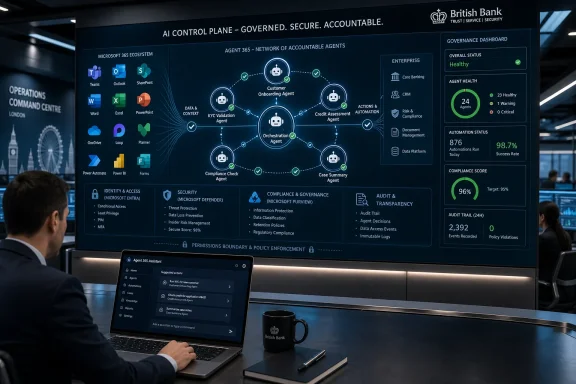
That is why the inclusion of Entra, Defender, Intune, and Purview is not decorative. In agentic systems, identity and data governance are not back-office hygiene; they are the brake system. The assistant must inherit permissions correctly, log activity meaningfully, protect sensitive information, and give security teams enough telemetry to investigate when something goes wrong. The bank is not just rolling out AI. It is rolling out AI that must be treated as part of the control environment.
That matters for Microsoft. The company’s AI strategy has always depended on enterprises accepting a premium price for capabilities that, in the early Copilot era, were sometimes perceived as uneven. If customers saw Copilot as an expensive meeting summariser, Microsoft had a pricing problem. If customers see Copilot plus agents as a route to tens or hundreds of millions in operational value, E7 becomes easier to justify.
The Lloyds case gives Microsoft something more persuasive than a product launch demo. It offers a regulated, risk-sensitive, non-tech company claiming material value from AI and then doubling down with a broader platform commitment. That is exactly the type of validation Microsoft needs as it pushes customers from optional Copilot licences toward a larger enterprise AI estate.
For Lloyds, the financial claim raises expectations. Once a bank publicly says AI generated £50 million in value and could generate more than £100 million the following year, internal stakeholders will expect the next wave to deliver more than enthusiasm. Agentic AI will be judged not just by adoption metrics, but by whether it reduces service friction, improves employee productivity, accelerates engineering, simplifies compliance-heavy processes, or improves customer outcomes without creating new operational risk.
The danger is that the second wave of AI value may be harder than the first. Early productivity gains often come from obvious use cases: summarising meetings, drafting documents, improving code completion, searching knowledge bases, and automating low-risk internal tasks. Agent-led transformation implies deeper workflow redesign, and deeper redesign requires process ownership, data cleanup, exception handling, human oversight, and organisational change. The software can enable that. It cannot do the politics.
Developer AI tools have clearer productivity narratives than many office assistants. Code completion, test generation, documentation support, migration assistance, and pull-request review can all help engineering teams move faster. The question is not whether developers will use AI coding assistants; many already do. The question is whether the organisation can govern their use without smothering the productivity gains.
In banking, that governance challenge is acute. AI-generated code must still satisfy secure development practices, code review standards, audit requirements, model risk considerations where applicable, and the boring but essential discipline of maintainability. A tool that helps an engineer write code faster does not eliminate the need to understand the code. In some cases, it increases the need for review because the volume of generated output rises.
Lloyds’ combined Microsoft 365 and GitHub Copilot posture suggests a broader platform alignment. The same vendor relationship now touches productivity, identity, endpoint management, compliance, security, developer workflows, and AI agents. That may simplify procurement and integration, but it also concentrates strategic dependence. A failure, price change, licensing shift, or governance gap in the Microsoft ecosystem has wider consequences when so many layers sit inside the same stack.
For WindowsForum readers, this is the enterprise version of a familiar story. Microsoft’s biggest wins rarely come from a single beloved feature. They come when enough features, admin tools, defaults, and contracts line up that choosing anything else becomes expensive. Lloyds’ move shows that the AI era has not changed that dynamic; it has amplified it.
A single self-service agent, if it works, attacks that problem directly. It becomes the front door to institutional memory. Instead of navigating intranet pages, service portals, Teams channels, knowledge bases, SharePoint libraries, and ticketing systems, staff ask for what they need and are guided to the answer or process. That is not glamorous AI, but it is where operational value often lives.
The implementation challenge is that institutional knowledge is rarely clean. Content goes stale. Ownership is unclear. Permissions drift. Regional variants exist. Exceptions accumulate. An AI assistant can make that mess more accessible, but it cannot magically make it correct. The bank will need content governance, lifecycle management, and clear accountability for the knowledge the agent surfaces.
This is where Microsoft’s integration pitch collides with organisational reality. Purview can classify and protect data; Entra can enforce identity and access; Defender can help detect threats; Intune can manage devices; Agent 365 can govern agents. None of those tools can decide whether a 2023 policy page contradicting a 2026 operating procedure should be retired. AI governance is partly tooling, but it is also institutional discipline.
If Lloyds gets that right, the staff assistant could become a template for regulated enterprise AI: start with employee-facing workflows, ground responses in controlled content, preserve human accountability, and expand action-taking only where the process is well understood. If it gets it wrong, the assistant risks becoming another layer employees must second-guess.
That is why the Lloyds deployment will be watched beyond Microsoft’s customer list. UK banking has spent years tightening its approach to operational resilience and third-party risk. Agentic AI introduces a new class of dependency because the system may not merely host data or transmit messages; it may influence decisions and initiate work. Even when humans remain formally in control, the practical reliance on AI recommendations can grow quickly.
Microsoft’s answer is to place agentic AI inside a governed enterprise architecture. That answer is credible in the sense that a controlled platform is better than unsanctioned tools scattered across departments. But it is not a complete answer. Governance dashboards do not automatically solve model reliability, process design, or the human tendency to trust confident systems.
The phrase “human-led, agent-operated” sounds reassuring, but it deserves scrutiny. Human-led can mean meaningful oversight, clear approval gates, and accountable process owners. It can also mean a human is technically present while the system frames the options, drafts the response, and nudges the outcome. In regulated environments, the distinction will matter.
For customers, the stakes are indirect but real. Lloyds says the AI push should make banking simpler, faster, and more personalised. Faster answers and more intuitive services are welcome, particularly in a sector where customers often experience digital journeys as a maze of authentication, scripted responses, and escalation queues. But if agentic AI is used to deflect human contact, over-personalise without transparency, or automate edge cases poorly, the customer experience could degrade under the banner of improvement.
That creates new questions for defenders. Which agents exist in the tenant? Who created them? What data can they access? Which users can invoke them? What actions can they take? Are they using approved connectors? Are prompts, responses, and actions logged in a way that supports investigation? Can a compromised account use an agent to accelerate data discovery or process abuse?
Agent 365 is Microsoft’s attempt to answer those questions before enterprise customers drown in unmanaged agents. The idea of an agent control plane is sensible because the alternative is the return of shadow IT in a more powerful form. The first era of shadow IT gave organisations unsanctioned SaaS apps and file-sharing tools. The agentic era could give them unsanctioned semi-autonomous workflows with access to sensitive data.
For a bank, that is intolerable. Lloyds cannot allow every business unit to improvise its own agent governance. A centralised platform gives security and compliance teams at least a fighting chance of seeing what is deployed, enforcing policy, and responding to incidents. That does not make the environment risk-free, but it makes the risk administrable.
The more uncomfortable implication is that AI adoption and security spending are becoming inseparable. Microsoft is not merely selling intelligence; it is selling the controls required to make that intelligence acceptable. E7 packages the accelerator and the seatbelt together, and then argues that responsible enterprises need both.
That is why Lloyds’ claimed AI value is commercially important. If a bank can point to tens of millions in realised and expected benefits, the licensing conversation changes. The question becomes less “Why is this seat so expensive?” and more “Can this platform help unlock value at scale?” Microsoft would like every enterprise CFO to think in those terms.
Still, the economics are not automatic. Licence costs are only one part of enterprise AI adoption. Organisations also need change management, training, content remediation, security architecture, integration work, process redesign, legal review, risk assessment, monitoring, and support. The total cost of making agentic AI useful can exceed the visible subscription line.
This is where many organisations will diverge from Lloyds. A large bank with existing Microsoft investment, mature identity controls, thousands of engineers, and a board-level AI strategy may find E7 a logical consolidation. A smaller enterprise may see an expensive bundle whose most advanced capabilities require more governance maturity than it currently has. The same suite can be a foundation for one customer and shelfware for another.
The broader market question is whether Microsoft can turn Frontier Suite adoption into the new default for enterprise AI. Lloyds gives it momentum, but momentum is not inevitability. IT leaders will still compare E7 against best-of-breed AI tools, internal platforms, cloud-native agent frameworks, and non-Microsoft productivity strategies. Microsoft’s advantage is distribution. Its challenge is proving that distribution produces better outcomes rather than merely broader deployment.
That is a more serious debate. It forces buyers to ask what work should be delegated, what must remain human, what evidence is needed to prove value, and what controls are mandatory before agents are allowed near sensitive processes. It also forces vendors to move beyond demos. If an agent cannot be governed, audited, secured, and integrated, it is not enterprise software; it is a liability with a friendly interface.
Lloyds’ public language is careful. The bank is not promising fully autonomous banking. It is talking about making banking simpler, faster, and more personalised, while helping colleagues spend more time on the things that matter. That is the right register for a regulated AI deployment: ambitious enough to matter, cautious enough to acknowledge that the work will unfold over time.
The phrase “agent-led transformation” should not be dismissed as marketing, but neither should it be accepted at face value. Transformation happens when processes change, incentives change, and measurable outcomes improve. Agents may enable that, but they can also become another automation layer placed on top of unreformed complexity. The difference will depend on execution.
For Windows and Microsoft 365 administrators, the lesson is immediate. AI strategy is becoming tenant strategy. Permissions, conditional access, data classification, endpoint compliance, retention policies, audit logs, app governance, and user training are no longer background tasks that happen after the exciting AI rollout. They are prerequisites for the rollout itself.
The bank will need to decide which agents can act, which can only advise, and which should not exist. It will need to measure not just usage but outcomes: reduced handling time, fewer internal support tickets, faster engineering cycles, improved employee satisfaction, lower operational errors, and better customer journeys. It will also need to detect failure patterns early, because agentic systems can make repeated mistakes at machine speed.
There is also a cultural dimension. Employees may welcome an assistant that removes administrative drag. They may be less enthusiastic if AI becomes a monitoring mechanism, a work intensification tool, or a justification for headcount reductions. Lloyds’ framing emphasises helping colleagues focus on the things that matter most. That promise will be tested by how the technology is managed on the ground.
For Microsoft, Lloyds is a showcase for the “frontier firm” narrative: the idea that organisations will become human-led and agent-operated, with AI embedded across everyday work. The phrase is aspirational, but the underlying commercial goal is concrete. Microsoft wants to make its cloud, productivity, identity, security, compliance, and developer platforms the default environment for enterprise AI.
For the rest of the market, Lloyds is an early indicator of where large-scale AI procurement is heading. The winners may not be the vendors with the flashiest models. They may be the vendors that can package models, identity, governance, security, workflow, and auditability into something a regulated buyer can defend.
 Lloyds Is Buying an Operating Model, Not Just an AI Licence
The most important word in the Lloyds announcement is not Copilot. It is foundation. Microsoft 365 E7 combines Microsoft 365 E5, Microsoft 365 Copilot, Agent 365, Microsoft Entra Suite, and advanced Defender, Intune, and Purview capabilities into a single enterprise package. That bundling matters because it shifts AI from a workplace productivity add-on into a managed corporate control plane.Banks do not buy collaboration software the way smaller companies buy SaaS. A UK high-street lender must account for identity, auditability, records retention, insider risk, data loss prevention, regulated communications, customer confidentiality, operational resilience, and a long chain of third-party dependencies. A general-purpose AI assistant that can summarize documents is useful; an AI layer that can be governed, monitored, restricted, audited, and revoked is the thing a bank can actually scale.
That is why Lloyds’ move is best understood as a transition from experimentation to standardisation. The bank has already deployed Microsoft 365 Copilot widely enough to move beyond the pilot theatre that surrounds many corporate AI announcements. Forty thousand licences are not a lab trial. Extending GitHub Copilot to more than 10,000 engineers suggests the same logic is being applied to software delivery as well as office work.
The arrival of Microsoft 365 E7 gives Lloyds a way to pull those strands into one procurement, governance, and security story. Microsoft would prefer customers to see E7 as the natural next step after E5 plus Copilot. Lloyds appears to be doing exactly that, but in a sector where “natural next step” still has to survive scrutiny from risk committees, regulators, auditors, and employees who will be asked to change how they work.
Microsoft’s Frontier Suite Is the New Shape of the Enterprise Upsell
Microsoft 365 E7 is a familiar Microsoft manoeuvre with unfamiliar stakes. The company has a long history of turning point products into suites, then making the suite the path of least resistance for large customers. Office became Microsoft 365; security tools became E5; Teams moved from insurgent product to default collaboration layer. E7 applies that same playbook to AI agents.The package is built around the idea that Copilot and agents need a common understanding of workplace context. Microsoft calls that layer Work IQ: a system meant to connect people, content, meetings, files, relationships, and workflows so AI tools can act with more relevance than a generic model would. In plain English, it is Microsoft’s attempt to make enterprise AI useful because it knows how work actually happens inside Microsoft 365.
That framing is powerful, but it also exposes the strategic bargain customers are making. The more useful the assistant becomes, the more it depends on the richness of the Microsoft tenant. The email graph, Teams history, documents, SharePoint sites, meetings, identity records, permissions, compliance labels, and security telemetry all become part of the gravitational field. Once agents begin acting across that field, Microsoft 365 is no longer merely the office suite; it becomes the workplace runtime.
For Lloyds, that may be acceptable because the alternative is fragmentation. A large bank could stitch together separate AI assistants, agent frameworks, identity governance tools, endpoint controls, and compliance platforms, then hope the seams hold. Microsoft’s pitch is that the seams are the risk. E7 says: buy the bundle, keep the context close, manage the agents where you already manage the users.
That argument will resonate with IT departments exhausted by AI sprawl. It will also sharpen concerns about lock-in. If the next generation of internal workflows is built around Microsoft’s agent layer, leaving the Microsoft stack becomes harder not because documents are stored in a proprietary format, but because business processes themselves begin to depend on Microsoft-managed intelligence.
Agentic AI Moves the Risk From Answers to Actions
The phrase agentic AI has been stretched by vendors until it can mean almost anything from a scheduled prompt to a multi-step autonomous workflow. In the Lloyds context, the practical distinction is simple: generative AI helps produce answers; agentic AI is supposed to perform work. That difference is exactly why the deployment is both more promising and more dangerous than the first wave of Copilot adoption.A summarisation mistake is irritating. A mistaken action taken across a workflow can be operationally significant. An AI agent that retrieves a policy, drafts a response, opens a ticket, updates a case, routes a request, or triggers a back-office process sits closer to the machinery of the bank than a chatbot that merely explains something. The value is higher because the agent can reduce friction; the risk is higher because the agent can move things.
Lloyds says the deployment will include an AI-based staff assistant: a single self-service agent across the bank, helping employees access systems, information, and answers in one place. That is the kind of internal use case where agentic AI can make sense. In a large institution, finding the right HR policy, technology request path, customer-process document, or risk procedure can consume enormous amounts of staff time. A well-governed assistant that gives employees a single front door to institutional knowledge could plausibly save money and reduce frustration.
But a bank-wide assistant is also a permission boundary test. It must know what an employee can see, what they should not see, what information is current, what information is regulated, and what actions require human approval. If it becomes a polished wrapper around inconsistent content and messy permissions, it can scale confusion as efficiently as it scales productivity.
That is why the inclusion of Entra, Defender, Intune, and Purview is not decorative. In agentic systems, identity and data governance are not back-office hygiene; they are the brake system. The assistant must inherit permissions correctly, log activity meaningfully, protect sensitive information, and give security teams enough telemetry to investigate when something goes wrong. The bank is not just rolling out AI. It is rolling out AI that must be treated as part of the control environment.
The £50 Million Claim Is the Proof Point Microsoft Needed
Lloyds recently said generative AI delivered around £50 million of value in 2025, with more than £100 million in additional value expected in 2026. Those numbers should be read carefully, because corporate “AI value” is often a blend of hard savings, avoided costs, productivity estimates, revenue opportunities, and process improvements. Still, the figures are notable because they suggest Lloyds believes AI has already moved from novelty to measurable business impact.That matters for Microsoft. The company’s AI strategy has always depended on enterprises accepting a premium price for capabilities that, in the early Copilot era, were sometimes perceived as uneven. If customers saw Copilot as an expensive meeting summariser, Microsoft had a pricing problem. If customers see Copilot plus agents as a route to tens or hundreds of millions in operational value, E7 becomes easier to justify.
The Lloyds case gives Microsoft something more persuasive than a product launch demo. It offers a regulated, risk-sensitive, non-tech company claiming material value from AI and then doubling down with a broader platform commitment. That is exactly the type of validation Microsoft needs as it pushes customers from optional Copilot licences toward a larger enterprise AI estate.
For Lloyds, the financial claim raises expectations. Once a bank publicly says AI generated £50 million in value and could generate more than £100 million the following year, internal stakeholders will expect the next wave to deliver more than enthusiasm. Agentic AI will be judged not just by adoption metrics, but by whether it reduces service friction, improves employee productivity, accelerates engineering, simplifies compliance-heavy processes, or improves customer outcomes without creating new operational risk.
The danger is that the second wave of AI value may be harder than the first. Early productivity gains often come from obvious use cases: summarising meetings, drafting documents, improving code completion, searching knowledge bases, and automating low-risk internal tasks. Agent-led transformation implies deeper workflow redesign, and deeper redesign requires process ownership, data cleanup, exception handling, human oversight, and organisational change. The software can enable that. It cannot do the politics.
GitHub Copilot Makes the Bank’s AI Bet More Than an Office Story
The extension of GitHub Copilot across more than 10,000 Lloyds engineers is a crucial part of the announcement because it shows the bank’s AI strategy is not confined to white-collar document work. Banks are software companies with branches, licences, balance sheets, and regulatory obligations. Their ability to ship secure, reliable systems quickly is now a competitive and operational issue.Developer AI tools have clearer productivity narratives than many office assistants. Code completion, test generation, documentation support, migration assistance, and pull-request review can all help engineering teams move faster. The question is not whether developers will use AI coding assistants; many already do. The question is whether the organisation can govern their use without smothering the productivity gains.
In banking, that governance challenge is acute. AI-generated code must still satisfy secure development practices, code review standards, audit requirements, model risk considerations where applicable, and the boring but essential discipline of maintainability. A tool that helps an engineer write code faster does not eliminate the need to understand the code. In some cases, it increases the need for review because the volume of generated output rises.
Lloyds’ combined Microsoft 365 and GitHub Copilot posture suggests a broader platform alignment. The same vendor relationship now touches productivity, identity, endpoint management, compliance, security, developer workflows, and AI agents. That may simplify procurement and integration, but it also concentrates strategic dependence. A failure, price change, licensing shift, or governance gap in the Microsoft ecosystem has wider consequences when so many layers sit inside the same stack.
For WindowsForum readers, this is the enterprise version of a familiar story. Microsoft’s biggest wins rarely come from a single beloved feature. They come when enough features, admin tools, defaults, and contracts line up that choosing anything else becomes expensive. Lloyds’ move shows that the AI era has not changed that dynamic; it has amplified it.
The Staff Assistant Is Where the Hype Meets the Help Desk
The proposed AI-based staff assistant may sound mundane compared with talk of autonomous agents and frontier firms, but it could be the most consequential part of the rollout. Large organisations are full of hidden transaction costs. Employees spend time asking where something is, which form to use, who owns a system, what the current policy says, whether a process has changed, and why an internal workflow does not match the last training deck.A single self-service agent, if it works, attacks that problem directly. It becomes the front door to institutional memory. Instead of navigating intranet pages, service portals, Teams channels, knowledge bases, SharePoint libraries, and ticketing systems, staff ask for what they need and are guided to the answer or process. That is not glamorous AI, but it is where operational value often lives.
The implementation challenge is that institutional knowledge is rarely clean. Content goes stale. Ownership is unclear. Permissions drift. Regional variants exist. Exceptions accumulate. An AI assistant can make that mess more accessible, but it cannot magically make it correct. The bank will need content governance, lifecycle management, and clear accountability for the knowledge the agent surfaces.
This is where Microsoft’s integration pitch collides with organisational reality. Purview can classify and protect data; Entra can enforce identity and access; Defender can help detect threats; Intune can manage devices; Agent 365 can govern agents. None of those tools can decide whether a 2023 policy page contradicting a 2026 operating procedure should be retired. AI governance is partly tooling, but it is also institutional discipline.
If Lloyds gets that right, the staff assistant could become a template for regulated enterprise AI: start with employee-facing workflows, ground responses in controlled content, preserve human accountability, and expand action-taking only where the process is well understood. If it gets it wrong, the assistant risks becoming another layer employees must second-guess.
Regulators Will Care Less About the Demo Than the Failure Mode
Financial regulators are unlikely to be impressed by a slick agentic AI demo on its own. They will care about resilience, accountability, explainability, customer impact, outsourcing dependencies, operational continuity, and controls. In a bank, the relevant question is not whether AI can complete a task on a good day. It is what happens when the model is wrong, the content is stale, the permission is overbroad, the workflow breaks, or the third-party service is unavailable.That is why the Lloyds deployment will be watched beyond Microsoft’s customer list. UK banking has spent years tightening its approach to operational resilience and third-party risk. Agentic AI introduces a new class of dependency because the system may not merely host data or transmit messages; it may influence decisions and initiate work. Even when humans remain formally in control, the practical reliance on AI recommendations can grow quickly.
Microsoft’s answer is to place agentic AI inside a governed enterprise architecture. That answer is credible in the sense that a controlled platform is better than unsanctioned tools scattered across departments. But it is not a complete answer. Governance dashboards do not automatically solve model reliability, process design, or the human tendency to trust confident systems.
The phrase “human-led, agent-operated” sounds reassuring, but it deserves scrutiny. Human-led can mean meaningful oversight, clear approval gates, and accountable process owners. It can also mean a human is technically present while the system frames the options, drafts the response, and nudges the outcome. In regulated environments, the distinction will matter.
For customers, the stakes are indirect but real. Lloyds says the AI push should make banking simpler, faster, and more personalised. Faster answers and more intuitive services are welcome, particularly in a sector where customers often experience digital journeys as a maze of authentication, scripted responses, and escalation queues. But if agentic AI is used to deflect human contact, over-personalise without transparency, or automate edge cases poorly, the customer experience could degrade under the banner of improvement.
Microsoft’s Security Bundle Is Also an Admission of AI’s Attack Surface
The inclusion of advanced Defender, Intune, Purview, and Entra capabilities underscores a truth vendors sometimes underplay: agentic AI expands the attack surface. Agents need identities, permissions, data access, connectors, logs, and policies. They may interact with internal systems and third-party services. They may be invoked by users who do not fully understand what the agent can access or do.That creates new questions for defenders. Which agents exist in the tenant? Who created them? What data can they access? Which users can invoke them? What actions can they take? Are they using approved connectors? Are prompts, responses, and actions logged in a way that supports investigation? Can a compromised account use an agent to accelerate data discovery or process abuse?
Agent 365 is Microsoft’s attempt to answer those questions before enterprise customers drown in unmanaged agents. The idea of an agent control plane is sensible because the alternative is the return of shadow IT in a more powerful form. The first era of shadow IT gave organisations unsanctioned SaaS apps and file-sharing tools. The agentic era could give them unsanctioned semi-autonomous workflows with access to sensitive data.
For a bank, that is intolerable. Lloyds cannot allow every business unit to improvise its own agent governance. A centralised platform gives security and compliance teams at least a fighting chance of seeing what is deployed, enforcing policy, and responding to incidents. That does not make the environment risk-free, but it makes the risk administrable.
The more uncomfortable implication is that AI adoption and security spending are becoming inseparable. Microsoft is not merely selling intelligence; it is selling the controls required to make that intelligence acceptable. E7 packages the accelerator and the seatbelt together, and then argues that responsible enterprises need both.
The Economics of E7 Will Decide How Widely This Model Spreads
Microsoft 365 E7’s published retail price has been positioned at the top end of the Microsoft 365 stack, and the Lloyds agreement is described as multi-year rather than transactional. Large customers rarely pay simple list prices, but the direction is clear: Microsoft wants AI to raise the revenue ceiling for enterprise productivity software. The Copilot era is not just about adding features; it is about resetting what a Microsoft 365 seat can be worth.That is why Lloyds’ claimed AI value is commercially important. If a bank can point to tens of millions in realised and expected benefits, the licensing conversation changes. The question becomes less “Why is this seat so expensive?” and more “Can this platform help unlock value at scale?” Microsoft would like every enterprise CFO to think in those terms.
Still, the economics are not automatic. Licence costs are only one part of enterprise AI adoption. Organisations also need change management, training, content remediation, security architecture, integration work, process redesign, legal review, risk assessment, monitoring, and support. The total cost of making agentic AI useful can exceed the visible subscription line.
This is where many organisations will diverge from Lloyds. A large bank with existing Microsoft investment, mature identity controls, thousands of engineers, and a board-level AI strategy may find E7 a logical consolidation. A smaller enterprise may see an expensive bundle whose most advanced capabilities require more governance maturity than it currently has. The same suite can be a foundation for one customer and shelfware for another.
The broader market question is whether Microsoft can turn Frontier Suite adoption into the new default for enterprise AI. Lloyds gives it momentum, but momentum is not inevitability. IT leaders will still compare E7 against best-of-breed AI tools, internal platforms, cloud-native agent frameworks, and non-Microsoft productivity strategies. Microsoft’s advantage is distribution. Its challenge is proving that distribution produces better outcomes rather than merely broader deployment.
Lloyds Shows the Enterprise AI Debate Has Moved Past Chatbots
The Lloyds announcement marks a shift in the enterprise AI conversation. The early Copilot debate centred on whether AI could summarise meetings, draft emails, search documents, and help with spreadsheets well enough to justify the cost. The next debate is whether AI agents can be trusted to participate in the operating fabric of a regulated institution.That is a more serious debate. It forces buyers to ask what work should be delegated, what must remain human, what evidence is needed to prove value, and what controls are mandatory before agents are allowed near sensitive processes. It also forces vendors to move beyond demos. If an agent cannot be governed, audited, secured, and integrated, it is not enterprise software; it is a liability with a friendly interface.
Lloyds’ public language is careful. The bank is not promising fully autonomous banking. It is talking about making banking simpler, faster, and more personalised, while helping colleagues spend more time on the things that matter. That is the right register for a regulated AI deployment: ambitious enough to matter, cautious enough to acknowledge that the work will unfold over time.
The phrase “agent-led transformation” should not be dismissed as marketing, but neither should it be accepted at face value. Transformation happens when processes change, incentives change, and measurable outcomes improve. Agents may enable that, but they can also become another automation layer placed on top of unreformed complexity. The difference will depend on execution.
For Windows and Microsoft 365 administrators, the lesson is immediate. AI strategy is becoming tenant strategy. Permissions, conditional access, data classification, endpoint compliance, retention policies, audit logs, app governance, and user training are no longer background tasks that happen after the exciting AI rollout. They are prerequisites for the rollout itself.
The Real Test Will Be Whether Lloyds Can Govern at the Speed of AI
Lloyds’ agreement with Microsoft reflects a broader corporate instinct: if employees are going to use AI anyway, better to put it inside a sanctioned environment with enterprise controls. That instinct is sound. The unmanaged alternative is worse. But sanctioned does not mean solved.The bank will need to decide which agents can act, which can only advise, and which should not exist. It will need to measure not just usage but outcomes: reduced handling time, fewer internal support tickets, faster engineering cycles, improved employee satisfaction, lower operational errors, and better customer journeys. It will also need to detect failure patterns early, because agentic systems can make repeated mistakes at machine speed.
There is also a cultural dimension. Employees may welcome an assistant that removes administrative drag. They may be less enthusiastic if AI becomes a monitoring mechanism, a work intensification tool, or a justification for headcount reductions. Lloyds’ framing emphasises helping colleagues focus on the things that matter most. That promise will be tested by how the technology is managed on the ground.
For Microsoft, Lloyds is a showcase for the “frontier firm” narrative: the idea that organisations will become human-led and agent-operated, with AI embedded across everyday work. The phrase is aspirational, but the underlying commercial goal is concrete. Microsoft wants to make its cloud, productivity, identity, security, compliance, and developer platforms the default environment for enterprise AI.
For the rest of the market, Lloyds is an early indicator of where large-scale AI procurement is heading. The winners may not be the vendors with the flashiest models. They may be the vendors that can package models, identity, governance, security, workflow, and auditability into something a regulated buyer can defend.
The Lloyds Deal Turns Microsoft’s AI Pitch Into an IT Checklist
The concrete implications of the Lloyds rollout are less mystical than the phrase agentic future suggests. This is a banking group trying to convert AI from scattered productivity gains into a managed operating capability, using Microsoft’s newest enterprise bundle as the platform.- Lloyds is moving from broad Copilot adoption toward a more integrated Microsoft 365 E7 model that combines productivity AI, agent governance, identity, security, endpoint management, and compliance tooling.
- The planned staff assistant is likely to be the practical proving ground, because internal self-service is valuable enough to matter but safer than many customer-facing autonomous workflows.
- GitHub Copilot’s expansion to more than 10,000 engineers shows that Lloyds sees AI as part of software delivery, not merely office productivity.
- The bank’s reported £50 million of AI value in 2025 and expected £100 million-plus in 2026 will raise pressure on the new rollout to produce measurable operational returns.
- Microsoft gains a high-profile regulated-sector customer for E7, strengthening its argument that agentic AI requires a suite rather than a collection of disconnected tools.
- The biggest risks will sit in governance, permissions, content quality, human oversight, and vendor concentration, not in whether the chatbot can write a polished paragraph.
References
- Primary source: Finextra Research
Published: 2026-06-04T10:12:07.595794
Lloyds prepares for agentic future with roll out of Microsoft 365 Frontier Suite
Lloyds Banking Group has signed a multi-year agreement to deploy Microsoft 365 E7: ‘The AI Frontier Suite’ company-wide.www.finextra.com
- Related coverage: lloydsbankinggroup.com
- Official source: blogs.microsoft.com
Introducing the First Frontier Suite built on Intelligence + Trust - The Official Microsoft Blog
Today Microsoft is announcing: Wave 3 of Microsoft 365 Copilot Expanded model diversity with Claude and next-gen OpenAI models available today General availability of Agent 365 on May 1 for $15 per user General availability of the new Microsoft 365 E7: The Frontier Suite on May 1 for $99 per...blogs.microsoft.com - Official source: microsoft.com
Powering Frontier Transformation with Copilot and agents | Microsoft 365 Blog
Wave 3 of Microsoft 365 Copilot introduces Copilot Cowork, multi‑model intelligence, and enterprise‑ready AI—built to get real work done.www.microsoft.com - Official source: microsoftpartners.microsoft.com
- Official source: partner.microsoft.com
Lead Frontier Transformation with Microsoft 365 E7, now generally available
Guide customers through Frontier Transformation—moving them from AI pilots to secure, governed scale with Microsoft 365 E7 and Microsoft Agent 365.partner.microsoft.com
- Related coverage: etworks.com
Microsoft 365 E7: A Guide to the New Frontier Suite | ET Works
Discover Microsoft 365 E7, the new Frontier Suite launching in May 2026. Learn how Microsoft 365 E7 integrates Copilot and Agent 365 to power a secure, agent-operated enterprise.www.etworks.com - Related coverage: techtask.com
Microsoft 365 E7 und Agent 365: Was hinter der «Frontier Suite» steckt • techtask consulting
Am 9. März 2026 hat Microsoft die nächste Stufe seiner Enterprise-Lizenzierungsstrategie eingeläutet, erstmals seit der Einführung von E5 im Jahr 2015 gibt eswww.techtask.com - Related coverage: anintent.com
Microsoft 365 E7 and Agent 365: What the Bundle Includes | AnIntent
Microsoft 365 E7 launches at $99 a seat with Copilot, Agent 365, and the Entra Suite. Here is what each piece does and who should upgrade.anintent.com - Related coverage: constellationr.com
Microsoft launches new E7 suite to integrate AI agents, Work IQ | Constellation Research
Microsoft launched a new suite for AI agents, Copilot Cowork in partnership with Anthropic and said Agent 365 will be available May 1. The moves are part of Microsoft's effort to differentiate in agentic AI with the context and trust layers. The company is looking to address enterprise pain...www.constellationr.com
- Related coverage: windowscentral.com
Microsoft 365 premium E7 tier is "the First Frontier Suite" | Windows Central
Microsoft’s latest subscription tier promises AI power at $99/month, but analysts are skeptical about its benefits compared to existing plans.www.windowscentral.com - Related coverage: itpro.com
Everything you need to know about the new E7 Microsoft 365 tier, including features, pricing, and release date | IT Pro
The new premium bundle for Microsoft 365 adds AI capabilities to traditional tierswww.itpro.com - Related coverage: techradar.com
Microsoft 365 confirms new premium tier focused on AI and productivity | TechRadar
Microsoft adds new E7 plan to cope with AI usagewww.techradar.com - Official source: adoption.microsoft.com
- Related coverage: news.cognizant.com
Cognizant and Microsoft Expand Partnership to Advance AI Transformation and Frontier Firm Experiences - Dec 18, 2025
PDF documentnews.cognizant.com