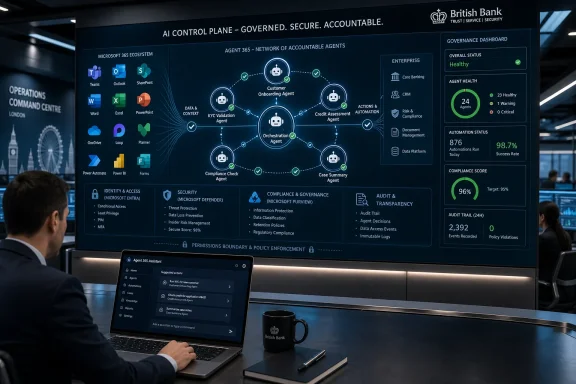
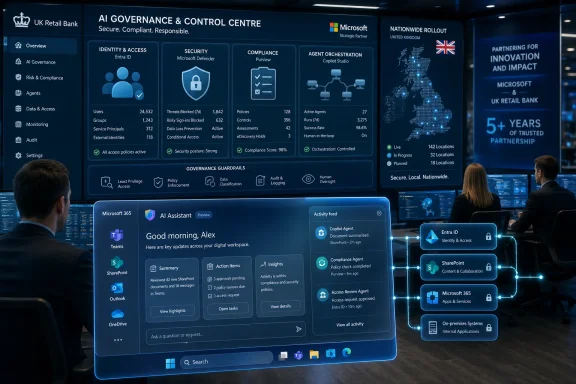
Lloyds Banking Group has signed a multi-year agreement to deploy Microsoft 365 E7, Microsoft’s AI-focused “Frontier Suite,” across the bank after already rolling out 40,000 Microsoft 365 Copilot licences and extending GitHub Copilot to more than 10,000 engineers. The deal is more than another enterprise software renewal dressed up in AI language. It is a bet that the next stage of office automation will not be a smarter chatbot in the sidebar, but a managed layer of agents operating inside the bank’s productivity, security, identity, and developer systems. For Microsoft, Lloyds is the kind of marquee customer that turns an AI bundle into a procurement pattern; for Lloyds, it is a high-stakes attempt to industrialise agentic AI without losing control of the institution it is meant to streamline.

Futuristic security command center with glowing network and shield icons over Europe map.Lloyds Is Buying an Operating Model, Not Just an AI Licence​

The most important word in the Lloyds announcement is not Copilot. It is foundation. Microsoft 365 E7 combines Microsoft 365 E5, Microsoft 365 Copilot, Agent 365, Microsoft Entra Suite, and advanced Defender, Intune, and Purview capabilities into a single enterprise package. That bundling matters because it shifts AI from a workplace productivity add-on into a managed corporate control plane.
Banks do not buy collaboration software the way smaller companies buy SaaS. A UK high-street lender must account for identity, auditability, records retention, insider risk, data loss prevention, regulated communications, customer confidentiality, operational resilience, and a long chain of third-party dependencies. A general-purpose AI assistant that can summarize documents is useful; an AI layer that can be governed, monitored, restricted, audited, and revoked is the thing a bank can actually scale.
That is why Lloyds’ move is best understood as a transition from experimentation to standardisation. The bank has already deployed Microsoft 365 Copilot widely enough to move beyond the pilot theatre that surrounds many corporate AI announcements. Forty thousand licences are not a lab trial. Extending GitHub Copilot to more than 10,000 engineers suggests the same logic is being applied to software delivery as well as office work.
The arrival of Microsoft 365 E7 gives Lloyds a way to pull those strands into one procurement, governance, and security story. Microsoft would prefer customers to see E7 as the natural next step after E5 plus Copilot. Lloyds appears to be doing exactly that, but in a sector where “natural next step” still has to survive scrutiny from risk committees, regulators, auditors, and employees who will be asked to change how they work.

Microsoft’s Frontier Suite Is the New Shape of the Enterprise Upsell​

Microsoft 365 E7 is a familiar Microsoft manoeuvre with unfamiliar stakes. The company has a long history of turning point products into suites, then making the suite the path of least resistance for large customers. Office became Microsoft 365; security tools became E5; Teams moved from insurgent product to default collaboration layer. E7 applies that same playbook to AI agents.
The package is built around the idea that Copilot and agents need a common understanding of workplace context. Microsoft calls that layer Work IQ: a system meant to connect people, content, meetings, files, relationships, and workflows so AI tools can act with more relevance than a generic model would. In plain English, it is Microsoft’s attempt to make enterprise AI useful because it knows how work actually happens inside Microsoft 365.
That framing is powerful, but it also exposes the strategic bargain customers are making. The more useful the assistant becomes, the more it depends on the richness of the Microsoft tenant. The email graph, Teams history, documents, SharePoint sites, meetings, identity records, permissions, compliance labels, and security telemetry all become part of the gravitational field. Once agents begin acting across that field, Microsoft 365 is no longer merely the office suite; it becomes the workplace runtime.
For Lloyds, that may be acceptable because the alternative is fragmentation. A large bank could stitch together separate AI assistants, agent frameworks, identity governance tools, endpoint controls, and compliance platforms, then hope the seams hold. Microsoft’s pitch is that the seams are the risk. E7 says: buy the bundle, keep the context close, manage the agents where you already manage the users.
That argument will resonate with IT departments exhausted by AI sprawl. It will also sharpen concerns about lock-in. If the next generation of internal workflows is built around Microsoft’s agent layer, leaving the Microsoft stack becomes harder not because documents are stored in a proprietary format, but because business processes themselves begin to depend on Microsoft-managed intelligence.

Agentic AI Moves the Risk From Answers to Actions​

The phrase agentic AI has been stretched by vendors until it can mean almost anything from a scheduled prompt to a multi-step autonomous workflow. In the Lloyds context, the practical distinction is simple: generative AI helps produce answers; agentic AI is supposed to perform work. That difference is exactly why the deployment is both more promising and more dangerous than the first wave of Copilot adoption.
A summarisation mistake is irritating. A mistaken action taken across a workflow can be operationally significant. An AI agent that retrieves a policy, drafts a response, opens a ticket, updates a case, routes a request, or triggers a back-office process sits closer to the machinery of the bank than a chatbot that merely explains something. The value is higher because the agent can reduce friction; the risk is higher because the agent can move things.
Lloyds says the deployment will include an AI-based staff assistant: a single self-service agent across the bank, helping employees access systems, information, and answers in one place. That is the kind of internal use case where agentic AI can make sense. In a large institution, finding the right HR policy, technology request path, customer-process document, or risk procedure can consume enormous amounts of staff time. A well-governed assistant that gives employees a single front door to institutional knowledge could plausibly save money and reduce frustration.
But a bank-wide assistant is also a permission boundary test. It must know what an employee can see, what they should not see, what information is current, what information is regulated, and what actions require human approval. If it becomes a polished wrapper around inconsistent content and messy permissions, it can scale confusion as efficiently as it scales productivity.
That is why the inclusion of Entra, Defender, Intune, and Purview is not decorative. In agentic systems, identity and data governance are not back-office hygiene; they are the brake system. The assistant must inherit permissions correctly, log activity meaningfully, protect sensitive information, and give security teams enough telemetry to investigate when something goes wrong. The bank is not just rolling out AI. It is rolling out AI that must be treated as part of the control environment.

The £50 Million Claim Is the Proof Point Microsoft Needed​

Lloyds recently said generative AI delivered around £50 million of value in 2025, with more than £100 million in additional value expected in 2026. Those numbers should be read carefully, because corporate “AI value” is often a blend of hard savings, avoided costs, productivity estimates, revenue opportunities, and process improvements. Still, the figures are notable because they suggest Lloyds believes AI has already moved from novelty to measurable business impact.
That matters for Microsoft. The company’s AI strategy has always depended on enterprises accepting a premium price for capabilities that, in the early Copilot era, were sometimes perceived as uneven. If customers saw Copilot as an expensive meeting summariser, Microsoft had a pricing problem. If customers see Copilot plus agents as a route to tens or hundreds of millions in operational value, E7 becomes easier to justify.
The Lloyds case gives Microsoft something more persuasive than a product launch demo. It offers a regulated, risk-sensitive, non-tech company claiming material value from AI and then doubling down with a broader platform commitment. That is exactly the type of validation Microsoft needs as it pushes customers from optional Copilot licences toward a larger enterprise AI estate.
For Lloyds, the financial claim raises expectations. Once a bank publicly says AI generated £50 million in value and could generate more than £100 million the following year, internal stakeholders will expect the next wave to deliver more than enthusiasm. Agentic AI will be judged not just by adoption metrics, but by whether it reduces service friction, improves employee productivity, accelerates engineering, simplifies compliance-heavy processes, or improves customer outcomes without creating new operational risk.
The danger is that the second wave of AI value may be harder than the first. Early productivity gains often come from obvious use cases: summarising meetings, drafting documents, improving code completion, searching knowledge bases, and automating low-risk internal tasks. Agent-led transformation implies deeper workflow redesign, and deeper redesign requires process ownership, data cleanup, exception handling, human oversight, and organisational change. The software can enable that. It cannot do the politics.

GitHub Copilot Makes the Bank’s AI Bet More Than an Office Story​

The extension of GitHub Copilot across more than 10,000 Lloyds engineers is a crucial part of the announcement because it shows the bank’s AI strategy is not confined to white-collar document work. Banks are software companies with branches, licences, balance sheets, and regulatory obligations. Their ability to ship secure, reliable systems quickly is now a competitive and operational issue.
Developer AI tools have clearer productivity narratives than many office assistants. Code completion, test generation, documentation support, migration assistance, and pull-request review can all help engineering teams move faster. The question is not whether developers will use AI coding assistants; many already do. The question is whether the organisation can govern their use without smothering the productivity gains.
In banking, that governance challenge is acute. AI-generated code must still satisfy secure development practices, code review standards, audit requirements, model risk considerations where applicable, and the boring but essential discipline of maintainability. A tool that helps an engineer write code faster does not eliminate the need to understand the code. In some cases, it increases the need for review because the volume of generated output rises.
Lloyds’ combined Microsoft 365 and GitHub Copilot posture suggests a broader platform alignment. The same vendor relationship now touches productivity, identity, endpoint management, compliance, security, developer workflows, and AI agents. That may simplify procurement and integration, but it also concentrates strategic dependence. A failure, price change, licensing shift, or governance gap in the Microsoft ecosystem has wider consequences when so many layers sit inside the same stack.
For WindowsForum readers, this is the enterprise version of a familiar story. Microsoft’s biggest wins rarely come from a single beloved feature. They come when enough features, admin tools, defaults, and contracts line up that choosing anything else becomes expensive. Lloyds’ move shows that the AI era has not changed that dynamic; it has amplified it.

The Staff Assistant Is Where the Hype Meets the Help Desk​

The proposed AI-based staff assistant may sound mundane compared with talk of autonomous agents and frontier firms, but it could be the most consequential part of the rollout. Large organisations are full of hidden transaction costs. Employees spend time asking where something is, which form to use, who owns a system, what the current policy says, whether a process has changed, and why an internal workflow does not match the last training deck.
A single self-service agent, if it works, attacks that problem directly. It becomes the front door to institutional memory. Instead of navigating intranet pages, service portals, Teams channels, knowledge bases, SharePoint libraries, and ticketing systems, staff ask for what they need and are guided to the answer or process. That is not glamorous AI, but it is where operational value often lives.
The implementation challenge is that institutional knowledge is rarely clean. Content goes stale. Ownership is unclear. Permissions drift. Regional variants exist. Exceptions accumulate. An AI assistant can make that mess more accessible, but it cannot magically make it correct. The bank will need content governance, lifecycle management, and clear accountability for the knowledge the agent surfaces.
This is where Microsoft’s integration pitch collides with organisational reality. Purview can classify and protect data; Entra can enforce identity and access; Defender can help detect threats; Intune can manage devices; Agent 365 can govern agents. None of those tools can decide whether a 2023 policy page contradicting a 2026 operating procedure should be retired. AI governance is partly tooling, but it is also institutional discipline.
If Lloyds gets that right, the staff assistant could become a template for regulated enterprise AI: start with employee-facing workflows, ground responses in controlled content, preserve human accountability, and expand action-taking only where the process is well understood. If it gets it wrong, the assistant risks becoming another layer employees must second-guess.

Regulators Will Care Less About the Demo Than the Failure Mode​

Financial regulators are unlikely to be impressed by a slick agentic AI demo on its own. They will care about resilience, accountability, explainability, customer impact, outsourcing dependencies, operational continuity, and controls. In a bank, the relevant question is not whether AI can complete a task on a good day. It is what happens when the model is wrong, the content is stale, the permission is overbroad, the workflow breaks, or the third-party service is unavailable.
That is why the Lloyds deployment will be watched beyond Microsoft’s customer list. UK banking has spent years tightening its approach to operational resilience and third-party risk. Agentic AI introduces a new class of dependency because the system may not merely host data or transmit messages; it may influence decisions and initiate work. Even when humans remain formally in control, the practical reliance on AI recommendations can grow quickly.
Microsoft’s answer is to place agentic AI inside a governed enterprise architecture. That answer is credible in the sense that a controlled platform is better than unsanctioned tools scattered across departments. But it is not a complete answer. Governance dashboards do not automatically solve model reliability, process design, or the human tendency to trust confident systems.
The phrase “human-led, agent-operated” sounds reassuring, but it deserves scrutiny. Human-led can mean meaningful oversight, clear approval gates, and accountable process owners. It can also mean a human is technically present while the system frames the options, drafts the response, and nudges the outcome. In regulated environments, the distinction will matter.
For customers, the stakes are indirect but real. Lloyds says the AI push should make banking simpler, faster, and more personalised. Faster answers and more intuitive services are welcome, particularly in a sector where customers often experience digital journeys as a maze of authentication, scripted responses, and escalation queues. But if agentic AI is used to deflect human contact, over-personalise without transparency, or automate edge cases poorly, the customer experience could degrade under the banner of improvement.

Microsoft’s Security Bundle Is Also an Admission of AI’s Attack Surface​

The inclusion of advanced Defender, Intune, Purview, and Entra capabilities underscores a truth vendors sometimes underplay: agentic AI expands the attack surface. Agents need identities, permissions, data access, connectors, logs, and policies. They may interact with internal systems and third-party services. They may be invoked by users who do not fully understand what the agent can access or do.
That creates new questions for defenders. Which agents exist in the tenant? Who created them? What data can they access? Which users can invoke them? What actions can they take? Are they using approved connectors? Are prompts, responses, and actions logged in a way that supports investigation? Can a compromised account use an agent to accelerate data discovery or process abuse?
Agent 365 is Microsoft’s attempt to answer those questions before enterprise customers drown in unmanaged agents. The idea of an agent control plane is sensible because the alternative is the return of shadow IT in a more powerful form. The first era of shadow IT gave organisations unsanctioned SaaS apps and file-sharing tools. The agentic era could give them unsanctioned semi-autonomous workflows with access to sensitive data.
For a bank, that is intolerable. Lloyds cannot allow every business unit to improvise its own agent governance. A centralised platform gives security and compliance teams at least a fighting chance of seeing what is deployed, enforcing policy, and responding to incidents. That does not make the environment risk-free, but it makes the risk administrable.
The more uncomfortable implication is that AI adoption and security spending are becoming inseparable. Microsoft is not merely selling intelligence; it is selling the controls required to make that intelligence acceptable. E7 packages the accelerator and the seatbelt together, and then argues that responsible enterprises need both.

The Economics of E7 Will Decide How Widely This Model Spreads​

Microsoft 365 E7’s published retail price has been positioned at the top end of the Microsoft 365 stack, and the Lloyds agreement is described as multi-year rather than transactional. Large customers rarely pay simple list prices, but the direction is clear: Microsoft wants AI to raise the revenue ceiling for enterprise productivity software. The Copilot era is not just about adding features; it is about resetting what a Microsoft 365 seat can be worth.
That is why Lloyds’ claimed AI value is commercially important. If a bank can point to tens of millions in realised and expected benefits, the licensing conversation changes. The question becomes less “Why is this seat so expensive?” and more “Can this platform help unlock value at scale?” Microsoft would like every enterprise CFO to think in those terms.
Still, the economics are not automatic. Licence costs are only one part of enterprise AI adoption. Organisations also need change management, training, content remediation, security architecture, integration work, process redesign, legal review, risk assessment, monitoring, and support. The total cost of making agentic AI useful can exceed the visible subscription line.
This is where many organisations will diverge from Lloyds. A large bank with existing Microsoft investment, mature identity controls, thousands of engineers, and a board-level AI strategy may find E7 a logical consolidation. A smaller enterprise may see an expensive bundle whose most advanced capabilities require more governance maturity than it currently has. The same suite can be a foundation for one customer and shelfware for another.
The broader market question is whether Microsoft can turn Frontier Suite adoption into the new default for enterprise AI. Lloyds gives it momentum, but momentum is not inevitability. IT leaders will still compare E7 against best-of-breed AI tools, internal platforms, cloud-native agent frameworks, and non-Microsoft productivity strategies. Microsoft’s advantage is distribution. Its challenge is proving that distribution produces better outcomes rather than merely broader deployment.

Lloyds Shows the Enterprise AI Debate Has Moved Past Chatbots​

The Lloyds announcement marks a shift in the enterprise AI conversation. The early Copilot debate centred on whether AI could summarise meetings, draft emails, search documents, and help with spreadsheets well enough to justify the cost. The next debate is whether AI agents can be trusted to participate in the operating fabric of a regulated institution.
That is a more serious debate. It forces buyers to ask what work should be delegated, what must remain human, what evidence is needed to prove value, and what controls are mandatory before agents are allowed near sensitive processes. It also forces vendors to move beyond demos. If an agent cannot be governed, audited, secured, and integrated, it is not enterprise software; it is a liability with a friendly interface.
Lloyds’ public language is careful. The bank is not promising fully autonomous banking. It is talking about making banking simpler, faster, and more personalised, while helping colleagues spend more time on the things that matter. That is the right register for a regulated AI deployment: ambitious enough to matter, cautious enough to acknowledge that the work will unfold over time.
The phrase “agent-led transformation” should not be dismissed as marketing, but neither should it be accepted at face value. Transformation happens when processes change, incentives change, and measurable outcomes improve. Agents may enable that, but they can also become another automation layer placed on top of unreformed complexity. The difference will depend on execution.
For Windows and Microsoft 365 administrators, the lesson is immediate. AI strategy is becoming tenant strategy. Permissions, conditional access, data classification, endpoint compliance, retention policies, audit logs, app governance, and user training are no longer background tasks that happen after the exciting AI rollout. They are prerequisites for the rollout itself.

The Real Test Will Be Whether Lloyds Can Govern at the Speed of AI​

Lloyds’ agreement with Microsoft reflects a broader corporate instinct: if employees are going to use AI anyway, better to put it inside a sanctioned environment with enterprise controls. That instinct is sound. The unmanaged alternative is worse. But sanctioned does not mean solved.
The bank will need to decide which agents can act, which can only advise, and which should not exist. It will need to measure not just usage but outcomes: reduced handling time, fewer internal support tickets, faster engineering cycles, improved employee satisfaction, lower operational errors, and better customer journeys. It will also need to detect failure patterns early, because agentic systems can make repeated mistakes at machine speed.
There is also a cultural dimension. Employees may welcome an assistant that removes administrative drag. They may be less enthusiastic if AI becomes a monitoring mechanism, a work intensification tool, or a justification for headcount reductions. Lloyds’ framing emphasises helping colleagues focus on the things that matter most. That promise will be tested by how the technology is managed on the ground.
For Microsoft, Lloyds is a showcase for the “frontier firm” narrative: the idea that organisations will become human-led and agent-operated, with AI embedded across everyday work. The phrase is aspirational, but the underlying commercial goal is concrete. Microsoft wants to make its cloud, productivity, identity, security, compliance, and developer platforms the default environment for enterprise AI.
For the rest of the market, Lloyds is an early indicator of where large-scale AI procurement is heading. The winners may not be the vendors with the flashiest models. They may be the vendors that can package models, identity, governance, security, workflow, and auditability into something a regulated buyer can defend.

The Lloyds Deal Turns Microsoft’s AI Pitch Into an IT Checklist​

The concrete implications of the Lloyds rollout are less mystical than the phrase agentic future suggests. This is a banking group trying to convert AI from scattered productivity gains into a managed operating capability, using Microsoft’s newest enterprise bundle as the platform.
  • Lloyds is moving from broad Copilot adoption toward a more integrated Microsoft 365 E7 model that combines productivity AI, agent governance, identity, security, endpoint management, and compliance tooling.
  • The planned staff assistant is likely to be the practical proving ground, because internal self-service is valuable enough to matter but safer than many customer-facing autonomous workflows.
  • GitHub Copilot’s expansion to more than 10,000 engineers shows that Lloyds sees AI as part of software delivery, not merely office productivity.
  • The bank’s reported £50 million of AI value in 2025 and expected £100 million-plus in 2026 will raise pressure on the new rollout to produce measurable operational returns.
  • Microsoft gains a high-profile regulated-sector customer for E7, strengthening its argument that agentic AI requires a suite rather than a collection of disconnected tools.
  • The biggest risks will sit in governance, permissions, content quality, human oversight, and vendor concentration, not in whether the chatbot can write a polished paragraph.
The Lloyds-Microsoft deal is not proof that agentic AI has solved enterprise work, and it is not evidence that every organisation should rush into Microsoft 365 E7. It is proof that the enterprise AI conversation has entered a more consequential phase, where the assistant is becoming an actor, the office suite is becoming an execution layer, and the security stack is becoming part of the AI product itself. If Lloyds can turn that architecture into faster service, safer workflows, and measurable value without surrendering control to automation theatre, it will give the rest of the market a serious template; if it cannot, the lesson will be just as useful, because the agentic future will belong not to the companies that deploy agents first, but to the ones that learn how to govern them best.

References​

  1. Primary source: Finextra Research
    Published: 2026-06-04T10:12:07.595794
  2. Related coverage: lloydsbankinggroup.com
  3. Official source: blogs.microsoft.com
  4. Official source: microsoft.com
  5. Official source: microsoftpartners.microsoft.com
  6. Official source: partner.microsoft.com
  1. Related coverage: etworks.com
  2. Related coverage: techtask.com
  3. Related coverage: anintent.com
  4. Related coverage: constellationr.com
  5. Related coverage: windowscentral.com
  6. Related coverage: itpro.com
  7. Related coverage: techradar.com
  8. Official source: adoption.microsoft.com
  9. Related coverage: news.cognizant.com
 

Lloyds Banking Group is preparing to deploy Microsoft 365 E7, Microsoft’s “AI Frontier Suite,” across the company under a multi-year agreement that follows its rollout of 40,000 Microsoft 365 Copilot licences and expanded GitHub Copilot use among more than 10,000 engineers. The move is not just another enterprise software renewal with a shinier SKU attached. It is a bet that the next phase of workplace AI will be governed less by chat windows and more by agents that can find, reason, and act across business systems. For Windows and Microsoft 365 administrators, Lloyds is an early signal of what “AI adoption” is likely to mean inside regulated enterprises: licensing, identity, security, endpoint control, data governance, and workflow redesign all collapsing into one expensive bundle.

Corporate office scene with holographic Microsoft 365 E7 security dashboard and staff monitoring compliance.Lloyds Is Buying the Operating Model, Not Just the Copilot Button​

The headline number is easy to understand: 40,000 Copilot licences, 10,000-plus engineers touched by GitHub Copilot, and a bank now signing up for Microsoft 365 E7 company-wide. But the more important story is that Lloyds is moving from AI as an employee productivity tool to AI as a managed operational layer.
Microsoft 365 Copilot began life, at least in the public imagination, as a better assistant for email, meetings, documents, and spreadsheets. That was useful, but it was still recognisably office software. A user asked a question, Copilot answered. A user requested a summary, Copilot wrote one. The human remained the obvious unit of work.
Agentic AI changes that premise. In Microsoft’s framing, Agent 365 is meant to give organisations a way to register, observe, govern, and control agents that can perform tasks across Microsoft 365 and third-party systems. Work IQ is the context layer that tells those agents what the organisation knows, what the user is allowed to see, and how work actually flows through Teams, Outlook, SharePoint, OneDrive, meetings, documents, and line-of-business data.
That is why the Lloyds announcement matters beyond banking. A major UK lender is not merely experimenting with a chatbot in a sandbox. It is preparing to put Microsoft’s agent-management layer at the centre of how employees navigate information, systems, and internal services.
Lloyds says the deployment will include an AI-based staff assistant: a single self-service agent intended to help employees reach the systems, information, and answers they need in one place. In enterprise IT terms, that is a familiar ambition wearing a new interface. Companies have spent years trying to reduce intranet sprawl, service-desk tickets, duplicate knowledge bases, and disconnected workflow portals. The difference now is that Microsoft is selling an AI layer that claims it can sit across that mess and make it navigable.
The risk is equally familiar. If the underlying permissions, data quality, ownership, retention rules, and business processes are messy, an agent does not magically make them clean. It makes the mess conversational.

Microsoft’s E7 Pitch Turns AI Governance Into a Suite​

Microsoft 365 E7 is the clearest sign yet that Microsoft wants the agentic era to look like previous Microsoft enterprise eras: a bundle, a control plane, and a licensing uplift. The suite combines Microsoft 365 E5, Microsoft 365 Copilot, Agent 365, Microsoft Entra Suite, and advanced security and compliance capabilities across Defender, Intune, and Purview.
That packaging is not accidental. Microsoft knows that large enterprises are no longer asking only whether generative AI can write a better email. They are asking how to control agents with identities, how to prevent sensitive data leakage, how to audit AI actions, how to enforce least privilege, and how to prove to regulators that automation did not run wild.
For a bank, those questions are existential. Financial institutions cannot adopt agentic AI the way a startup adopts a new SaaS tool. They must account for operational resilience, customer data, model risk, vendor concentration, audit trails, regulated communications, insider risk, and the simple fact that a mistaken action at scale can become a compliance incident.
E7’s appeal is that it gives Microsoft a single answer to several uncomfortable boardroom questions. How will identities be governed? Entra. How will endpoints and apps be managed? Intune. How will threats be monitored? Defender. How will information protection and compliance be handled? Purview. How will agents be overseen? Agent 365. How will employees experience the thing? Copilot, grounded in Work IQ.
That is powerful because it turns the AI adoption conversation into a Microsoft architecture conversation. If an organisation already lives in Microsoft 365, already standardises on Windows, already uses Entra ID, already depends on Defender and Purview, the path of least resistance is not to build a neutral AI governance fabric from scratch. It is to extend the Microsoft estate and accept the gravity of the platform.
The less comfortable interpretation is that Microsoft is using the urgency around AI safety to pull more enterprise workloads into its premium licensing orbit. E7 is not merely a feature release. It is a commercial thesis: if agents are going to act inside your company, the platform that owns identity, productivity, security, and compliance should also own the agent layer.

Lloyds Shows Why Banks Are Perfect Early Adopters​

Banks are conservative in public and aggressive in private. They are heavily regulated, slow to change core systems, and allergic to unnecessary operational risk. They are also vast machines of repetitive knowledge work, compliance checking, customer service, software maintenance, document review, and internal process navigation.
That makes them almost tailor-made for agentic AI. The banking back office is full of tasks that are too complex for old robotic process automation but too repetitive to justify constant human reinvention. Employees need answers from policies, product documents, customer histories, compliance rules, risk systems, HR systems, engineering repositories, and ticketing platforms. Engineers must modernise legacy estates while keeping services live and secure.
Lloyds has already been making the case that AI is producing measurable value. The group has said generative AI delivered around £50 million of value in 2025 and expects more than £100 million in additional value from next-generation AI in 2026. Those figures should be read carefully, because enterprise “value” can include avoided cost, productivity estimates, faster delivery, and operational improvements rather than simple cash dropping to the bottom line. Still, they are important because they give the Microsoft deal a business rationale beyond innovation theatre.
The GitHub Copilot expansion is especially revealing. Lloyds says the Microsoft agreement extends its use of GitHub Copilot, building on deployment to more than 10,000 engineers. In a bank, developer productivity is not just about shipping flashy apps. It is about maintaining brittle systems, migrating legacy code, reducing incidents, improving test coverage, and accelerating change without breaking services that millions of customers rely on.
That is where agentic AI could become more consequential than document drafting. A coding assistant that helps explain old code, generate tests, suggest refactors, and speed up repetitive engineering work can have an outsized effect in institutions with decades of accumulated software. The harder question is how much of that effect survives contact with real-world change control, audit requirements, security review, and production risk.
The staff assistant points to another high-value target: internal friction. Every large organisation contains a shadow economy of “who knows how to do this?” Employees ask colleagues, search SharePoint, open tickets, browse outdated intranet pages, or give up. If Lloyds can turn even part of that into a reliable self-service agent, the productivity case becomes less speculative.

The Staff Assistant Is the New Front Door to the Enterprise​

The phrase “single self-service agent” sounds benign. In practice, it could become one of the most important interfaces inside the bank. If it works, employees will not think first about which system contains an answer. They will ask the assistant and expect it to know where to go.
That is the same shift consumer technology has been chasing for years: the interface moves from menus and search boxes to intent. Inside an enterprise, however, intent is constrained by permissions, policy, workflow, and accountability. A staff assistant cannot simply be helpful. It must be right enough, safe enough, and auditable enough.
For WindowsForum readers, this is where the announcement gets practical. Agentic AI will not live only in a browser tab. It will touch Windows endpoints, Microsoft 365 apps, Teams, identity systems, device compliance policies, data loss prevention rules, conditional access, app governance, and security operations. The user experience may be conversational, but the administrative burden is deeply traditional.
IT teams will need to decide which agents are approved, which data sources they can access, which actions require human confirmation, how agent activity is logged, and what happens when an agent produces a wrong answer from an outdated document. Those are not philosophical concerns. They are ticket queues, policy meetings, risk registers, and security reviews.
The “single front door” model also creates a new dependency. If employees are trained to ask one assistant for everything, outages, degraded answers, permission errors, or hallucinated guidance become more visible and more disruptive. A bad intranet page can be ignored. A bad AI assistant becomes a company-wide credibility problem.
This is why the Microsoft stack matters. Lloyds is not just buying generative models. It is buying the surrounding machinery that might make a company-wide assistant acceptable to internal audit, security, and regulators. Whether that machinery is sufficient is the question the rest of the market will be watching.

Work IQ Is Microsoft’s Name for the Thing Enterprises Actually Need​

Generative AI’s first wave often failed in enterprises for a simple reason: the model was impressive, but it did not know the company. It could draft a general memo, summarise pasted text, or answer broad questions. It could not reliably understand a role, a project, a policy hierarchy, a permissions boundary, or the difference between an obsolete file and the approved source of truth.
Work IQ is Microsoft’s attempt to package that missing context. It is not just a feature name; it is the strategic centre of Microsoft’s enterprise AI pitch. The idea is that Copilot and agents become more useful because they are grounded in the signals Microsoft already controls: documents, email, calendar, meetings, chats, organisational relationships, permissions, and workflow patterns.
For Lloyds, that context is both the opportunity and the hazard. A bank’s internal knowledge is sprawling, sensitive, and unevenly maintained. If Work IQ can help agents distinguish between what an employee can access and what they should act on, the productivity gains could be significant. If it merely amplifies the existing chaos of shared drives and legacy knowledge bases, the result could be faster confusion.
The term agentic also deserves some scepticism. Vendors use it to suggest autonomy, but autonomy exists on a spectrum. An agent that retrieves an HR policy is different from an agent that initiates a customer remediation workflow, updates a record, or triggers an engineering change. The governance burden rises sharply as agents move from answering to acting.
That is the line Lloyds will have to manage. A self-service assistant that helps staff find answers is one thing. Agent-led transformation across the group implies deeper integration into business processes. At that point, the question is no longer whether AI can improve productivity. It is whether the organisation can safely delegate pieces of work to software that reasons probabilistically.
Microsoft’s architecture is designed to make that delegation feel manageable. But enterprises should remember that governance tooling does not eliminate governance work. It makes the work possible at scale, assuming the organisation is disciplined enough to use it.

E7 Makes the Windows Admin an AI Infrastructure Admin​

For years, Microsoft 365 administrators have lived at the intersection of productivity and control. They manage identities, licences, mailboxes, Teams policies, SharePoint access, endpoint compliance, retention labels, Defender alerts, conditional access rules, and the endless churn of Microsoft roadmap changes. Agentic AI adds another layer, but it does not replace the old ones.
In an E7 world, the administrator’s job expands from managing users and devices to managing digital actors. Agents need inventories, ownership, permissions, lifecycle rules, logging, and retirement plans. Some will be built by Microsoft. Some may be built internally. Others may come from vendors or low-code platforms. Each one becomes a potential path to data exposure or unauthorised action.
That changes the meaning of identity. Human users are no longer the only principals that matter. AI agents need to be treated as governed entities, not magical extensions of whoever clicked “run.” If an agent accesses a document, calls an API, or performs a workflow step, the organisation must know under whose authority it acted and how that authority was constrained.
It also changes endpoint management. The user may experience AI in Word, Excel, Outlook, Teams, Edge, or Windows itself, but the controls around data access, browser sessions, device health, and app protection still matter. A poorly managed endpoint remains a weak link, even if the agent layer is beautifully governed in the cloud.
Security teams will also face a new alerting problem. If agents perform more actions, normal behaviour becomes more complex. A human downloading 500 files at midnight may be suspicious. An agent summarising a large document set for a legitimate project may look similar unless telemetry, context, and policy are mature enough to tell the difference.
This is why Microsoft’s bundling of Defender, Entra, Intune, and Purview into the same story is not mere marketing garnish. Agentic AI pushes security and productivity closer together. The companies that treat Copilot as a user-facing add-on while ignoring the underlying control plane will be the ones that discover the hard way that AI adoption is infrastructure adoption.

The Vendor Lock-In Question Gets Harder to Dodge​

There is a reason Microsoft’s AI strategy feels so effective: it begins where many enterprises already are. If a company lives in Windows, Microsoft 365, Teams, Entra ID, SharePoint, Exchange Online, and Defender, then Microsoft does not need to win a greenfield AI platform debate. It only needs to argue that the safest AI platform is the one already wrapped around the company’s data and identities.
That argument has merit. Fragmented AI adoption is a nightmare. Employees paste sensitive data into unsanctioned tools, departments buy overlapping copilots, developers connect experimental agents to internal systems, and security teams chase shadows. A consolidated Microsoft approach can reduce that chaos.
But consolidation has a price. E7 deepens the dependency on Microsoft not just as a productivity vendor but as the broker of enterprise intelligence. The more Work IQ understands the organisation, the more Agent 365 governs digital labour, and the more Copilot becomes the front end to internal work, the harder it becomes to imagine switching away.
For Lloyds, that may be an acceptable trade. Large banks already build long relationships with strategic technology suppliers. The important question is whether Microsoft’s agentic platform remains interoperable enough for a bank that inevitably runs on non-Microsoft systems as well: core banking platforms, risk engines, CRM tools, data warehouses, mainframes, cloud services, and industry-specific applications.
The phrase “single self-service agent across the bank” suggests ambition beyond Microsoft 365 content. Employees do not only need emails and documents. They need information from operational systems. That means connectors, APIs, permissions translation, data classification, and careful process design.
If Microsoft becomes the interface to everything, the company gains a privileged position. It can shape how employees discover information, which systems feel modern, and which workflows become agent-friendly first. That is an extraordinary platform opportunity — and a governance challenge for customers that do not want their enterprise nervous system owned by one vendor’s roadmap.

The Economics Will Decide Whether This Is Transformation or Shelfware​

Every big enterprise AI deal now carries the same unspoken question: will employees actually use it enough to justify the cost? Microsoft 365 E7 is positioned as a premium enterprise bundle, and its value depends on more than licence activation. It depends on adoption, workflow redesign, measurable productivity, risk reduction, and the ability to retire or simplify older tools.
Lloyds has an advantage because it is not starting from zero. It has already rolled out tens of thousands of Copilot licences and embedded GitHub Copilot across a large engineering population. That gives it usage data, training experience, support patterns, and a clearer view of where AI helps or disappoints.
But moving from Copilot adoption to agent-led transformation is not automatic. Many organisations find that employees enjoy AI summaries but do not change core workflows. Others discover that the best use cases require data cleanup, process ownership, legal review, and integration work that is far harder than buying licences.
The value claims around generative AI should therefore be watched over time. £50 million of reported value in 2025 is meaningful, but the real test is repeatability. Can Lloyds turn pilots into durable operating improvements? Can it measure time saved without double-counting? Can it show better customer outcomes, faster engineering delivery, reduced operational risk, or lower support demand?
Agentic AI may help because it is aimed at processes rather than isolated tasks. A staff assistant that reduces internal service friction can be measured through ticket deflection, resolution time, employee satisfaction, and reduced duplication. Engineering agents can be measured through cycle time, defect rates, test coverage, and migration velocity. Compliance and operations agents can be measured through throughput and error reduction.
The danger is that AI value remains trapped in presentation decks. Enterprises are good at deploying technology and less good at redesigning work around it. Microsoft can provide the suite, but Lloyds must do the organisational surgery.

Banking Customers May Feel the Effects Last​

Lloyds’ public framing points to customers: simpler, faster, more personalised banking, with employees spending more time on the work that matters. That is the right promise, but customers may not immediately see a new interface or feature as a result of this agreement. Much of the early impact is likely to happen behind the scenes.
That does not make it unimportant. Banking experiences are shaped by internal operations. If staff can find answers faster, customer queries may be resolved faster. If engineers can modernise systems more quickly, digital services may improve. If agents reduce repetitive internal work, humans may spend more time on exceptions, advice, complaints, fraud, vulnerability support, or complex cases.
Still, banks need to be careful with the phrase “personalised.” Customers often hear convenience; regulators hear fairness, explainability, and data use. AI-driven personalisation in financial services must be handled with special care because product recommendations, credit decisions, fraud interventions, and customer treatment can all raise conduct and discrimination concerns.
The Lloyds announcement does not suggest that Microsoft 365 E7 will directly make customer decisions. It is primarily an internal productivity, engineering, and agent-governance story. But internal agentic AI can still influence customer outcomes indirectly by shaping what employees see, how quickly they respond, and which guidance they follow.
That is why transparency and auditability matter. If an employee uses an AI assistant to answer a customer question, the bank needs confidence in the source material, the permission model, and the escalation path. If an agent summarises a policy incorrectly, the customer may never know AI was involved, but the institution still owns the result.
The best version of this future is not a bank that hides humans behind automation. It is a bank where automation reduces the internal burden enough that humans can focus on judgement, empathy, and accountability. The worst version is faster bureaucracy with a conversational interface.

The Compliance Department Becomes the Main Character​

The agentic AI story is often told as a productivity story because productivity sells. In a bank, the compliance story may matter more. A system that can act across internal information and workflows must be governed with the assumption that mistakes will happen and that investigators will later ask who knew what, when, and why.
Microsoft’s inclusion of Purview, Defender, Entra, and Intune in the E7 narrative reflects this reality. Data classification, retention, eDiscovery, insider risk, device compliance, identity governance, and threat detection are not side quests. They are prerequisites for allowing AI deeper into the business.
The old model of AI risk focused heavily on prompts and outputs. Did the model hallucinate? Did it leak sensitive data? Did it produce biased language? Those questions remain, but agents add process risk. Did the agent take the wrong action? Did it act on stale information? Did it combine data in a way the user could technically access but should not have used for that purpose? Did it create a record that must be retained? Did it trigger a downstream workflow without adequate approval?
These are hard problems because they sit between technology, policy, and human behaviour. A company can buy a governance platform, but it must still define what good governance means. Which agents are allowed to act autonomously? Which require human approval? Which departments can build them? How are they tested? Who owns them when the original creator leaves?
The most mature organisations will treat agents like production software, not clever macros. They will require documentation, testing, monitoring, access review, incident response, and retirement. They will maintain inventories and assign owners. They will define boundaries between suggestion, decision support, and action.
That is the work hidden beneath the sleek phrase “agent-led transformation.” It is not glamorous, but it is where the success or failure of Lloyds’ deployment will probably be decided.

Microsoft’s Frontier Language Is Selling a Future of Work With Fewer Edges​

Microsoft’s “Frontier” branding is deliberately grand. It suggests that the enterprise is crossing from AI experimentation into a new operating model: human-led, agent-operated work. For a company of Lloyds’ scale, that framing is attractive because it turns scattered productivity gains into a transformation programme.
But the language also smooths over the conflict that every large organisation will face. If agents make work faster, what happens to the people who performed that work manually? If self-service improves, what happens to support teams? If engineering assistants accelerate modernisation, what happens to outsourcing models built around labour-intensive maintenance? If AI becomes the front door to knowledge, what happens to the managers and specialists who mediated access to that knowledge?
The answer may be that work changes rather than disappears. That is the answer vendors prefer, and in many cases it will be true. Banks have enough complexity, regulation, and legacy technology that productivity gains may be absorbed by backlogs rather than immediate headcount reduction.
Still, the politics of AI inside the workplace should not be ignored. Employees may welcome tools that remove drudgery, but they may distrust systems that monitor work patterns, suggest process changes, or appear to turn expertise into a retrievable commodity. Adoption depends on trust, not just training.
Lloyds’ challenge will be cultural as much as technical. A staff assistant must be useful enough that employees choose it, reliable enough that managers endorse it, and governed enough that risk teams tolerate it. GitHub Copilot must help engineers without weakening code review discipline. Copilot in Microsoft 365 must save time without flooding the organisation with plausible but mediocre content.
Microsoft can supply the scaffolding. Lloyds must decide what kind of workplace gets built on top.

The Lloyds Deal Gives IT Teams a Preview of Their Own Roadmap​

The practical message for WindowsForum readers is that agentic AI is arriving through familiar enterprise channels, not as a separate revolution. It will come through Microsoft 365 licensing, Entra policies, Defender dashboards, Intune baselines, Purview controls, Teams experiences, Office apps, developer tools, and executive pressure to show AI value.
That means the people who already run the Microsoft estate will become central to AI adoption, whether or not their job titles change. The Lloyds deal is a useful preview because it shows how the components are being assembled: Copilot for everyday work, GitHub Copilot for engineering, Agent 365 for governance, Work IQ for context, and E7 as the commercial wrapper.
The near-term lessons are concrete:
  • Organisations that already use Microsoft 365 E5 should expect E7 to become the default comparison point for large-scale AI and agent governance discussions.
  • Agentic AI projects will fail quickly if identity, permissions, data classification, and endpoint compliance are not already in good shape.
  • A company-wide AI assistant is only as reliable as the knowledge sources, ownership models, and escalation paths behind it.
  • GitHub Copilot and Microsoft 365 Copilot should be measured differently because engineering acceleration and office productivity produce value in different ways.
  • Security and compliance teams need to be involved before agents are widely deployed, not after a business unit has already connected them to sensitive workflows.
  • The biggest cost of agentic AI may not be the licence fee, but the organisational work required to redesign processes around it.
The Lloyds announcement should therefore be read less as a one-off banking technology deal and more as a market signal. Microsoft has built the bundle it wants large enterprises to buy, and Lloyds is giving that bundle a high-profile regulated-sector deployment.
Microsoft’s agentic future will not arrive as a single dramatic cutover. It will arrive as a staff assistant that answers one more internal question, a developer tool that explains one more legacy function, a Copilot workflow that drafts one more customer response, and an admin console that quietly fills with non-human actors needing policies of their own. Lloyds is betting that this can be made safe, useful, and valuable at banking scale; the rest of the Microsoft enterprise world will soon find out whether that bet looks like leadership, lock-in, or simply the next unavoidable phase of running Windows and Microsoft 365 in a company that cannot afford to stand still.

References​

  1. Primary source: Finextra Research
    Published: Thu, 04 Jun 2026 09:49:08 GMT
  2. Related coverage: windowscentral.com
  3. Official source: blogs.microsoft.com
  4. Official source: microsoft.com
  5. Related coverage: lloydsbankinggroup.com
  6. Official source: microsoftpartners.microsoft.com
  1. Official source: news.microsoft.com
  2. Official source: partner.microsoft.com
  3. Related coverage: techradar.com
  4. Related coverage: itpro.com
  5. Related coverage: news.cognizant.com
  6. Official source: adoption.microsoft.com
  7. Related coverage: licensingschool.co.uk
 

Lloyds Banking Group announced on June 5, 2026, that it has signed a multi-year agreement with Microsoft to roll out Microsoft 365 E7 company-wide and accelerate agentic AI across the UK bank’s operations. The deal is not just another Copilot deployment with a press-release bow. It is a signal that Microsoft’s next enterprise software battleground is no longer productivity alone, but identity, governance, security, and AI labor bundled into one stack. For banks, that may be exactly the pitch that makes AI operationally plausible — and exactly the dependency that should make CIOs sit up straight.

Futuristic command room with executives viewing a holographic cybersecurity network over a night skyline.Lloyds Is Buying the Control Plane, Not Just the Chatbot​

The headline version is simple: Lloyds wants AI to make banking faster, more personal, and easier for staff. But the more interesting version is buried in the product name. Microsoft 365 E7 is not merely Microsoft 365 plus a shinier Copilot; it is Microsoft’s attempt to package the enterprise AI operating layer before customers build one themselves.
That matters because Lloyds is not a startup experimenting with a support bot in the corner. It is a major retail and commercial bank operating inside a dense web of regulation, legacy systems, fraud risk, identity controls, and customer trust obligations. For an institution like that, “AI adoption” is less about whether a model can summarize a document and more about whether an AI system can be allowed near the work at all.
Microsoft’s pitch is designed for precisely that anxiety. E7 wraps Microsoft 365 E5, Microsoft 365 Copilot, Entra Suite, and Agent 365 into a single enterprise package aimed at organizations that want agents to operate under the same kind of policy, identity, and security boundaries as people. The vendor framing is “frontier.” The more sober reading is “control plane.”
That distinction is important. The chatbot era let companies ask whether AI could help employees write, search, and summarize. The agentic era forces a harder question: who, or what, is allowed to take action inside the business?

Agentic AI Moves the Risk From Output to Authority​

For the past two years, much of the enterprise AI debate has focused on accuracy. Can the model hallucinate? Can it cite the wrong policy? Can it confidently invent an answer to a customer complaint? Those risks remain, but agentic AI shifts the center of gravity from bad answers to delegated authority.
A colleague assistant that helps Lloyds employees find information is one kind of system. An agent that can resolve a workflow, move a case along, trigger a process, or interact with multiple internal applications is another. The first is a knowledge tool; the second begins to resemble an operational actor.
That is why Microsoft’s bundling of Copilot with Entra and Agent 365 is strategically clever. It turns a model problem into an identity problem, and identity is where Microsoft already has enormous enterprise leverage. If an AI agent is treated as something with permissions, lifecycle management, audit trails, and conditional access rules, then Microsoft can argue that agentic AI belongs inside the same administrative universe that already governs employees, devices, apps, and data.
For a bank, that argument has obvious appeal. A rogue spreadsheet macro is irritating. A poorly governed agent touching customer data, internal case systems, or regulated communications is a board-level incident waiting to happen. Lloyds’ emphasis on security, identity, and governance boundaries is therefore not boilerplate. It is the core of the deal.

Microsoft’s E7 Bet Is a Licensing Strategy Dressed as a Governance Strategy​

Microsoft has always been at its most powerful when it turns a new computing behavior into a bundle. Office did it for documents. Microsoft 365 did it for productivity, endpoint management, security, and cloud identity. E7 attempts the same maneuver for AI: put the assistant, the agents, the identity fabric, and the compliance tooling in one commercial envelope.
That is convenient for customers, but it is also commercially aggressive. Enterprises that started with Copilot as an add-on are now being invited to adopt a broader suite that makes AI governance feel inseparable from Microsoft licensing. This is not accidental. If agents become a normal part of business operations, the question of how they are licensed, governed, monitored, and secured becomes a recurring revenue machine.
The clever part is that Microsoft is not selling AI as a sidecar. It is selling AI as the next reason to move up the Microsoft 365 stack. For companies already standardized on Teams, Outlook, SharePoint, OneDrive, Defender, Purview, Intune, and Entra, the friction is low. The more the AI touches those services, the stronger the argument becomes that the safest AI is the one already embedded in the Microsoft estate.
That may be true in practical terms. It may also narrow the enterprise imagination. Once the assistant, agent registry, identity layer, compliance tools, and productivity surface are all from one supplier, choosing an AI strategy starts to look suspiciously like renewing an enterprise agreement.

Lloyds Has Been Preparing the Ground​

This deal does not appear from nowhere. Lloyds has already been public about scaling Microsoft 365 Copilot and about expecting substantial value from generative and agentic AI. Earlier this year, the bank said generative AI had delivered around £50 million of value in 2025 and that it expected more than £100 million from next-generation AI in 2026.
Those numbers are worth treating carefully. Corporate AI value claims often blend hard savings, avoided costs, productivity estimates, and strategic optimism. Still, they show that Lloyds is not presenting this as a lab experiment. The bank is talking about AI as part of its operating model.
The new Microsoft agreement fits that arc. Lloyds says it will introduce a colleague assistant to help employees access systems, information, and answers through self-service. That is a modest-sounding use case, but in a bank it can be consequential. Much of financial services work is not glamorous model reasoning; it is finding the right policy, retrieving the right data, navigating internal systems, understanding the current status of a case, and responding consistently.
If AI can reduce the drag of that internal search-and-switch routine, it can improve both employee productivity and customer experience. The risk is that internal convenience becomes a pretext for deeper automation before the bank has fully understood where human judgment is still doing quiet but essential work.

The Colleague Assistant Is the Wedge​

The phrase “colleague assistant” sounds deliberately reassuring. It suggests help, not replacement; augmentation, not automation. That is the right language for a regulated employer and a workforce that has heard years of AI hype framed around efficiency.
But assistants have a way of becoming wedges. First they answer questions. Then they retrieve documents. Then they summarize cases. Then they recommend actions. Then, with sufficient guardrails, they carry out steps themselves. Each stage can be defensible on its own, but the cumulative effect is a redesign of work.
For Lloyds, the assistant could make life easier for frontline and back-office staff who spend too much time wrestling with fragmented systems. Banks are notorious for operational complexity, and employees often become the human middleware between aging platforms, compliance requirements, and impatient customers. A well-designed assistant could reduce that cognitive load.
The harder question is what happens when the assistant becomes the default route to institutional knowledge. If employees stop reading the underlying policy and start relying on AI-mediated answers, the bank will need strong controls over provenance, freshness, escalation, and accountability. In financial services, a fast wrong answer is not an innovation; it is a liability with a user-friendly interface.

Customers Will Feel the Effects Before They See the Technology​

Most Lloyds customers will not care whether the bank is using Microsoft 365 E7, Copilot, Agent 365, or Entra Suite. They will care whether mortgage queries are resolved faster, fraud cases are handled more clearly, complaints do not vanish into process fog, and branch or contact-center staff can see the relevant information without repeatedly asking customers to explain themselves.
That is where agentic AI could deliver real benefits. Banking interactions often fail not because the employee is unwilling to help, but because the system around them is slow, fragmented, or procedurally brittle. If AI can surface the right information at the right moment, it can make the human interaction feel less like a battle with the institution.
But personalization in banking is a loaded word. More personalized service can mean better context and fewer repetitive steps. It can also mean more automated nudging, more segmentation, and more reliance on inferred intent. Lloyds will need to show that its AI push improves service without making customers feel profiled, steered, or processed by an invisible machine.
This is especially true in a market where financial vulnerability, fraud, affordability, and digital exclusion are live concerns. Agentic AI in banking cannot be judged only by productivity metrics. It has to be judged by whether it makes the institution more accountable to customers, not merely more efficient at handling them.

The Security Story Is Strong, but Not Self-Executing​

Microsoft’s strongest argument in regulated enterprise AI is that security and governance have to be built in from the start. In theory, E7 gives organizations the components they need to control users, devices, data, apps, and agents under a coherent identity and compliance model. That is a more serious proposition than letting departments connect random AI tools to sensitive workflows.
Still, buying the suite is not the same as achieving governance. Agent permissions must be designed. Data boundaries must be mapped. Logs must be monitored. Human review points must be defined. Exceptions must be handled. Retention, discovery, and audit requirements must be tested against real workflows rather than slideware.
This is where many AI programs become fragile. Executives approve a platform, pilots show promise, adoption expands, and only then do teams discover that policy, data classification, and operational ownership are messier than expected. The problem is not that Microsoft lacks tools; it is that tools cannot compensate for unclear institutional accountability.
For Lloyds, the test will be whether the bank can make agentic AI boring in the best possible sense. Boring means observable, permissioned, logged, explainable enough for internal review, and constrained enough that a failure does not cascade. In banking, “boring” is not an insult. It is the difference between technology and operational infrastructure.

Windows and Microsoft 365 Admins Are Being Pulled Into the AI Era​

For WindowsForum readers, the Lloyds deal is not just a banking story. It is a preview of where Microsoft administration is going. The old admin perimeter was users, devices, mailboxes, applications, and data. The new perimeter includes agents that may have identities, permissions, workflows, and access patterns of their own.
That changes the job. Microsoft 365 administrators, security teams, and endpoint managers will increasingly be asked to understand not only who has access to what, but which automated actors can do what on whose behalf. Conditional Access policies, Entra governance, Purview controls, Defender signals, and Intune posture may become part of the same conversation as Copilot adoption.
This is a meaningful shift. Many organizations still struggle with basic least privilege, stale groups, overshared SharePoint sites, and inconsistent data labeling. Agentic AI raises the cost of that mess. A human employee may ignore a badly organized document library; an AI assistant may faithfully retrieve from it.
That means the practical precondition for enterprise AI is not a better prompt. It is cleaner identity, cleaner data, and cleaner administrative discipline. Microsoft can sell the stack, but customers still have to do the unglamorous work.

The Vendor Lock-In Debate Is Back, This Time Wearing a Copilot Badge​

There is a familiar trade-off at the center of this deal. Standardizing on Microsoft can simplify deployment, reduce integration pain, and give security teams one coherent control environment. It can also deepen dependence on a single vendor at the very moment when AI architecture is still fluid.
Banks have long relied on major technology suppliers, so this is not new in principle. What is new is the layer of abstraction. If Microsoft becomes the place where employees work, agents act, identities are governed, and AI-driven workflows are monitored, then the platform is no longer just a productivity suite. It becomes a substrate for institutional behavior.
That may be defensible for Lloyds. Large banks are not going to stitch together a dozen experimental AI tools and hope procurement catches up. They need vendors with indemnities, roadmaps, security attestations, support contracts, and enterprise controls. Microsoft is one of the few companies that can plausibly meet that bar at scale.
But the cost of convenience is leverage. Once AI workflows are built around Microsoft’s agent framework, identity model, and productivity graph, migrating away becomes harder. The strategic question for every enterprise is not whether Microsoft’s bundle is useful. It is whether the organization is comfortable letting Microsoft define the shape of its AI operating model.

Regulators Will Care About Outcomes, Not Branding​

The UK financial sector is not short of technology ambition, but regulators tend to care less about vendor branding than about accountability. If an AI-assisted process produces poor outcomes, the explanation cannot be “the model did it.” Banks remain responsible for decisions, communications, controls, and customer treatment.
That is why Lloyds’ language around responsible scaling matters. Agentic AI in finance touches operational resilience, data protection, conduct risk, model risk, outsourcing, and cybersecurity. Even when a system is positioned as an internal colleague assistant, its recommendations may influence customer-facing decisions.
The governance challenge is therefore broader than classic IT security. It includes how the bank validates AI behavior, how it documents decisions, how it handles disputes, and how it ensures that vulnerable customers are not disadvantaged by automated patterns. A bank can adopt Microsoft’s controls and still fail these tests if it treats AI as a technology deployment rather than a business-process redesign.
The most serious financial institutions understand this. The risk is not that they will ignore governance. The risk is that the speed of vendor roadmaps and executive expectations will compress the time needed for careful organizational learning.

The AI Productivity Story Is Becoming an AI Operations Story​

Microsoft’s Copilot push began in the language of individual productivity: write faster, summarize meetings, draft emails, search documents, analyze spreadsheets. The Lloyds agreement points to the next phase, where AI is tied to operational throughput and institutional workflows. That is where the stakes become larger.
Productivity gains are hard to measure but relatively easy to tolerate. If an employee saves time drafting a message, the blast radius is limited. Operational agents are different. They sit closer to process execution, case handling, customer service, and enterprise data movement. Their value can be higher, but so can the cost of failure.
This is why the word agentic deserves scrutiny. In vendor language, it suggests autonomous systems that can plan and act. In enterprise reality, the useful version will often be constrained, supervised, and heavily permissioned. That does not make it less important. It makes it more likely to survive contact with regulated operations.
For Lloyds, the prize is not a sci-fi bank run by agents. It is a bank where employees spend less time hunting for answers and more time resolving problems. That is a credible ambition, provided the organization resists the temptation to overstate what the technology can safely do.

The Real Test Will Be Adoption, Not Announcement​

Enterprise software history is littered with grand deployments that changed licensing more than work. Microsoft 365 Copilot itself has produced mixed reactions across the market, with some users finding real value and others struggling to justify the cost or discover reliable daily use cases. E7 raises the bar because it asks organizations to think beyond individual AI assistance.
Lloyds has advantages. It has scale, a clear operational incentive, an existing Microsoft relationship, and a public AI strategy. It also has the kind of process-heavy environment where even small improvements can compound. A better internal assistant across thousands of employees could be materially useful.
But adoption will depend on trust. Employees need to believe the assistant is accurate enough to use, constrained enough not to create risk, and helpful enough not to become another corporate portal with better marketing. Managers need to understand where AI changes performance expectations. Security teams need to see what agents are doing. Customers need better service, not a new excuse for opacity.
The rollout will also expose a cultural question. If AI is framed mainly as a way to free staff for “higher-value work,” staff will reasonably ask who defines that value and what happens when the lower-value work disappears. Banks do not have to answer that in every product announcement, but they will have to answer it in practice.

The Lloyds Deal Shows Where Microsoft Wants the Enterprise to Land​

The most important part of this story is not that Lloyds is adopting Microsoft AI. It is that Microsoft has made the next step feel almost inevitable for organizations already living inside Microsoft 365. Once Copilot is in the building, Agent 365 and Entra-centered governance become the next logical pieces. Once those are in place, E7 looks less like a premium SKU and more like the default destination for AI-serious enterprises.
That is how platform shifts happen. They do not arrive as a single mandatory migration. They arrive as a sequence of reasonable decisions, each solving the next problem created by the previous one. Need AI assistance? Buy Copilot. Need agents? Add Agent 365. Need governance? Lean on Entra, Purview, Defender, and Intune. Need it packaged? Move to E7.
For Microsoft, this is a strong hand. For customers, it is both useful and constraining. The same integration that reduces risk also concentrates power. The same bundle that simplifies procurement also shapes architecture. The same governance story that reassures executives also makes Microsoft the broker of enterprise AI legitimacy.
Lloyds may be among the first UK banks to deploy E7 company-wide, but it is unlikely to be the last large institution tempted by that logic.

The Fine Print Behind the Frontier​

The practical lesson from Lloyds’ Microsoft agreement is not that every enterprise should rush to E7. It is that agentic AI is forcing organizations to revisit foundations they should already have fixed: identity, permissions, data governance, auditability, and workflow ownership. The banks that benefit will be the ones that treat AI as controlled infrastructure rather than executive theater.
  • Lloyds is using Microsoft 365 E7 to scale agentic AI within an enterprise security, identity, and governance framework.
  • The agreement places Microsoft’s AI strategy squarely inside regulated financial services, where auditability and control matter as much as model capability.
  • The colleague assistant is likely to be the first visible wedge, helping staff retrieve information and resolve internal queries more quickly.
  • Microsoft’s broader play is to make Copilot, Agent 365, Entra, and the Microsoft 365 security stack feel like one inseparable AI platform.
  • The biggest implementation risks are not only hallucinations, but excessive permissions, unclear accountability, poor data hygiene, and over-automation of sensitive workflows.
  • Windows and Microsoft 365 administrators should expect AI agents to become part of the identity and access management landscape, not a separate novelty.
Lloyds’ move is best understood as an early marker in the normalization of enterprise agents: cautious in language, ambitious in architecture, and deeply aligned with Microsoft’s desire to make AI governance a Microsoft 365 problem. If the rollout works, customers may simply experience a bank that responds faster and staff may get tools that cut through institutional friction. If it stumbles, it will remind every CIO that the frontier of AI is not the model demo — it is the messy, permissioned, regulated workplace where software is finally allowed to act.

References​

  1. Primary source: UKTN
    Published: Fri, 05 Jun 2026 08:14:55 GMT
  2. Related coverage: lloydsbankinggroup.com
  3. Official source: ukstories.microsoft.com
  4. Official source: techcommunity.microsoft.com
  5. Official source: learn.microsoft.com
  6. Official source: news.microsoft.com
  1. Related coverage: windowscentral.com
  2. Related coverage: techradar.com
  3. Related coverage: itpro.com
  4. Official source: microsoft.com
 

Lloyds Banking Group and Microsoft announced on June 4, 2026, a new multi-year agreement in the United Kingdom to deploy Microsoft 365 E7, Agent 365, and expanded Copilot capabilities across the bank’s workforce and AI operations. The deal is not simply another Copilot rollout with a larger seat count. It is one of the clearest signs yet that Microsoft wants agentic AI to become an enterprise control-plane business, not just a productivity add-on. For Lloyds, the bet is that banking can be made faster and more personal without letting autonomous software outrun governance, identity, or regulatory discipline.

British Bank dashboard shows secure AI agent governance with compliance metrics, displayed beside a laptop.Lloyds Is Turning Copilot From Office Helper Into Banking Infrastructure​

The headline number is familiar because Microsoft has trained the market to read AI adoption in licenses: 40,000 Microsoft 365 Copilot seats, with Lloyds saying 97 percent of licensed colleagues are active users. That is a strong adoption claim in a sector where pilots often produce glossy case studies and then quietly stall. But the more important shift is what Lloyds is doing after that adoption curve has been established.
The new agreement moves the bank toward Microsoft 365 E7, the “AI Frontier Suite” bundle that combines Microsoft 365 E5, Microsoft 365 Copilot, Agent 365, Work IQ, Entra, Defender, Intune, and Purview capabilities. In plain English, Microsoft is selling Lloyds not just the assistant in the document editor, but the surrounding machinery for identity, security, compliance, device management, data governance, and agent orchestration.
That is why this announcement matters beyond Lloyds. Copilot began life in the public imagination as a clever way to summarize meetings, write drafts, and interrogate spreadsheets. Agentic AI is a different proposition: software that can interpret intent, call tools, access corporate data, and execute multi-step workflows with varying degrees of autonomy.
Banks are among the least forgiving environments for that transition. A hallucinated meeting summary is annoying; an agent with excessive access to customer data or a poorly governed ability to trigger workflow actions is a risk event. Lloyds and Microsoft are effectively saying the next phase of AI adoption in financial services will be won or lost in the boring layer: identity, auditability, permissions, and lifecycle controls.

The Real Product Is the Control Plane​

Microsoft’s Agent 365 pitch lands squarely on a problem every large organization is about to face: agents multiply faster than traditional IT governance processes can comfortably absorb. If every department can create assistants, task-specific bots, workflow agents, and custom copilots, the old inventory model starts to break. Shadow IT becomes shadow agency.
Agent 365 is Microsoft’s answer to that sprawl. It is framed as a control plane for AI agents, with a registry, identity model, observability, governance, security, and lifecycle management. That language will sound familiar to anyone who has lived through the rise of cloud management platforms, endpoint management, SaaS discovery tools, and identity governance systems.
The difference is that agents are not merely applications. They act with delegated authority, consume prompts and context, retrieve documents, call APIs, and may initiate actions that look enough like human work to confuse accountability. The classic enterprise question of “who had access?” becomes “which agent had access, who owned it, what did it know, what did it do, and why was it allowed to do it?”
That is where Microsoft’s strategy becomes more ambitious than selling chat windows. By tying Agent 365 to Entra, Defender, Intune, and Purview, Microsoft is trying to make the agent layer inseparable from the Microsoft security and compliance estate. For customers already deep in Microsoft 365, that is a powerful convenience. For competitors, it is a warning that the company intends to make AI governance another reason not to leave the Microsoft stack.
For Lloyds, the attraction is obvious. A bank with tens of thousands of employees cannot scale agents by relying on informal best practice and departmental enthusiasm. It needs a register of agents, enforceable identities, permission boundaries, audit trails, data loss prevention, and a way to retire or modify agents when policy changes. The sales language may be futuristic, but the underlying need is traditional enterprise hygiene.

Financial Services Wants Autonomy, But It Cannot Afford Ambiguity​

Lloyds says the deployment will help free colleague time, improve processes, accelerate innovation, and improve customer experience. Those are the expected nouns in any enterprise AI announcement, but in banking they point to real pressure. Customers expect instant answers, regulators expect explainability, and legacy systems still drag against every attempt to make digital service feel effortless.
The proposed colleague assistant is a telling first move. Rather than launching with a customer-facing autonomous agent as the centerpiece, Lloyds is emphasizing an all-colleague-facing, self-service assistant that helps employees access systems, information, and answers in one place. That is strategically safer and operationally useful: internal agents can reduce friction while the organization learns how to govern them.
The bank is also developing more specialized agents for colleague and customer journeys. That is where the complexity will rise. A general assistant that retrieves internal policy documents is one thing; an agent embedded in a mortgage, fraud, complaint, account servicing, or lending workflow is another. The more valuable the agent, the closer it gets to regulated decisions, sensitive data, and customer-impacting outcomes.
This is why agentic AI in banking is less a model problem than an accountability problem. The underlying models will improve, but accountability cannot be retrofitted casually after deployment. A financial institution must be able to explain not only the output, but the access path, the permissions, the data sources, the human handoff, and the controls that stopped the agent from doing more than it should.
Microsoft’s pitch is that E7 and Agent 365 make that possible within a familiar administrative universe. That does not eliminate risk. It shifts the argument from whether agents are manageable to whether Microsoft’s ecosystem should become the default place where that management happens.

The Numbers Show Momentum, But Also a Vendor Shaped Story​

The adoption figures are impressive on their face. Lloyds moved from nearly 30,000 Copilot licenses and a reported 93 percent active-use rate in late 2025 to 40,000 licenses and 97 percent active users in the new announcement. Earlier Lloyds reporting also claimed employees were saving an average of 46 minutes per day with Copilot.
Those figures deserve attention, but also caution. “Active user” is a broad metric, and time-saved surveys are not the same as audited productivity gains. In the enterprise AI market, vendors and customers both have incentives to turn early adoption into proof of transformation. The more nuanced question is what kind of work is being changed, whether savings translate into measurable customer or operational outcomes, and whether new review burdens offset some of the gains.
Lloyds has been more concrete than many organizations. It has said generative AI delivered around £50 million of value in 2025 and that it expects more than £100 million in additional value in 2026 as it scales generative and agentic AI. It has also pointed to more than 50 AI use cases, faster in-app search, improved customer operations support, and GitHub Copilot use by thousands of engineers.
Still, the most important metric may not be minutes saved. It may be whether Lloyds can move from scattered productivity improvements to repeatable operating model changes. Copilot that helps an employee prepare for a meeting is useful. An agent that safely reduces resolution time across customer operations, with auditable behavior and controlled access, is structurally more significant.
That distinction matters for IT leaders watching from outside banking. The first wave of Copilot adoption was about individual productivity. The next wave will be judged by whether AI can be embedded into processes without making those processes opaque, fragile, or impossible to govern.

Microsoft 365 E7 Is a Bundle With a Strategy Attached​

Microsoft 365 E7 is not merely a higher-numbered SKU for procurement teams to decode. It represents Microsoft’s attempt to bundle the AI era into a single enterprise tier: productivity apps, Copilot, agent management, identity, endpoint controls, data governance, threat protection, and organizational context.
That bundling solves a real problem. Enterprises do not want to stitch together agent registries, DLP systems, identity tools, security monitoring, and AI orchestration from scratch. If an agent can read email, search SharePoint, call a workflow, and act on behalf of a user, then governance has to span all of those layers. A fragmented control model is an invitation to gaps.
But bundling also narrows customer choice. When Microsoft says E7 unifies the stack, it is also making a commercial argument that AI governance should be bought from the same vendor that already owns the productivity surface. For a bank like Lloyds, the appeal is integration and reduced operational complexity. For the market, the risk is that AI governance becomes another lever of platform consolidation.
There is a familiar pattern here. Microsoft has repeatedly turned adjacency into gravity: Windows into Office, Office into Microsoft 365, Microsoft 365 into Teams, Entra and Defender into a broader security platform, and now Copilot into an agentic AI operating layer. The Lloyds agreement is a case study in that gravitational strategy.
The interesting competitive wrinkle is that Lloyds has also worked with other cloud AI partners. Large banks rarely want a single-vendor AI future, and many will use multiple model providers, clouds, and internal platforms. Microsoft’s Agent 365 positioning anticipates that reality by promising governance for agents built in different environments, not only those born in Copilot Studio or Microsoft Foundry. Whether that cross-platform promise feels open in practice will matter enormously.

GitHub Copilot Makes the Back Office Part of the Same AI Story​

The agreement also extends Lloyds’ use of GitHub Copilot, building on deployment to more than 10,000 engineers. That detail can look secondary beside the 40,000 Microsoft 365 Copilot seats, but it may be just as important. Developer tooling is where AI can change not only how employees communicate, but how the bank modernizes the systems that make communication necessary in the first place.
Banks carry enormous technical estates: mainframe-adjacent systems, legacy code, bespoke middleware, compliance workflows, data platforms, mobile applications, risk engines, and customer service tooling. AI-assisted development does not magically erase that complexity, but it can accelerate test generation, code conversion, documentation, refactoring, and support for engineers working in aging systems.
Lloyds has previously pointed to AI-supported coding tools improving conversion work for established systems. That is the kind of claim that resonates with enterprise IT because legacy modernization is not glamorous, but it is where money and operational risk live. If GitHub Copilot helps engineers move faster through modernization bottlenecks, it indirectly supports every customer-facing AI ambition Lloyds has.
There is also a governance mirror here. Just as business agents need identity and oversight, developer copilots need code review, security scanning, policy enforcement, and careful treatment of proprietary code. The productivity upside is real, but so is the danger of accelerating bad patterns, insecure snippets, or misunderstood dependencies.
The Lloyds-Microsoft deal therefore spans two sides of enterprise AI adoption. One side gives knowledge workers and operations teams assistants and agents. The other gives engineers AI support to alter the systems those agents will eventually touch. That is a more complete transformation story than a simple “bank buys chatbot licenses” headline.

The Colleague Assistant Is the Sensible Opening Move​

The planned all-colleague assistant is arguably the most pragmatic part of the announcement. Big companies are full of internal friction: policy portals, HR systems, IT help desks, compliance guidance, product documentation, knowledge bases, and approval workflows. Employees lose time not because the information does not exist, but because finding the right answer across sprawling systems is hard.
A well-designed colleague assistant can become a front door to that maze. It can route employees to systems, summarize policy, answer procedural questions, and reduce repetitive support demand. In a bank, that has immediate appeal because frontline and operations staff often need fast, reliable answers under pressure.
The challenge is that internal does not mean low-risk. Internal agents may touch sensitive employee information, customer records, privileged procedures, security guidance, or confidential business plans. If the assistant becomes trusted, its mistakes become more consequential because users may stop treating it as a draft generator and start treating it as an authoritative interface.
That makes grounding, permissions, and escalation design critical. The assistant should know when to answer, when to cite internal source material, when to refuse, and when to hand off to a human or system of record. The hardest design problem will not be making the assistant conversational. It will be making it appropriately humble.
For WindowsForum readers in enterprise IT, that is the lesson worth taking home. The first agent you deploy should probably not be the one with the most spectacular demo. It should be the one where the organization can learn identity, permissions, logging, content grounding, support processes, and user training before autonomy reaches more sensitive workflows.

Agentic AI Raises the Cost of Bad Identity Design​

Identity management appears in the Lloyds announcement as part of the assurance layer: governance, security, and identity management. That phrasing may sound routine, but identity is the load-bearing wall of agentic AI. Without it, every other promise becomes harder to believe.
Traditional automation often runs through service accounts, app registrations, scripts, and workflow connectors. Enterprises already struggle with over-permissioned service principals and long-lived credentials. Agents intensify the problem because they can appear in many more places, be created by more teams, and act in ways that are less predictable than traditional deterministic scripts.
The right model treats agents as distinct, managed actors. Each agent needs an identity, an owner, a purpose, defined permissions, lifecycle state, and observable behavior. It should not simply borrow a user’s authority in a way that makes accountability impossible. Nor should it run under broad shared credentials that become impossible to audit.
Microsoft’s Entra Agent ID and Agent 365 model is designed around this shift. The idea is to make agents traceable and governable using policy concepts administrators already understand: least privilege, Conditional Access, lifecycle management, audit logs, risk signals, and ownership. In theory, that brings agents into the same enterprise discipline as users, devices, and applications.
In practice, success will depend on implementation. If organizations rubber-stamp agent access, ignore ownership, and fail to review behavior, the control plane becomes theater. If they use the tools rigorously, agent identities could become one of the most important security boundaries of the AI era.

Regulators Will Care Less About the Demo Than the Evidence Trail​

Financial regulators are unlikely to be impressed by generic claims that AI makes banking faster and more personalized. They will want evidence that customer outcomes are fair, data is protected, decisions can be explained, and operational resilience is maintained. Agentic AI adds a new layer to those expectations because agents may participate in workflows that previously had clearer human ownership.
That does not mean banks cannot use agentic systems. It means deployment has to be engineered for accountability from the start. Auditability is not a compliance afterthought; it is part of the product. Every material agentic workflow needs records of inputs, actions, data sources, permission checks, handoffs, and exceptions.
This is where Microsoft’s Purview, Defender, and Entra integration becomes central to the sales case. If agent activity can be monitored, classified, investigated, and governed through existing compliance and security tooling, banks have a more plausible route to production use. If agent behavior sits in a separate black box, adoption will slow.
There is also a cultural dimension. Employees must know when they are using an assistant, when they are triggering an agentic workflow, and when human judgment remains mandatory. Customers, too, may need clearer disclosure depending on the use case. The more invisible the agent becomes, the more important the governance evidence becomes behind the scenes.
Lloyds’ language about “simpler, faster and more personalised” banking is commercially attractive. The test will be whether the bank can deliver that experience while preserving the trust assumptions customers attach to a major financial institution. In banking, speed without trust is not transformation; it is exposure.

Windows Administrators Should Read This as a Licensing and Governance Signal​

For Windows and Microsoft 365 administrators, the Lloyds deal is less about a UK bank and more about the direction of the enterprise stack. Microsoft is moving from Copilot as an optional AI overlay toward AI as a managed layer inside the Microsoft 365 administrative universe. That has practical consequences for budgeting, tenant architecture, identity policy, data governance, and endpoint management.
The E7 bundle suggests that Microsoft sees the AI-ready enterprise as one that buys the whole stack: productivity, identity, endpoint, data protection, security analytics, and agents together. Administrators should expect more pressure from business units asking why their tenant cannot support the same agentic features showcased by large customers. They should also expect licensing conversations to become more complicated, not less.
The operational burden will not sit only with innovation teams. Security administrators will need to understand agent identities and behavior. Compliance teams will need to review agent data access and retention. Endpoint teams may need to think about agent execution environments. Microsoft 365 admins will have to manage who can create, share, publish, and run agents.
This is the point at which AI stops being a pilot owned by a center of excellence and becomes part of the normal enterprise control surface. That is a healthier model, but it also means the work becomes less glamorous. Someone has to define naming conventions, ownership requirements, approval workflows, access reviews, incident response paths, and retirement procedures for agents.
The Lloyds announcement gives Microsoft a flagship proof point for that governance-first framing. It also gives IT departments a preview of the questions they will face as executives move from “Can we use Copilot?” to “Can we automate this process with agents?”

The Productivity Debate Is About to Move From Minutes to Workflows​

The early Copilot era was dominated by personal productivity claims: saved minutes, faster summaries, better drafts, fewer meetings, quicker preparation. Those benefits can be real, but they are inherently uneven. Some employees gain a lot, some gain little, and some spend time correcting AI output that looked plausible but missed the point.
Agentic AI shifts the debate toward workflows. Instead of asking whether an employee can write an email faster, organizations will ask whether a customer query can be resolved sooner, whether a lending document can be processed with fewer handoffs, whether an engineer can modernize code faster, or whether an operations team can reduce backlog without lowering quality.
That is a more serious test. Workflow gains require integration with systems of record, process redesign, exception handling, monitoring, and management discipline. They also produce clearer evidence. Either the backlog falls, resolution time improves, error rates decline, customer satisfaction rises, or they do not.
Lloyds is positioning itself for that second phase. The company’s claims about customer operations, in-app search, colleague support, and future agentic journeys point beyond individual convenience. If the bank can translate AI usage into operational metrics, it will have a stronger story than most enterprise Copilot deployments.
But the second phase is also where failures become more visible. A bad draft can be fixed before it leaves the building. A flawed workflow agent can create repeated errors at scale. That is why governance cannot trail adoption; it has to lead it.

The Lloyds Deal Shows Where the Copilot Era Is Really Going​

The Lloyds-Microsoft agreement is a marker for enterprise AI’s next phase, where the strategic question is no longer whether employees will use assistants but whether organizations can safely let agents participate in real work. The most concrete lessons are not buried in the marketing language; they are visible in the architecture of the deal.
  • Lloyds is moving from broad Copilot usage toward agentic systems that require stronger identity, governance, and security controls.
  • Microsoft 365 E7 is designed to make Copilot, Agent 365, Entra, Defender, Intune, and Purview feel like one enterprise AI platform rather than separate products.
  • The planned colleague assistant is a practical first step because it lets the bank reduce internal friction while learning how to govern agents at scale.
  • The expansion of GitHub Copilot to more than 10,000 engineers shows that Lloyds wants AI to affect both employee workflows and the modernization of underlying systems.
  • The biggest risk is not that agents fail to sound intelligent, but that they act with unclear authority, excessive access, or insufficient auditability.
  • For Microsoft-centric IT shops, the announcement is an early signal that agent governance will become a routine part of Microsoft 365 administration.
The deal is easy to file under “another big company buys more AI,” but that understates what is happening. Lloyds is not just adding Copilot seats; it is helping define the enterprise pattern Microsoft wants others to copy: assistants for people, agents for workflows, GitHub Copilot for engineering, and Agent 365 as the governance fabric tying it together. If that pattern works, the next wave of AI adoption will look less like a chatbot revolution and more like a new administrative layer for work itself. If it fails, it will fail in the places enterprise technology always fails — unclear ownership, messy permissions, weak controls, and a gap between the demo and the operating reality. For now, Lloyds and Microsoft have made a serious bet that the bank of the near future will be staffed not only by people using AI, but by people managing fleets of accountable agents that must earn their place inside the institution.

References​

  1. Primary source: digit.fyi
    Published: 2026-06-05T12:10:11.851441
  2. Official source: ukstories.microsoft.com
  3. Related coverage: lloydsbankinggroup.com
  4. Official source: blogs.microsoft.com
  5. Related coverage: resultsense.com
  6. Related coverage: technologyrecord.com
  1. Official source: news.microsoft.com
  2. Official source: learn.microsoft.com
 

Lloyds Banking Group said on June 4, 2026, that it has expanded its Microsoft partnership through a multi-year deal to deploy Microsoft 365 E7, the “AI Frontier Suite,” across the UK bank and support agentic AI services for 28 million customers. The announcement is not just another Copilot rollout; it is a marker for where large regulated enterprises think workplace AI is heading next. Lloyds is moving from AI as a productivity add-on to AI as a governed operating layer. That is a much bigger bet, and a much harder one to unwind if it goes wrong.

Corporate dashboard presentation for UK Retail Bank’s AI governance and control, with Microsoft branding and analytics screens.Lloyds Is Turning Copilot From Office Assistant Into Banking Infrastructure​

The headline number is impressive enough: Lloyds has already issued 40,000 Microsoft 365 Copilot licences, and says 97 percent of licensed employees actively use the tool. In enterprise software, that kind of usage claim is the dream outcome, especially for a product category that has often been criticised as expensive, fuzzy, and unevenly useful. Banks do not typically roll out speculative tools at this scale unless there is a management thesis behind the spend.
But the more important part of the announcement is what comes next. Lloyds is not presenting Copilot as a clever way to summarise meetings or draft email. It is positioning Microsoft 365 E7 as the foundation for agentic systems that can complete tasks, support business processes, and mediate access to internal knowledge through a single assistant-like interface.
That shift matters because the unit of value changes. A chat assistant helps a worker do a task faster. An agent, at least in the way Microsoft and Lloyds are now framing the term, starts to become part of the task itself. It can retrieve information, route requests, trigger workflows, and eventually act across systems under policy controls.
For Windows and Microsoft 365 administrators, that is the moment the story stops being about AI novelty and becomes a governance story. The agent becomes another actor inside the enterprise: authenticated, logged, permissioned, monitored, and, if the system is designed properly, constrained. Lloyds’ deal is a reminder that Microsoft’s AI pitch to enterprise customers is not just “Copilot everywhere”; it is “Copilot plus identity, security, compliance, and agent management as one bundle.”

The E7 Bundle Is Microsoft’s New Enterprise Lock-In Machine​

Microsoft 365 E7, branded as the AI Frontier Suite, combines Microsoft 365 E5, Microsoft 365 Copilot, Agent 365, and Microsoft’s security, identity, and governance stack. That packaging is not accidental. Microsoft’s strongest enterprise products have always been the ones that turn separate categories into a licensing gravity well.
E5 already gave Microsoft a formidable base in security, compliance, analytics, voice, and productivity. Copilot added a premium AI layer over the Microsoft 365 estate. Agent 365 extends the logic further by giving companies a way to manage and govern AI agents, including agents that interact with Microsoft 365 and potentially adjacent systems.
For Microsoft, this is the strategic elegance of the E7 bundle: it makes AI governance feel like a natural extension of the tenant. If a company is already using Entra for identity, Purview for compliance, Defender for security, SharePoint and Teams for collaboration, and Microsoft 365 apps for daily work, then a Microsoft-governed agent plane is not a separate platform decision. It is the next checkbox in the enterprise agreement.
That is also the risk. Bundling reduces friction, but it also narrows architectural imagination. If banks standardise agent oversight inside Microsoft 365 because that is where the users, permissions, documents, and audit trails already live, Microsoft becomes not merely a productivity vendor but the control plane for AI-mediated work.
Lloyds may be a particularly attractive proof point because financial services is among the sectors least able to treat AI as casual experimentation. A bank needs auditability, resilience, access control, data boundaries, and accountability. If Microsoft can persuade a major UK bank to deploy E7 company-wide, it can point other regulated organisations to a familiar argument: if Lloyds can do this at scale, your compliance department can at least take the meeting.

Agentic AI Sounds Autonomous, But the Real Product Is Control​

The phrase “agentic AI” is now carrying too much weight. Vendors use it to describe everything from a chatbot with a tool button to a semi-autonomous workflow system that can act across multiple enterprise applications. The ambiguity is useful marketing, but it is also dangerous for buyers.
In Lloyds’ case, the substance appears to be a staged move toward assistants and agents that support colleagues and customer journeys. The planned bank-wide colleague assistant is described as a self-service AI agent that helps employees access systems, information, and answers through a single interface. That sounds less like a rogue autonomous worker and more like a governed front door into institutional knowledge.
That is the sensible end of the agentic AI spectrum. In a bank, the first high-value agent is often not the one that makes independent decisions. It is the one that reduces the cost of finding the right policy, the right customer context, the right internal process, or the right next step. Anyone who has worked inside a large enterprise knows that institutional friction is rarely just one bad database; it is a maze of systems, permissions, acronyms, exceptions, and tribal knowledge.
The danger comes when the language of autonomy outruns the system of responsibility. If an agent gives the wrong guidance to a bank employee, who owns the error? If it retrieves stale policy, misreads a customer’s circumstances, or automates the wrong follow-up, is that a model failure, a workflow failure, a permissions failure, or a human supervision failure? These are not philosophical questions for a bank. They determine operational risk.
That is why the governance layer is the heart of this story. Agentic AI without governance is a demo. Agentic AI with governance is infrastructure. Lloyds and Microsoft are clearly trying to sell the second version.

Lloyds’ Google Cloud Envoy Platform Makes This More Interesting, Not Less​

The Microsoft deal lands just weeks after Lloyds unveiled Envoy, an internal AI agent platform built with Google Cloud. Envoy is designed to give Lloyds teams a standardised way to build, deploy, monitor, and manage AI agents, with governance and risk controls built in. It also includes pre-configured templates so teams do not reinvent the same agent patterns across business units.
At first glance, the combination looks like vendor sprawl: Microsoft for E7 and Agent 365, Google Cloud for Envoy. In reality, it may be a more honest picture of how enterprise AI will be deployed. Large organisations are unlikely to pick a single AI vendor and live happily ever after. They will run Microsoft where Microsoft owns the work surface, Google where Google owns the platform capability, and other tools wherever line-of-business needs demand them.
That hybrid reality is why agent governance is becoming such a contested market. If AI agents can be built in multiple environments, invoked through multiple interfaces, and connected to multiple systems of record, then the question becomes: where does authority live? Is the primary registry in Microsoft’s tenant? In a Google Cloud platform? In an internal governance layer? In the bank’s risk systems? In all of them, imperfectly synchronised?
Lloyds appears to be building toward a two-track model. Envoy gives internal teams a repeatable way to create and share agents. Microsoft 365 E7 gives the bank a company-wide productivity, identity, security, and agent-management bundle for the Microsoft work environment. The result could be powerful if the boundaries are clear. It could become messy if every platform claims to be the centre of gravity.
For IT pros, that is the practical lesson. The agent era will not simplify enterprise architecture by magic. It may add another layer of abstraction over already complex identity, data, workflow, and compliance systems. The organisations that benefit will be the ones that treat agents as managed software assets, not as enchanted chat windows.

The 97 Percent Usage Claim Is Impressive, But It Is Not the Whole Measurement​

Lloyds says 97 percent of licensed employees actively use Microsoft 365 Copilot. That is a strong adoption claim, and it will be repeated often because it counters the narrative that Copilot licences sit idle after the pilot phase. But usage is not the same thing as value, and value is not the same thing as safety.
There are several possible explanations for high usage. Copilot may be genuinely useful across roles. Lloyds may have invested heavily in training and change management. The licensed population may be concentrated among employees whose workflows are well suited to Copilot. Or the bank may have embedded the tool deeply enough into daily work that “active use” covers a wide range of behaviours, from occasional summarisation to meaningful process acceleration.
None of that invalidates the claim. It simply means adoption metrics need to be read carefully. A bank does not get a strategic advantage because employees click an AI button. It gets an advantage if the technology reduces cycle times, improves service quality, lowers operational burden, strengthens risk management, or frees employees to focus on work that actually benefits customers.
Lloyds says Copilot has helped employees respond to customer queries more quickly and spend more time on higher-value activities. That is exactly the kind of claim every bank wants to make about AI. The harder part is proving it in a way that separates AI-driven improvement from parallel process redesign, staffing changes, workflow automation, or normal productivity variation.
The next phase will demand better measurement. Once agents begin supporting business processes, the bank will need to know not only whether employees use them, but whether they produce reliable outcomes. That means tracking accuracy, escalation rates, user overrides, customer impact, risk events, and the quality of decisions made with AI assistance. The dashboard has to move beyond adoption.

Banking Is the Test Case Microsoft Wanted​

Financial services is one of the clearest proving grounds for enterprise AI because the constraints are so visible. A consumer app can ship an AI feature, apologise for weird outputs, and iterate. A bank lives under a different bargain. It handles money, identity, credit, fraud, vulnerability, complaints, and regulatory scrutiny.
That does not make banks slow by nature. In many areas, banks are highly automated and technically sophisticated. But it does make them cautious about systems that change the flow of information and action inside the organisation. AI agents are precisely that kind of system.
Lloyds’ public framing is therefore cautious but ambitious. It emphasises personalised services, quicker answers, improved customer journeys, and colleague productivity, while repeatedly pointing to governance, monitoring, risk controls, and accountability. That is the language of an institution trying to move fast without sounding reckless.
Microsoft benefits from that language too. The company’s enterprise AI pitch has matured from productivity theatre into a broader claim about trustworthy operational AI. The message is that Copilot alone is not enough; enterprises also need identity controls, security telemetry, compliance tooling, agent orchestration, and a management plane. In other words, the agent is the shiny part, but the suite is the sale.
If Lloyds can show measurable gains without a public governance failure, Microsoft gains a valuable case study. If the bank struggles with complexity, cost, user trust, or operational risk, the lesson will be just as important: the market may discover that agentic AI is less a product category than a long integration programme with a chatbot on the front end.

The Windows Angle Is the Work Surface​

For WindowsForum readers, the relevance is not that Lloyds bought another Microsoft licence. The relevance is that Microsoft is trying to make Windows, Microsoft 365, Entra, Defender, Purview, Teams, SharePoint, GitHub, and Copilot feel like a single AI operating environment for enterprise work. The desktop is no longer the whole operating system; the tenant is.
That has consequences for administrators. Policy design becomes more complicated when AI can summarize, retrieve, transform, and act on information across services. Permissions that were tolerable when humans clicked through files may become risky when an agent can rapidly traverse the same accessible content. Data hygiene, already a chronic SharePoint and Teams problem, becomes an AI governance problem.
It also changes the helpdesk and endpoint management story. If employees increasingly interact with corporate systems through an AI assistant, support teams will need to debug not only devices and applications but also prompts, connectors, permissions, content indexing, agent behaviour, and policy blocks. The old complaint that “the system won’t let me do it” may become “the agent gave me the wrong answer” or “the assistant can see this but I can’t.”
Security teams will have their own version of the same headache. Agents need identities, scopes, audit trails, and behavioural monitoring. They need rules about when they can act, when they must ask, when they must escalate, and when they must refuse. A compromised account in an agent-rich environment may be more dangerous if the attacker can use automation to accelerate discovery or action.
Microsoft’s answer is to bring agent governance into the same ecosystem where many enterprises already manage users, devices, access, and data loss prevention. That is coherent. It is also a reminder that AI adoption will reward organisations that have done the unglamorous identity and data work already. If your permissions model is a mess, Copilot will not fix it. It may expose it.

GitHub Copilot Shows the Strategy Runs Beyond Office Work​

Lloyds also plans to expand its use of GitHub Copilot, which it says is already deployed to more than 10,000 engineers. This part of the announcement deserves attention because software development is where AI assistance has moved fastest from novelty to daily habit. Developers were among the first enterprise users to accept that AI could sit inside the workflow rather than beside it.
For a bank, engineering productivity is not a side issue. Modern banking is software: mobile apps, fraud systems, payment rails, data platforms, risk models, compliance tooling, customer service systems, and internal workflow engines. If Lloyds can improve developer velocity while maintaining code quality and security, the benefits could ripple far beyond the engineering department.
But coding assistants also illustrate the governance paradox. The more useful they become, the more deeply they enter the software supply chain. Generated code, suggested fixes, test creation, documentation, and refactoring can all improve productivity, but they also require controls around review, provenance, secrets, licensing, vulnerability management, and secure development practices.
The combination of Microsoft 365 Copilot for knowledge work and GitHub Copilot for engineering work shows Microsoft’s larger ambition. It wants AI to follow the employee from inbox to meeting to document to codebase to workflow. In that model, the assistant is not a feature inside one product. It is a layer across the workday.
That is why the Lloyds deal matters beyond banking. It is a live example of Microsoft’s “frontier” language becoming a procurement decision. The idea is no longer that AI helps with discrete tasks. The idea is that organisations redesign work around a managed population of assistants and agents.

The Real Risk Is Not Robot Bankers, But Process Debt at Machine Speed​

The public imagination still tends to picture AI risk as a machine making a dramatic wrong decision. In enterprise settings, the more likely problem is duller and more pervasive. AI can accelerate bad process, stale knowledge, excessive permissions, poor documentation, and ambiguous ownership.
If an internal process is already confusing, an AI assistant may make it easier to follow the wrong version of it. If access permissions are too broad, an AI tool may surface information that was technically accessible but socially obscure. If teams duplicate similar agents across business units, the organisation may end up with inconsistent answers to the same operational question.
This is where Lloyds’ Envoy platform and Microsoft’s Agent 365 story overlap. Both are attempts to prevent uncontrolled proliferation. Templates, registries, monitoring, orchestration, and governance are not optional extras. They are the difference between enterprise AI and a thousand unsupervised scripts with friendlier interfaces.
The challenge is cultural as much as technical. Business teams want speed. Risk teams want control. IT wants standardisation. Vendors want platform adoption. Employees want tools that save time without making them responsible for mysterious automated behaviour. Customers want faster service but not at the expense of fairness, privacy, or accountability.
Lloyds’ stated goal is to make banking simpler, faster, and more personalised. That is a reasonable ambition. The question is whether agentic AI simplifies the customer experience by absorbing complexity internally, or whether it merely hides complexity until it fails in harder-to-debug ways.

Microsoft’s Frontier Pitch Meets the Regulated Enterprise Reality​

Microsoft’s “frontier” branding is clever because it turns an uncertain transition into a destination. Nobody wants to be stuck in the pre-AI back office. Nobody wants to tell investors, regulators, or employees that the organisation is still experimenting while competitors industrialise. The language invites executives to imagine a firm where AI is not bolted on but built in.
Yet regulated enterprises do not become frontier firms by buying frontier suites. They become them by doing the slow work: classifying data, rationalising workflows, training staff, defining accountability, testing failure modes, and integrating AI into controls that auditors and regulators can understand. The licence is the easy part, even when it is expensive.
Lloyds has some advantages here. It has scale, a large technology workforce, existing Copilot adoption, and a public commitment to responsible AI infrastructure. It is also pairing Microsoft’s suite with its own Envoy platform, suggesting it understands that internal standardisation matters. The bank is not merely sprinkling AI over desktop apps; it is trying to build a repeatable operating model.
Still, the uncertainty should not be ignored. Agentic AI remains a young category, and many vendor claims are ahead of broadly proven enterprise practice. Long-running, multi-step AI workflows introduce new failure modes. Governance tools are improving, but they are also part of the same fast-moving market they are meant to discipline.
The most credible reading of Lloyds’ move is therefore neither hype nor dismissal. It is a serious institutional bet that the next phase of AI value will come from governed agents embedded into everyday work. The payoff could be substantial. The integration burden will be substantial too.

The Bank’s AI Bet Leaves a Practical Trail for Everyone Else​

Lloyds’ announcement is big-bank news, but the pattern will feel familiar to any Microsoft-heavy organisation considering its own AI roadmap. The lesson is not that every company needs E7 immediately. The lesson is that agentic AI forces decisions about identity, data, workflow, and governance that many organisations have postponed for years.
  • Lloyds is moving from individual Copilot productivity gains toward governed AI agents that support repeatable business processes.
  • Microsoft 365 E7 matters because it bundles productivity, Copilot, Agent 365, security, identity, and compliance into one enterprise AI control plane.
  • Envoy shows that Lloyds is not relying on Microsoft alone, and that large enterprises may run multiple agent platforms at once.
  • The strongest near-term use case is likely employee assistance and internal knowledge navigation, not fully autonomous customer-facing decision-making.
  • Administrators should treat agents as managed enterprise identities and software assets, not as harmless chat features.
  • The success of the rollout will depend less on demos than on measurable outcomes, auditability, data quality, and disciplined permission design.
Lloyds’ expanded Microsoft partnership is a sign that agentic AI has entered the procurement phase of enterprise computing, where slogans are converted into licences, controls, and operational commitments. For Microsoft, it is a chance to make E7 the default premium tier for AI-era organisations. For Lloyds, it is a bet that the bank can make AI useful without making it ungovernable. For everyone else watching from the Windows and Microsoft 365 ecosystem, the message is clear: the agent future will not arrive as one dramatic replacement for human work, but as a managed layer of software actors creeping into the workflows, permissions, and support queues administrators already own.

References​

  1. Primary source: FStech
    Published: Fri, 05 Jun 2026 09:42:06 GMT
  2. Related coverage: lloydsbankinggroup.com
  3. Official source: ukstories.microsoft.com
  4. Related coverage: resultsense.com
  5. Official source: blogs.microsoft.com
  6. Related coverage: payspacemagazine.com
  1. Related coverage: uktech.news
  2. Related coverage: finnoex.com
  3. Official source: news.microsoft.com
  4. Related coverage: bobsguide.com
  5. Official source: microsoftpartners.microsoft.com
  6. Related coverage: completeaitraining.com
  7. Related coverage: news.cognizant.com
  8. Related coverage: windowscentral.com
  9. Official source: cdn-dynmedia-1.microsoft.com
 

Back
Top