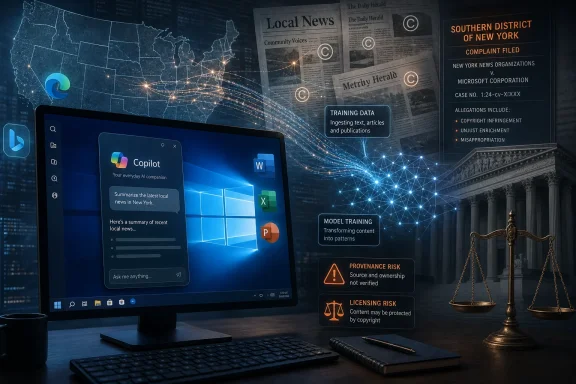
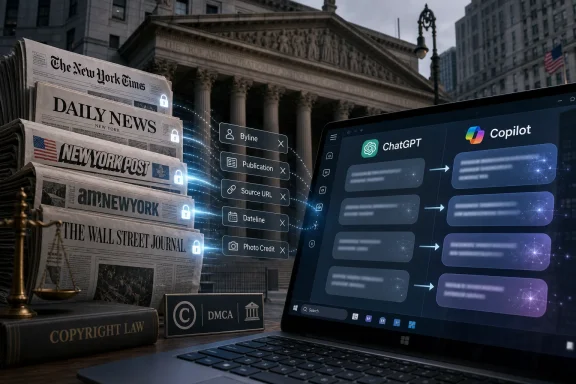
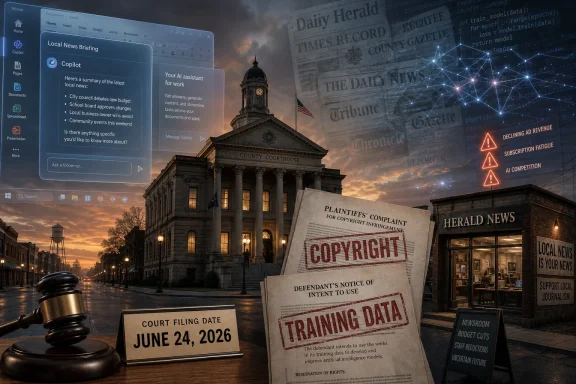
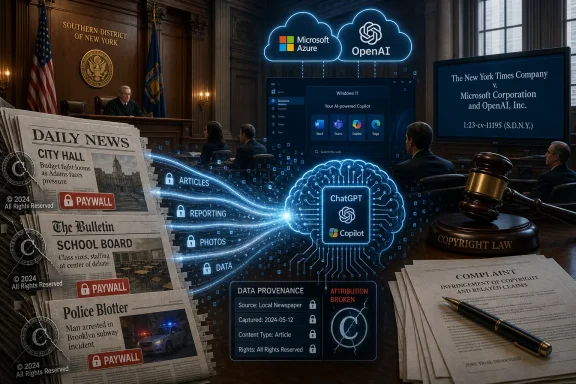
Nearly 400 local and regional newspapers sued OpenAI and Microsoft in federal court in New York on June 24, 2026, alleging that the companies copied millions of copyrighted articles to build and operate products including ChatGPT and Microsoft Copilot without permission or payment. The suit, filed in the Southern District of New York by Platkin LLP, is not the first copyright attack on generative AI, but it may be the one that best exposes the industry’s weakest political flank. This is no longer just a fight between elite national publishers and Silicon Valley platforms. It is a fight over whether local reporting becomes raw material for AI systems before the business model that created it collapses entirely.
The plaintiffs in Richner Communications, Inc. v. Microsoft Corp. are not presenting themselves as incumbents trying to tax innovation. They are presenting themselves as the last working infrastructure of civic visibility in hundreds of American communities. That distinction matters because the AI copyright debate has often been framed as a clash between sophisticated media giants and sophisticated technology giants, with both sides presumed capable of absorbing the legal costs.
This case shifts the optics. The coalition includes publishers behind nearly 400 newspapers across dozens of states, from family-owned operations to regional chains serving small cities, rural counties, suburban corridors, and urban neighborhoods. Their argument is simple: local reporters paid to attend city council meetings, cover courts, document crime, photograph high school sports, write obituaries, and investigate corruption; OpenAI and Microsoft allegedly copied that work at scale and converted it into commercial AI capability.
That is a sharper claim than the abstract argument that large language models “learn” from the web. Local reporting is often not duplicated elsewhere. A school board vote in New Hampshire, a zoning fight in New Mexico, a local business closure in Texas, or a county corruption story in Arkansas may exist in only one professionally reported version. If that version is absorbed into a model and later summarized without attribution, the publisher has not merely lost a licensing opportunity. It has lost some of the scarcity that made the reporting economically defensible.
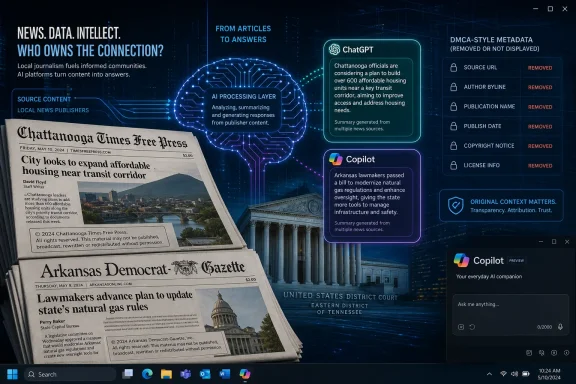
The complaint reportedly tracks familiar legal theories: copyright infringement, unauthorized copying, output that reproduces or repurposes protected material, and removal of copyright management information under the Digital Millennium Copyright Act. But the social theory of the case is more ambitious. It argues that AI companies are not simply training on “data”; they are extracting value from an already weakened public-service business and returning little or nothing to the institutions that made the data trustworthy.
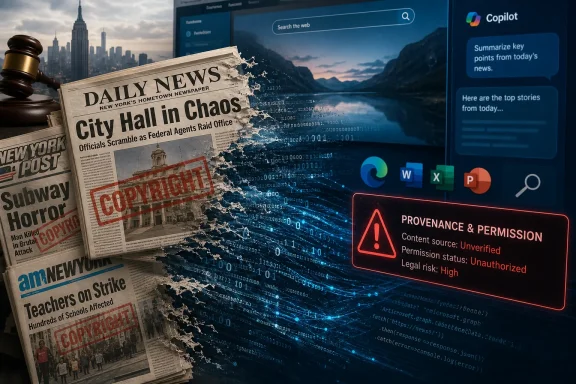
That is why the allegations about ChatGPT and Copilot matter to WindowsForum readers. Microsoft’s role is not incidental. Copilot is not a side experiment sitting behind a research login; it is being woven through Windows, Microsoft 365, Edge, Bing, GitHub, Azure, and the broader Microsoft productivity stack. If AI-generated answers become a default interface for knowledge work, the dispute over training data becomes a dispute over who gets traffic, attribution, and money in the next computing platform.
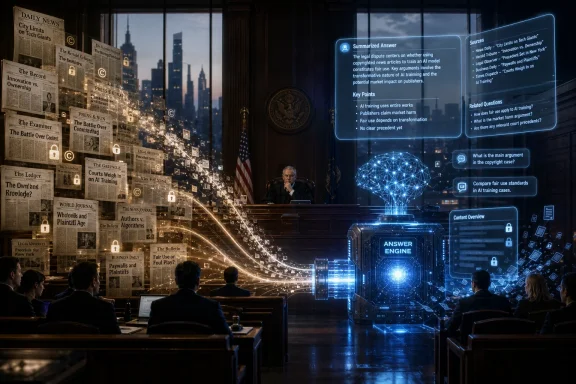
Traditional search created plenty of tension with publishers, but it at least offered a recognizable bargain. Search engines indexed pages, displayed snippets, and sent users onward through links. Publishers complained about snippets, rankings, and ad-market power, but the traffic loop remained visible. Generative AI threatens to sever that loop by turning source material into a direct answer.
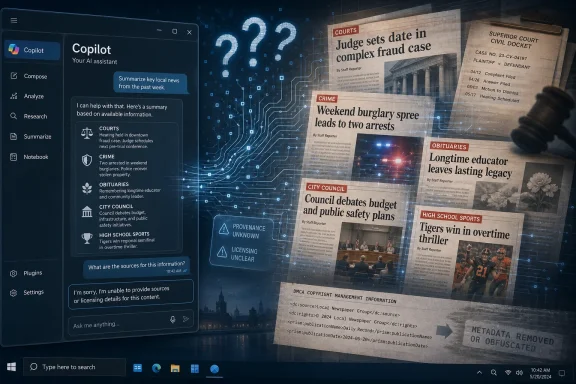
That shift is existential for local media because local newspapers do not usually have the brand gravity of The New York Times or The Wall Street Journal. A national subscriber may seek out a known publication. A resident asking an AI assistant “what happened at last night’s council meeting?” may never know whether the answer came from the local paper, a government agenda, a social media post, or a hallucinated blend of all three.
The lawsuit therefore asks courts to examine not only whether copyrighted works were copied during training, but whether AI products substitute for the publishers’ own offerings. That substitution theory has become central to media lawsuits against AI companies. It is also the theory that most directly threatens Microsoft’s plan to make Copilot feel less like a search box and more like a universal work companion.
When Microsoft attaches Copilot to Windows and Office, it makes generative AI feel like part of the operating environment rather than a destination website. A user does not need to decide to visit an AI startup. They can ask a question from a browser sidebar, a productivity app, or an enterprise workflow. That convenience is precisely what makes the technology powerful, and precisely what makes publishers nervous.
For IT departments, this is not just a media-industry drama. The litigation touches procurement, compliance, AI governance, and risk management. Enterprises adopting Copilot are already asking whether confidential business information can leak into models, whether AI outputs are reliable enough for regulated workflows, and whether generated text carries copyright risk. A major publisher coalition suing over alleged unauthorized training and reproduction adds another line item to the risk register.
Microsoft will presumably argue, as AI developers generally have, that training models on large corpora can be lawful under fair use, that model outputs are not equivalent to databases of copied articles, and that the public benefits of AI are substantial. But the company’s presence in the case complicates any attempt to paint this as merely a research dispute. Copilot is a commercial product embedded in software that millions of businesses already license.
The plaintiffs’ theory is built for that reality. They are not saying OpenAI built a clever lab demo. They are saying OpenAI and Microsoft used local journalism to create products that now compete for the same user attention, search behavior, and information value that publishers need to monetize. That turns Microsoft’s distribution power from a business advantage into a legal and reputational vulnerability.
This distinction matters because fair use is a flexible doctrine. Courts weigh purpose, nature of the work, amount used, and market effect. AI companies have leaned heavily on the argument that training is transformative because models extract statistical relationships rather than distribute exact copies. Publishers respond that copying entire archives to build commercial substitutes is not transformative enough to excuse the market harm.
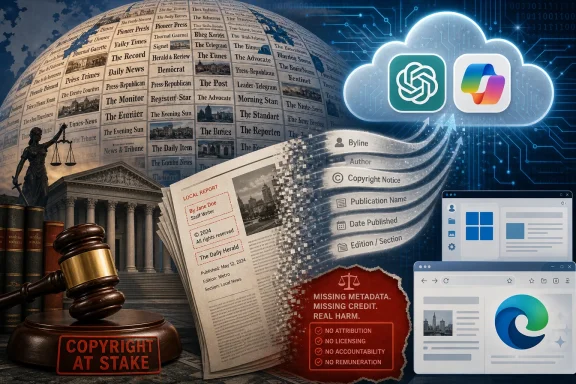
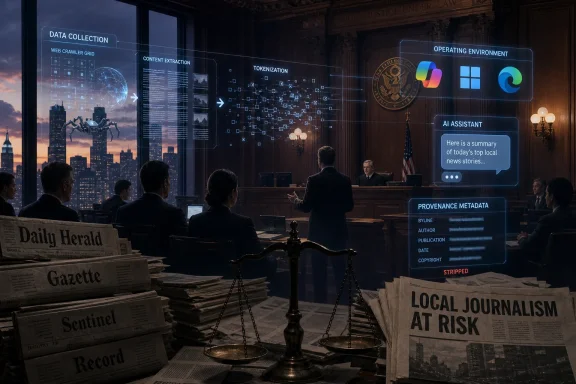
DMCA claims can cut through that debate in a different way. If a court accepts that copyright information was intentionally removed or stripped in a way that facilitated infringement, the analysis may not depend entirely on whether model training itself is fair use. It becomes a question of metadata, attribution, and knowledge.
That is especially relevant for news. A news article is not just a block of prose. It carries a byline, publication identity, date, corrections history, licensing context, and editorial accountability. Strip those signals away, and the article becomes undifferentiated text. For a model trainer, that may be convenient. For a publisher, it is the removal of the very markers that distinguish accountable journalism from generic web content.
The DMCA theory also speaks to a wider frustration among creators: AI firms often talk about training data at a level of abstraction that erases authorship. The phrase publicly available data can sound harmless until it includes paywalled investigations, archival reporting, and local beat work produced under copyright. The publishers are asking the court to treat those missing labels as part of the alleged injury, not as a technical footnote.
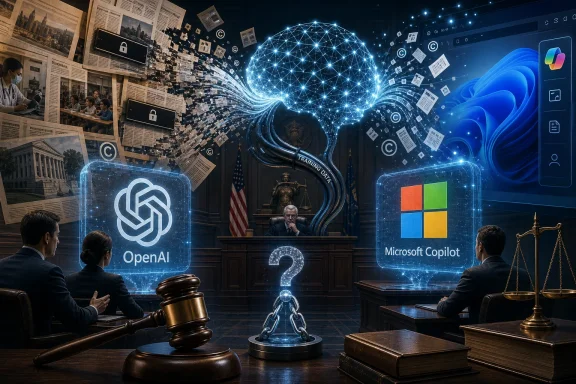
The legal landscape remains unsettled. Some AI defendants have won important fair-use arguments in related contexts, while other cases continue through discovery and motion practice. The result is a patchwork of early rulings, unresolved appeals, private licensing deals, and public threats. Nobody should pretend the central question has been definitively answered.
That uncertainty is part of the leverage. Publishers do not need every court to reject AI training as unlawful to change the market. They need enough risk, enough discovery, and enough credible damages exposure to make licensing cheaper than litigation. AI companies, conversely, need enough favorable precedent to avoid turning the entire public web into a rights-clearance swamp.
Local newspapers are late to the table only in the sense that they lacked the resources and national megaphone of larger plaintiffs. Their legal theory is not exotic. It borrows from earlier complaints and applies the same core allegations to a broader, more politically sympathetic class of publishers.
That may matter in settlement dynamics. A resolution that satisfies only the largest national outlets would create a two-tier information economy: premium publishers get paid, local publishers get scraped. Platkin’s argument, as reported, is that local news cannot be left outside the compensation framework if AI companies are forced or persuaded to license professional journalism.
Publishers want to decide whether their work can be used to train models, under what terms, with what attribution, and with what protections against substitution. AI companies want broad freedom to ingest and learn from the web without negotiating millions of fragmented licenses. Both positions have internal logic. Both become harder to defend at the extremes.
If every copyrighted sentence requires individualized permission before a model can learn from it, AI development becomes legally and operationally burdensome in ways that favor only the richest firms. If every article ever published online can be copied into commercial systems without compensation, the incentive to produce expensive original reporting weakens further. The law has to draw a line somewhere between those poles.
Local news makes the line harder to dodge. Much of the information that citizens need most is not naturally profitable. It exists because a reporter is paid to show up. When that reporting is used to answer questions inside an AI interface, the user receives value. The question is whether the institution that created the value receives anything back.
This is where the case becomes politically uncomfortable for AI boosters. The industry has sold generative AI as a democratizing tool, a way to broaden access to knowledge and productivity. But if the tool depends on hollowing out local knowledge institutions, the democratization story begins to look extractive. A smarter interface is not an adequate substitute for the reporting pipeline that feeds it.
If courts or settlements force stricter licensing, Copilot could become more explicit about sources, more cautious with news summaries, or more dependent on licensed content feeds. That might improve reliability and attribution, but it could also narrow what the assistant can answer. Users may see fewer confident summaries of paywalled reporting and more prompts to consult original sources.
For administrators, the more immediate concern is governance. Enterprises deploying AI assistants need policies about what outputs can be used, how employees should verify generated summaries, and when legal review is required. Copyright risk has sometimes been treated as a theoretical worry compared with privacy and security. Cases like this make it harder to keep it theoretical.
There is also a reputational angle. Microsoft has spent decades turning Windows and Office into trusted enterprise defaults. Copilot asks customers to extend that trust to probabilistic systems that summarize the world. If those systems are accused of reproducing protected journalism or obscuring attribution, the trust question widens beyond accuracy into legitimacy.
That does not mean businesses should panic and disable every AI feature. It does mean the era of casual AI rollout is ending. The same organizations that demand software bills of materials for security may increasingly demand content provenance, model documentation, and contractual protection for AI-generated outputs.
Robots.txt was built for web-crawler etiquette, not as a comprehensive copyright licensing regime. Paywalls, terms of service, and metadata provide additional signals, but the AI training pipeline has often treated web availability as practical accessibility. Courts are now being asked whether practical accessibility equals legal permission.
The publishers’ complaint reportedly emphasizes that they invested heavily in protecting their work, including through paywalls. That allegation is meant to undercut any suggestion that the material was simply lying in an open field. If a model developer bypassed or ignored publisher controls, the case becomes less about passive learning and more about intentional acquisition.
Even where content is publicly reachable, the social contract is fraying. A local paper may tolerate search indexing because search can drive subscriptions. It may reject AI ingestion because AI can satisfy the user without a visit. The technical act of crawling may look similar; the economic effect is different.
That is the gap current law is struggling to close. Copyright doctrine was not written for models that can absorb enormous corpora, compress patterns, and generate plausible substitutes on demand. The courts will have to decide whether existing categories are flexible enough or whether Congress eventually needs to intervene.
Large publishers have already explored licensing arrangements with AI companies, and more will follow if courts allow enough claims to proceed. The difficulty is that local publishers are fragmented. A coalition of nearly 400 newspapers is therefore not only a legal tactic; it is a market-making tactic. It aggregates small claims into a negotiating bloc large enough to matter.
That aggregation could become a model. If local newspapers can coordinate, so can trade publishers, specialty magazines, academic publishers, stock photography archives, and professional databases. AI firms may eventually prefer standardized licensing frameworks to an endless stream of lawsuits.
But there is a danger here too. If the licensing market favors only those with scale, the same local publishers now suing may still find themselves underpaid. The platforms can afford to cut deals with national brands and premium data providers while leaving smaller outlets dependent on collective actions and after-the-fact damages claims.
The public interest is not served by a licensing regime that preserves only famous institutions. The distinctive value of local journalism is precisely that it covers what national outlets do not. If AI companies want to claim they expand access to knowledge, they cannot build that claim on a map where local knowledge disappears.
That transformation creates enormous consumer value. It also threatens to make the original container — the publication, the byline, the newsroom, the subscription relationship — seem optional. For local newspapers, optional often means unsustainable.
OpenAI and Microsoft will likely argue that AI does not merely copy journalism but creates new capabilities from broad learning. There is truth in that description. Modern AI systems can perform tasks far removed from any single article. But the broader the claimed transformation, the more aggressively courts will examine market harm, especially when outputs answer the same informational demand that sent readers to publishers in the first place.
The strongest version of the publishers’ case is not that AI should be stopped. It is that AI companies should not be allowed to privatize the upside of publicly valuable reporting while socializing the damage to communities. The strongest version of the AI defense is not that creators deserve nothing. It is that overbroad liability could freeze useful technology and entrench incumbents who can afford licenses.
The court will have to navigate between those claims. The rest of us should resist the easy slogans. This is not a simple morality play about pirates and victims, nor a simple innovation story about outdated industries resisting the future. It is a distribution fight over who gets paid when knowledge becomes infrastructure.
The lawsuit filed on June 24, 2026, may take years to resolve, and it may not produce the sweeping precedent either side wants. But it marks a turn in the AI copyright war because it gives the fight a local address: the newsroom covering the council meeting, the reporter writing the obituary, the publisher trying to keep a county informed with fewer subscribers and thinner margins. If AI is going to become the next interface for Windows users and the next layer of the web, it will need a more durable bargain with the people who still do the reporting no model can do on its own.
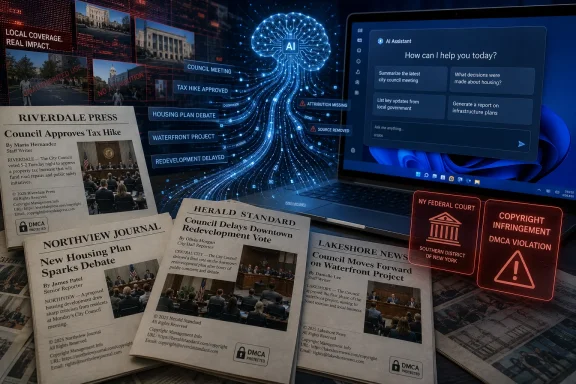 Local News Turns the AI Copyright War Into a Main Street Case
The plaintiffs in Richner Communications, Inc. v. Microsoft Corp. are not presenting themselves as incumbents trying to tax innovation. They are presenting themselves as the last working infrastructure of civic visibility in hundreds of American communities. That distinction matters because the AI copyright debate has often been framed as a clash between sophisticated media giants and sophisticated technology giants, with both sides presumed capable of absorbing the legal costs.This case shifts the optics. The coalition includes publishers behind nearly 400 newspapers across dozens of states, from family-owned operations to regional chains serving small cities, rural counties, suburban corridors, and urban neighborhoods. Their argument is simple: local reporters paid to attend city council meetings, cover courts, document crime, photograph high school sports, write obituaries, and investigate corruption; OpenAI and Microsoft allegedly copied that work at scale and converted it into commercial AI capability.
That is a sharper claim than the abstract argument that large language models “learn” from the web. Local reporting is often not duplicated elsewhere. A school board vote in New Hampshire, a zoning fight in New Mexico, a local business closure in Texas, or a county corruption story in Arkansas may exist in only one professionally reported version. If that version is absorbed into a model and later summarized without attribution, the publisher has not merely lost a licensing opportunity. It has lost some of the scarcity that made the reporting economically defensible.
The complaint reportedly tracks familiar legal theories: copyright infringement, unauthorized copying, output that reproduces or repurposes protected material, and removal of copyright management information under the Digital Millennium Copyright Act. But the social theory of the case is more ambitious. It argues that AI companies are not simply training on “data”; they are extracting value from an already weakened public-service business and returning little or nothing to the institutions that made the data trustworthy.
The Copyright Complaint Is Really a Distribution Complaint
The lawsuit’s formal target is copying, but its deeper anxiety is distribution. Newspapers can survive some unauthorized copying if readers still find their way back to the original publication. They cannot survive a world in which AI assistants become the front door to information and the source becomes invisible.That is why the allegations about ChatGPT and Copilot matter to WindowsForum readers. Microsoft’s role is not incidental. Copilot is not a side experiment sitting behind a research login; it is being woven through Windows, Microsoft 365, Edge, Bing, GitHub, Azure, and the broader Microsoft productivity stack. If AI-generated answers become a default interface for knowledge work, the dispute over training data becomes a dispute over who gets traffic, attribution, and money in the next computing platform.
Traditional search created plenty of tension with publishers, but it at least offered a recognizable bargain. Search engines indexed pages, displayed snippets, and sent users onward through links. Publishers complained about snippets, rankings, and ad-market power, but the traffic loop remained visible. Generative AI threatens to sever that loop by turning source material into a direct answer.
That shift is existential for local media because local newspapers do not usually have the brand gravity of The New York Times or The Wall Street Journal. A national subscriber may seek out a known publication. A resident asking an AI assistant “what happened at last night’s council meeting?” may never know whether the answer came from the local paper, a government agenda, a social media post, or a hallucinated blend of all three.
The lawsuit therefore asks courts to examine not only whether copyrighted works were copied during training, but whether AI products substitute for the publishers’ own offerings. That substitution theory has become central to media lawsuits against AI companies. It is also the theory that most directly threatens Microsoft’s plan to make Copilot feel less like a search box and more like a universal work companion.
Microsoft Is in the Case Because Copilot Makes the Harm Concrete
OpenAI is the obvious defendant because ChatGPT is the defining consumer AI product of the era. Microsoft is the strategic defendant because it has turned generative AI into workplace plumbing. That difference gives the publishers’ case a practical edge.When Microsoft attaches Copilot to Windows and Office, it makes generative AI feel like part of the operating environment rather than a destination website. A user does not need to decide to visit an AI startup. They can ask a question from a browser sidebar, a productivity app, or an enterprise workflow. That convenience is precisely what makes the technology powerful, and precisely what makes publishers nervous.
For IT departments, this is not just a media-industry drama. The litigation touches procurement, compliance, AI governance, and risk management. Enterprises adopting Copilot are already asking whether confidential business information can leak into models, whether AI outputs are reliable enough for regulated workflows, and whether generated text carries copyright risk. A major publisher coalition suing over alleged unauthorized training and reproduction adds another line item to the risk register.
Microsoft will presumably argue, as AI developers generally have, that training models on large corpora can be lawful under fair use, that model outputs are not equivalent to databases of copied articles, and that the public benefits of AI are substantial. But the company’s presence in the case complicates any attempt to paint this as merely a research dispute. Copilot is a commercial product embedded in software that millions of businesses already license.
The plaintiffs’ theory is built for that reality. They are not saying OpenAI built a clever lab demo. They are saying OpenAI and Microsoft used local journalism to create products that now compete for the same user attention, search behavior, and information value that publishers need to monetize. That turns Microsoft’s distribution power from a business advantage into a legal and reputational vulnerability.
The DMCA Claim Gives Publishers a Second Route Around Fair Use
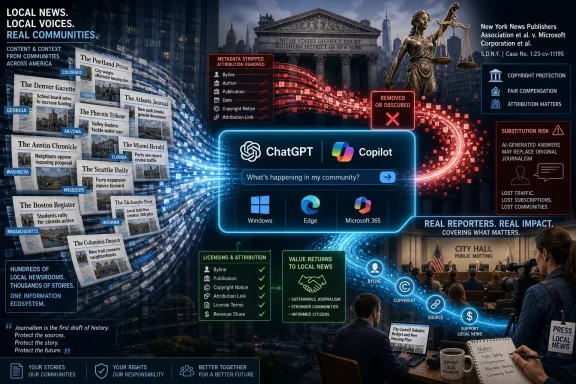
The headline copyright fight will revolve around fair use, but the DMCA allegations may prove just as important. The publishers claim that copyright management information — including author names, copyright notices, and terms-of-use information — was removed from their works. That is not the same legal question as whether training is transformative.This distinction matters because fair use is a flexible doctrine. Courts weigh purpose, nature of the work, amount used, and market effect. AI companies have leaned heavily on the argument that training is transformative because models extract statistical relationships rather than distribute exact copies. Publishers respond that copying entire archives to build commercial substitutes is not transformative enough to excuse the market harm.
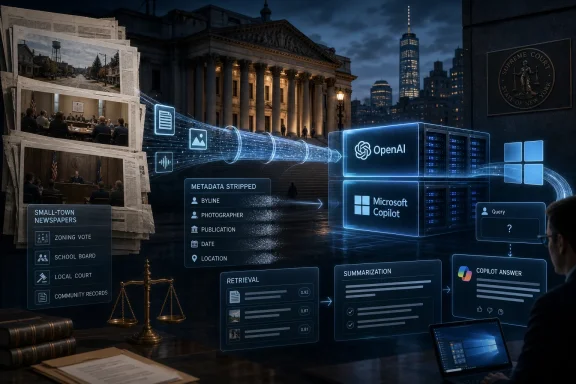
DMCA claims can cut through that debate in a different way. If a court accepts that copyright information was intentionally removed or stripped in a way that facilitated infringement, the analysis may not depend entirely on whether model training itself is fair use. It becomes a question of metadata, attribution, and knowledge.
That is especially relevant for news. A news article is not just a block of prose. It carries a byline, publication identity, date, corrections history, licensing context, and editorial accountability. Strip those signals away, and the article becomes undifferentiated text. For a model trainer, that may be convenient. For a publisher, it is the removal of the very markers that distinguish accountable journalism from generic web content.
The DMCA theory also speaks to a wider frustration among creators: AI firms often talk about training data at a level of abstraction that erases authorship. The phrase publicly available data can sound harmless until it includes paywalled investigations, archival reporting, and local beat work produced under copyright. The publishers are asking the court to treat those missing labels as part of the alleged injury, not as a technical footnote.
The New Lawsuit Joins a Courtroom Map That Is Still Being Drawn
This case arrives after years of escalating litigation over generative AI and copyrighted work. The New York Times sued OpenAI and Microsoft in late 2023, making the issue impossible for the news industry to ignore. Other authors, publishers, and media organizations have since pursued claims against AI companies, including suits involving books, dictionaries, journalism, and other professional content.The legal landscape remains unsettled. Some AI defendants have won important fair-use arguments in related contexts, while other cases continue through discovery and motion practice. The result is a patchwork of early rulings, unresolved appeals, private licensing deals, and public threats. Nobody should pretend the central question has been definitively answered.
That uncertainty is part of the leverage. Publishers do not need every court to reject AI training as unlawful to change the market. They need enough risk, enough discovery, and enough credible damages exposure to make licensing cheaper than litigation. AI companies, conversely, need enough favorable precedent to avoid turning the entire public web into a rights-clearance swamp.
Local newspapers are late to the table only in the sense that they lacked the resources and national megaphone of larger plaintiffs. Their legal theory is not exotic. It borrows from earlier complaints and applies the same core allegations to a broader, more politically sympathetic class of publishers.
That may matter in settlement dynamics. A resolution that satisfies only the largest national outlets would create a two-tier information economy: premium publishers get paid, local publishers get scraped. Platkin’s argument, as reported, is that local news cannot be left outside the compensation framework if AI companies are forced or persuaded to license professional journalism.
The Stakes Are Bigger Than a Licensing Check
It is tempting to reduce this case to money. That would be a mistake. Money is the remedy, but control is the issue.Publishers want to decide whether their work can be used to train models, under what terms, with what attribution, and with what protections against substitution. AI companies want broad freedom to ingest and learn from the web without negotiating millions of fragmented licenses. Both positions have internal logic. Both become harder to defend at the extremes.
If every copyrighted sentence requires individualized permission before a model can learn from it, AI development becomes legally and operationally burdensome in ways that favor only the richest firms. If every article ever published online can be copied into commercial systems without compensation, the incentive to produce expensive original reporting weakens further. The law has to draw a line somewhere between those poles.
Local news makes the line harder to dodge. Much of the information that citizens need most is not naturally profitable. It exists because a reporter is paid to show up. When that reporting is used to answer questions inside an AI interface, the user receives value. The question is whether the institution that created the value receives anything back.
This is where the case becomes politically uncomfortable for AI boosters. The industry has sold generative AI as a democratizing tool, a way to broaden access to knowledge and productivity. But if the tool depends on hollowing out local knowledge institutions, the democratization story begins to look extractive. A smarter interface is not an adequate substitute for the reporting pipeline that feeds it.
Windows Users Will Feel This Fight Through Copilot, Search, and Trust
For Windows users, the case is not merely about newspaper archives. It is about the future shape of information inside the Microsoft ecosystem. Copilot’s promise is that it can synthesize, summarize, draft, and explain across contexts. The controversy is that synthesis requires inputs, and the provenance of those inputs is becoming a central legal and trust problem.If courts or settlements force stricter licensing, Copilot could become more explicit about sources, more cautious with news summaries, or more dependent on licensed content feeds. That might improve reliability and attribution, but it could also narrow what the assistant can answer. Users may see fewer confident summaries of paywalled reporting and more prompts to consult original sources.
For administrators, the more immediate concern is governance. Enterprises deploying AI assistants need policies about what outputs can be used, how employees should verify generated summaries, and when legal review is required. Copyright risk has sometimes been treated as a theoretical worry compared with privacy and security. Cases like this make it harder to keep it theoretical.
There is also a reputational angle. Microsoft has spent decades turning Windows and Office into trusted enterprise defaults. Copilot asks customers to extend that trust to probabilistic systems that summarize the world. If those systems are accused of reproducing protected journalism or obscuring attribution, the trust question widens beyond accuracy into legitimacy.
That does not mean businesses should panic and disable every AI feature. It does mean the era of casual AI rollout is ending. The same organizations that demand software bills of materials for security may increasingly demand content provenance, model documentation, and contractual protection for AI-generated outputs.
The AI Industry Cannot Solve This With Robots.txt Alone
One predictable response is that publishers can block crawlers or use technical controls to limit scraping. That answer is insufficient, especially for archives allegedly copied before controls changed or for content that appears in third-party datasets. It also reverses the burden: the creator must build fences fast enough to stop the most valuable companies in technology from copying at scale.Robots.txt was built for web-crawler etiquette, not as a comprehensive copyright licensing regime. Paywalls, terms of service, and metadata provide additional signals, but the AI training pipeline has often treated web availability as practical accessibility. Courts are now being asked whether practical accessibility equals legal permission.
The publishers’ complaint reportedly emphasizes that they invested heavily in protecting their work, including through paywalls. That allegation is meant to undercut any suggestion that the material was simply lying in an open field. If a model developer bypassed or ignored publisher controls, the case becomes less about passive learning and more about intentional acquisition.
Even where content is publicly reachable, the social contract is fraying. A local paper may tolerate search indexing because search can drive subscriptions. It may reject AI ingestion because AI can satisfy the user without a visit. The technical act of crawling may look similar; the economic effect is different.
That is the gap current law is struggling to close. Copyright doctrine was not written for models that can absorb enormous corpora, compress patterns, and generate plausible substitutes on demand. The courts will have to decide whether existing categories are flexible enough or whether Congress eventually needs to intervene.
The Settlement Market May Move Faster Than the Courts
The most likely near-term outcome is not a clean Supreme Court answer. It is a growing market of licenses, carve-outs, private settlements, and product adjustments. That is how platform disputes often evolve: litigation creates uncertainty, uncertainty creates bargaining power, and bargaining power creates deals before doctrine fully matures.Large publishers have already explored licensing arrangements with AI companies, and more will follow if courts allow enough claims to proceed. The difficulty is that local publishers are fragmented. A coalition of nearly 400 newspapers is therefore not only a legal tactic; it is a market-making tactic. It aggregates small claims into a negotiating bloc large enough to matter.
That aggregation could become a model. If local newspapers can coordinate, so can trade publishers, specialty magazines, academic publishers, stock photography archives, and professional databases. AI firms may eventually prefer standardized licensing frameworks to an endless stream of lawsuits.
But there is a danger here too. If the licensing market favors only those with scale, the same local publishers now suing may still find themselves underpaid. The platforms can afford to cut deals with national brands and premium data providers while leaving smaller outlets dependent on collective actions and after-the-fact damages claims.
The public interest is not served by a licensing regime that preserves only famous institutions. The distinctive value of local journalism is precisely that it covers what national outlets do not. If AI companies want to claim they expand access to knowledge, they cannot build that claim on a map where local knowledge disappears.
The Real Precedent Will Be About Bargaining Power
This lawsuit will be described as a copyright case because that is what it is. But its broader precedent will be about bargaining power in the information economy. The web trained users to expect information to be abundant and cheap. Generative AI trains users to expect information to be conversational, synthesized, and detached from its original container.That transformation creates enormous consumer value. It also threatens to make the original container — the publication, the byline, the newsroom, the subscription relationship — seem optional. For local newspapers, optional often means unsustainable.
OpenAI and Microsoft will likely argue that AI does not merely copy journalism but creates new capabilities from broad learning. There is truth in that description. Modern AI systems can perform tasks far removed from any single article. But the broader the claimed transformation, the more aggressively courts will examine market harm, especially when outputs answer the same informational demand that sent readers to publishers in the first place.
The strongest version of the publishers’ case is not that AI should be stopped. It is that AI companies should not be allowed to privatize the upside of publicly valuable reporting while socializing the damage to communities. The strongest version of the AI defense is not that creators deserve nothing. It is that overbroad liability could freeze useful technology and entrench incumbents who can afford licenses.
The court will have to navigate between those claims. The rest of us should resist the easy slogans. This is not a simple morality play about pirates and victims, nor a simple innovation story about outdated industries resisting the future. It is a distribution fight over who gets paid when knowledge becomes infrastructure.
The Court Filing Is Only the First Bill Coming Due
The concrete implications are already visible, even before a judge reaches the merits.- Nearly 400 local and regional newspapers are now part of the most prominent local-news challenge yet to OpenAI and Microsoft’s AI training and output practices.
- The complaint places Microsoft Copilot directly in the copyright spotlight, making the case relevant to Windows, Microsoft 365, Edge, Bing, and enterprise AI adoption.
- The publishers are pursuing both copyright infringement and DMCA theories, which means attribution and removal of copyright information may matter alongside the larger fair-use fight.
- The case strengthens the argument that AI licensing frameworks must include local and regional journalism, not only national media brands with enough money to sue alone.
- IT departments should treat AI output provenance and copyright exposure as governance issues, not as abstract policy debates reserved for media lawyers.
- The larger market may move through settlements and licensing deals long before courts produce a final, stable rule for generative AI and copyrighted news.
The lawsuit filed on June 24, 2026, may take years to resolve, and it may not produce the sweeping precedent either side wants. But it marks a turn in the AI copyright war because it gives the fight a local address: the newsroom covering the council meeting, the reporter writing the obituary, the publisher trying to keep a county informed with fewer subscribers and thinner margins. If AI is going to become the next interface for Windows users and the next layer of the web, it will need a more durable bargain with the people who still do the reporting no model can do on its own.
References
- Primary source: Insider NJ
Published: 2026-06-24T21:23:29.572940
Coalition of hundreds of local and regional newspapers sues OpenAI and Microsoft - Insider NJ
Coalition of hundreds of local and regional newspapers sues OpenAI and Microsoft The lawsuit, filed by Platkin LLP on behalf of publishers of hundreds of newspapers across dozens of states, argues that OpenAI systematically and willfully stole millions of copyrighted news articles New York, NY...www.insidernj.com - Independent coverage: Bloomberg Law News
Published: 2026-06-24T21:05:29.581414
OpenAI, Microsoft Sued by Publishers for Scraping News Articles
Publishers that collectively own and operate nearly 400 newspapers are suing OpenAI Inc. and Microsoft Corp. for scraping their content to build products like ChatGPT and Microsoft Copilot without permission or compensation.news.bloomberglaw.com
- Related coverage: techcrunch.com
OpenAI faces investigation from state attorneys general | TechCrunch
It's not clear which states are involved, but they're asking about everything from OpenAI's ad policies to its handling of health data.techcrunch.com - Related coverage: bloomberg.com
- Related coverage: news.bloombergtax.com
OpenAI Sued Over Sharing of Chatbot Queries With Meta, Google
A California resident sued OpenAI Global LLC for allegedly sharing users’ ChatGPT queries and personal information with Meta Platforms Inc. and Google LLC through online tracking technology.news.bloombergtax.com
- Related coverage: washingtonpost.com
- Related coverage: news.bgov.com
OpenAI Sued by New Set of Authors Over Training Data Copyrights
A new group of authors hit OpenAI Inc. and Microsoft Corp. with another putative class action alleging mass copyright infringement through training AI on books pilfered from “shadow libraries.”news.bgov.com
- Related coverage: theguardian.com
Major publishers sue Meta for copyright infringement over AI training | Meta | The Guardian
Hachette, Macmillan and others allege that Meta pirated millions of works from textbooks to novels for Llama modelwww.theguardian.com - Related coverage: geekwire.com
Jury finds Musk waited too long to sue OpenAI and Microsoft, clearing defendants in landmark AI case – GeekWire
A jury ruled unanimously Monday that Elon Musk waited too long to file his lawsuit against OpenAI, Sam Altman, and Microsoft, finding the defendants not liable on all claims after less than two hours of deliberation.www.geekwire.com - Related coverage: rothwellfigg.com
Microsoft, OpenAI Call Papers' Suit A 'Copycat' Of NYT's Case - Law360
PDF documentwww.rothwellfigg.com
- Related coverage: beneschlaw.com
2-colorLogo_masterfile
Big Data Analytics Neural Network Data Flow Visualization, AI Machine Learning, Quantum Computing, Binary Code Digital Grid, Futuristic Artificial Intelligence Technology Abstract Backgroundwww.beneschlaw.com
- Related coverage: fm.cnbc.com
- Related coverage: srz.com
McDermott Will & Schulte, a global law firm
McDermott Will & Schulte is a modern, elite law firm committed to global legal excellence and client service that is Always Better. Contact us today.www.srz.com












%22 d=%22M44,140.1h42.8V272H54.9c0-0.1,0-103.8,0-103.8H44V140.1z M44,1c28.4,0,42.6,16.2,42.6,42.2v66.1H54.9V43.8 c0-7.2-3.1-11.7-10.6-11.7c-7,0-10.6,4.2-10.6,11.7c0,0,0,228.1,0,228.2H0.2c0-0.5,0-228.8,0-228.8C0.1,16.8,14.8,1,44,1L44,1z%22/><style>path { fill: %23262626 } @media (prefers-color-scheme: dark) { path { fill: %23EEEFE9 } }</style></svg>)