

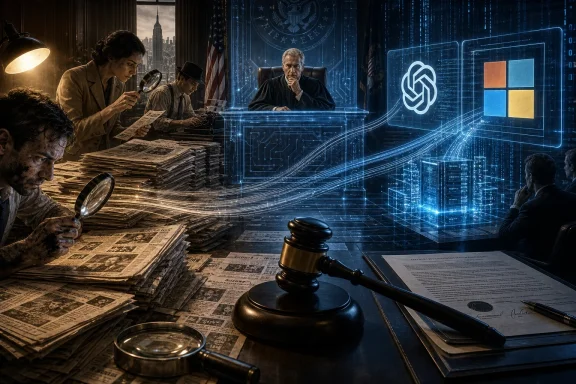
A coalition of 35 publishers operating nearly 400 local and regional newspapers sued OpenAI and Microsoft in federal court in New York on June 24, 2026, alleging that ChatGPT and Microsoft Copilot were built in part by scraping and ingesting their copyrighted reporting without permission or payment. The case, detailed in the complaint and reported by outlets including Bloomberg Law and the Yakima Herald-Republic, is not just another entry in the expanding docket of AI copyright fights. It is a test of whether the smallest remaining engines of American journalism can force the richest software companies on earth to recognize that “publicly accessible” is not the same thing as “free to industrialize.” For Microsoft watchers, the lawsuit lands squarely in Redmond’s AI era: Copilot is no longer a side bet, and the legal theory behind its training data is becoming a business risk.
The first wave of AI copyright litigation was easy to caricature as a clash between elite cultural producers and the new machine-learning economy. Novelists, visual artists, musicians, actors, and eventually The New York Times all argued that generative AI systems had absorbed their work and were now competing against them. The new local-newspaper suit is harder to dismiss, because it comes from publishers that rarely have the money, staff, or political leverage to fight Silicon Valley on equal footing.
According to Platkin LLP, the firm representing the publishers, the coalition spans nearly 400 newspapers across 33 states. The plaintiffs include family-owned and community-focused operations, with Richner Communications of Long Island named as a lead plaintiff. That matters because the economics of local journalism are not the economics of a national media brand with a global subscriber base and an in-house litigation budget.
The complaint alleges that OpenAI and Microsoft copied, scraped, and ingested copyrighted stories to train and commercialize AI products, including ChatGPT and Microsoft Copilot. In plain English, the newspapers say their reporters did the expensive work of attending school board meetings, covering town councils, documenting local crime, explaining tax fights, and chronicling community life — and that AI companies then converted that archive into training fuel.
Microsoft, in a statement quoted by the Yakima Herald-Republic, said the claims mirror prior litigation, lack merit, and will be defended vigorously. The company also argued that lawfully developed AI tools should be allowed to advance responsibly while saying they are not a substitute for journalism. That is the central tension of the case: Microsoft wants to praise the civic role of local news while defending a system that allegedly used local news as raw material without paying for it.
That legal argument can sound abstract until it is applied to a small-town newspaper. A local reporter may spend days extracting meaning from a zoning dispute, a police budget, or a school board controversy. The resulting story is then indexed, scraped, summarized, and folded into an AI product that can answer a user’s question without sending that reader back to the publication that paid for the work.
This is why the local publishers’ case is different from a generic complaint about “the internet.” News reporting is not simply a pile of facts. It is a chain of labor: identifying what matters, confirming what happened, attributing claims, editing for accuracy, and presenting the result in a voice and context that a community recognizes.
OpenAI and Microsoft will likely argue that AI training is not the same as republishing articles and that preventing training on publicly available material would damage innovation. But the publishers are not asking the court to ban software from learning in the human sense. They are asking whether companies can create enormously valuable products from copyrighted archives while cutting out the people who created those archives.
That makes Microsoft’s legal exposure qualitatively different. If courts eventually decide that some kinds of AI training or output substitution require licensing, Microsoft cannot treat the issue as a niche problem for model labs. It becomes a cost of doing business across Windows, Office, search, cloud, and developer tools.
For Windows users and IT administrators, this may sound remote. It is not. Copilot is being embedded into the desktop, productivity suites, and enterprise environments where information retrieval increasingly happens through generated answers rather than blue links. The more Microsoft trains customers to ask an assistant instead of visiting a source, the more important it becomes to know whether the assistant’s knowledge economy has a lawful and sustainable supply chain.
The company’s defense will almost certainly emphasize legality, innovation, and responsible deployment. But Redmond’s broader problem is reputational as well as legal. Microsoft spent decades positioning itself as the adult in the room — the enterprise-grade vendor that understands compliance, licensing, and institutional trust. If its AI future depends on a theory that local newspapers’ archives were effectively free for the taking, that posture becomes harder to maintain.
That history is why the rhetoric around this lawsuit is so sharp. Jeremy Gulban, a New Jersey technology entrepreneur who began acquiring newspapers in 2020, told the Yakima Herald-Republic that publishers cannot repeat the early-2000s mistake of giving away content and hoping for the best. The point is not nostalgia. It is that platform bargains tend to look generous at the beginning and extractive once the platform becomes the market.
AI threatens to compress that cycle. Search at least sent users outward, even if imperfectly. Generative AI is designed to satisfy the query inside the interface. If a user asks Copilot what happened at a local council meeting and receives a fluent answer drawn from reporting, the originating outlet may lose the page view, the subscription prompt, the brand impression, and the relationship.
That is not a theoretical harm for a weekly paper running on thin margins. A single local-newsroom job can be the difference between a town having a watchdog and having only official press releases. If AI systems become the dominant layer between citizens and information, the question of compensation becomes a question of whether original reporting survives in the places where it is already weakest.
The local-newspaper coalition is now joining that broader legal train before the same federal judiciary in New York. The venue matters because judges are beginning to shape the early contours of AI copyright law case by case. In March 2025, the Associated Press reported that a federal judge allowed the Times and other newspapers to proceed with key copyright claims against OpenAI and Microsoft, even as some claims in adjacent AI cases have been narrowed or dismissed.
Small papers bring a different moral and economic weight. The Times can argue that AI products threaten a premium subscription business. A local weekly can argue that AI companies are extracting from one of the last remaining sources of verifiable civic information in its community.
That distinction may not decide the law, but it could influence how the public understands the stakes. A court will not simply rule that “local journalism is good” and therefore OpenAI owes money. Yet judges do consider market effects, substitution, and the purpose and character of the use. The smaller and more fragile the market, the easier it is to see how uncompensated extraction could become destructive.
The local papers’ complaint effectively asks why the largest outlets get a seat at the table while smaller publishers are left outside the room. If AI companies need reliable news content to make their products useful, local reporting should be part of that value chain. A model that can explain national politics but cannot account for school boards, county commissions, local courts, and community emergencies is not a universal knowledge system.
There is also a competition problem lurking beneath the copyright claim. If only the largest publishers can negotiate AI licensing deals, the AI economy may further consolidate media power. National brands get checks, platform placement, and technical partnerships; local papers get scraped and summarized.
That outcome would be perverse. The information most likely to disappear from the internet is not another national election take or celebrity profile. It is the routine, unglamorous reporting that makes corruption harder, civic life legible, and local government accountable.
The legal system will ask more technical questions. Were the works copied? Were they protected? Was the use transformative? Did the use affect the market for the originals? Were outputs substantially similar, or did the alleged infringement occur primarily during training? Those questions are less satisfying than the moral argument, but they are where the case will be fought.
Still, the moral frame should not be dismissed. Law often catches up to new markets only after a simpler public intuition becomes impossible to ignore. Musicians argued for royalties when radio, recordings, and streaming changed distribution. Software companies built licensing regimes around code that can be copied at near-zero cost. News publishers are now asking why AI should be exempt from the same basic economic logic.
The strongest version of the publishers’ argument is not that AI must never learn from the world. It is that commercial-scale ingestion of copyrighted journalism, used to build products that can answer news queries and compete for attention, should not be treated as a natural right of the platform owner.
If an enterprise asks whether Copilot respects data boundaries, Microsoft has a sophisticated answer. If a publisher asks whether Copilot’s underlying capabilities were built on uncompensated copyrighted reporting, the answer becomes litigation. That gap is increasingly difficult to ignore.
For IT pros, this resembles a software supply-chain problem. Enterprises learned to care not only whether an application works, but what libraries, licenses, dependencies, and vulnerabilities sit underneath it. AI systems introduce a parallel concern: what data, rights, and unresolved claims sit beneath the model?
Microsoft does not need to lose this case for the issue to matter. Prolonged litigation can shape procurement questions, compliance reviews, product disclosures, and licensing budgets. If courts move toward requiring compensation, vendors with cleaner content supply chains will have an advantage; if courts bless broad fair use, publishers will face a harsher future.
A town without reporters does not become apolitical. It becomes easier to govern in the dark. Public officials face fewer questions, residents rely more on rumor, and national partisan narratives rush in to explain local events they did not observe.
AI does not solve that problem by summarizing what remains. A model cannot attend a planning meeting unless someone sends it there through a reporting process. It cannot cultivate sources, inspect records, notice evasions, or understand why a seemingly minor agenda item matters to people who live nearby.
That is the central economic asymmetry. AI systems can make existing knowledge easier to retrieve, but they do not automatically create the institutions that produce trustworthy knowledge in the first place. If those institutions collapse, the models inherit a thinner, noisier, more official version of reality.
Judges are better at applying statutes than designing media ecosystems. Copyright law can address unauthorized copying and market harm, but it cannot by itself rebuild local advertising, restore classified revenue, or create new habits of civic attention. Even a publisher victory would be only one piece of a much larger repair job.
But courts are where the leverage now exists. If the judiciary narrows AI companies’ fair-use claims, publishers gain bargaining power. If judges endorse the broadest version of AI training as fair use, the industry will have to seek survival through subscriptions, philanthropy, consolidation, or platform charity.
That is why the local newspapers’ case matters beyond damages. A settlement could create a licensing template. A ruling could define negotiating boundaries. Even discovery could reveal more about how local news content moved through AI training pipelines.
That vision depends on trust. Users must trust the output, administrators must trust the controls, and rights holders must trust that Microsoft is not turning their work into unlicensed substrate. If any of those layers cracks, Copilot becomes less a productivity revolution than a litigation magnet with a sidebar.
There is a practical enterprise implication as well. Companies adopting AI tools will increasingly ask vendors about indemnity, training data, content provenance, and copyright exposure. Microsoft is large enough to absorb legal shocks, but customers do not want their workflows built on unresolved rights disputes.
The irony is that Microsoft understands licensing better than almost anyone. Its entire empire was built on the premise that copying software without permission is not innovation; it is infringement. Local newspapers are now applying a version of that argument back to Microsoft’s AI stack.
That would not be the end of the dispute. Publishers would still fight over rates, attribution, opt-outs, output substitution, and whether compensation should flow to individual outlets, collectives, or industry-wide licensing bodies. But a flawed market is better than a vacuum in which the richest party declares the input free.
The newspapers’ argument is strongest when it avoids pretending that AI has no legitimate uses. Zack Richner, quoted by the Yakima Herald-Republic, said publishers are not anti-innovation and may use AI tools themselves. That is the mature position: journalism should not reject useful technology, but technology should not be allowed to launder uncompensated journalism into platform value.
The AI industry likes to talk about abundance. Local journalism lives in scarcity. The courtroom collision between those two realities will help decide whether the next information economy rewards original reporting or merely rewards whoever can ingest it fastest.
 Local News Has Finally Entered the AI Copyright War
The first wave of AI copyright litigation was easy to caricature as a clash between elite cultural producers and the new machine-learning economy. Novelists, visual artists, musicians, actors, and eventually The New York Times all argued that generative AI systems had absorbed their work and were now competing against them. The new local-newspaper suit is harder to dismiss, because it comes from publishers that rarely have the money, staff, or political leverage to fight Silicon Valley on equal footing.According to Platkin LLP, the firm representing the publishers, the coalition spans nearly 400 newspapers across 33 states. The plaintiffs include family-owned and community-focused operations, with Richner Communications of Long Island named as a lead plaintiff. That matters because the economics of local journalism are not the economics of a national media brand with a global subscriber base and an in-house litigation budget.
The complaint alleges that OpenAI and Microsoft copied, scraped, and ingested copyrighted stories to train and commercialize AI products, including ChatGPT and Microsoft Copilot. In plain English, the newspapers say their reporters did the expensive work of attending school board meetings, covering town councils, documenting local crime, explaining tax fights, and chronicling community life — and that AI companies then converted that archive into training fuel.
Microsoft, in a statement quoted by the Yakima Herald-Republic, said the claims mirror prior litigation, lack merit, and will be defended vigorously. The company also argued that lawfully developed AI tools should be allowed to advance responsibly while saying they are not a substitute for journalism. That is the central tension of the case: Microsoft wants to praise the civic role of local news while defending a system that allegedly used local news as raw material without paying for it.
The Fair-Use Fight Is Really a Market-Structure Fight
The lawsuit will turn in part on fair use, the elastic doctrine that allows certain uses of copyrighted work without permission. AI companies have generally argued that training models on large bodies of text is transformative because the systems do not merely republish the originals; they learn statistical patterns and generate new outputs. Publishers respond that copying works at massive scale to build commercial products is still copying, especially when those products can summarize, substitute for, or reproduce the value of the original reporting.That legal argument can sound abstract until it is applied to a small-town newspaper. A local reporter may spend days extracting meaning from a zoning dispute, a police budget, or a school board controversy. The resulting story is then indexed, scraped, summarized, and folded into an AI product that can answer a user’s question without sending that reader back to the publication that paid for the work.
This is why the local publishers’ case is different from a generic complaint about “the internet.” News reporting is not simply a pile of facts. It is a chain of labor: identifying what matters, confirming what happened, attributing claims, editing for accuracy, and presenting the result in a voice and context that a community recognizes.
OpenAI and Microsoft will likely argue that AI training is not the same as republishing articles and that preventing training on publicly available material would damage innovation. But the publishers are not asking the court to ban software from learning in the human sense. They are asking whether companies can create enormously valuable products from copyrighted archives while cutting out the people who created those archives.
Microsoft’s Copilot Bet Makes This More Than an OpenAI Story
OpenAI is the obvious defendant because ChatGPT became the consumer face of generative AI. Microsoft is the more strategically interesting one because it has spent the past several years turning AI into the organizing principle of its product line. Copilot now appears across Windows, Microsoft 365, Edge, Bing, GitHub, Azure, and enterprise workflows; it is not a research demo but a platform strategy.That makes Microsoft’s legal exposure qualitatively different. If courts eventually decide that some kinds of AI training or output substitution require licensing, Microsoft cannot treat the issue as a niche problem for model labs. It becomes a cost of doing business across Windows, Office, search, cloud, and developer tools.
For Windows users and IT administrators, this may sound remote. It is not. Copilot is being embedded into the desktop, productivity suites, and enterprise environments where information retrieval increasingly happens through generated answers rather than blue links. The more Microsoft trains customers to ask an assistant instead of visiting a source, the more important it becomes to know whether the assistant’s knowledge economy has a lawful and sustainable supply chain.
The company’s defense will almost certainly emphasize legality, innovation, and responsible deployment. But Redmond’s broader problem is reputational as well as legal. Microsoft spent decades positioning itself as the adult in the room — the enterprise-grade vendor that understands compliance, licensing, and institutional trust. If its AI future depends on a theory that local newspapers’ archives were effectively free for the taking, that posture becomes harder to maintain.
The Ghost of Search and Social Is Haunting This Case
Local newspapers have already lived through one platform revolution that promised reach and delivered dependency. Search engines and social networks trained publishers to optimize for distribution they did not control, then changed the economics underneath them. Traffic arrived, advertising collapsed, subscriptions lagged, and communities lost reporters.That history is why the rhetoric around this lawsuit is so sharp. Jeremy Gulban, a New Jersey technology entrepreneur who began acquiring newspapers in 2020, told the Yakima Herald-Republic that publishers cannot repeat the early-2000s mistake of giving away content and hoping for the best. The point is not nostalgia. It is that platform bargains tend to look generous at the beginning and extractive once the platform becomes the market.
AI threatens to compress that cycle. Search at least sent users outward, even if imperfectly. Generative AI is designed to satisfy the query inside the interface. If a user asks Copilot what happened at a local council meeting and receives a fluent answer drawn from reporting, the originating outlet may lose the page view, the subscription prompt, the brand impression, and the relationship.
That is not a theoretical harm for a weekly paper running on thin margins. A single local-newsroom job can be the difference between a town having a watchdog and having only official press releases. If AI systems become the dominant layer between citizens and information, the question of compensation becomes a question of whether original reporting survives in the places where it is already weakest.
The New York Times Case Opened the Door, but Small Papers Change the Room
The New York Times sued OpenAI and Microsoft in December 2023, alleging that millions of Times articles were used to train systems that could compete with and sometimes reproduce its work. The case became the flagship legal battle over AI and news, and the Times has reportedly spent tens of millions of dollars pursuing it. Other publishers, including newspapers owned by Alden Global Capital, later filed related claims.The local-newspaper coalition is now joining that broader legal train before the same federal judiciary in New York. The venue matters because judges are beginning to shape the early contours of AI copyright law case by case. In March 2025, the Associated Press reported that a federal judge allowed the Times and other newspapers to proceed with key copyright claims against OpenAI and Microsoft, even as some claims in adjacent AI cases have been narrowed or dismissed.
Small papers bring a different moral and economic weight. The Times can argue that AI products threaten a premium subscription business. A local weekly can argue that AI companies are extracting from one of the last remaining sources of verifiable civic information in its community.
That distinction may not decide the law, but it could influence how the public understands the stakes. A court will not simply rule that “local journalism is good” and therefore OpenAI owes money. Yet judges do consider market effects, substitution, and the purpose and character of the use. The smaller and more fragile the market, the easier it is to see how uncompensated extraction could become destructive.
Licensing Deals Prove the Market Exists
One of the awkward facts for AI companies is that many have already signed content deals with major publishers and wire services. OpenAI has reached licensing arrangements with organizations such as the Associated Press, Axel Springer, News Corp, and others. Those deals do not settle the legal question, but they do undercut the idea that publisher content has no licensable value.The local papers’ complaint effectively asks why the largest outlets get a seat at the table while smaller publishers are left outside the room. If AI companies need reliable news content to make their products useful, local reporting should be part of that value chain. A model that can explain national politics but cannot account for school boards, county commissions, local courts, and community emergencies is not a universal knowledge system.
There is also a competition problem lurking beneath the copyright claim. If only the largest publishers can negotiate AI licensing deals, the AI economy may further consolidate media power. National brands get checks, platform placement, and technical partnerships; local papers get scraped and summarized.
That outcome would be perverse. The information most likely to disappear from the internet is not another national election take or celebrity profile. It is the routine, unglamorous reporting that makes corruption harder, civic life legible, and local government accountable.
The “Stolen Goods” Frame Is Morally Powerful but Legally Incomplete
The Yakima Herald-Republic opinion piece that prompted this debate uses deliberately blunt language, describing AI platforms as peddling “stolen goods.” That phrase captures the anger of publishers who watched their work become input material for systems valued in the hundreds of billions. It is also the kind of language that AI companies will resist, because copyright law is not theft law in the simple sense.The legal system will ask more technical questions. Were the works copied? Were they protected? Was the use transformative? Did the use affect the market for the originals? Were outputs substantially similar, or did the alleged infringement occur primarily during training? Those questions are less satisfying than the moral argument, but they are where the case will be fought.
Still, the moral frame should not be dismissed. Law often catches up to new markets only after a simpler public intuition becomes impossible to ignore. Musicians argued for royalties when radio, recordings, and streaming changed distribution. Software companies built licensing regimes around code that can be copied at near-zero cost. News publishers are now asking why AI should be exempt from the same basic economic logic.
The strongest version of the publishers’ argument is not that AI must never learn from the world. It is that commercial-scale ingestion of copyrighted journalism, used to build products that can answer news queries and compete for attention, should not be treated as a natural right of the platform owner.
Redmond’s Responsible-AI Language Now Faces a Supply-Chain Test
Microsoft has invested heavily in the language of responsible AI: safety, governance, transparency, enterprise controls, and compliance. Those are real concerns, and Microsoft has more institutional experience than many AI startups in selling to regulated customers. But responsibility cannot stop at the output layer.If an enterprise asks whether Copilot respects data boundaries, Microsoft has a sophisticated answer. If a publisher asks whether Copilot’s underlying capabilities were built on uncompensated copyrighted reporting, the answer becomes litigation. That gap is increasingly difficult to ignore.
For IT pros, this resembles a software supply-chain problem. Enterprises learned to care not only whether an application works, but what libraries, licenses, dependencies, and vulnerabilities sit underneath it. AI systems introduce a parallel concern: what data, rights, and unresolved claims sit beneath the model?
Microsoft does not need to lose this case for the issue to matter. Prolonged litigation can shape procurement questions, compliance reviews, product disclosures, and licensing budgets. If courts move toward requiring compensation, vendors with cleaner content supply chains will have an advantage; if courts bless broad fair use, publishers will face a harsher future.
Local Journalism Is Infrastructure, Not Sentiment
The best argument for the publishers is not that newspapers are noble. Some are excellent, some are mediocre, and some have failed their communities in familiar ways. The argument is that local reporting performs an infrastructure function that markets have been underpricing for two decades.A town without reporters does not become apolitical. It becomes easier to govern in the dark. Public officials face fewer questions, residents rely more on rumor, and national partisan narratives rush in to explain local events they did not observe.
AI does not solve that problem by summarizing what remains. A model cannot attend a planning meeting unless someone sends it there through a reporting process. It cannot cultivate sources, inspect records, notice evasions, or understand why a seemingly minor agenda item matters to people who live nearby.
That is the central economic asymmetry. AI systems can make existing knowledge easier to retrieve, but they do not automatically create the institutions that produce trustworthy knowledge in the first place. If those institutions collapse, the models inherit a thinner, noisier, more official version of reality.
The Courtroom Is a Bad Legislature, but It May Be the Only One Left
Congress and state legislatures have flirted with laws that would force large platforms to compensate publishers, but those efforts have repeatedly run into fierce opposition from tech companies and their allies. The failure of legislation leaves courts to resolve questions that are really about market design, democratic infrastructure, and industrial policy. That is not ideal.Judges are better at applying statutes than designing media ecosystems. Copyright law can address unauthorized copying and market harm, but it cannot by itself rebuild local advertising, restore classified revenue, or create new habits of civic attention. Even a publisher victory would be only one piece of a much larger repair job.
But courts are where the leverage now exists. If the judiciary narrows AI companies’ fair-use claims, publishers gain bargaining power. If judges endorse the broadest version of AI training as fair use, the industry will have to seek survival through subscriptions, philanthropy, consolidation, or platform charity.
That is why the local newspapers’ case matters beyond damages. A settlement could create a licensing template. A ruling could define negotiating boundaries. Even discovery could reveal more about how local news content moved through AI training pipelines.
The Fight Over Copilot Is Also a Fight Over the Future Desktop
For WindowsForum readers, the Microsoft angle is especially concrete. Copilot is becoming part of the everyday computing environment, not merely a chatbot in a browser tab. Microsoft’s ambition is to make AI assistance ambient across the operating system, documents, email, search, code, and business data.That vision depends on trust. Users must trust the output, administrators must trust the controls, and rights holders must trust that Microsoft is not turning their work into unlicensed substrate. If any of those layers cracks, Copilot becomes less a productivity revolution than a litigation magnet with a sidebar.
There is a practical enterprise implication as well. Companies adopting AI tools will increasingly ask vendors about indemnity, training data, content provenance, and copyright exposure. Microsoft is large enough to absorb legal shocks, but customers do not want their workflows built on unresolved rights disputes.
The irony is that Microsoft understands licensing better than almost anyone. Its entire empire was built on the premise that copying software without permission is not innovation; it is infringement. Local newspapers are now applying a version of that argument back to Microsoft’s AI stack.
This Case Gives the AI Economy a Price Tag It Has Avoided
The most concrete outcome of this lawsuit may not be a dramatic trial verdict. It may be the creation of a price. Once courts, settlements, or negotiations establish that local news archives have compensable value, AI companies will have to decide whether they want lawful access badly enough to pay for it.That would not be the end of the dispute. Publishers would still fight over rates, attribution, opt-outs, output substitution, and whether compensation should flow to individual outlets, collectives, or industry-wide licensing bodies. But a flawed market is better than a vacuum in which the richest party declares the input free.
The newspapers’ argument is strongest when it avoids pretending that AI has no legitimate uses. Zack Richner, quoted by the Yakima Herald-Republic, said publishers are not anti-innovation and may use AI tools themselves. That is the mature position: journalism should not reject useful technology, but technology should not be allowed to launder uncompensated journalism into platform value.
The AI industry likes to talk about abundance. Local journalism lives in scarcity. The courtroom collision between those two realities will help decide whether the next information economy rewards original reporting or merely rewards whoever can ingest it fastest.
The Newspaper Plaintiffs Have Turned Copilot Into a Civic Test Case
The local publishers’ lawsuit is not just another copyright complaint to track in the background while AI features keep shipping. It is a rare moment when the economics of Windows-era platform power, the fragility of local news, and the unfinished law of machine learning all meet in one docket.- The lawsuit was filed on June 24, 2026, by 35 publishers that operate nearly 400 local and regional newspapers across 33 states.
- The plaintiffs allege that OpenAI and Microsoft used copyrighted local journalism without permission or payment to build and commercialize products including ChatGPT and Microsoft Copilot.
- Microsoft says the claims lack merit and argues that lawfully developed AI tools should be allowed to advance responsibly.
- The central legal issue is whether large-scale AI training on copyrighted newspaper content qualifies as fair use.
- The practical issue is whether AI companies can build answer engines from local reporting while weakening the business model that produces that reporting.
- For Microsoft customers, the case adds copyright provenance and licensing risk to the growing list of enterprise AI governance concerns.
References
- Primary source: Yakima Herald-Republic
Published: 2026-07-05T15:50:12.351427
Loading…
www.yakimaherald.com - Related coverage: shacknews.com
Loading…
www.shacknews.com - Related coverage: pymnts.com
PYMNTS | 400 Newspapers Sue Microsoft, OpenAI for Alleged Content Theft
A coalition of publishers of nearly 400 local and regional newspapers has filed a suit against OpenAI and Microsoft. www.pymnts.com
- Related coverage: theguardian.com
Loading…
www.theguardian.com - Related coverage: insidernj.com
Coalition of hundreds of local and regional newspapers sues OpenAI and Microsoft - Insider NJ
Coalition of hundreds of local and regional newspapers sues OpenAI and Microsoft The lawsuit, filed by Platkin LLP on behalf of publishers of hundreds of newspapers across dozens of states, argues that OpenAI systematically and willfully stole millions of copyrighted news articles New York, NY...www.insidernj.com - Related coverage: cryptobriefing.com
Microsoft and OpenAI face copyright lawsuit from 400 publishers
Nearly 400 newspaper publishers filed a federal copyright lawsuit against Microsoft and OpenAI, alleging unauthorized scraping of articles to train AIcryptobriefing.com
- Related coverage: aiweekly.co
- Related coverage: axios.com
Loading…
www.axios.com - Related coverage: windowscentral.com
OpenAI forced to release 20 million chat logs in NYT lawsuit | Windows Central
OpenAI has been ordered to provide millions of ChatGPT chat logs in its copyright battle with the New York Times.www.windowscentral.com
