

A deep, exploitable buffer overflow in the GNU C Library’s dynamic loader — triggered by specially crafted GLIBC_TUNABLES environment values — lets local attackers escalate to root on many mainstream Linux distributions unless systems are patched or mitigated.
The GNU C Library (glibc) is the foundational C runtime used by the vast majority of Linux distributions. Its dynamic loader, ld.so, runs before user programs start and is responsible for resolving shared libraries and performing early initialization. In October 2023 researchers disclosed a buffer overflow in ld.so’s handling of the GLIBC_TUNABLES environment variable that can be abused during the launch of SUID binaries to obtain elevated privileges.
This vulnerability — tracked as CVE‑2023‑4911 and nicknamed “Looney Tunables” in some write-ups — was introduced in glibc 2.34 and affects glibc versions up to, but not including, the patched versions distributed by vendors. Multiple security teams reproduced reliable local privilege escalation on default installs of Fedora, Ubuntu and Debian variants; public proof‑of‑concepts and exploit modules
Our community and vendor advisories have a steady record of following glibc problems because flaws in this component have system‑wide impact; recent forum threads tracking glibc CVEs show the same pattern of rapid vendor response and distribution backports.
The vulnerability exists in ld.so’s parsing and sanitization of GLIBC_TUNABLES. A specific input pattern — where the value looks like
The response after disclosure was robust: vendors issued fixes and the community produced high‑quality advisories and mitigation advice. Still, the combination of a local attack vector, low complexity, and public proof‑of‑concepts means that any unpatched host with SUID binaries remains a serious compromise risk.
If you manage Linux systems, make this a top‑priority patching item: identify vulnerable hosts, apply vendor patches immediately, and use the containment checklist above to reduce exposure while you remediate. The pattern of discovery, rapid publication, and swift vendor patching that followed CVE‑2023‑4911 is a good model — but it only protects systems once administrators act.
Source: MSRC Security Update Guide - Microsoft Security Response Center
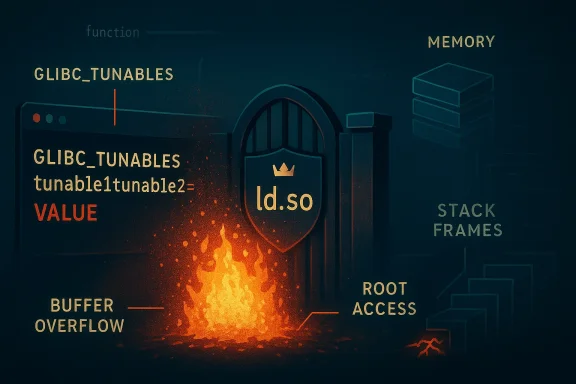 Background / Overview
The GNU C Library (glibc) is the foundational C runtime used by the vast majority of Linux distributions. Its dynamic loader, ld.so, runs before user programs start and is responsible for resolving shared libraries and performing early initialization. In October 2023 researchers disclosed a buffer overflow in ld.so’s handling of the GLIBC_TUNABLES environment variable that can be abused during the launch of SUID binaries to obtain elevated privileges.This vulnerability — tracked as CVE‑2023‑4911 and nicknamed “Looney Tunables” in some write-ups — was introduced in glibc 2.34 and affects glibc versions up to, but not including, the patched versions distributed by vendors. Multiple security teams reproduced reliable local privilege escalation on default installs of Fedora, Ubuntu and Debian variants; public proof‑of‑concepts and exploit modules
Our community and vendor advisories have a steady record of following glibc problems because flaws in this component have system‑wide impact; recent forum threads tracking glibc CVEs show the same pattern of rapid vendor response and distribution backports.
How the bug works — technical root cause
GLIBC_TUNABLES: intent versus parsing reality
The GLIBC_TUNABLES environment variable was added to permit runtime configuration of certain glibc behaviors without recompiling software. It contains colon‑separated key=value tunables that the dynamic loader reads very early during process startup.The vulnerability exists in ld.so’s parsing and sanitization of GLIBC_TUNABLES. A specific input pattern — where the value looks like
tunable1=tunable2=VALUE (notice the missing colon between two key/value pairs) — causes ld.so’s parsing loop to treat text erroneously and perform an unsafe copy/concatenation into a bounded buffer. The code path performs an in‑place copy during the first iteration, then appends during a subsequent pass without sufficient bounds checks, producing a classic heap/stack buffer overflow depending on the platform and build.Where it fails: parse_tunables and __tunables_init
At runtime ld.so calls an initialization routine (roughly referred to as __tunables_init / parse_tunables in analysis posts) to locate, copy, sanitize and then split GLIBC_TUNABLES into tokens. Because this parsing happens before the main program executes — and crucially, for SUID processes with elevated privileges — any overflow that occurs here is executed in a high‑privilege context. The overflow can corrupt function pointers, heap metadata, or adjacent control data that the attacker can then weaponize into code execution or other privilege escalation techniques.Exploitation mechanics in practice
- The attacker must have local access to run programs on the target system (it’s a local attack vector).
- The attacker crafts GLIBC_TUNABLES (for example, using environment injection in a shell) to contain the pathological pattern and a payload-sized region.
- The attacker executes a SUID‑root binary (or another setuid/setgid program that doesn’t sanitize the environment), causing ld.so to parse GLIBC_TUNABLES early and overflow internal buffers.
- With careful payload construction (and often accounting for ASLR, stack canaries and other mitigations), the overflow can be turned into arbitrary code execution in the context of the privileged process — typically root. Public reports and advisories demonstrate practical PoCs against standard installs of several distributions.
Who is affected
A broad-family impact
Because glibc is the standard C library on most Linux distributions, the set of potentially affected systems is broad:- glibc versions introduced in 2.34 and prior to the fix (commonly packaged as releases 2.34 through 2.38 in various distros) were flagged as vulnerable by multiple vendors and researchers.
- Researchers showed reproducible exploitation against default installs of Fedora 37/38, Ubuntu 22.04/23.04 and Debian 12/13 in their controlled tests; other distributions using glibc (RHEL, CentOS, Oracle Linux, Amazon Linux variants, SUSE, etc.) had vendor advisories and patches in due course.
Scope and limitations
- Attack vector: local (requires an account on the host). Network‑facing services are not directly exploited from the network alone.
- Privileges required: low — an unprivileged local user can trigger the bug by launching an affected SUID binary while controlling GLIBC_TUNABLES.
- User Interaction: none beyond the attacker executing a binary with a manipulated environment.
- Certain programs are less attackable: utilities that sanitize or clear environment variables before loading ld.so, or binaries built with particular ELF RUNPATH semantics (some protective behaviours are distribution‑ or program‑specific). Nonetheless, many SUID programs shipped by default historically had no such sanitization, which made the issue acute in default installs.
Evidence of exploitation and public code
Multiple sources reported proof‑of‑concept code and even exploit modules being made public following disclosure:- Qualys published a detailed technical advisory and reproducible test vectors demonstrating root escalation on common distro defaults.
- Independent PoC repositories and exploit scripts were posted to public code hosting platforms; at least one hosted proof‑of‑concept repository and rapid7/Metasploit documentation exist describing exploit modules. That public availability increased the urgency of vendor backports and mitigations.
- Because exploit code exists and because the weakness can yield full root on default systems, the vulnerability was added to several “known exploited” or high‑priority lists and flagged with high EPSS/KEV indicators by multiple security trackers.
Impact assessment: confidentiality, integrity, availability
This flaw is a textbook high‑impact local privilege escalation:- Confidentiality: the attacker can obtain root and thus read any data on the system.
- Integrity: the attacker can modify binaries, system configurations and logs, undermining trust in the host.
- Availability: an attacker could disable services, delete data, or otherwise render hosts unusable; Microsoft’s vulnerability reasoning for similar host‑impact issues emphasizes how availability can suffer both as sustained or persistent loss when an attacker can repeatedly trigger destructive operations. Administrators should treat successful local root escalation as a direct availability risk.
Vendor responses, patches and timeline
- The vulnerability was publicly disclosed in early October 2023; vendors responded with coordinated security advisories and glibc patches or distribution backports shortly thereafter. Distribution packages replaced vulnerable glibc builds with patched releases or backported fixes.
- Fix status varies by vendor and release channel. Most modern mainstream distributions issued glibc package updates; enterprises running older or customized systems should confirm their vendor advisory and installed package versions. For many deployments the practical remedy was to upgrade glibc to the vendor‑supplied patched package or apply the vendor backport.
- Red Hat, Debian, Ubuntu, Fedora and cloud Linux vendors published advisories and errata addressing the issue; administrators were urged to prioritize those updates due to the reliable local exploitability and the existence of public PoCs.
Practical mitigation and containment steps (immediate to short term)
If you cannot install vendor patches immediately, apply layered mitigations to reduce the attack surface.- Patch glibc as the first and primary action.
- Apply vendor‑supplied glibc updates from your distribution repositories and reboot or restart affected services per vendor guidance. This is the only reliable long‑term fix.
- Reduce SUID/SGID exposure:
- Audit and remove unnecessary SUID/SGID bits from programs that don’t require them.
- Restrict who can execute remaining SUID programs through filesystem ACLs or sudo policies.
- Use the command: find / -type f -perm -4000 -ls (or the distribution’s recommended audit procedure) to list SUID binaries and triage them.
- Sanitize environment variables for privileged programs:
- When possible, ensure privileged programs are executed in sanitized environments that drop untrusted environment variables (systemd unit files can be configured to clear specific environment variables before ExecStart for services).
- Where feasible, set wrappers to clear GLIBC_TUNABLES before invoking SUID binaries.
- Apply mandatory access controls (MAC):
- Enforce SELinux or AppArmor policies that limit what SUID programs can do if they become compromised. Systems with strict MAC can severely limit the practical damage from a gained root shell.
- Monitor for exploitation:
- Watch for unexpected crashes of SUID programs, unusual process creation as root from user accounts, and suspicious core dumps or missing logging entries.
- Check for new or modified setuid binaries, altered /etc/sudoers, or unexpected changes to system binaries.
- Short‑term vendor workarounds:
- Some advisories suggested unsetting GLIBC_TUNABLES in environments that might invoke SUID programs (for example run: GLIBC_TUNABLES= /path/to/suid-program) as a stopgap; this is not a scalable long‑term fix but can be useful for tightly controlled remediation windows.
Detection and forensic indicators
- Crashes or segmentation faults in system SUID binaries (e.g., su, passwd) when launched with certain environment variables.
- Unexplained root shells or accounts created shortly after an SUID binary crash on a host.
- Core dumps that indicate ld.so activity or stack/heap corruption during early process initialization.
- Presence of public PoCs or exploit artifacts (malicious GLIBC_TUNABLES patterns) in process environment snapshots or in shell history files belonging to low‑privilege users.
- Memory images (subject to legal/organizational rules) for offline analysis of overwritten function pointers or corrupted heap structures.
- Audit logs (use auditd) showing which user executed which binary and whether SUID binaries were run unusually.
- System integrity checks against package management metadata to detect replaced system files.
Why this class of bug is especially worrying
- The dynamic loader is executed before normal application code and runs in the highest privilege contexts for SUID binaries. A failure here bypasses many of the usual application‑level safeguards.
- The attack leverages environment data — a long‑standing source of privilege‑related bugs — which is easy for a local user to control.
- Because glibc is present on almost every general‑purpose Linux system, vulnerability in a single component multiplies the blast radius: many programs and services implicitly inherit the risk. Our community’s tracking of glibc CVEs underscores how quickly an upstream library bug becomes a platform problem.
Critical evaluation: strengths of the response and residual risks
What vendors and the community did well:- The vulnerability received coordinated, rapid public analysis from credible researchers and vendors.
- Multiple distribution vendors issued patches and backports in a reasonable timeframe after coordination.
- Public advisories and PoCs raised awareness quickly, prompting administrators to prioritize remediation.
- Public PoCs and Metasploit modules increased the chance of opportunistic exploitation in unpatched environments. Systems that are difficult to patch (embedded devices, appliance OS images, older enterprise images) remain at elevated risk.
- The attack requires local access, but threats arising from credential theft, weak accounts, or exposed shells make local escalation a plausible second‑stage tactic for many adversaries.
- Some mitigations (removing SUID bits, environment sanitization) are operationally disruptive and may be slow in large fleets; until patched glibc is deployed broadly there remains a window of elevated risk.
Recommended operational checklist (for sysadmins and security teams)
- Prioritize patching:
- Identify hosts with vulnerable glibc packages and apply vendor updates. Verify package versions after remediation.
- Audit SUID/SGID:
- Inventory and triage SUID binaries. Remove SUID where it’s not essential.
- Harden processes:
- Configure systemd units and service wrappers to clear GLIBC_TUNABLES and other untrusted environment variables for privileged service starts.
- Apply MAC where possible:
- Enforce SELinux/AppArmor profiles and verify they apply to SUID programs.
- Monitor and hunt:
- Add detection rules for abnormal SUID execution, crashes of privileged binaries, and suspicious environment strings in process execution traces.
- Rebuild images:
- For container and image‑based fleets, update base images with patched glibc and redeploy containers rather than attempting patching in-place which can become error‑prone.
- Communicate:
- Notify DevOps/Platform teams of the risk and coordinate remediation windows — this is a cross‑team patching priority because of the library’s systemic role.
Final thoughts
CVE‑2023‑4911 is a reminder that even mature, high‑quality system libraries can contain dangerous mistakes — especially where early startup code touches external inputs. The dynamic loader is a high‑value target for privilege escalation research because control there can yield root before application defenses are engaged.The response after disclosure was robust: vendors issued fixes and the community produced high‑quality advisories and mitigation advice. Still, the combination of a local attack vector, low complexity, and public proof‑of‑concepts means that any unpatched host with SUID binaries remains a serious compromise risk.
If you manage Linux systems, make this a top‑priority patching item: identify vulnerable hosts, apply vendor patches immediately, and use the containment checklist above to reduce exposure while you remediate. The pattern of discovery, rapid publication, and swift vendor patching that followed CVE‑2023‑4911 is a good model — but it only protects systems once administrators act.
Source: MSRC Security Update Guide - Microsoft Security Response Center
